

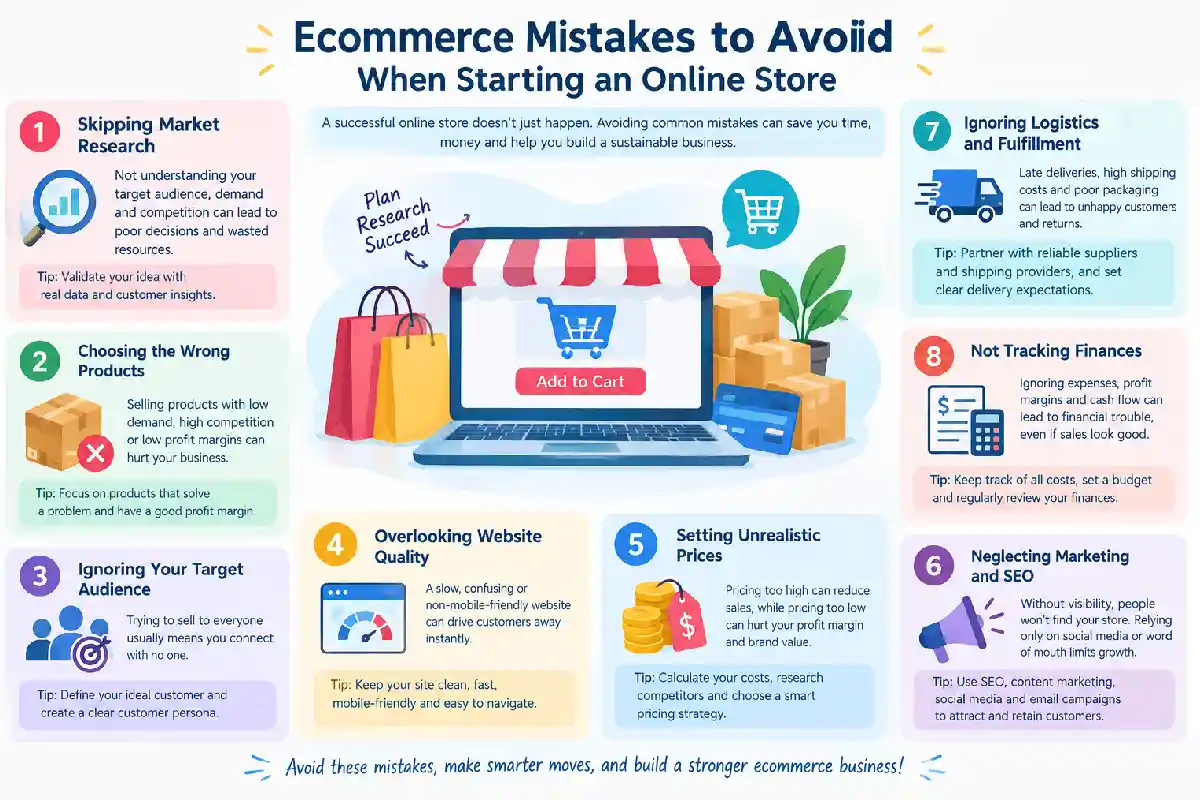
Ecommerce Mistakes to Avoid When Starting an Online Store
Last Updated: September 9, 2026
Ecommerce Mistakes. Launching an ecommerce business can be exciting and lucrative. However, success rarely occurs just by putting up a website and then leaving it to bring new customers. New ecommerce entrepreneurs commonly make certain avoidable errors in choosing the right products, setting the prices, designing the website, delivering the products, and promoting their store. Such mistakes can eat up a fledgling business’s scant startup budget very quickly and undermine customers’ confidence.
Knowing the most common mistakes in ecommerce before you start can help you avoid costly errors and set up your business with a higher potential for success.
Choosing the Wrong Ecommerce Niche
One of the biggest mistakes that new players make is selecting a niche only because it excites them, but neglecting to investigate if there are sufficient customers interested in the products.
A good online market is one where there‘s a target audience, some demand, the competition isn‘t crazy, and you can make money off it. just because like selling something in the market doesn‘t mean people will buy it.
Before choosing a niche, research:
- Customer demand and search interest
- Existing competitors
- Average product prices
- Potential profit margins
- Customer problems and purchasing motivations
- Product availability and supplier reliability
- Opportunities for repeat purchases
Don‘t enter “Oversized” Markets. No matter how good your product is, if you take on a market that is too broad when you‘re just starting out you won‘t be able to compete. For example, don‘t open a new department store that sells, (clothes to cosmetics to electrical Goods).
For example, instead of selling general fitness items, you might sell a new business could single-mindedly supply home exercise gear to new (and not-so-new) exercisers. Narrow niche makes branding, making content and advertising and targeting customers much easier.
But be careful not to pick a niche that is so specialized that you do not find enough buyers. You want to stay centered around a niche that is targeted yet wide enough of a market to attract the corresponding consumers.
Ignoring Product and Market Research
Another more common ecommerce mistake is to launch products before analyzing the market.
Product research should be done BEFORE large amounts of money are spent on stock, packaging, ad & websites. Under initially attractive conditions the product will have written ‘good buy’, but then proves to be impossible to sell because customers already have cheap options for it, or the market has become saturated.
Study competing stores and markets to see what your customers are buying. Read the products reviews they can give you a lot of ideas.
Lifeline: Negative reviews can be a great indicator of potential flaws such as the quality of a product, the fit, packaging, delays in delivery, lack of clarity with instructions or lack of support from customer service. These flaws can actually serve as opportunities.
You need to calculate your potential profits as well prior to launching. Think about the full expense incurred to sell a product, which may include:
Product cost + packaging + shipping + payment fee + advertising + return= Selling costs in total
For example, a product selling at a retail price of $50 that cost $40 to produce, inclusive of all costs, may appear to generate a healthy gross revenue but in reality…
Testing small quantities (or small campaigns) can be another way to reduce risk. Rather than diving in with a large budget up-front, “push out” and test the demand first.
Common Ecommerce Website Design Mistakes
When potential customers first visit your website, it is often the first substantial experience they have with your business. An poorly designed ecommerce website will cause them to leave before making a purchase.

A common error is building a site that looks good but is difficult to use. Customers should immediately know what you sell, why they should buy it and how to place an order.
Important website elements include:
- Clear product images
- Simple navigation
- Detailed product descriptions
- Transparent pricing
- Visible shipping information
- Mobile-friendly design
- Secure checkout
- Easy-to-find contact information
- Clear return and refund policies
No bombard them with pop-ups, screensavers, banners and any other added clutter. Less clutter on the site generally makes it easier to shop through.
Make sure your ecommerce website is optimized for mobile users. Many online shoppers shop on their mobile devices, so test your site on many different types/sizes of screens to ensure that buttons, products images, menus, and checkout forms display and function correctly.
Wrong to make check out complicated. Making customer to registration, multiple pages or provide irrelevant information can cause the abandoning of the cart.
Keep the checkout as simple and transparent as possible.
Pricing and Shipping Mistakes That Reduce Sales
Price is one of the key factors affecting online buying decisions. Inexperienced sellers occasionally mistake setting their products’ price point too low in an effort to draw customers. This can however make it hard to generate a profitable return.
Reverse engineer your own costs and what you need to earn as a margin, rather than copying a competitor‘s price.
Simultaneously, too high PRICE without additional value assistance can lead customers to select other stores.
Shipping is a major source of problems also. Customers can be surprised at checkout by hidden shipping charges.
Whenever possible, inform the customer of shipment charges and lead time during the early stages of the sales process. If you do offer free shipping, bear in mind that free shipping is not truly free as it has to be reflected in your prices or financial model.
You need to set reasonable estimates of when a product will be deliver. If you send out your product and tell the customer that it will be on their doorstep in 2 days but it actually takes 7 you are likely to get complaints, refund requests and negative feedback.
Returns should also be taken into account when determining prices. Remember to include all possible scenarios such as returns, damaged goods, replacements and customer service in your account calculations.
Ecommerce Marketing Mistakes New Businesses Make
Having an online store does not mean it will bring in business. The worst mistake you can do in marketing is thinking that your clients will find your business without having the right marketing plan.

New ecommerce businesses need to determine where their target customers are Web shopping and create a marketing activity from this.
Depending on the audience, this could include:
- Search engine optimization
- Social media marketing
- Email marketing
- Content marketing
- Influencer partnerships
- Paid advertising
- Referral programs
- Retargeting campaigns
Running multiple channels at once can be costly and hard to measure what is a success. Begin with a few channels and test their effectiveness.
A further error is just to promote and not give information. Your customer may require information before they are ready to purchase. Product guides, comparisons, demonstrations, how-to‘s, insight, and other educational information will generate confidence.
Don‘t forget that new store. Do not continuously promote on discounts. It will teach the customer to always expect sales and therefore “depreciate” your offerings.
Instead, concentrate on speaking of benefits and building a powerful motive to buy.
Lastly, not measuring marketing results could drain your budget when growing ecommerce. Keep an eye on website visits, conversion rate, cost per acquisition, average order value, repeat purchase rate and return of advertising investments.
Conclusion
Save Time, Money, and Frustration by preventing simple ecommerce errors. The most vital of these is to research the niche and product thoroughly before putting too much into it. Then follow up by designing an easy to use website, figure out selling price, make shipping expectations understood, and develop a quantifiable marketing plan.
Few ecommerce success stories are born from a one-hit wonder of the immortal product or immortal ad. They are created by learning about your customers, trying things, measuring what works, and refining your shopping experience to perfection.
Get it right early on and entrepreneurs will have created an online store that is easier to establish and provides a firm foundation for growth.