

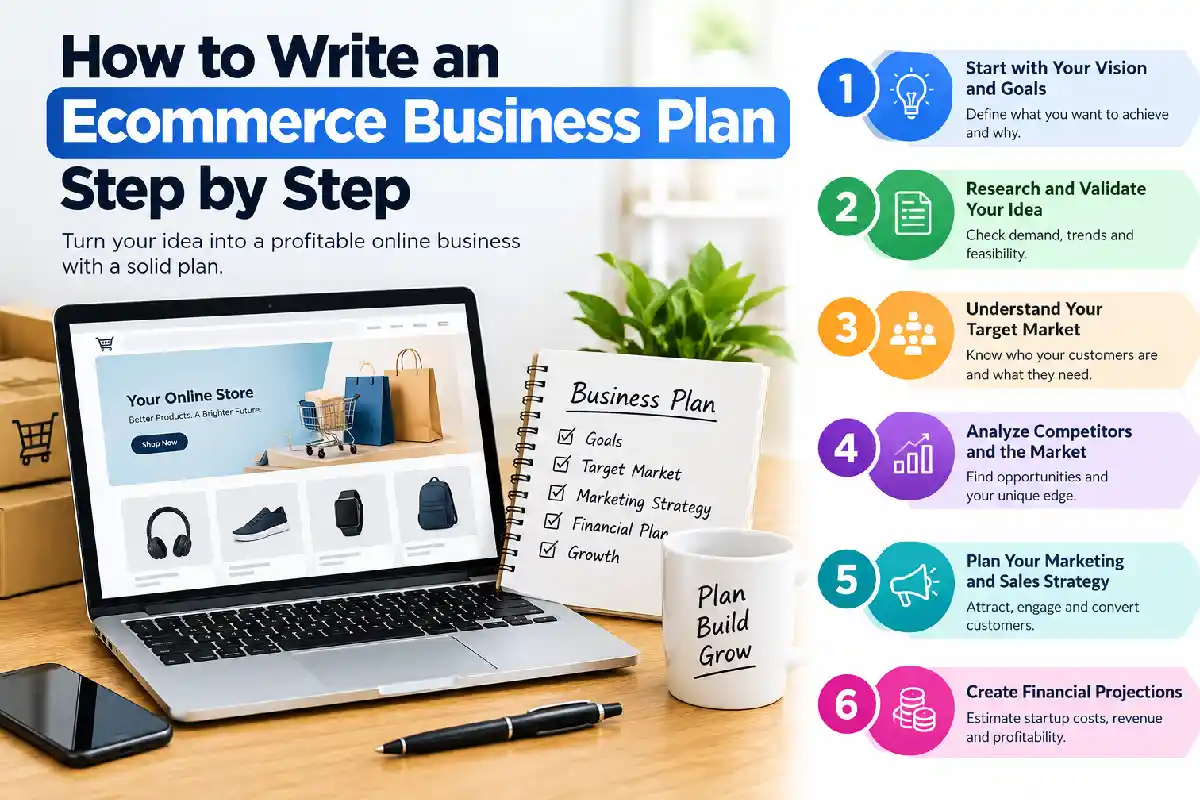
How to Write an Ecommerce Business Plan Step by Step
Last Updated: September 9, 2026
Business plan. Base your e-commerce business on strong arguments. Creating a robust foundation for your ecommerce venture requires establishing your product and setting up a website notwithstanding. A good developed e-commerce business plan allows you to position the target market, evaluate the competitors, establish marketing techniques, estimate the costs and project income.
It does not matter if you are thinking to start a small ecommerce business on the web (a small online shop, a dropshipping, subscription or private label store), the framework described below is a complete step by step guide to develop a feasible ecommerce business plan.
What do you have to include in an ecommerce business plan?
Your ecommerce business plan should clearly communicate your product, your market, your marketing methodologies and your revenue streams.
A typical plan includes:
| Business Plan Section | What to Cover |
| Executive summary | Business idea, goals, products, and overall strategy |
| Business description | Business model, ownership, location, and mission |
| Target market | Ideal customers, demographics, needs, and buying behavior |
| Market analysis | Industry trends, demand, opportunities, and risks |
| Competitor analysis | Major competitors, pricing, products, strengths, and weaknesses |
| Products or services | Product range, pricing, sourcing, and value proposition |
| Marketing and sales plan | SEO, social media, advertising, email, promotions, and sales channels |
| Operations plan | Suppliers, inventory, fulfillment, shipping, technology, and customer service |
| Financial plan | Startup costs, expenses, pricing, revenue forecasts, and profitability |
| Goals and milestones | Launch targets, sales goals, customer acquisition, and growth plans |
The plan should be achievable rather than over-elaborating over abstract ideas. You should have an elaborate planning of 10 pages than 50 pages basis on no fundamented assumptions.

Step 1: Write Your Executive Summary
Introduce your ecommerce site briefly. It might be easier to write after having completed the other sections of your plan, even though it appears at the beginning:
Explain:
- What your ecommerce business sells
- Who your customers are
- What makes your business different
- Which ecommerce model you will use
- Where you will sell
- Your primary business goals
- How you expect to generate revenue
Your revenue model how you will make money
For instance, so if you‘re starting an online skincare business your summary could say that you‘ll be selling low cost skincare products to young professionals via your website and social media with profits coming from the direct sale of the products.
Your executive summary has to ‘sell’ the opportunity quickly without overstating the potential.
Step 2: Describe Your Ecommerce Business Model
Describe how the business will function.
According to (Barber), the most common ecommerce models are B2C, B2B, dropshipping, wholesale, private label, subscription ecommerce and marketplace selling.
Explain what methods will be used to deliver the product and how it will be distributed. Also include details about how and where the money will be spent for the business.
For example:
Manufacturer → Ecommerce store → Customer
Or:
Supplier → Dropshipping platform → Customer
Also explain your sales channels. You might sell through your own website, online marketplaces, social commerce sites or mix of all of this.
Write in your business mission and big picture goals. They will guide your product, marketing, and customer-service decisions;
Step 3: Define Your Ecommerce Target Market
Know your target market is a critical area in any ecommerce business plan. Rather than actually trying to pitch your product to the masses, it is better to pinpoint the customer segment who will actually buy what you have to sell.
Research factors such as:
- Age
- Location
- Income
- Occupation
- Lifestyle
- Interests
- Purchasing habits
- Problems or needs
- Preferred shopping channels
- Price sensitivity
Create one or more customer personas.
Urban professional 25–35 year old shopping online on a regular basis for convenience, price sensitive, looking for brand with solid reviews.
Think about the why? What are customers going to buy from you that they would not purchase from another company?
Know what their pain points are and how your products are a solution to that. This will be used later within your website messaging, advertising messaging, product descriptions, content.
Step 4: Conduct Ecommerce Competitor and Market Analysis
Your ecommerce competitor analysis allows you to get a head start on the marketplace before making heavy (financial) investment into your business.
Understand who your competitors are. – direct offer similar products to the same market. – indirect offer a different solution to the same customer problem.
Compare competitors based on:
| Factor | Questions to Ask |
| Products | What do they sell? |
| Pricing | Are their prices premium, average, or budget? |
| Website | Is the shopping experience easy to use? |
| Marketing | Which channels do they use? |
| Reviews | What do customers like or dislike? |
| Shipping | What delivery options do they offer? |
| Customer service | How quickly do they respond? |
| Branding | What makes their brand memorable? |
| Promotions | Do they use discounts, bundles, or loyalty programs? |
Searching for holes is more important than copying winning competitors.
Example: your competitors might have good products but bad customer service, or they might have beautiful websites but few ways of paying, delivery choices, and so on. Exploit them for your own benefit.
You should also look into the general market demand, trends in the industry, customer tastes and possible barriers to entry.
Step 5: Develop Your Product and Pricing Strategy
Describe what you plan to offer and why people will buy it.
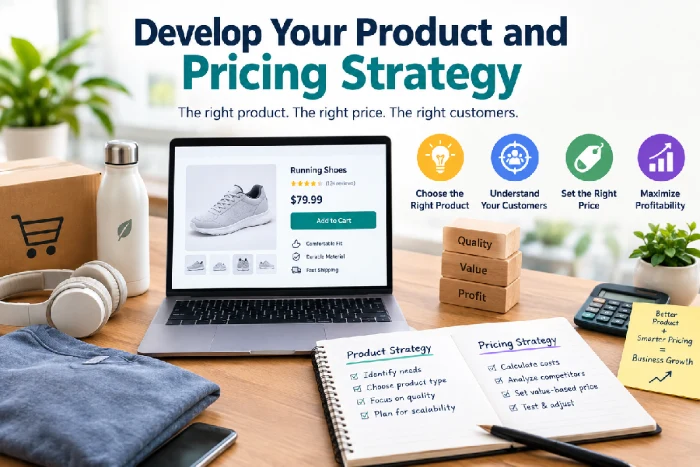
For each major product category, consider:
- Product cost
- Supplier or manufacturing cost
- Packaging
- Shipping
- Platform fees
- Payment processing fees
- Marketing costs
- Expected selling price
- Profit margin
Do not choose a selling price simply by looking at competitors. Calculate your actual costs first.
For example, if a product costs $15 to source, $3 to package and ship, and $5 in average marketing costs per sale, your effective cost is already $23. Selling it for $24 may produce very little profit despite appearing competitive.
You may choose a pricing strategy of: competitive, value-based, premium pricing, introductory pricing, bundling, volume discounts.
Step 6: Create an Ecommerce Marketing and Sales Plan
Your marketing plan outlines how your prospective customers will learn about your products and why they will buy them.
Consider using multiple channels, including:
- Search engine optimization (SEO)
- Content marketing
- Social media
- Email marketing
- Influencer marketing
- Paid search advertising
- Display advertising
- Affiliate marketing
- Referral programs
- Marketplace advertising
Connect every marketing activity to a specific objective.
Step 7: Create an Ecommerce Operations Plan
An ecommerce business plan should explain how you will fulfill orders after customers make purchases.
Cover:
- Supplier selection
- Inventory management
- Warehousing
- Packaging
- Order fulfillment
- Shipping carriers
- Returns and refunds
- Customer support
- Payment processing
- Ecommerce platform
- Website maintenance
Decide whether you will manage fulfillment yourself, use a third-party logistics provider, or work with a dropshipping supplier.
Your operations strategy should be scalable. A process that works for 20 orders per week may become inefficient when you receive 500 orders.
Step 8: Complete Ecommerce Financial Planning and Revenue Forecasting
Financial planning shows whether your ecommerce idea can become a sustainable business.
Start by calculating startup costs, including:
- Website development
- Domain and hosting
- Inventory
- Packaging
- Branding
- Photography
- Software
- Business registration
- Initial advertising
- Equipment
Then estimate recurring monthly expenses such as inventory purchases, advertising, software subscriptions, shipping, storage, salaries, and transaction fees.
Example Revenue Forecast
| Metric | Month 1 | Month 2 | Month 3 |
| Website visitors | 2,000 | 3,000 | 4,500 |
| Conversion rate | 2% | 2.2% | 2.5% |
| Orders | 40 | 66 | 113 |
| Average order value | $45 | $45 | $48 |
| Estimated revenue | $1,800 | $2,970 | $5,424 |
These figures are just estimates, they are not set in stone. Create your forecast using realistic assumptions for your traffic, conversion rate, average order value, product margins and marketing budget.
Also calculate your break-even point. This tells you how many products or orders you need to sell before covering your fixed and variable costs.
Step 9: Set Ecommerce Goals and KPIs
Finish your plan by establishing measurable goals.
Useful ecommerce KPIs include:
- Monthly revenue
- Gross profit margin
- Conversion rate
- Average order value
- Customer acquisition cost
- Customer lifetime value
- Repeat purchase rate
- Cart abandonment rate
- Website traffic
- Return rate
Define SMART objectives. For example, instead of “want more sales,” an objective could be “monthly online revenues to increase by 25% over a six-month period while maintaining a certain profit margin.”
Conclusion
Guides to creating an ecommerce business plan one step at a time will help you understand everything you need to know about your proposition to see if it is worth pursuing and how to go about expanding it. List a business model and target market, look at competitors, write a list of products and prices, develop a marketing and sales plan, arrange operations and develop a realistic set of financial projections.
Keep an updated copy of it as things change and as you learn more about how and where your customers shop. Regularly rewriting your business plan is one of the best tools for your business to stay on top, minimize risk and take advantage when you develop your ecommerce business.