

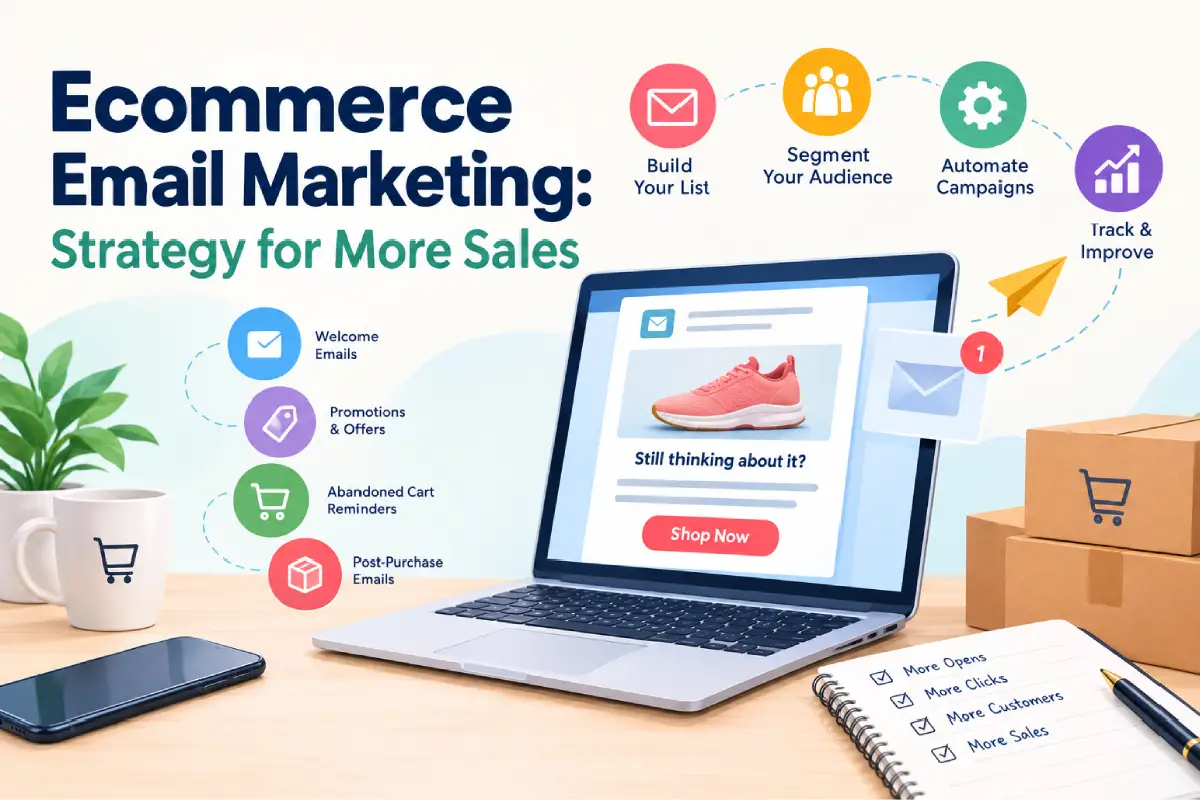
Ecommerce Email Marketing: Strategy for More Sales
Last Updated: September 12, 2026
Email Marketing. Ecommerce email marketing is one of the most powerful ways that online retail sites can convert window-shoppers into customers and convert existing customers into repeat customers. Unlike social media or paid advertising, email provides a business a direct marketing channel to those who already have an interest in what they are selling.
But if you develop the strategic approach that is right, you‘ll be able to use ecommerce email marketing effectively for a variety of purposes, from leveraging product promotion and recovering abandoned shopping carts to establishing customer relationships, making announcements, and expanding customer lifetime value. Just know how to choose the right message for the right customer at the right time.
How Ecommerce Email Marketing Works
Ecommerce email marketing is a method of capturing and maintaining contact with customers by using email. This can be done by sending targeted, relevant messages through email to the customer, guiding them through the buying process.
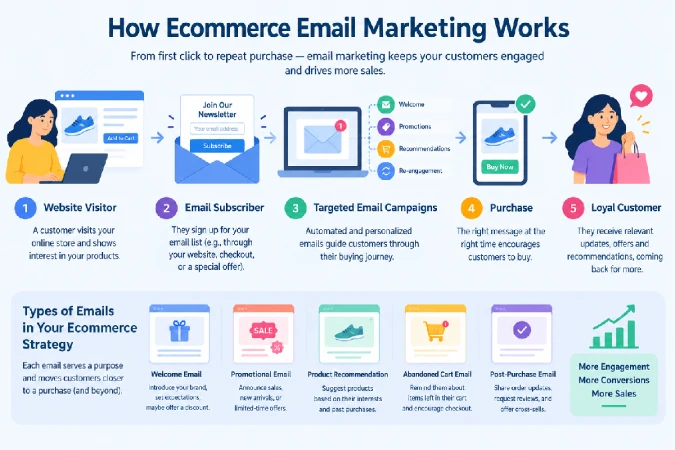
A typical email marketing funnel can look like this:
Website visitor, Mailing list subscriber, Engaged customer, First purchase, Repeat customer, Loyal customer
For instance, a visitor may come to your ecommerce website and not purchase anything. If they enrolled to your mailing list, you can then send a targeted, relevant welcome message, product recommendations, knowledge items, or perhaps a promotional offer.
This is exactly where automation is taking the pain out of the process. Rather than sending the message manually, ecommerce businesses can set up an automated campaign that can be activated on the back of a customer event:
Common triggers include:
- Signing up for an email list
- Purchasing a product
- Abandoning a shopping cart
- Browsing specific products
- Reaching a customer anniversary
- Becoming an inactive customer
Use personalization. If I had ten people on my email list, and I sent them each one promotion, it would not be very relevant to them. Would you? Now I have the ability to tailor my emails to your purchase history, what you‘ve been browsing, your location and what you like to target our efforts.
Essential Ecommerce Email Campaigns to Create
Most effective ecommerce email programs will have several different campaigns and not use promotional email only.
1. Welcome Email Campaign
A welcome email is the first communication a subscriber gets after joining your list is:
Let it be a way of launching your brand, describe what are the type of content subscribers can expect, and offer a discount or incentive if needed.
A welcome sequence might include:
- Email 1: Welcome and brand introduction
- Email 2: Best-selling products
- Email 3: Customer reviews or social proof
- Email 4: Special offer
2. Promotional Campaigns
Promotional emails announce sales, discounts, product launches, seasonal offers, and limited-time deals.
Examples include:
- Black Friday promotions
- Holiday sales
- New product launches
- Clearance events
- Birthday offers
- Limited-time discounts
Do not overuse promotional emails. If subscribers are targeted with too many emails, they may ignore or stop receiving them altogether.
3. Product Recommendation Emails
Many product recommendations can help existing members become aware of other products of interest.
Say this customer has just purchased a pair of running shoes; they may then be shown running socks, sportswear or accessories, etc.
So for a great shopping experience, customers will receive a bundle of email messages. The result of such a bundle would be able to boost the average order value.
4. Re-Engagement Campaigns
Some subscribers fall off; they stop opening emails and buying. A reactivation campaign is used to try to bring them back to the list.
You might offer:
- A personalized discount
- New product recommendations
- Popular products they may have missed
- A simple “We miss you” message
If subscribers remain inactive, consider removing them from your active marketing list to maintain healthier engagement rates.
How to Build an Ecommerce Email List
The number of email addresses you gather is nowhere near as important as the quality of your list. Don‘t just aim to collect email addresses have people who want to hear from your business.
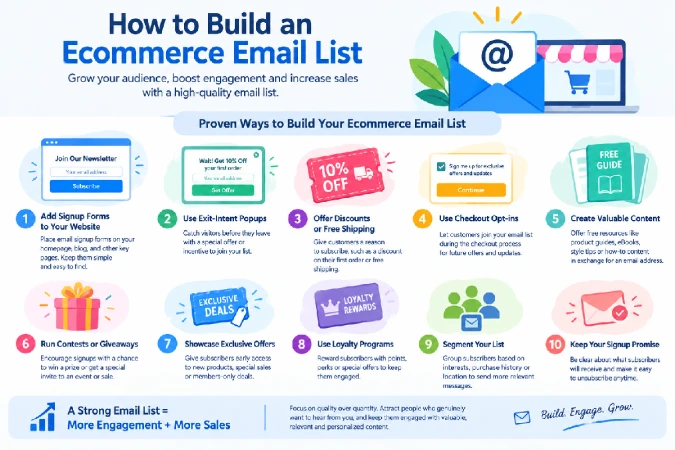
Start by adding prominent signup opportunities to your ecommerce website.
Effective methods include:
- Homepage signup forms
- Newsletter forms
- Checkout opt-ins
- Exit-intent popups
- Discount offers
- Free shipping incentives
- Product guides
- Exclusive content
- Loyalty programs
For instance, a new clothes website might say that if you sign up to their email list, you will receive 10% off the first order.
Don‘t hide the signup terms. Be transparent about what it is that they are signing up for and make it very simple to unsubscribe.
Break down your list into segments. Examples of useful segments are: new subscribers, first-time buyers, repeat purchasers, high-profit customers, dormant subscribers, and product interest groups.
Segmentation ensures you can send more targeted communications and means you no longer have to treat all your customers as one and treat them the same.
Abandoned Cart and Post-Purchase Email Strategies
Abandoned cart emails are one of the most valuable automated campaigns for any ecommerce business.
A customer may click “add to cart” but abandon the purchase momentarily due to distraction, price comparisons, shipping issues, or overall readiness to buy.
A prevent cart abandonment sequence could be used to re-engage the customer and get them to come back.
A simple sequence could include:
Email 1: Reminder that the cart is waiting
Email 2: You will want to point out the benefits of your product or include reviews.
Email 3: Create urgency with a time-sensitive message or incentive, when appropriate
The first reminder doesn’t necessarily need a discount. Offering discounts immediately can train customers to abandon carts intentionally.
Post-purchase emails are equally important. The relationship shouldn’t end after the transaction.
Useful post-purchase emails include:
- Order confirmation
- Shipping updates
- Product-use instructions
- Review requests
- Cross-sell recommendations
- Replenishment reminders
- Loyalty program invitations
For products that customers regularly consume, replenishment emails can be especially effective. For example, a skincare store could remind customers to reorder a product around the expected time they may run out.
How to Measure Ecommerce Email Marketing Performance
Sending emails isn’t enough. Ecommerce businesses need to measure performance and determine which campaigns actually contribute to revenue.
Important ecommerce email marketing metrics include:
| Metric | What It Measures |
| Open rate | How many recipients opened an email |
| Click-through rate | How many recipients clicked a link |
| Conversion rate | How many recipients completed a desired action |
| Revenue per email | Revenue generated by an email |
| Unsubscribe rate | How many subscribers opted out |
| Bounce rate | Emails that could not be delivered |
| List growth rate | How quickly your email list is growing |
| Cart recovery rate | Abandoned carts recovered through email |
Open rates do provide some directional information, but not in isolation. Clicks, conversions and revenues tend to be more meaningful for an ecommerce business.
For instance, a campaign that yields a lower open rate but whose openers are more relevant and produce more buys may produce a higher CTR.
Use A/B testing to improve campaign performance. Experiment with different subject lines, offers, calls to action, product images, layout, and delivery time.
Best Practices for Ecommerce Email Marketing
Follow these practices to build a stronger long-term email strategy:
Personalize messages: take advantage of your customer base (identity, preferences, transaction history) or their’ clickstream data to make your emails more targeted.
Segment your audience: Customers are all different; some have different needs, buying patterns, interests, and so on.
Simple subject lines: Write compelling subject lines. Keep them direct and concise, and match the content of the email.
Include powerful calls to action: Give your subscribers precise direction, like “Shop New Arrivals” or “Complete Your Order.”.
Optimize for mobile: Designing with mobile in mind is crucial as many customers access their emails through mobile devices. Ensure your email uses a mobile-friendly layout, clear text, and easy-to-find call-to-action buttons.
Do not inundate users: Pitch info of value/relevance not incessant emailing.
Test and improve: Analyze campaign results to determine success and refine your approach.
Conclusion
Ecommerce email marketing can be a great for selling if you base the campaigns on customer behavior rather than freebies. Orders can be pushed by a welcome campaign, stimulated quickly with promotional emails, converted from abandoned carts, and encouraged to reorder with a post-purchase campaign.
The most successful approach is a cocktail of a successful list building strategy, segmentation, personalisation, automation, focused communication to benefit the customer and analytics. Constantly running testing on campaigns and focus on the customer, ecommerce business can turn their email list into profit stream and a customer relationship tool.