

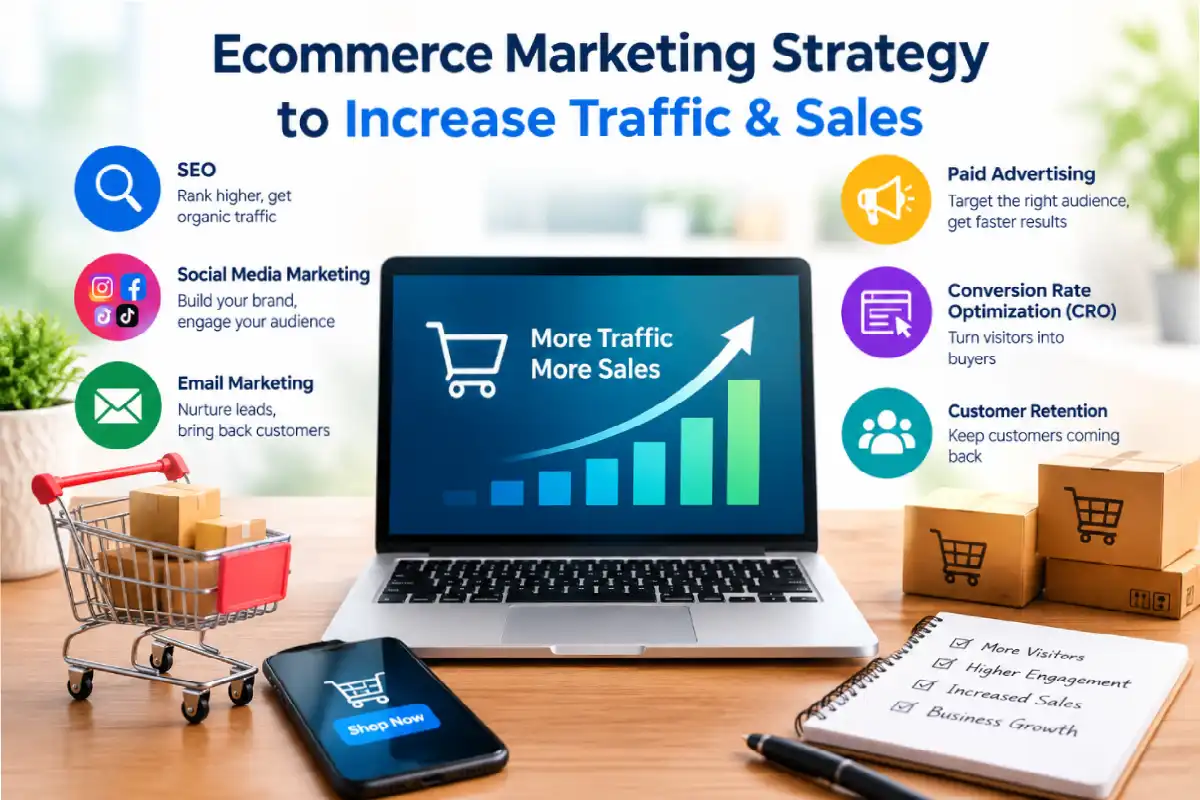
Ecommerce Marketing Strategy to Increase Traffic & Sales
Last Updated: September 11, 2026
Ecommerce Marketing Strategy. A good online store will have the best products on the market, website will have pleasing design and easy checkout & purchase process, but all these will go to a waste if the right customers cannot find this store. That‘s why you need an ecommerce marketing strategy.
Ecommerce marketing is much more than online ads. It is a fusion of SEO, content marketing, social media, email marketing, paid advertising, influencer marketing, sales promotions, conversion optimization, analytics and CRM.
The aim is not to make the maximum number of hits. The true objective is to bring in the right visitors, provides every possible opportunity for them to buy, get rid of any obstacles from the payment process and maximize the lifetime value of each customer.
Here’s a guide on what an ecommerce marketing strategy is, how to build an ecommerce marketing plan, which marketing channels work the best, how convert visitors into customers and how to measure your marketing efforts.
In 1958, the pharmaceutical industry adopted a new approach to produce a second generation of oral contraceptives. The rationale for new drug development was to design a pill with lower doses of steroids that would have fewer side effects in order to attract wider usage. However, this product did not emerge until the 1960s.
What is an E-Commerce Marketing Strategy?
Ecommerce marketing plan is a systematic plan written to promote a website, to achieve and attract potential customers for the website, convert the visitors to a customer and generate revenues
It defines:
- Who the business wants to reach
- What products or services it wants to promote
- How it will reach potential customers
- Which marketing channels it will use
- What content and offers it will provide
- How visitors will be converted into customers
- How marketing results will be measured
- What approaches will be adopted to motivate current customers to re-purchase
A really good strategy is linking marketing activities and particular business goals.
Perhaps new e-commerce store in the beginning its branding and traffic generation. As long as the e-commerce obtains enough traffic, then there should be results in order to work on conversion rate and customer acquisition cost. And maybe it already has existed e-commerce would concentrate onRepeat purchasing, customer lifetime value, Earned growth.
Ecommerce Marketing vs. Ecommerce Advertising
There is some use the terms holism and complexity interchangeably, but they are not identical.
Ecommerce advertising is usually related to paid commercials including search advertisement, shopping advertisement, social media advertisement, and display advertisement among others.
Ecommerce marketing is broader. It includes both paid and unpaid activities such as:
- SEO
- Content marketing
- Email marketing
- Social media
- Paid advertising
- Influencer partnerships
- Affiliate marketing
- Referral programs
- Conversion rate optimization
- Customer retention
An advertisement can result in immediate traffic, however other marketing streams allow for a more consistent presence and client base.
In a sense, then, this could be seen as the most challenging form of ‘play’ within the discipline. While I still adhere to my conviction that all theory, whether academic or ‘applied’ like Marxism, is based on certain assumptions which are inherently biased, I acknowledge the need to engage with the theories presented within my course at a theoretical level.
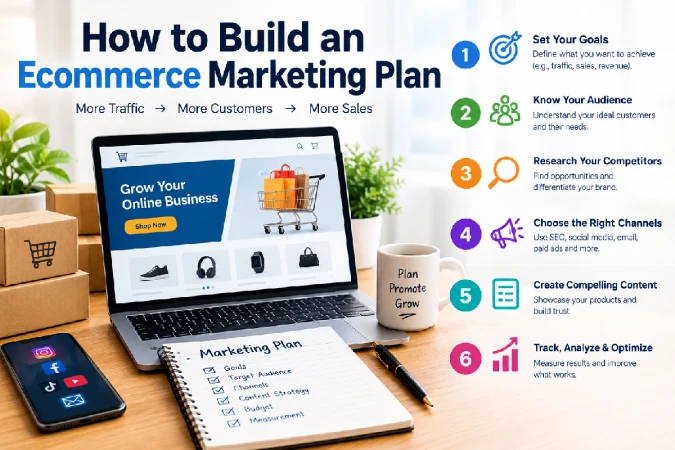
How to Build an Ecommerce Marketing Plan
A marketing plan translates an overall strategy into specific tasks and initiatives. When developing your campaigns, you‘ll need to identify your audience, objectives, positioning, communication channels, budget, content and measurement procedures.
1. Define Your Target Audience
The first thing to figure out is who is going to be your customer?
Create customer profiles based on factors such as:
- Age range
- Location
- Interests
- Shopping habits
- Purchasing power
- Problems and needs
- Preferred devices
- Preferred social platforms
- Buying motivations
- Common objections
Take for instance, an internet shop providing high quality running shoes should not advertise itself to all shoe lovers. It might be more successful in selecting either casual joggers, marathon runners, health addicts or those in need of particular types of running shoes.
The more you truly understand your audience, the easier to design advertisements, landing pages, product details, emails, and content.
2. Research Your Competitors
Competitor research enables us to find gaps and advantage points in the market place.
Analyze competing ecommerce stores for:
- Product selection
- Pricing
- Offers and discounts
- Website experience
- SEO visibility
- Social media activity
- Content strategy
- Reviews
- Shipping policies
- Return policies
- Email marketing
- Advertising messages
Do not simply copy competitors. Instead, determine how your store can provide a better or more distinctive customer experience.
Your competitive advantage might be:
- Better product quality
- Lower prices
- Faster shipping
- Better customer support
- Specialized products
- Unique designs
- Sustainable materials
- Expert guidance
- Better guarantees
- More convenient purchasing
3. Establish Clear Marketing Goals
Marketing goals should be specific and measurable.
Instead of saying:
“Increase ecommerce sales.”
Set a measurable objective such as:
“Increase monthly online revenue by 25% over the next six months while maintaining a sustainable customer acquisition cost.”
Common ecommerce marketing goals include:
- Increase organic traffic
- Generate more qualified leads
- Increase online revenue
- Improve conversion rate
- Reduce customer acquisition cost
- Increase average order value
- Increase repeat purchases
- Reduce cart abandonment
- Improve return on advertising spend
- Increase email revenue
Traffic, conversion, and revenue goals collectively give a fuller overview of performance.
4. Define Your Value Proposition
Your value proposition is the reason behind purchasing from your store, rather than a competitor‘s.
Should explicitly state a benefit not just gather information about your products.
For example:
- “Professional-quality skincare sent to you”.
- “Budget-friendly home office furniture for tight spaces.”
- ” Everyday sportwear designed for easy wear. ”
Your home page, ad campaigns, product page, social media pages, and email campaigns should all exhibit a compelling value proposition.
5. Choose Your Marketing Channels
You‘re not required to grab each marketing channel at the same time.
Choose channels based on:
- Where your target audience spends time
- Product type
- Purchase cycle
- Available budget
- Marketing skills
- Expected return
- Business objectives
For many ecommerce businesses, a combination of SEO, paid search, social media, email, and conversion optimization provides a strong foundation.
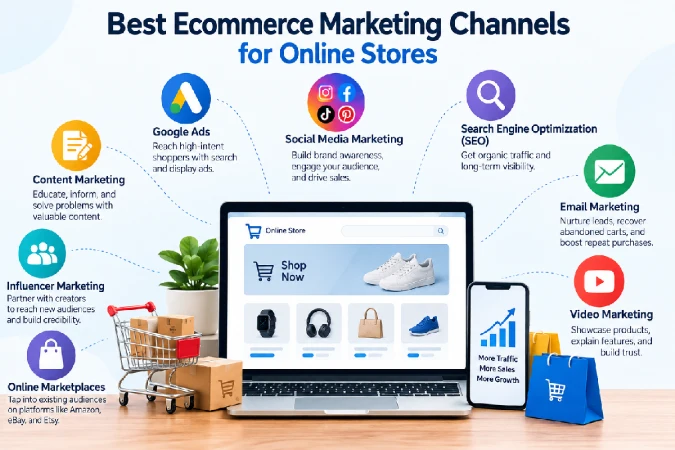
Best Ecommerce Marketing Channels for Online Stores
Different channels serve different purposes. The best marketing strategy typically combines channels rather than depending on one source of traffic.
1. Ecommerce SEO
Search engine optimization helps ecommerce websites attract people who are actively searching for products or information.
SEO can target searches such as:
- Product names
- Product categories
- Brands
- “Best” product searches
- Product comparisons
- Buying guides
- How-to searches
- Problem-based searches
Ecommerce SEO Essentials
Optimize:
- Product titles
- Product descriptions
- Category pages
- Meta titles and descriptions
- URLs
- Internal links
- Image alt text
- Structured data
- Page speed
- Mobile usability
Create useful content around customer questions as well. For example a furniture shop would be able to release advice on office furniture, using measurements of rooms or the selecting of materials.
Organic visibility can be a highly useful source of ongoing traffic, but SEO generally is a slow process.
2. Content Marketing
Content marketing brings in potential clients by how they respond to questions and sharing relevant information.
Examples include:
- Buying guides
- Product comparisons
- Tutorials
- How-to articles
- Product demonstrations
- FAQs
- Case studies
- Videos
- Infographics
- Customer stories
Content should connect naturally with products.
For example, they could put information online about the best choice of a home espresso machine, and some links to places selling such equipment.
Publishing content just to rank for search engines is not an objective. The goal is to produce content that will improve the customer purchasing.
3. Social Media Marketing
Social media to be used to develop brand awareness the access for social media is easier, cheaper and more flexible. It will offer chances for display and presentation.
Useful ecommerce content includes:
- Product demonstrations
- Short-form videos
- Customer reviews
- Before-and-after content
- Tutorials
- Behind-the-scenes content
- New product announcements
- User-generated content
- Seasonal promotions
Social media is effective when used for goods which are visually enhanced or can be showcased through demonstration.
Businesses however should not rely on just social platforms. Changes to the algorithm can influence reach, so social media should be complemented by other channels such as SEO and email marketing.
4. Email Marketing
Email marketing is one of the most beneficial channel to build relationship with existing clients and leads.
Important ecommerce email campaigns include:
Welcome Emails
Familiarize new subscribers with the brand and tell what makes the store unique.
Abandoned Cart Emails
Encourage familiarity with items saved in shopping carts.
Product Recommendations
Recommend products to the user based on the user purchasing or browsing preferences (history).
Promotional Emails
Promote sales, special offers, seasonal promotions and product launches.
Post-Purchase Emails
Open, provide order updates, usage info, review requests, and similar products.
Targeted individual email marketing more more possible if customers are broken into groups. Rather than sending the same email to all customers.
5. Paid Search Advertising
Paid search provides ecommerce companies the opportunity to come to the top of the page when a customer is searching for what they sell.
Search can be beneficial in reaching on–intent traffic because the user is actually searching for something relevant to the product.
Campaigns can target:
- Product keywords
- Category keywords
- Brand searches
- Competitor-related searches where appropriate
- High-intent commercial queries
Track revenue and profitability rather than focusing only on clicks.
6. Shopping and Product Advertising
Product-focused advertising can display product information such as images, names, and prices directly in search results or other advertising placements.
These campaigns can be particularly effective because shoppers can see product information before clicking.
Keep product feeds accurate and ensure:
- Product titles are descriptive
- Prices are current
- Images are high quality
- Availability is accurate
- Landing pages match the advertised products
7. Influencer Marketing
Influencers can introduce products to established audiences.
The best partnerships are not necessarily with the largest creators. A smaller creator with a highly relevant and engaged audience may produce better results.
Before partnering with an influencer, evaluate:
- Audience relevance
- Engagement quality
- Content style
- Previous brand partnerships
- Audience demographics
- Campaign objectives
- Cost
- Expected conversions
Use trackable links, discount codes, or dedicated landing pages to measure results.
8. Affiliate Marketing
Affiliate marketing allows partners to earn a commission for generating sales.
This can reduce upfront marketing risk because commissions are generally tied to measurable results.
Potential affiliates include:
- Bloggers
- Review websites
- Content creators
- Industry publishers
- Comparison websites
Make sure affiliate relationships are transparent and that tracking systems accurately attribute sales.
9. Referral Marketing
Existing customers can become a valuable source of new customers.
Create referral incentives such as:
- Discounts
- Store credit
- Loyalty points
- Exclusive offers
Referral programs work particularly well when customers are already enthusiastic about a product.
How to Turn Ecommerce Traffic Into Customers
Getting visitors to your website is only half the job. The next challenge is converting those visitors into paying customers.
This is where conversion rate optimization (CRO) becomes important.
1. Create Strong Product Pages
Product pages should answer the customer’s most important questions quickly.
Include:
- Clear product name
- High-quality images
- Product benefits
- Detailed specifications
- Price
- Availability
- Shipping information
- Return information
- Customer reviews
- Frequently asked questions
- Clear call-to-action
Use multiple images where appropriate and show products from useful angles.
2. Write Benefit-Focused Product Descriptions
But don‘t list technical data alone. However, don‘t just list the technical data.
Describe what the product does or how it benefits the customer.
For example, instead of only saying:
20/500 ml stainless steel bottle.
Explain benefits such as:
A sturdy 500 ml stainless steel bottle that will be easy to transport around the day.
Specific benefits clarified the value of the product.
3. Make Calls-to-Action Clear
Your first call-to-action should be prominent.
Examples include:
- Add to Cart
- Buy Now
- Start Shopping
- Get Yours
- Subscribe
Avoid cluttering the page with too many competing actions.
4. Build Trust
Customers may hesitate to purchase from an unfamiliar store.
Build confidence through:
- Customer reviews
- Ratings
- Testimonials
- Secure payment indicators
- Clear return policies
- Shipping information
- Contact information
- Product guarantees
- Transparent pricing
Trust signals should be visible near important purchase decisions.
5. Simplify Checkout
A complicated checkout can cause customers to abandon their purchases.
Reduce unnecessary steps and fields.
Consider offering:
- Guest checkout
- Multiple payment options
- Address autofill
- Clear shipping costs
- Order summaries
- Mobile-friendly forms
- Simple error messages
Do not surprise customers with unexpected costs late in the checkout process.
6. Offer Multiple Payment Options
Customers have different payment preferences. Depending on your target market, consider supporting relevant options such as:
- Credit and debit cards
- Digital wallets
- Bank transfers
- Buy-now-pay-later services where appropriate
- Other trusted local payment methods
Make sure every payment method is tested regularly.
7. Use Personalization Carefully
Personalization can make ecommerce experiences more relevant.
Examples include:
- Recently viewed products
- Related products
- Personalized recommendations
- Location-specific offers
- Behavior-based email campaigns
- Recommendations based on previous purchases
The objective should be to make shopping easier rather than intrusive.
8. Increase Average Order Value
Increasing revenue does not always require finding more visitors.
You can increase average order value through:
Cross-Selling
Recommend complementary products.
For example, someone purchasing a camera may also need a memory card or camera bag.
Upselling
Present a higher-value version of the product when it genuinely provides additional benefits.
Product Bundles
Combine related products into a package.
Free Shipping Thresholds
For example, offer free shipping when an order exceeds a defined amount.
Use thresholds carefully so they remain financially sustainable.
How to Measure Ecommerce Marketing Performance
Marketing decisions should be based on measurable results rather than assumptions.
1. Website Traffic
Monitor:
- Total visitors
- New visitors
- Returning visitors
- Organic traffic
- Paid traffic
- Referral traffic
- Social traffic
- Email traffic
Traffic volume alone is not enough. A smaller amount of highly qualified traffic can be more valuable than large volumes of visitors who are unlikely to purchase.
2. Conversion Rate
The ecommerce conversion rate is defined as ‘the percentage of visitors to an ecommerce site who complete a desired purchase’.
A basic calculation is:
Conversion Rate = No. Orders/Visitors× 100
For example, if 10,000 visitors generate 250 purchases:
250 divided by 10,000 multiplied by 100 = 2.5%
Track conversion rates over time and compare by traffic source, device, landing page and campaign.
3. Customer Acquisition Cost
Customer acquisition cost (CAC): it illustrates the total expense of new client acquisition.
A simple formula is:
Total Customer Acquisition Cost (CAC) Total Customer Acquisition Costs over the number of new customers.
This would have a CAC of if a company spends $5000 on marketing and gains 250 new customers.
It is also important to look at this metric in conjunction with customer lifetime value.
4. Customer Lifetime Value
Customer lifetime value (CLV or LTV) estimates how much money a customer will bring to the company during the period of their business association.
Repeated customers may be more profitable than a one-time big purchaser.
Repeat purchase increment can therefore also improve marketing return on investment in the absence of increased new customer acquisition.
5. Return on Ad Spend
Return on ad spend (ROAS). ROAS is the revenue generated from advertising divided by advertising spend.
A basic formula is:
ROAS = Revenue Attributed to Ads ÷ Advertising Cost
For instance, 10k attributed revenue on 2k advertising spend results in a 5:1 ROAS.
But it should not be considered in isolation. Other costs such as product margins, shipping, returns, discounts, etc have an impact on the real profit.
6. Average Order Value
Average order value-AOV: This is the average amount the customer spend each time they use (order) the website.
AOV = Total Revenue ÷ Number of Orders
Monitor the AOV and the conversion rate.While an increased AOV can be beneficial, it will not be if a drastic reduction in purchase completion is brought on.
7. Cart Abandonment Rate
Cart abandon. It tracks how many users are placing their products to shopping cart but not finished buying.
A high abandonment rate can indicate:
- Unexpected shipping costs
- Complicated checkout
- Limited payment options
- Website errors
- Slow loading
- Lack of trust
- Forced account creation
- Poor mobile experience
Reducing checkout friction can improve revenue without requiring additional advertising traffic.
8. Email Performance
Monitor:
- Delivery rate
- Open rate
- Click-through rate
- Conversion rate
- Revenue per campaign
- Unsubscribe rate
Evaluate email performance by campaign type and customer segment rather than treating all subscribers as one audience.
9. SEO Performance
Monitor:
- Organic traffic
- Search visibility
- Search rankings
- Organic conversions
- Indexed pages
- Click-through rates
- Non-branded search traffic
Of course, the best SEO measure of success should always be the bottom line of your business. Ultimately, driving higher rankings is good if it leads to higher value visitors, customers and revenue.
The experimental setup appears to have been designed with the use of yeast in mind, which makes the formation of the floating cell lawn rather convenient.
Creating an Ecommerce Marketing Funnel
A successful ecommerce marketing plan encompasses the entire customer experience.
Awareness
Customers may not have heard of your brand.
Use:
- SEO content
- Social media
- Influencer marketing
- Video content
- Display advertising
- Educational content
The goal is to introduce the brand and attract relevant audiences.
Consideration
Customers are researching their options.
Use:
- Product comparisons
- Reviews
- Buying guides
- Demonstrations
- FAQs
- Retargeting
- Email campaigns
Your objective is to demonstrate why your product is a good choice.
Conversion
The customer is ready to purchase.
Focus on:
- Strong product pages
- Clear pricing
- Trust signals
- Easy checkout
- Multiple payment options
- Fast website performance
- Relevant offers
Retention
After the purchase, continue communicating with customers.
Use:
- Post-purchase emails
- Loyalty programs
- Product recommendations
- Exclusive offers
- Review requests
- Replenishment reminders
Retention can be significantly more valuable than treating every purchase as a one-time transaction.
Ecommerce Marketing Budget Allocation
There is no universal percentage that every ecommerce business should spend on each channel.
Instead, allocate budget according to:
- Business stage
- Profit margins
- Customer acquisition costs
- Product category
- Competition
- Existing organic traffic
- Customer lifetime value
- Marketing performance
A practical approach is to divide spending between proven channels, growth experiments, and measurement.
For example:
- Invest consistently in channels that produce profitable customers.
- Reserve a smaller portion for testing new channels.
- Invest in analytics and conversion optimization.
- Reduce spending on campaigns that consistently fail to produce acceptable results.
Do not automatically increase advertising spend simply because a campaign generates more sales. Determine whether the additional sales are profitable.
Common Ecommerce Marketing Mistakes
You can have a good product, but that can still be a problem if you do not know how to market it.
Trying to Target Everyone
Targeting too broadly can lead to spending money while acquiring poor quality traffic.
Focusing Only on Traffic
More visitors don‘t necessarily mean more revenue. Conversion quality is what really counts.
Ignoring Existing Customers
Satisfy the customers you already have. It‘s expensive to get new customers, so, times spent on customer retention and repeat purchases should be recognized too.
Running Too Many Channels
Managing ten channels poorly is usually less effective than managing three or four channels well.
Ignoring Mobile Users
A poor mobile shopping experience can reduce conversions significantly.
Using Weak Product Content
Low-quality images and generic descriptions make it difficult for customers to evaluate products.
Not Testing Checkout
Checkout problems can remain hidden until they cause lost sales.
Measuring Vanity Metrics
Followers, impressions and click may serve as good indicators, but revenue, profit, conversions, CAC, LTV and retention are generally more significant in business decisions.
Failing to Test
From marketing point of view, marketing should be an ongoing process of trial and error.
Test:
- Headlines
- Product images
- Calls-to-action
- Offers
- Landing pages
- Email subject lines
- Ad creative
- Checkout experiences
Keep the elements that produce meaningful improvements and continue testing new ideas.
Ecommerce Marketing Strategy Checklist
Use this checklist when building or reviewing your marketing strategy:
Strategy
- Define your target audience
- Research competitors
- Establish your value proposition
- Set measurable goals
- Determine your marketing budget
- Select appropriate marketing channels
Traffic Generation
- Optimize ecommerce SEO
- Publish useful content
- Build social media visibility
- Run appropriate paid campaigns
- Explore influencer partnerships
- Consider affiliate marketing
- Build referral opportunities
Conversion Optimization
- Improve product pages
- Use high-quality product images
- Add reviews and trust signals
- Make calls-to-action clear
- Simplify checkout
- Provide relevant payment methods
- Optimize for mobile
- Reduce unexpected costs
- Test landing pages
Customer Retention
- Build an email list
- Send welcome campaigns
- Recover abandoned carts
- Send post-purchase messages
- Recommend relevant products
- Develop loyalty or referral programs
- Encourage repeat purchases
Measurement
- Track traffic sources
- Monitor conversion rate
- Measure CAC
- Track AOV
- Calculate ROAS
- Monitor customer lifetime value
- Analyze cart abandonment
- Track email performance
- Measure organic search performance
- Review revenue and profitability
Final Thoughts
A good ecommerce marketing strategy (a not-so-good one!) isn‘t about one ad campaign or one source of traffic. I think the successful system is attractive, targeted, builds a relationship, provides user-friendly shopping, turns visitors into buyers and keeps them coming.
So first learn who is your best customer, and set clear goals for your business that are easily measurable. Get a foundation and then a solid one by either using SEO, quality content, social medias, money for paid campaigns or emails marketing. Put a great emphasis on conversion optimization and make sure you get the most of the traffic generated.
Lastly, measure your whole customer journey from beginning to end. Track traffic, conversions, acquisition costs, average order value, advertising returns, repat purchases, customer lifetime value… use those insights to make decisions whether to scale up or make changes.
The most successful ecommerce marketing strategies are never a project that is once and done. Focus on a process that is designed to evolve as you grow, as customer habits change, competition increases, search engines update themselves, advertising channels improve, and overall market conditions shift. Nobody should say, ‘I did my ecommerce marketing strategy for the year.’ Instead, test, measure, and optimize at each step of the customer‘s journey nonstop for real and predictable results.