

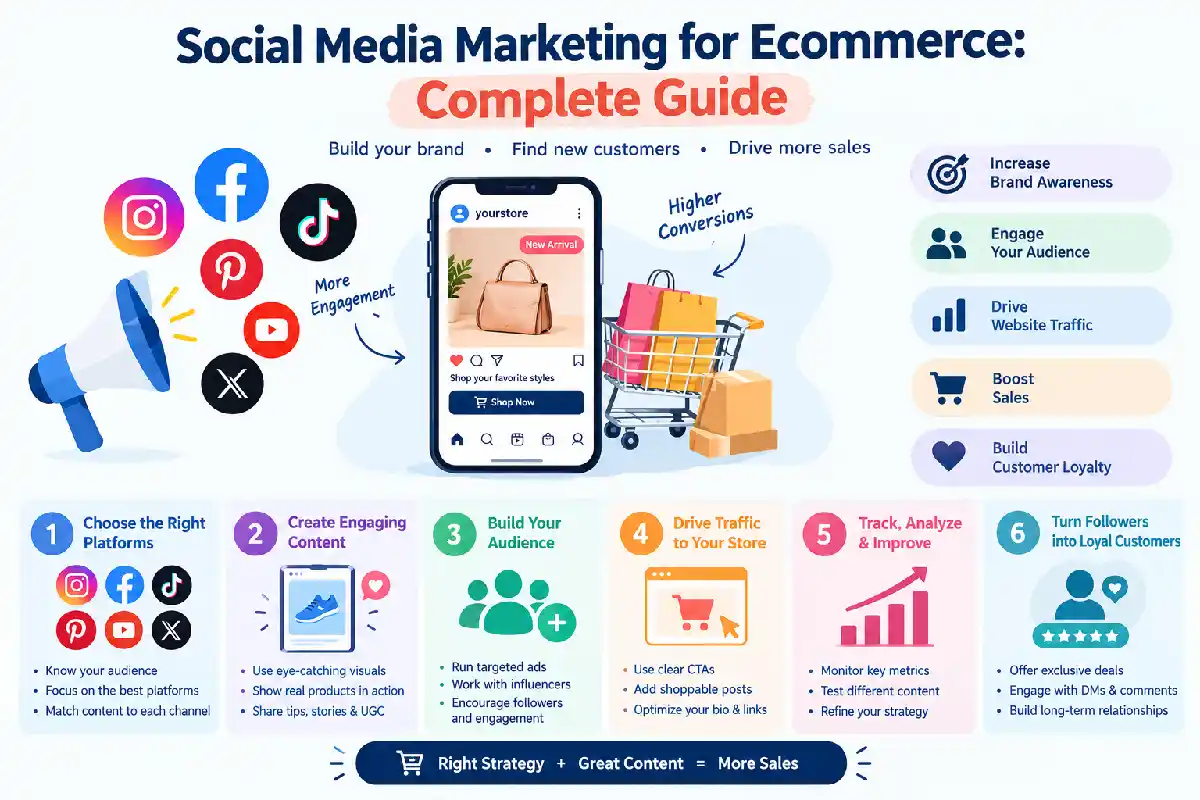
Social Media Marketing for Ecommerce: Complete Guide
Last Updated: September 12, 2026
Social media marketing is an important solution for ecommerce to bring consumers, create brand awareness, and generate sales. Through channels including Instagram, Facebook, TikTok, Pinterest, and YouTube, ecommerce companies can directly promote, communicate and send visitors to their own online shops.
However, setting up the social media accounts alone will not suffice. The most successful ecommerce brands have a well-defined plan of action that makes use of:
No matter if you‘re opening a new online store or trying to grow an existing ecommerce business, a good social media plan will encourage followers to become customers.
Best Social Media Platforms for Ecommerce Businesses
Different media creates different value for each product and targeted customer group. There are some platforms ore suitable for one product but not suitable for another product. So choose the right media platform for ecommerce depends on which kind of customer group you would like to target, what category of products you are offering, what kind of content you would like to having, and what kinds of marketing measures you are planning to have.

Helpful for visually attractive products including fashion, beauty, home décor, food and lifestyle products.
Ecommerce brands can use:
- Instagram Reels
- Stories
- Product demonstrations
- Customer-generated content
- Influencer collaborations
- Shopping features
- Product launches
Strong visuals and short-form videos can help products reach new audiences.
First, the most advantage of Facebook for ecommerce reasons is because of the popularity of Facebook and an effective of advertising. Businesses can also have business pages, communities, product catalogs, and advertising campaigns.
Facebook can be particularly useful for targeting select customer segments using pay-per-click advertising.
TikTok
Perfect for brands that can produce fun, educational or topical short video content. Product reviews, unboxings, how to, for example, customer reviews, and behind-the-scenes videos all work.
Pinterest is ideal for those finding products relating to fashion, home improvements, recipes, wedding plans, crafts, beauty and lifestyle. As search on Pinterest is often about gaining ideas and inspiration, ecommerce businesses can appeal to potential customers through the use of product-focused visuals.
YouTube
YouTube can be handy for longer product demonstrations and tutorials, comparisons, reviews, and educational content. You tube videos can also continue to receive traffic long after they are published, which makes it a useful source of long-term ecommerce content marketing.
The key to boosting engagement everywhere is to begin on the social media networks where your potential customers are hanging out.
How to Create an Ecommerce Social Media Strategy
A successful ecommerce social media strategy starts with clearly defined goals.
Your objectives might include:
- Increasing brand awareness
- Driving website traffic
- Generating product sales
- Building an email list
- Increasing engagement
- Growing a loyal customer community
- Launching new products
1. Define Your Target Customer
Understand who you’re trying to reach. Consider their age range, interests, purchasing behavior, problems, and reasons for buying your products.
Creating customer personas can make content creation much easier.
2. Choose the Right Platforms
Instead of spreading your resources across every platform, focus on two or three channels where your target audience is most likely to engage.
3. Create Content Pillars
Content pillars are recurring categories that keep your social media strategy organized.
For an ecommerce brand, these could include:
- Product education
- Tutorials
- Customer reviews
- Behind-the-scenes content
- Lifestyle content
- User-generated content
- Promotions
- Industry tips
4. Create a Content Calendar
Plan your posts. A content calendar will help you post regularly and maintain a good balance between promotional and interesting/entertaining content.
5. Test and Optimize
Track engagement as well as sales data to identify the most successful formats, subjects, and channels. Keep experimenting with content and push those that give you a good return on investment.
Social Media Content Ideas for Ecommerce Brands
Developing new content all the time is not an easy task. There is plenty of scope for ecommerce companies to use their contents and customers.
Here are useful social media content ideas:
Product demonstrations: The more you show and say about your product the more interest you will generate.
Before-and-after content: The biggest impact works for beauty, home improvement, organization and related types of products.
Customer reviews: Convert positive reviews into appealing posts or short videos.
Unboxing videos: Provide customers with an idea of what to anticipate when receiving their purchase.
Backstage footage: Showcase manufacturing, packaging, product development, or your team to your followers.
How-to videos: Show consumers how to make the most of your products.
Q & A: Address common customer concerns in short videos or carousel posts.
User-generated content: Let your customers upload photos or videos of themselves using your products.
Seasonal content: Relate your products to holidays, events, seasons and relevant trends.
Time-sensitive promotions: Use the time element in sales without turning all your posts into sales pitches.
A valuable content mix should be naturally showcase your products with value.
How to Turn Social Media Followers Into Customers
As a general rule, attaining thousands of followers does not guarantee thousands of sales. Clarity of the steps from social media to purchase is what matters.

Make it simple for people to find you to begin with. Include in your bio an outline of what you‘re selling and a link to your ecommerce site.
Use strong calls to action such as:
- Shop now
- Explore the collection
- See what’s new
- Get the offer
- Learn more
- Shop the look
Describe product content in terms of benefits and not features. Demonstrate to potential customers how the product addresses an issue or creates a better experience.
At the same time, social proof can play a big part in easing purchase hesitation, such as customer reviews, testimonials, ratings, influencer-generated content, and user-generated content.
Use Social Commerce
Social commerce features that facilitate browsing and, depending on the feature, even purchasing directly on the respective platform all hinge on whichever level of user empowerment is granted by the feature.
The more capabilities a feature provides, the more customer empowerment it enables.
However, you can also use retargeting campaigns to target anyone who has been on your website, checked out your products or engaged with your social content.
The overall customer journey should be simple:
Discover → Engage → Consider → Click → Purchase → Repeat
Ecommerce Social Media Metrics You Should Track
Tracking the right metrics helps you determine whether your social media strategy is actually contributing to business growth.
| Metric | What It Tells You |
| Reach | How many people saw your content |
| Impressions | How often content was displayed |
| Engagement rate | How actively people interacted |
| Click-through rate | How many people clicked links |
| Website traffic | Visitors coming from social media |
| Conversion rate | Visitors who completed a desired action |
| Social sales | Revenue generated through social channels |
| Follower growth | How quickly your audience is increasing |
| Cost per conversion | How much paid campaigns spend per conversion |
| Return on ad spend | Revenue generated relative to advertising costs |
Don‘t over-emphasize followers. A smaller loyal base that keeps clicking and buying and recommending you is likely to sell far more than a huge audience not actively looking to buy.
Tips for Successful Ecommerce Social Media Marketing
Stay customer-centric and don‘t turn all your posts into a sales pitch.
Utilise the visual element by using quality images, respond to comments and messages, ask customers to generate content and use short form video.
Consistency is key too. Blog regularly so people can see your posts more often and you stay fresh in people‘s minds.
While doing all of this is important, perhaps the most crucial thing is to ensure that your use of social media ties into your overall ecommerce marketing strategies. Your followers on social media should be able to work in harmony with your email marketing, SEO, content marketing, paid advertising and loyalty programs.
Conclusion
Ecommerce and social media marketing. The power of social media for online businesses can be used for customer acquisition, building up a brand, encouraging brand loyalty, and, as a result, increasing sales. Maximum effect is achieved by selecting the appropriate channels, providing high-quality, informative and appealing content, developing relationships, and allowing interested followers to purchase easily.
Begin with a focused approach, experiment with different content types, monitor significant ecommerce metrics, and keep refining your approach according to customer behavior. Only if you hold to this practice and maintain your efforts over time can social media evolve from awareness to an effective ecommerce selling channel.