

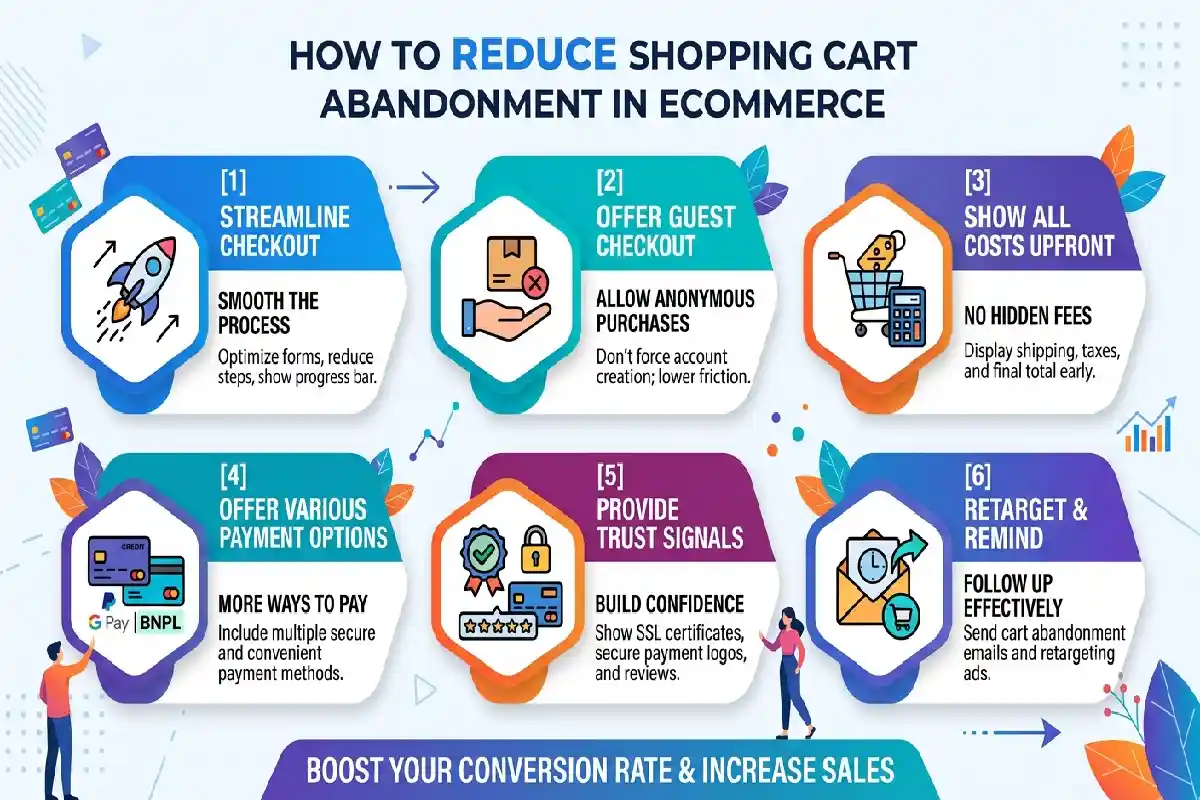
How to Reduce Shopping Cart Abandonment in Ecommerce
Last Updated: September 14, 2026
Shopping cart abandonment is one of the most serious conversion issues in ecommerce. How to minimize shopping cart abandonment in ecommerce begins with understanding the root causes of shopping cart abandonment among shoppers, then eliminating the factors that hinder the purchase process through to “Place Order”. In 2026, the world average ecommerce cart abandonment rate persist to be approximately 70%, which equals to about 7 out of 10 shopping carts don‘t conclude in an unspecified purchase.
Fortunately, not every abandoned cart is a missed sale. Some people are just shopping around, trying different prices, or saving items to come back to. Others are facing something that you could actually resolve unexpected shipping costs, confusing checkout forms, limited payment options, slow loading pages, or no security credentials.
This manual details identifying these issues, decreasing shopping-cart friction, and reclaiming high-demand consumers.
What Motivates Ecommerce Customers to Leave Their Carts?
The first step is separating natural abandonment from avoidable abandonment.
Baymard’s current research shows that cart abandonment is influenced by multiple factors, including additional costs, complicated checkout processes, website errors, unsatisfactory return policies and limited payment methods.

Common reasons shoppers leave
| Abandonment trigger | Shopper reaction | What to fix |
| Unexpected shipping/tax/fees | “This costs more than I expected.” | Show total costs earlier |
| Complicated checkout | “This takes too long.” | Remove unnecessary fields |
| Account required | “I don’t want another account.” | Add guest checkout |
| Website errors | “Something isn’t working.” | Monitor checkout errors |
| Poor return policy | “What if I don’t like it?” | Make returns easy to find |
| Limited payment options | “I can’t pay how I want.” | Add relevant payment methods |
| Slow delivery | “I need it sooner.” | Show delivery dates |
| Security concerns | “Is this site safe?” | Add trust signals |
Baymard reports that 17% of US online shoppers have abandoned an order because checkout was too long or complicated, while its testing indicates an optimized checkout can be as short as 12–14 form elements.
How to Simplify the Ecommerce Checkout Process
Your checkout should feel like a short path to the finish line—not a form-filling exercise.
Start by testing your checkout yourself on both desktop and mobile.
1. Offer guest checkout
Don’t force first-time customers to create an account before purchasing.
Instead, offer:
- Continue as Guest
- Sign In
- Express Checkout
You can invite customers to create an account after the order is complete.
2. Remove unnecessary form fields
Ask yourself whether every field is genuinely required to fulfill the order.
Baymard’s research found that the average US checkout contains 23.48 form elements by default, while an optimized flow can be substantially shorter.
Remove or hide fields such as:
- Company name
- Address Line 2
- Separate billing address when unnecessary
- Optional phone fields
- Unnecessary demographic information
Autofill and address lookup can also reduce typing.
3. Make errors easy to fix
Don’t make customers search for what went wrong.
Instead of:
“Invalid information.”
Use:
“Enter a valid 10-digit phone number.”
Keep the error beside the relevant field and preserve information they’ve already entered.
4. Add express payment options
Depending on your audience and market, consider options such as:
- Digital wallets
- PayPal
- Shop Pay
- Google Pay
- Apple Pay
- Buy-now-pay-later options where appropriate
- Local payment methods
The right payment mix depends on your customers, average order value and geography.
Screenshot opportunity: Add a real screenshot of your checkout showing guest checkout, payment methods and the final order total.
How Shipping Costs Affect Cart Abandonment
Shipping is often where a seemingly affordable product suddenly becomes expensive.
Baymard’s research identifies extra costs such as shipping, taxes and fees as one of the largest abandonment triggers.
Don’t wait until the final payment step to reveal shipping.
Instead, communicate:
Product page → Cart → Checkout
For example:
Free shipping on orders over $75
or:
Standard delivery: $6.99 — arrives September 18–20
Compare shipping strategies
| Strategy | Best for | Potential benefit |
| Free shipping | High-margin products | Removes major friction |
| Free shipping threshold | Increasing AOV | Encourages larger baskets |
| Flat-rate shipping | Predictable costs | Simple customer experience |
| Real-time rates | Variable shipping costs | Accurate pricing |
| Local pickup | Local retailers | Removes delivery cost |
Don’t automatically make shipping free. First calculate your average shipping cost, gross margin and AOV.
For example, if your AOV is $60 and average shipping costs $8, offering free shipping above $75 could encourage customers to add another item without sacrificing as much margin as completely free shipping.
How to Recover Abandoned Ecommerce Carts
Prevention is important, but recovery can turn some abandoned carts back into revenue.
A basic recovery sequence can look like this:
| Timing | Message | Objective |
| 1–2 hours | Cart reminder | Remove forgetfulness |
| 12–24 hours | Benefits + trust | Overcome hesitation |
| 24–48 hours | Incentive if appropriate | Create motivation |
Don’t automatically give every shopper a discount. That can train customers to abandon carts deliberately.
Your first message can simply say:
You left something behind.
Include:
- Product image
- Product name
- Price
- Cart link
- Delivery information
- Returns information
- Clear CTA
Klaviyo recommends automated cart-abandonment flows and reports that these flows can generate significant revenue per recipient, while Shopify also emphasizes timely recovery messages.
Go beyond email
Depending on customer consent and your setup, recovery can include:
- SMS
- Retargeting
- Push notifications
- Personalized onsite messages
BigCommerce similarly recommends combining checkout optimization with abandoned-cart emails, retargeting, exit-intent messaging and personalized incentives.
How to Measure and Reduce Cart Abandonment Rate
You can’t optimize what you don’t measure.
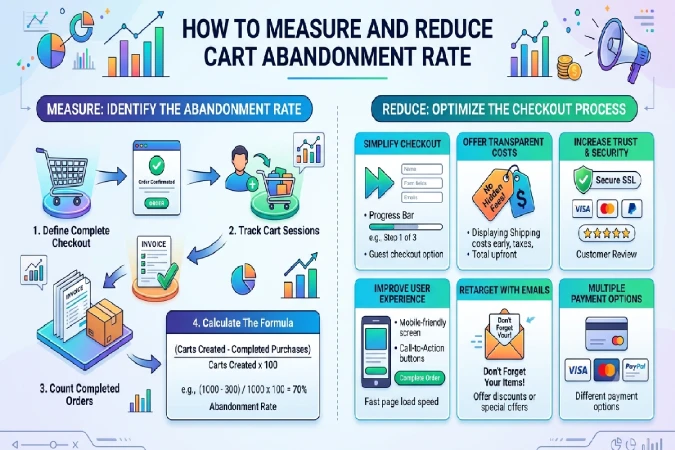
Use this formula:
Cart Abandonment Rate = (Abandoned Carts ÷ Created Carts) × 100
For example:
- 1,000 carts created
- 700 abandoned
- 300 purchased
Cart abandonment rate = 70%
But don’t stop there.
Track abandonment by:
- Device
- Traffic source
- Product category
- New vs returning customer
- Country
- Payment method
- Shipping method
- Checkout step
Your ecommerce CRO dashboard should monitor
| Metric | Why it matters |
| Add-to-cart rate | Measures product interest |
| Cart-to-checkout rate | Identifies cart friction |
| Checkout completion rate | Measures checkout effectiveness |
| Cart abandonment rate | Measures lost purchase opportunities |
| Recovery rate | Measures recovered revenue |
| Revenue per session | Connects CRO to business results |
| Mobile vs desktop conversion | Finds device-specific problems |
For example, if desktop abandonment is 58% but mobile abandonment is 78%, don’t immediately redesign your entire website. Audit the mobile checkout experience first.
A Practical 7-Step Cart-Abandonment Checklist
Before changing your store, run this checklist:
- Show shipping costs before the final payment step.
- Offer guest checkout.
- Remove unnecessary form fields.
- Add preferred payment methods.
- Make returns and guarantees visible.
- Test your checkout on multiple mobile devices.
- Set up automated abandoned-cart recovery.
Then A/B test the highest-impact changes rather than changing everything simultaneously.
Baymard’s research suggests that checkout redesign can produce substantial conversion improvements, with its research estimating an average large ecommerce site could increase conversion by 35.26% through better checkout design.
Troubleshooting: Cart Abandonment Is Still High
If abandonment remains high after simplifying checkout, check these issues:
High mobile abandonment: Test page speed, keyboard behavior, form sizing, sticky buttons and mobile payment options.
High abandonment at shipping: Check whether shipping costs or delivery dates are being revealed too late.
The High abandonment at payment: Look for declined transactions, missing payment methods and confusing payment instructions.
High abandonment from new customers: Review guest checkout, trust signals, reviews and return policies.
Lots of abandoned carts but poor recovery: Test recovery timing, subject lines, product recommendations and checkout links.
Most importantly, don’t assume every abandoned cart is a UX problem. Some shoppers simply aren’t ready to buy.
FAQ: Reducing Shopping Cart Abandonment
What is a good ecommerce cart abandonment rate?
There is no universal “good” rate because abandonment varies by industry, device, traffic source and purchase intent. Baymard currently reports a global average of about 70.19%, so businesses should benchmark against their own historical performance and segment data.
What is the biggest cause of cart abandonment?
Unexpected additional costs are one of the biggest causes. Shipping, taxes and fees should be communicated as early and clearly as possible.
Does guest checkout reduce cart abandonment?
It can. Forced account creation introduces additional effort, so offering guest checkout removes one common source of friction.
How can I recover abandoned carts?
Use timely email or SMS reminders, retargeting and personalized recovery campaigns. Start with reminders before automatically offering discounts.
Should I offer free shipping?
Not necessarily. Test free shipping, flat-rate shipping and free-shipping thresholds against your margins and average order value.
Final Takeaway
Reducing shopping cart abandonment in ecommerce is less about sending additional abandoned-cart emails and more about rectifying the reasons behind the initial abandonment.
Start with the fundamentals:
Translucent prices > easy check out > guests buying all trusted payment types > understandable delivering > clean returns & fast getting back.
Then use analytics and A/B testing to identify the next bottleneck.
For a topical ecommerce CRO strategy, this article can act as the hub page, with supporting articles covering checkout optimization, ecommerce conversion rate optimization, ecommerce SEO, product-page optimization, mobile ecommerce and abandoned-cart email marketing.