

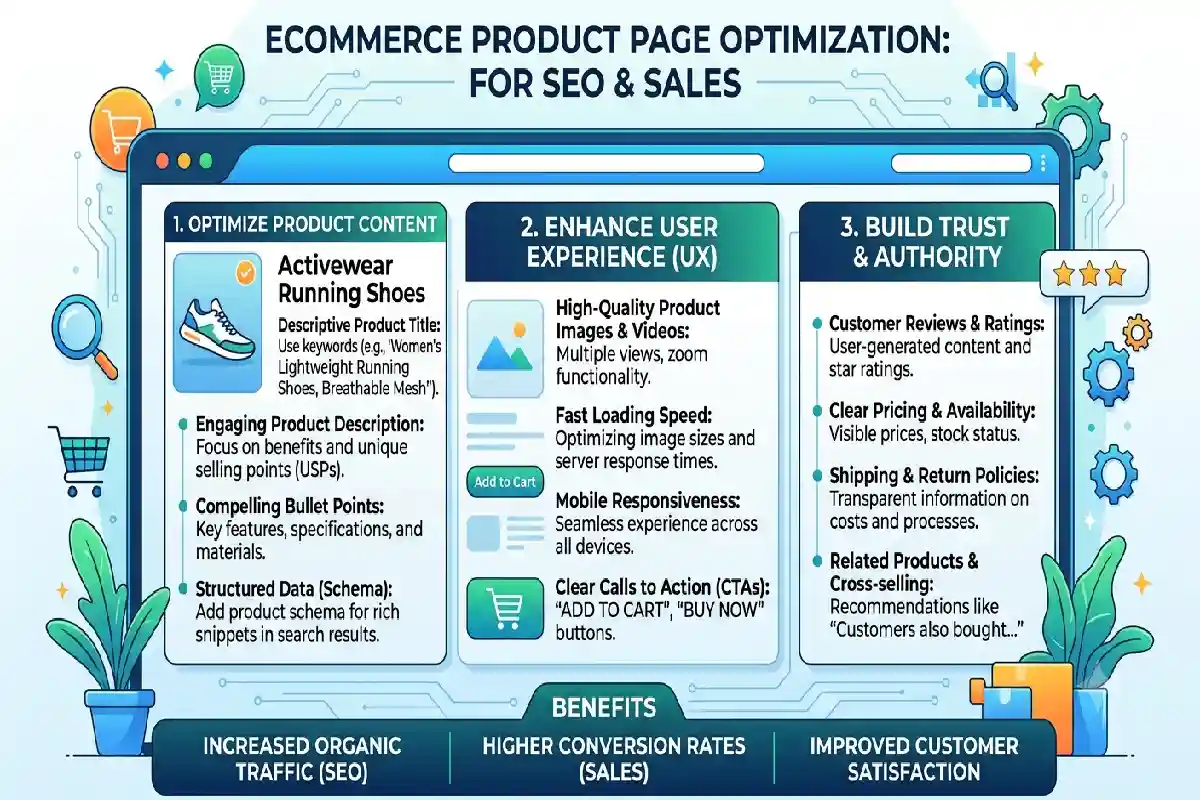
Ecommerce Product Page Optimization for SEO & Sales
Last Updated: September 13, 2026
Ecommerce product page optimization for SEO & sales is the practice of optimizing your product pages to bring in targeted organic traffic, answer customer questions, generate trust, and convert a greater share of visitors into buyers. A good product page addresses two audiences simultaneously: search engines, which need to index what you are selling, and shoppers, who need sufficient information to buy.
Google suggests providing ecommerce sites with good product data, structured data and a logical overall site structure so that its systems can better find and understand products.
So it‘s better not to get into the selection battle of SEO versus conversion optimization. Your product pages need to optimize both for rankings and conversions.
What Creates an Effective Ecommerce Product Page?
The bare minimum for high conversion is a product page that eliminates any risk.
A high-converting product page removes uncertainty. Visitors should quickly understand:
- What the product is
- Who it is for
- What problem it solves
- How much it costs
- What makes it different
- When it will arrive
- Whether they can return it
- Why they should trust your store
The key details should be followed immediately by the most prominent placement of key information: product name, main image, price, selling points, available stock, reviews, variants and an eye-catching Add to Cart/Buy Now button.
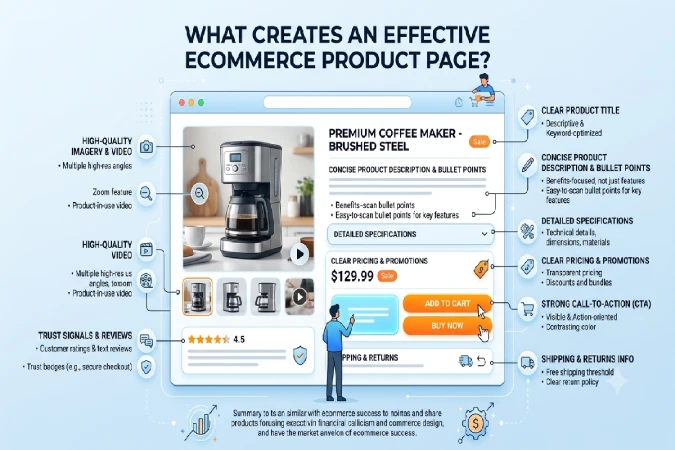
Shopify‘s 2026 product-page research is indicative that imagery, descriptions, reviews, CTA visibility, mobile usability, and clear product information are also essential for optimization.
Product page optimization priorities
| Element | SEO benefit | Sales benefit | Priority |
| Product title | High | High | Essential |
| Unique description | High | High | Essential |
| Product images | Medium | High | Essential |
| Reviews | Medium | High | Essential |
| Product/Offer schema | High | Medium | Essential |
| Internal links | High | Medium | High |
| Mobile UX | High | High | Essential |
| Page speed | High | High | Essential |
| FAQs | Medium | High | High |
| Related products | Medium | High | High |
Baymard’s research shows why UX deserves equal attention: its 2026 benchmark found that 52% of desktop and 62% of mobile ecommerce sites had mediocre or worse product-page UX.
How to Optimize Product Titles and Descriptions
Your product title is one of the strongest signals for communicating what a product page is about.
Instead of:
Premium Running Shoes
use a more descriptive title such as:
Men’s Lightweight Road Running Shoes – Breathable Mesh
The second version communicates product type, audience, use case, and differentiating characteristics.
Product title checklist
- Include the primary product keyword naturally.
- Put the most important information near the beginning.
- Include relevant attributes such as brand, model, size, material, color, or compatibility.
- Avoid keyword stuffing.
- Keep the title understandable to humans.
- Make sure the H1 and title tag accurately represent the product.
Followed by your description of the product Further elaborate on the title, do not duplicate the manufacturer description. Exclusive interesting product content will provide extra contextual information to buyers and distinguish the page from other URLs.
Use a simple structure:
Concise summary → main advantages → characteristics → details → applications → delivery/returns → questions
Use bullet points where possible so that the shopper can scan the important things quickly.
Shopify recommends providing search engines and other consumers with the most useful product information and its SEO advice for product information specifically only mentions useful descriptions rather than plain product descriptions.
Product Images and Videos That Improve Conversions
A product page can have excellent SEO and still fail if shoppers cannot properly understand the product.
Use multiple images showing:
- The product from different angles
- Close-up details
- The product in use
- Size or dimensions
- Important features
- Packaging or included accessories
- Different colors or variants
Add video when it genuinely helps demonstrate the product.

Your images should also be optimized for search and performance:
- Use descriptive filenames.
- Write useful alt text.
- Compress images without noticeably reducing quality.
- Use modern image formats where appropriate.
- Avoid unnecessarily oversized files.
- Prevent layout shifts by reserving image dimensions.
When a shopper selects a variant, the relevant product image should change whenever possible. This reduces uncertainty about what they are actually purchasing. Shopify specifically recommends connecting variant selections with relevant imagery.
How to Use Reviews and Trust Signals on Product Pages
Reviews offer what your marketing won‘t proof from other customers.
Make your rating and review count visible near the product title or the price for visitors to see the recommendations easily.
A strong review section should include:
- Average rating
- Total review count
- Rating distribution
- Written reviews
- Customer photos or videos
- Review filtering
- Verified-purchase indicators where applicable
- Answers to common questions
Do not display only perfect reviews. A realistic review profile can help shoppers understand the product and set appropriate expectations.
Beyond reviews, consider adding trust signals such as:
- Clear return policy
- Shipping information
- Secure payment indicators
- Warranty information
- Money-back guarantee, when genuinely offered
- Customer support availability
- Stock or availability information
Baymard’s research emphasizes that product pages are central to purchase decisions and that unresolved usability issues can cause shoppers to abandon otherwise suitable products.
Product Page SEO Checklist for Ecommerce Websites
Use this checklist when auditing individual product pages.
On-page SEO
- One clear, descriptive H1
- Primary keyword aligned with search intent
- Unique title tag
- Compelling meta description
- Clean, descriptive URL
- Unique product description
- Helpful headings and subheadings
- Natural use of related terms
Images
- High-quality product photography
- Descriptive alt text
- Compressed images
- Appropriate image dimensions
- Variant-specific images where useful
- Product video when valuable
Technical SEO
- Product structured data
- Accurate price and availability data
- Review data where eligible
- Canonical URL strategy
- Mobile-friendly layout
- Fast loading experience
- XML sitemap coverage
- Correct handling of discontinued products
- Correct handling of out-of-stock products
Google’s ecommerce documentation emphasizes helping Google understand products and ecommerce site structure, while Shopify and Ahrefs both recommend structured data, internal links, optimized images, mobile performance, and product-specific content.
Internal linking
Don’t let product pages become isolated URLs.
Link to them from:
- Relevant category pages
- Collection pages
- Buying guides
- Comparison articles
- Blog posts
- Related product pages
- Best-seller pages
Use descriptive anchor text rather than generic phrases such as “click here.”
Conversion optimization
- Clear price
- Clear availability
- Prominent Add to Cart button
- Easy variant selection
- Shipping information
- Returns information
- Reviews near the buying area
- Clear product benefits
- Mobile-friendly CTA
- Related products or cross-sells
A Simple Product Page Optimization Framework
Manage your workload by focusing on it, rather than constantly alter things.
1: Locate sale pages that rank well in search engine results for popular product-related keywords.
To begin, focus on products that are currently getting organic or paid traffic.
2: Find the major pain spots.
Unclear descriptions, feeble images, missing reviews, confusing variants, lagging load time and unclear shipping information at the product page.
3. Correct SEO basics.
Enhance titles, meta descriptions, internal links, structured data, images, and technical performance.
4: Enhancing Conversion Factors.
Test CTA placement, messaging, reviews, trust signals, variants.
5: Measure Your Results.
Track organic clicks, impressions, rankings, product-page conversion rate, add-to-cart rate, revenue per visitor, AOV, and return rate.
Shopify suggests using conversion rate as the most important KPI, then AOV and return rate should be used as guardrails during testing of new productpage changes.
Common Product Page Problems and How to Fix Them
Issue: The webpage attracts viewers but it doesn‘t convert to sales.
Review of product clarity, price, positive reviews, presence of CTAs, delivery details, and indications of trust.
Problem: Non-ranking product page.
Review the search intent for the keywords/phrases, focus on how the titles are targeted (serp titles), duplicate content, internal linking strategy, use of structured data, indexability of information (e.g., crawlers), and overall the technical performance.
Problem: Varying versions all competing chaos sets in.
Double check your canonicalization, URL, indexing and variant strategy. Don‘t develop a life of its own create a huge set of near duplicate indexable pages without any SEO logic behind.
The problem we faced, was a lack of mobile conversion.
The size of test images; CTA visibility; number of variants; page speed; navigation; amount of scrolling necessary to make a buy decision.
Problem: All the details of each product are the same in any store.
Replace manufacturer copy with original copies in your voice for the questions your customers have, use cases, specifications, benefits, and buying concerns.
FAQ
Ecommerce product page optimization is?
The process of enhancing the copy (text) used on product-pages, Search Engine Optimization (SEO), User Experience (UX), and Conversion components in order to generate relevant traffic to the pages with a higher conversion rate.
What is the best way to do an SEO optimization of a product page?
Begin with search intent and keyword research. Then optimize the product title, H1, description, URL, images, internal links, structured data, mobile experience and page speed.
How to boost conversions on individual product pages:
Enhance product details, images, reviews, build trust, present accurate price, allow easy selection of options, provide shipping information, and make CTAs more prominent. Experiment with variations; never assume one layout will suit all your shops.
Is it guaranteed that every product page in ecommerce will have Product schema?
The product structured data is usually helpful to assist search engines comprehend products however ensure the structured data is properly exampled that of the visible product data and the current offer.
Part of the ongoing process is determining the frequency at which each of the following activities should be carried out. Here‘s how often the product pages should be updated:
Perform an audit on frequently most viewed product pages and immediately when there are changes to prices, inventory, variations, queries or questions from customers, search demand, or conversion.
Final Takeaway
We believe the best ecommerce product page is not just a page filled with keywords. It is search optimized buying experience.
Provide Google with detailed product data by providing content, coded information, links and technically optimized pages. Provide customers with the information they need to make a confident buying decision by providing good pictures, useful descriptions, reviews, pricing, availability, shipping info and clear calls to action.
The biggest opportunity is usually not a single SEO trick. It is making every important product page easier to discover, easier to understand, and easier to buy from.