

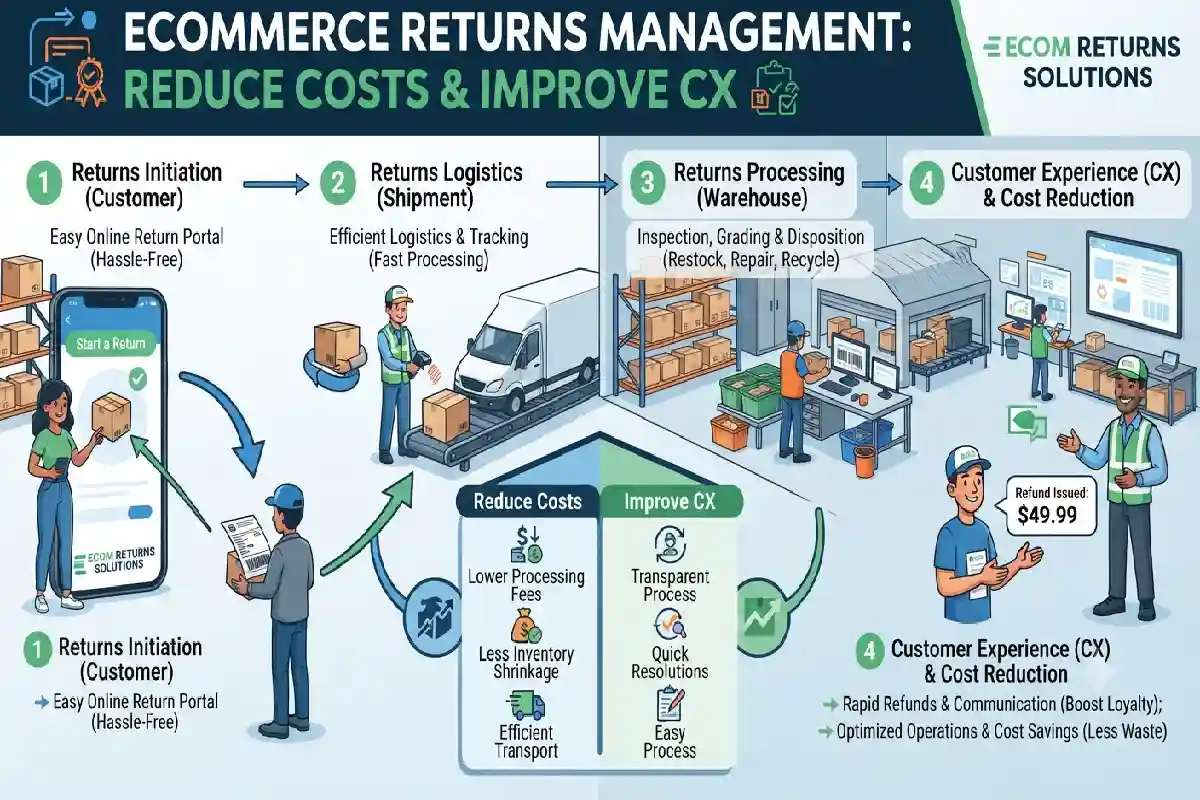
Ecommerce Returns Management: Reduce Costs & Improve CX
Last Updated: September 17, 2026
Returns management for ecommerce returns management is the process of returning a product from your customer from purchase through to shipping, inspecting, and issuing a refund or exchange, and reclaiming inventory. Ecommerce stores will want to design a returns system that minimizes costs for unnecessary returns and maximizes the ease for customers in the post-purchase experience. Ecommerce returns management is a major concern of online retail.
In 2025, sales returns alone will represent 19.3% of all ecommerce sales and result in $849.9 billion in retail sales, estimates NRF.
This same report also found that 82% of online consumers ranked free return shipping among the top considerations when choosing an ecommerce retailer. The aim isn’t to accept fewer returns. The aim is to understand why product returns occur, recover maximum value, and create a hassle-free process for legitimate returns.
What is Ecommerce Returns Management?
Ecommerce returns management is the end-to-end system a business uses to manage products customers send back.
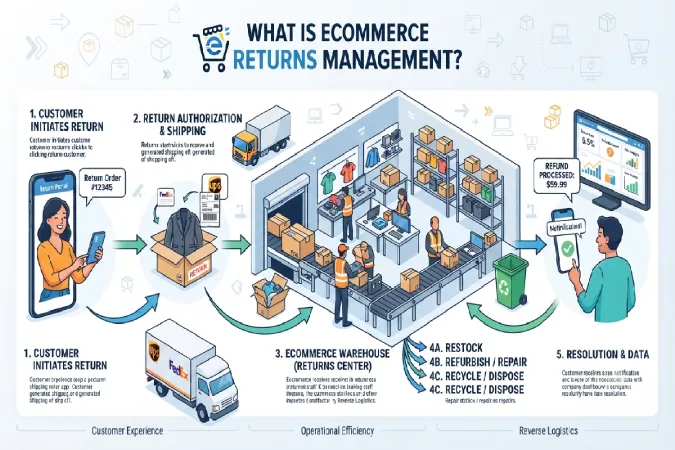
A typical process includes:
- Customer submits a return request.
- The business checks eligibility.
- A return authorization or shipping instruction is provided.
- The product is shipped back.
- The returned item is inspected.
- The business decides whether to restock, refurbish, liquidate, donate, or dispose of it.
- The customer receives a refund, exchange, or store credit.
- The return reason is recorded for future analysis.
Returns management is more comprehensive than reverse logistics. Reverse logistics deals with the actual transportation of product up the supply chain. Returns management encompasses that function but also includes customer communication, return policies, refunds and exchanges, inventory management, and reporting and analysis.
An effective returns-management system links customer service, ecommerce platform, inventory management, order fulfillment, and finance, not simply as a subfunction of support but as an integrated experience.
How to Create an Ecommerce Return Policy
Your return policy should be easy for customers to understand and easy for your team to enforce.
Clearly explain:
- Return window
- Eligible and non-returnable products
- Product-condition requirements
- Return shipping responsibility
- Restocking fees, if applicable
- Refund processing time
- Exchange options
- Store-credit options
- Final-sale products
- International-return rules
- Holiday or seasonal extensions
Don’t hide the policy at the bottom of your website. Customers often check return conditions before purchasing. Narvar’s 2025 post-purchase research found that 90% of surveyed U.S. online shoppers check a retailer’s return policy before buying, while 76% said they would not purchase again after a poor return experience.
Practical tip: Create a short summary near the product or checkout experience and link to the complete policy for details.
How to Make the Ecommerce Returns Process Easier
Complex returns add unnecessary stress to both customers and support teams. Offer your customers a way to do their own returns. Instead of the traditional approach of taking a support email, allow customers to simply enter their order number, select the item, choose the reason for return, and then follow the next set of steps.
A simpler return process might look like this:
Order → Return request → Eligibility check → Return label/instructions → Tracking → Inspection → Refund/exchange → Inventory update
Automation can take care of the boring tasks – and leave your employees to focus on tricky ones.
For example, you can have your system automatically detect if an item was returned within the time window, display instructions, change the order’s status, and log the return reason. You can also offer exchanges to help capture extra revenue if the customer needs a different size, colour, or style. Shopify’s 2026 guidance recommends offering exchanges where appropriate and not automatically returning everything as a refund.
2026 Returns Experience Snapshot
| Metric | Latest reported figure |
| Online sales expected to be returned in 2025 | 19.3% |
| Total retail returns projected for 2025 | $849.9B |
| Consumers considering free returns important | 82% |
| Consumers preferring instant refund/exchange | 76% |
| Consumers less likely to shop again after poor returns experience | 71% |
| Estimated fraudulent returns | 9% |
How to Reduce Product Return Rates
The best return is often the one you prevent before the order is placed.
Analyze your return reasons and look for repeated patterns.
For example:
| Return reason | Improvement | Possible underlying problem |
| Wrong size | Add detailed size charts and fit guidance | Poor sizing information |
| Product different from expectation | Improve photos, videos and descriptions | Weak product information |
| Damaged on arrival | Improve protective packaging | Packaging problem |
| Wrong item shipped | Add barcode/order verification | Fulfillment error |
| Product quality issue | Review supplier/product quality | Manufacturing problem |
| Customer changed mind | Improve product education | Expectation or purchase-intent issue |
Product pages are critical. Accurately document dims, specs, photos and videos, compatibility, materials, and fit notes. Don’t just glance at the overall return rate. Narrow down to which SKUs, category, supplier, warehouse, size, color, and reason for returns is causing the most returns.
This makes the data about returns a driver of product and merchandising intelligence.
How to Track Ecommerce Return Costs and Trends
A return rate alone doesn’t tell you whether your returns operation is profitable.
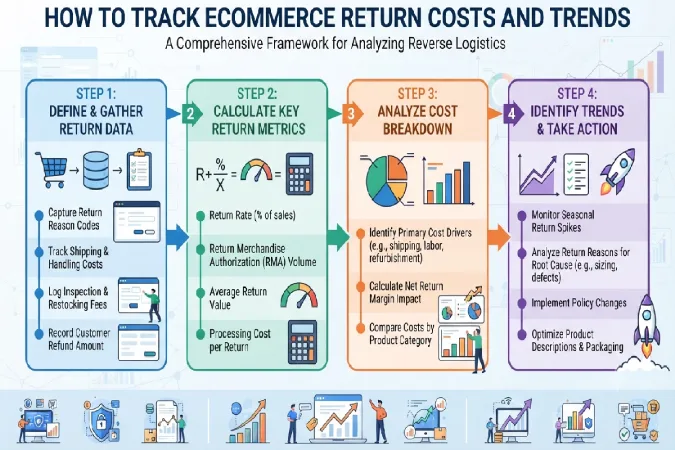
Track metrics such as:
Return Rate
Returned Orders ÷ Total Orders × 100
Return Cost per Order
Total Return Costs ÷ Number of Returned Orders
Return Cost can include shipping, warehouse labor, inspection, packaging, refund fees, markdowns, disposal, and other processing expenses.
Also monitor:
- Return rate by SKU
- Return rate by product category
- Return reasons
- Refund vs. exchange rate
- Store-credit usage
- Time to process returns
- Percentage of returned products resold
- Inventory recovery value
- Return fraud rate
- Repeat returns by customer
- Customer support contacts per return
The most practical dashboard links return reason, product, operational cost and financial outcome. For instance, if one product has a high return rate because customers are constantly complaining about its size, changing the product page might cost less than charging for return fees – and make more of a dent in profitability. That kind of insight is important because you want to prevent returns at the root, not just give refunds.
Conclusion
Great ecommerce returns management isn’t just a way to make returns more painful. It’s a way to develop a refund process that’s easy for customers and easier for the business. Establish a return policy, develop a simple process (self-service), learn the reasons products are returning, optimize product data, and monitor the cost of returns.
Then apply exchanges, automation, inventory recapture, and data-driven controls to shrink margins and deliver a better customer experience.
That approach converts returns from a reactive cost of doing business into a valuable lens on customers, products, and process.