
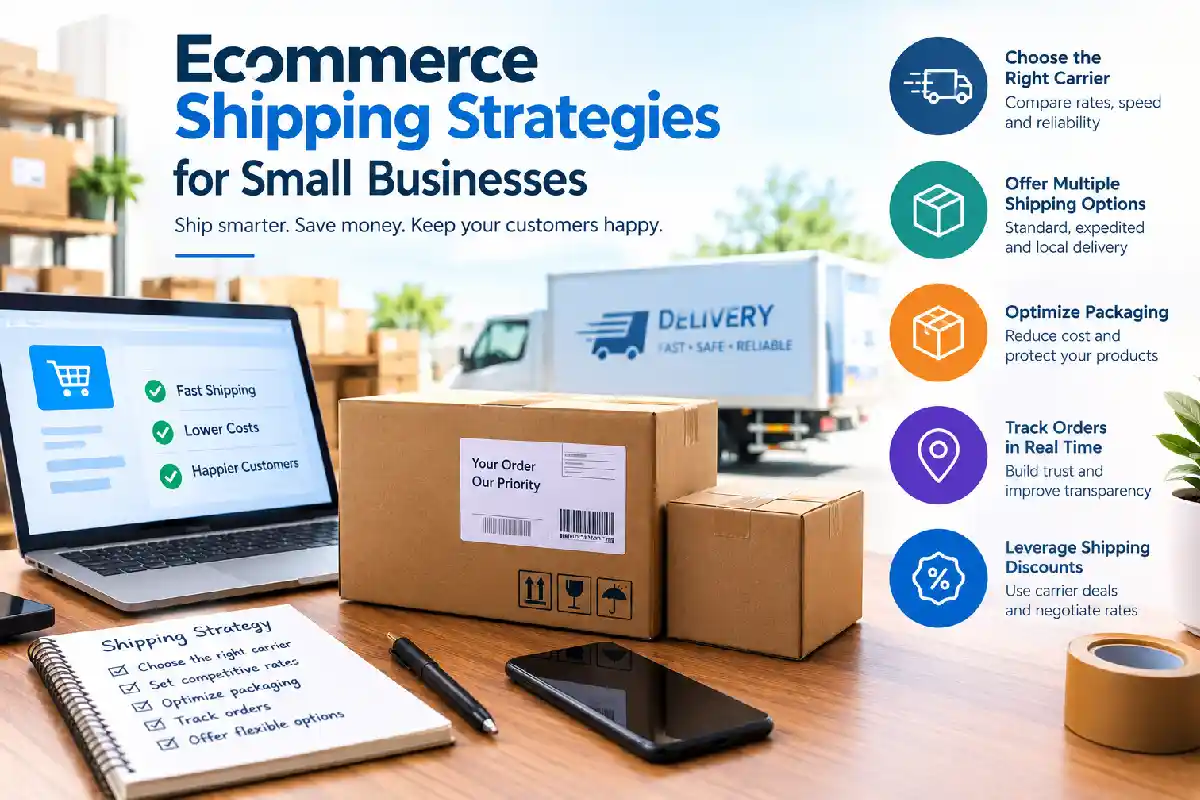
Ecommerce Shipping Strategies for Small Businesses
Last Updated: September 16, 2026
Shipping Strategies. It’s definitely far more than just getting a customer’s order out the door of your store and into the postal system. When it comes to small e-commerce businesses, a smart shipping strategy is one way to cut down costs, boost profit margins, reduce cart abandonment, and improve customer experience.
What you want is an effective strategy that balances: cost of shipping, time of delivery, reliability of carriers, packaging, and how your customer expects things to be done. You certainly don’t need any fancy systems to implement this effectively; even a small enterprise can develop great shipping through awareness of their products, customers, and available shipping partners.
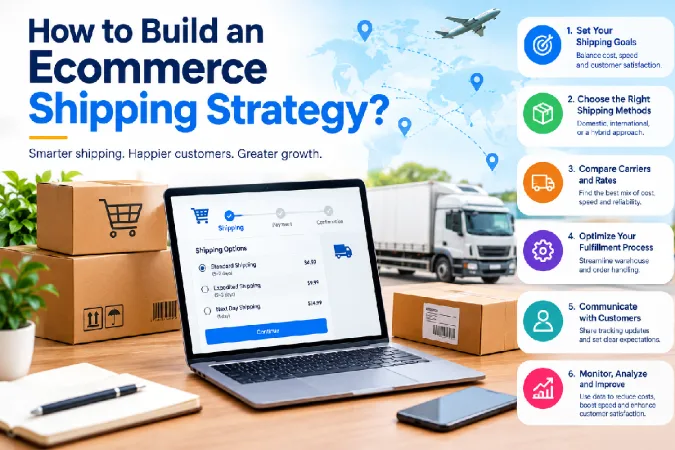
How to Build an Ecommerce Shipping Strategy?
First, you need to be aware of the product(s) that you will ship and the destination of the customers, so the product dimensions and weight, destination, value, and speed can affect shipping price. Before you make a decision you may check your former shipping order records or estimated typical delivery order. Look at the general dimensions of a package, the average value per delivery order, and the frequent destinations of the deliveries.
Key Elements of a Shipping Strategy
| Factor | What to Consider |
| Product size | Small, medium, oversized, or irregular |
| Product weight | Lightweight or heavy products |
| Delivery locations | Local, national, or international |
| Delivery speed | Standard, expedited, or same-day |
| Packaging | Boxes, mailers, protective materials |
| Shipping costs | Carrier charges and additional fees |
| Returns | Cost and process for returned products |
| Tracking | Whether customers receive tracking updates |
Then determine which shipping methods your business will accept payments for. Some businesses may begin by offering a standard shipping method, and may add rush delivery as your business and customer base increase.
Develop clear shipping time policies and shipping region policies, including policies for damaged packages and returned merchandise. Make these policies accessible on your website so customers will be able to view your policies.
Free Shipping vs Flat-Rate Shipping
Customers find free shipping appealing, but really someone is taking care of this shipment. Business owners usually make it free from their end by including all or partial shipping costs into a product price or business profit.
Fixed rate implies that any customer’s order is delivered at the same shipping price up to a certain distance.
| Shipping Model | Advantages | Potential Drawbacks |
| Free shipping | Simple and attractive to customers | Business absorbs shipping costs |
| Flat-rate shipping | Predictable for customers and business | May be expensive for some orders |
| Real-time carrier rates | More accurate shipping charges | Checkout can become more complicated |
| Free shipping threshold | Encourages larger orders | Requires careful margin calculations |
| Local delivery | Useful for nearby customers | Requires additional logistics |
When Should You Offer Free Shipping?
Free shipping also performs great when you have a healthy profit margin on your products or if your customers normally order several items at once.
You also commonly see the free shipping threshold. As in, provide free shipping when their total exceeds $X. This can motivate them to add a second product to their order.
Before offering free shipping, get a sense of what it costs you to ship an order compared to your average customer value and profit margins.
When Is Flat-Rate Shipping Better?
Flat-rate shipping can also make sense if you ship products that are roughly the same size and weight. It will greatly simplify the checkout process for the customer since they will know how much they will be charged for shipping without calculating. If one fixed rate will cost about the same for the majority of orders you ship, it simplifies budgeting.
How to Choose Shipping Carriers for Ecommerce?
Your shipping costs and customer satisfaction will vary greatly depending on which carrier you select. Do not simply go with a carrier based on a quoted rate. Consider comparing carriers on price, coverage area, transit times, tracking capabilities, reliability of service, pickup methods, and claims processes.
| Carrier Factor | Why It Matters |
| Shipping price | Directly affects your profit |
| Delivery coverage | Determines where you can sell |
| Delivery time | Influences customer satisfaction |
| Tracking | Helps customers monitor orders |
| Pickup service | Saves time for businesses |
| Reliability | Reduces delays and complaints |
| Insurance | Protects valuable shipments |
| Returns support | Makes reverse logistics easier |
Small businesses can also compare and balance different carriers instead of having to rely on one. A different carrier may provide better rates locally compared to shipping long distances and internationally.
Test any carrier chosen with a few small deliveries before full use. Pay close attention to on-time delivery, damaged packages, and customer complaints, as well as how much is actually being spent.
How to Calculate Ecommerce Shipping Rates?
There is a fine line between losing a substantial amount of money with every package you ship out by miscalculating shipping charges and ensuring a small profit on each and every one: a flat rate for shipping. A simplistic example of shipping calculations includes:
Shipping Rate=Carrier Charge + Packaging cost +Handling fee+ Extra charge:
| Cost Component | Example |
| Carrier charge | $6.00 |
| Packaging | $1.00 |
| Handling | $0.50 |
| Additional fees | $0.50 |
| Total shipping cost | $8.00 |
Actual charges differ and depend on the carrier, destination, size, weight of the package, type of service selected, etc
Important Shipping Cost Factors
Real weight: the actual weight of the package.
Dimensional weight: some carriers base shipping on the package dimensions rather than on the physical weight of the package.
Destination: shipping to somewhere local costs more than shipping all over the country and then shipping worldwide.
Package dimensions: large packaging may increase costs if even though the item within is lighter than it could be.
Speed of delivery: faster shipping services cost more than ground or postal delivery.
Surcharges: fuel surcharges, residential delivery surcharges, remote-area surcharges, and others may apply and influence the cost of your shipment.
You should be doing the calculation for your average cost of shipping per package frequently. If shipping costs are too high, adjust your product prices, packaging choices, carrier selection, or your shipping policy.
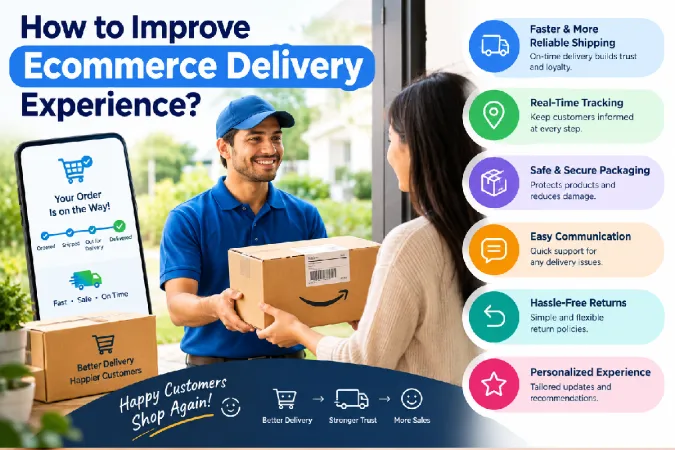
How to Improve Ecommerce Delivery Experience?
Ecommerce Delivery Experience. Not only do customers appreciate receiving their parcel. They also want to know how and where their order is located.
A fully transparent delivery process can reduce customer queries and establish greater trust.
1. Communicate realistic delivery estimates
Do not make delivery promises your business or courier cannot live up to! Give customers a reasonable shipping window. For example, “Est. Delivery: 3-5 business days” is likely to be more convenient than just offering ‘fast shipping’.
2. Let customers track orders
With tracking, your customers are able to find out where their purchase is located without having to bother the customer service department. Tracking numbers should be delivered the moment the packages are received by the courier.
3. Use appropriate packaging
Using proper packaging will ensure that your package isn’t damaged during transit. The size, weight, fragility, and shape of your item will factor in when deciding what to package your item in.
| Product Type | Suitable Packaging Approach |
| Clothing | Poly mailer or lightweight box |
| Cosmetics | Protective box with cushioning |
| Electronics | Sturdy box with protective padding |
| Glass products | Strong box and cushioning |
| Books | Rigid mailer or protective box |
Just don’t over-package; sending big boxes, which will result in dimensional shipping costs as well as waste resources, is not the way.
4. Transparent Delays
In unforeseen circumstances such as extreme weather, carrier mistakes, holidays, customs issues, or a mistaken customer delivery address, there will surely be delivery delays. Let the customer know; don’t keep them waiting in the dark.
5. Offer easy returns
Offer a clear policy for returns, which will make customers more comfortable making future purchases. Detail the shipping cost of returns and the returns procedure.
Ecommerce Shipping Strategy Checklist
When you are implementing, setting up, or reviewing your shipping system, use this checklist to:
| Task | Priority |
| Calculate average shipping costs | High |
| Measure products and packages accurately | High |
| Compare multiple carriers | High |
| Select standard shipping options | High |
| Decide between free and paid shipping | High |
| Set a free shipping threshold if appropriate | Medium |
| Provide tracking information | High |
| Create a shipping and returns policy | High |
| Review damaged and delayed shipments | Medium |
| Monitor shipping costs regularly | High |
Final Thoughts
So, it’s clear there’s nothing inherently complex about an e-commerce shipping strategy. The core considerations-knowing your products, knowing your actual shipping costs, comparing shipping carriers, and offering a pricing model that secures your margins-are the key to getting shipping right. For most small e-commerce businesses, a combination of reputable standard shipping, clear delivery estimations, real-time tracking, reasonable shipping and packaging options, and a well-considered free-shipping or flat-rate offer works best.
As your business grows and evolves, consistently examine your shipping data and use that information to not only trim costs by negotiating lower carrier rates, improving packaging, or shortening delivery times but to streamline your return process as well.
That’s how your e-commerce shipping strategy will progress from a simple cost center to a legitimate competitive advantage.