

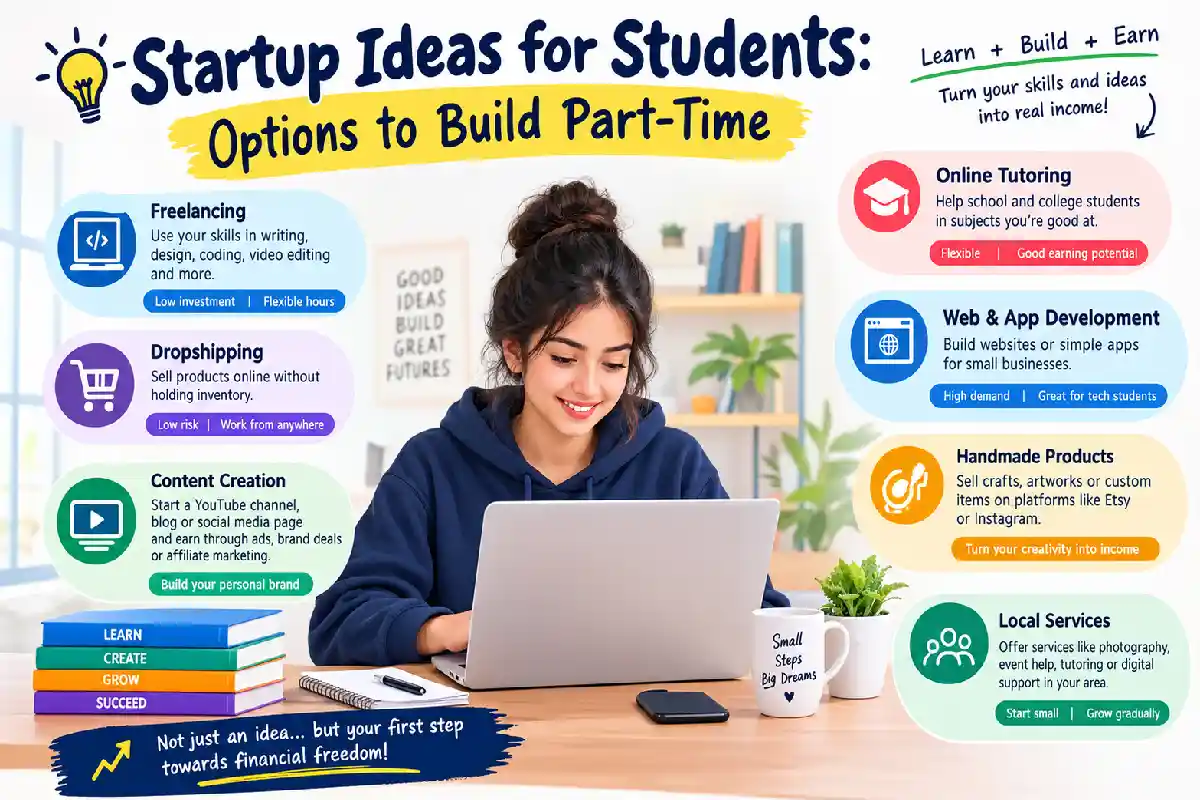
Startup Ideas for Students: Options to Build Part-Time
Last Updated: September 23, 2026
Studying entrepreneurship has the advantage of enabling students to set up a business while they are still studying in order to learn entrepreneurial skills, to earn some extra money, to build a track record and understand how customers and markets function. Students benefit from a number of ideal testing environments such as University campuses, University societies, clubs, social networks and the Internet.
The difficulty is certainly managing a startup along with courses, exams, assignments and other business. An ideal student business should be flexible, cheap to try out and simple enough to operate on nights and weekends.
Instead of trying to start a big company right away, students should start with a small proposal, identify a few customers, gather feedback and go into a phase of incremental development if the idea proves feasible.
Choose an Idea Around Your Skills and Study Schedule
The best startup idea for a student is not really the fashionable one. It should be suitable to your current skills, free time, financial resources and studies.
Start by listing skills you already have. These might include:
- Writing and editing
- Graphic design
- Photography or video editing
- Coding and web development
- Social media management
- Tutoring
- Research
- Presentation design
- Foreign languages
- Data analysis
- Sales and communication
- Event organization
Next, think about which tasks are feasible for you to do. For example, a student with an hour just once a week has a different, less promising business model than one with many hours an afternoon.
Service businesses tend to be very adaptable as you can choose how many customers you take on. Digital products may work well as they can often be produced around your university timetable, and be marketed repeatedly.
Try to steer clear of business models which demand your full time availability if your scheduling is a bit erratic. i.e. a service which claims it responds to your customers all day could be a disaster if you need to go into a few days during your exams.
A useful starting question is:
“With one skill I already possess, what problem can I solve for people I can easily identify.”
This method can also cut down on firm entry costs and the associated learning intensity.
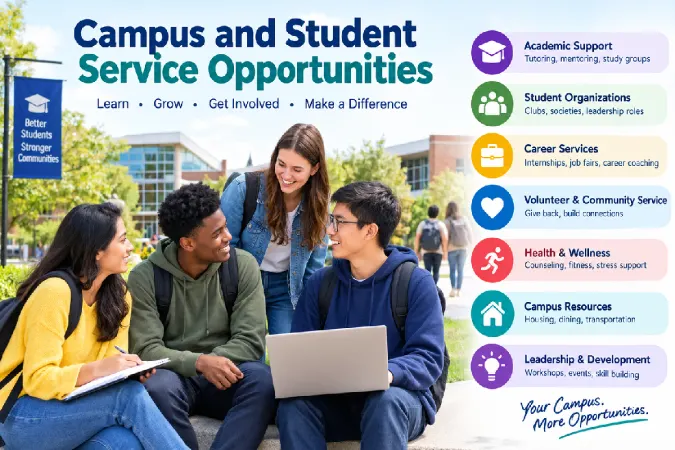
Campus and Student Service Opportunities
A campus of a university or college may be a good test site to evaluate a new business idea that the students have comparable needs.
Tutoring
Students who perform well in a particular subject can offer tutoring to classmates or students in lower academic years.
Tutoring can be offered individually, in small groups, or online. The business can begin with one subject and expand based on demand.
Student Notes and Study Resources
Students often look for organized revision materials, study planners, flashcards, templates, and other educational resources.
Any materials should be original and comply with institutional rules and copyright requirements. The goal is to create useful study aids rather than redistribute protected course materials.
Photography and Video Services
Students with photography or video skills can provide services for campus events, clubs, student organizations, graduation celebrations, or small businesses.
A basic portfolio can be created from existing projects before investing in additional equipment.
Event Support
Student clubs and organizations frequently hold workshops, competitions, conferences, cultural events, and social opportunities an organized individual could work with logistics, registration, taking photographs, designing fliers or working with Facebook.
Resume and Presentation Assistance
JOB PREPARATION Assistance needed for resumes, presentations, portfolios or professional profiles for students interested in internships or entry level jobs.
Not solely on the number of words. The emphasis should be on editing, formatting, organization and presentation of the work and not making unsubstantiated statements about the student‘s abilities.
Campus Convenience Services
Simple convenience businesses can also address everyday student problems. Examples include:
- Errand assistance
- Moving or packing help
- Laundry coordination
- Printing and document services
- Club merchandise coordination
- Basic technology setup
- Student-focused delivery or pickup services
Before starting any physical campus service, check campus policies, permissions, and applicable local requirements.
Online Services and Digital Product Ideas
Online businesses can allow students to work with customers outside their campus and potentially continue after graduation.
Freelance Writing
Freelance Writing
Skilled writers can produce blog articles, website pages, newsletters, product descriptions or social media writes.
It makes marketing easier when you stick to a niche. For example, a student may select content aimed at local businesses, technology companies, education vendors, or online stores.
Social Media Management
Small organizations require support in producing posts, scheduling content, answering simple queries, and tracking interaction.
The student might begin with one or two clients, and develop a repeatable process to handle the work without taking on too much.
Graphic Design
An individual that’s experienced with design applications is capable of creating graphics for social media, slides for presentations, posters, thumbnails, flyers, and simple brand graphics.
You should prepare a portfolio that better emphasizes your recommendations as opposed to just telling what you are talented in, so prepare several sample projects to show the kind of work you wanted to offer.
Website and No-Code Services
Students with technical skills can build simple websites, landing pages, booking pages, or online stores for small businesses and professionals.
No-code tools can reduce development time for certain projects, although students should still understand the platform’s limitations and ongoing costs.
Digital Templates
Templates can include:
- Budget spreadsheets
- Study planners
- Project management templates
- Presentation templates
- Resume templates
- Social media calendars
- Business checklists
- Notion or productivity templates
The advantage of digital products is that they can potentially be sold multiple times without requiring the founder to recreate the product for every customer.
Online Courses and Tutorials
A student with strong knowledge in a particular subject or practical skill can create tutorials, workshops, or short courses.
Instead of producing a large course immediately, consider testing a small paid workshop or introductory resource first. Customer questions can help determine what should be included in a larger product.
Micro-SaaS and Small Software Tools
Students studying computer science or related fields can experiment with small software products that solve specific problems.
Examples include scheduling tools, calculators, productivity utilities, reporting dashboards, or niche workflow applications.
The key is to start with a narrow problem. Building a small tool for a clearly defined audience can be more manageable than attempting to create a broad platform.
Plan Time, Costs and a Small First Offer
A student startup should fit around education rather than automatically competing with it.
Start by calculating how much time you can realistically dedicate each week. Then divide that time between finding customers, delivering the service, improving the product, and administration.

A simple weekly schedule might look like:
| Activity | Example Weekly Allocation |
| Customer work | 3 hours |
| Marketing/outreach | 1 hour |
| Product development | 1 hour |
| Administration | 30 minutes |
| Learning/improvement | 30 minutes |
The exact allocation will depend on your course load and business model.
You should also calculate startup and recurring costs. Potential expenses include:
- Domain and website hosting
- Software subscriptions
- Design tools
- Payment processing
- Advertising
- Equipment
- Transportation
- Business registration or professional services where applicable
Do not assume that every expense is necessary from day one.
Create a Small First Offer
Instead of launching ten products or services, create one simple offer.
For example:
Instead of:
“I provide complete digital marketing services.”
Try:
“I will create and schedule 12 social media posts for a small business each month.”
A clearly defined offer makes it easier to explain your value, calculate your price, and deliver consistent results.
The same principle applies to digital products. Rather than spending months creating a comprehensive course, test a small workshop, guide, or template first.
The first objective is validation, not perfection.
Assess Whether an Idea Can Grow Beyond Campus
A campus-based business can be an excellent starting point, but students should consider whether the opportunity can continue after graduation.
Ask yourself:
Does the problem exist outside my campus?
If you provide resume assistance to classmates, for example, the broader market could include job seekers, graduates, career changers, and professionals.
Can the service be delivered online?
An online delivery model can make it easier to serve customers in other locations.
Can I create repeatable processes?
A business becomes easier to scale when tasks can be documented, standardized, automated, or delegated.
Can the product be sold repeatedly?
Digital products, subscriptions, software, courses, and templates may have greater potential for repeat sales than services that require the founder to personally perform every task.
Is there an identifiable target customer segment?
It‘s much easier to grow a business when you actually know who has the problem and is willing to pay for a solution.
For instance, consider a student who starts out creating posters for university clubs – he might progress to working for schools, event organizers, local companies, and even websites.
Final Thoughts
Getting into student entrepreneurship doesn´t take any big investments or solid business plan. A good way to start is a small problem, a wellknown skill and people that you have access to.
Testing through campus services can be a safe and feasible way, but online services and digital products can open up new opportunities outside of campus. The key is to make it small enough that the business activity does not hinder the stud…
Select an idea that you are capable of executing with the type of availability you have, put together an easily managed initial offer, record your costs and time, and get feedback from actual customers. If the idea takes hold you can build up the offering, grow the customer base, and set the stage for a larger enterprise after college.