

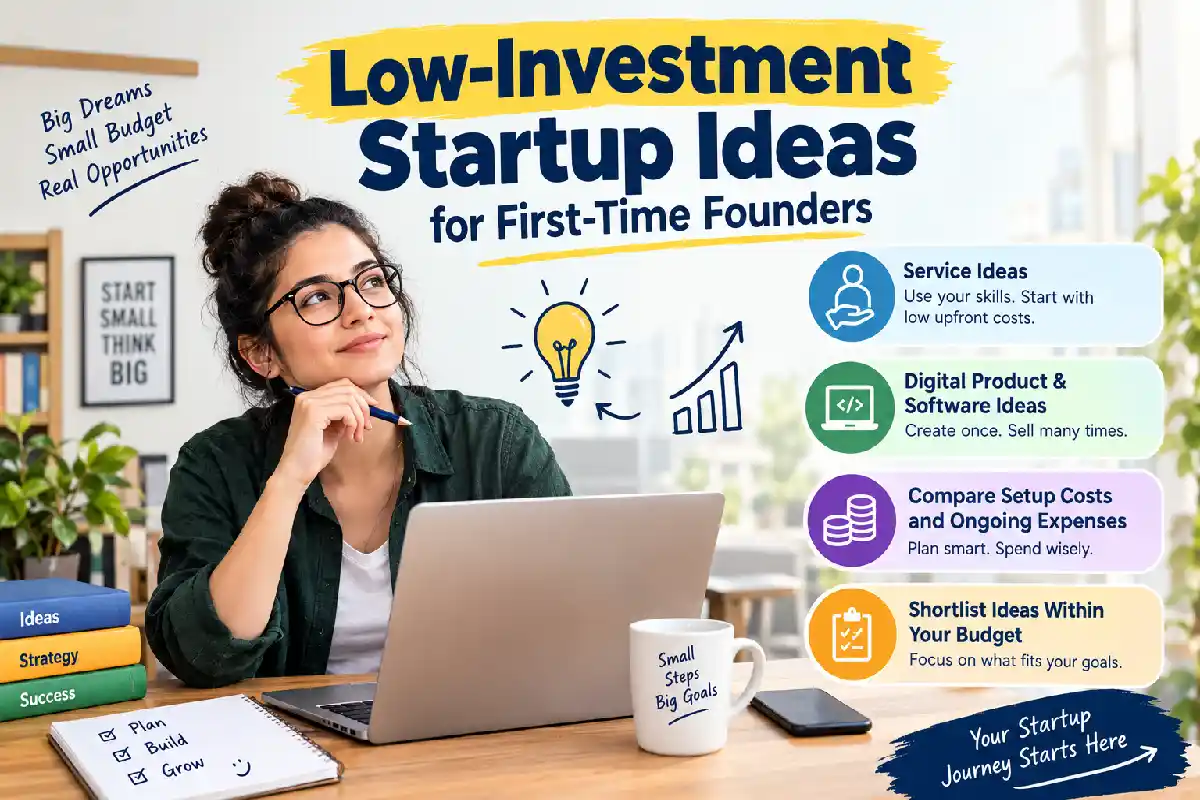
Low-Investment Startup Ideas for First-Time Founders
Last Updated: September 23, 2026
Beginnings can be taken with nothing more than a laptop, an Internet connection, and a specific skill set at one‘s fingertips. They certainly don‘t require a big lump of ready cash, a bricks-and-mortar office, and a whole team of staff.
The trick is to take on a sort of startup where the first costs are not astronomical and customers can be reached without requiring a huge amount of physical infrastructure. Services, ebooks, consulting, online learning, software tools or specialty ecommerce models are where to look.
But “low investment” does not imply “no investment”. Founders will still face the issues of technology, marketing, registration, tools, gaining users, and their own time. The objective should be minimize non-essential high costs upfront and build demand elasticity before financially investing further.
What do we consider a low-investment startup?
A low-investment startup refers to a firm that has little to no need for a large capital investment such as stocking inventory, renting premises and machinery, hiring staff or other fixed assets.
The actual investment will vary depending on your type of business and your location. For example a consulting business may only need to invest in a computer and some professional tools for building websites, whereas a digital product business could need funds for design, development, hosting and marketing.
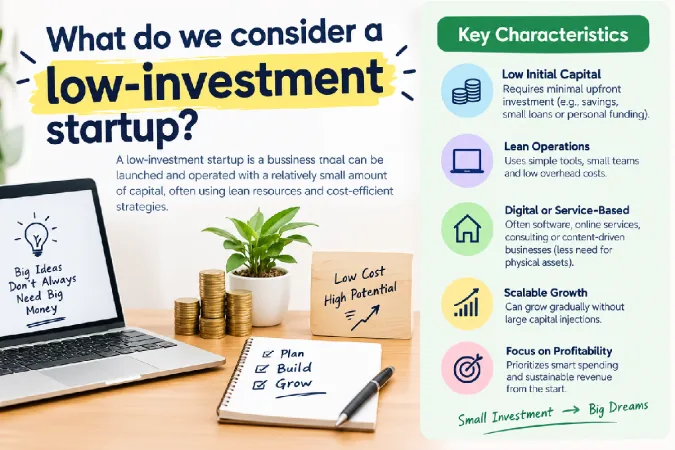
Several characteristics commonly define low-investment startups:
The initial investment in equipment is low: Equipment you may already have or tools you can acquire for a small expense.
Storage constraints: preferably digital products, one-off Production or sales without stock.
Low fixed overhead: The company doesn‘t require costly office or retail space.
Flexible staffing: initially, the founder is able to manage all critical functions alone.
Online customer acquisition: Websites, social media, search engines, marketplaces, and e-mail channels are much more easier accessible avenues.
Scalable delivery: The business can cater to more clients without costs growing as fast as revenue.
Another simple distinction can be between startup costs and operating costs. Startup costs are all those costs associated with starting the organization (branding, website creation, licenses, equipment, initial marketing, etc). Operating costs are other costs of the business, such as software, advertising, payment processing fees, hosting, contractors, and accounting.
Before choosing an idea, estimate both categories. A business that costs very little to launch but has high monthly expenses may require more capital than expected.
Service Ideas with Low Upfront Costs
Service businesses can be especially appealing to new entrepreneurs because they don’t require parent manufacturing, inventory storage costs, markups or setting up production facilities. Instead, the business owner offers a fee, time, ideas, or some unique result.
Freelance Digital Marketing
The business requires assistance with search engine optimization, social media, paid advertising, content writing, and other fields. Someone with experience in this domain can start the implementation by providing a niche service to a certain category of clients.
For example, rather than offering “digital marketing for everyone”, a new agency could specifically focus on SEO services for local restaurants, social media management for small ecommerce brands, etc.
Content Writing and Copywriting
Writing services can be started with minimal equipment. Potential offerings include blog articles, website copy, product descriptions, newsletters, and sales pages.
Specialization can make the business easier to position. A writer who understands a particular industry may be able to offer more valuable expertise than a general-purpose writing service.
Graphic and Presentation Design
Businesses regularly need logos, social media graphics, presentations, advertisements, brochures, and other visual assets. Designers can use existing design software and online portfolios to attract their first customers.
Virtual Assistance
Virtual assistants support companies and entrepreneurs by handling general administration tasks including answering calls, scheduling appointments, providing customer service, researching, inputting data, managing emails and preparing reports.
There might not even be a requirement for the physical infrastructure as the work can
Since the work can be distributed over the Internet, the physical infrastructure may not even be required.
Consulting and Coaching
Individuals withprofessional experience can translate their knowledge intodesign consulting, coaching, training, or workshops.
One of the most effective strategies is to target the end-result (the outcome) rather than selling hours. For instance, instead of selling consulting, you could be selling a30-day ecommerce conversion audit.
Website Development
Founders with coding or no-code skills can build websites for small businesses, professionals, and organizations. Starting with a narrow service—such as landing pages or small business websites—can make the initial offering easier to sell and deliver.
The advantage of many service startups is that revenue can arrive before substantial investment is required. However, founders should account for the value of their own time and avoid taking on more work than they can reliably deliver.
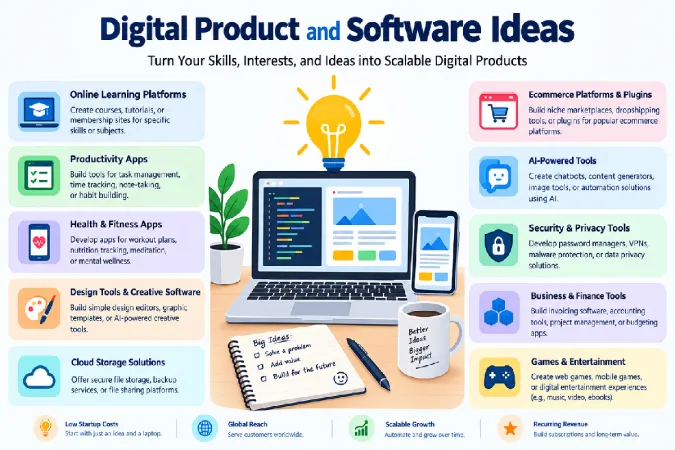
Digital Product and Software Ideas
Digital businesses can offer another low-investment path because digital products can often be created once and sold repeatedly.
Templates and Digital Downloads
Templates for spreadsheets, presentations, business documents, project management, budgeting, marketing, or social media can be sold through online platforms or a founder’s own website.
The main investment is generally the creator’s time, although design, platform, payment, and marketing costs should also be considered.
Online Courses
A founder with specialized knowledge can create an online course around a specific skill or problem.
Rather than building an enormous course immediately, consider creating a focused introductory product. Customer feedback can then guide future modules and improvements.
Paid Guides and Educational Resources
Ebooks, checklists, industry reports, tutorials, and specialized resource libraries can become digital products when they solve a specific problem for a defined audience.
The strongest opportunities are usually based on genuine customer needs rather than simply turning general information into a downloadable document.
Micro-SaaS
Micro-SaaS refers to small software products designed to solve a narrow business problem. Examples might include appointment tools, reporting dashboards, calculators, workflow utilities, or specialized integrations.
A first-time founder does not necessarily need to build a huge software platform. A narrowly defined tool can be easier to develop, test, market, and maintain.
No-code and low-code platforms can also reduce development requirements for certain applications. However, founders should still budget for hosting, software subscriptions, maintenance, security, customer support, and future development.
Paid Communities and Memberships
A membership business can provide access to educational resources, professional communities, research, templates, events, or other recurring benefits.
The challenge is that customers generally expect continuing value. A membership should therefore have a clear reason for customers to remain subscribed rather than simply pay once.
Compare Setup Costs and Ongoing Expenses
Choosing a startup based only on its launch price can be misleading. A better approach is to calculate both initial and recurring costs.
Consider these categories:
| Cost Category | Examples |
| Equipment | Laptop, camera, microphone, specialized tools |
| Software | Design, accounting, CRM, productivity, development |
| Website | Domain, hosting, ecommerce platform |
| Marketing | Advertising, content, email marketing, promotions |
| Professional services | Accounting, legal, consulting |
| Operations | Contractors, fulfillment, customer support |
| Payments | Transaction and payment-processing fees |
| Education | Courses, certifications, books, research |
For example, a service business might have relatively low startup costs but require significant founder time. A software startup may have higher development costs but potentially lower delivery costs per additional customer.
A simple cost calculation can help:
First-year cost = Initial setup costs + 12 months of recurring expenses + estimated variable costs
Then compare this with your available startup capital.
It is also useful to separate essential expenses from optional expenses. A founder may need a domain, business email, accounting system, and basic website. A premium office, expensive branding package, or advanced software subscription may be unnecessary during the validation stage.
Keeping initial expenses low gives you more time to discover whether customers actually want the product or service.
Shortlist Ideas Within Your Budget
Once you have several potential ideas, narrow the list using practical criteria rather than choosing based solely on excitement.
1. Set a Maximum Starting Budget
Decide how much money you are comfortable putting into the experiment. Keep personal living expenses and an emergency reserve separate from business capital.
2. Identify Your Existing Advantages
Consider your skills, professional experience, network, equipment, audience, and industry knowledge.
An idea that fits your existing capabilities may require less money to launch than one that requires you to acquire entirely new skills.
3. Estimate the First Customer Cost
Think about how customers will find you If the advertising of your business costs a lot for each customer gained, this small initial budget could quickly be exhausted.
While rules as well as policies of certain channels and platforms will limit the options, service businesses can start utilizing networking, referrals, communities of professionals, content marketing, or direct outreach.
4. Calculate Break-Even Requirements
Calculate how many customers you will need to recoup your initail investment.
Let‘s say you have a $1,000 startup cost and you make $250 in gross profit per customer (before any other fixed costs). In this case, you would need four customers to recover your initial investment.
5. Test Before Scaling
Don‘t pour a large purchase until you see the signal of demand. Create a minimum viable proposition, talk to potential customers, create a bare bones landing page, or sell a first version of the product.
Customer responses will tell you if you need to change your price, positioning, offering and target market.
6. Keep a Cash Buffer
Do not have to use whole budget available at a launch. Unexpected needs are frequent and spare cash allows you to be more responsive to customer.
7. Create a Shortlist
Your final shortlist might contain three to five ideas. For each one, record:
- Estimated startup cost
- Monthly operating cost
- Required skills
- Time to first sale
- Target customer
- Expected pricing
- Customer acquisition method
- Scalability potential
- Major risks
- First validation experiment
The objective is not to find an idea that is completely risk-free. Every business involves uncertainty. Instead, seek to find opportunities where you can test the most vital assumptions and do so without risking a lot of money.
Final Thoughts
First-time entrepreneurs at low-investment startups can explore entrepreneurship without taking on too much financial risk. For service providers, it utilizes your skills with the potential to scale into repeatable revenue streams for lower risk.
Perhaps the most critical bit is to distinguish between the notion and the amount of investment necessary to validate it. There‘s no need to execute a full business on day one. Begin with the minimum credible version, define a clear customer issue, validate willingness to pay, and based upon that determine which areas are worth further investment.