

How to Choose a Startup Idea: A Scoring Framework
Last Updated: September 24, 2026
Selecting a startup idea becomes more straightforward when you rely less on your intuition and more on a well thought-out assessment. budding entrepreneurs can conceive a lot of ideas but face difficulty in assessing which ones are worth investing in, in terms of time, money and effort.
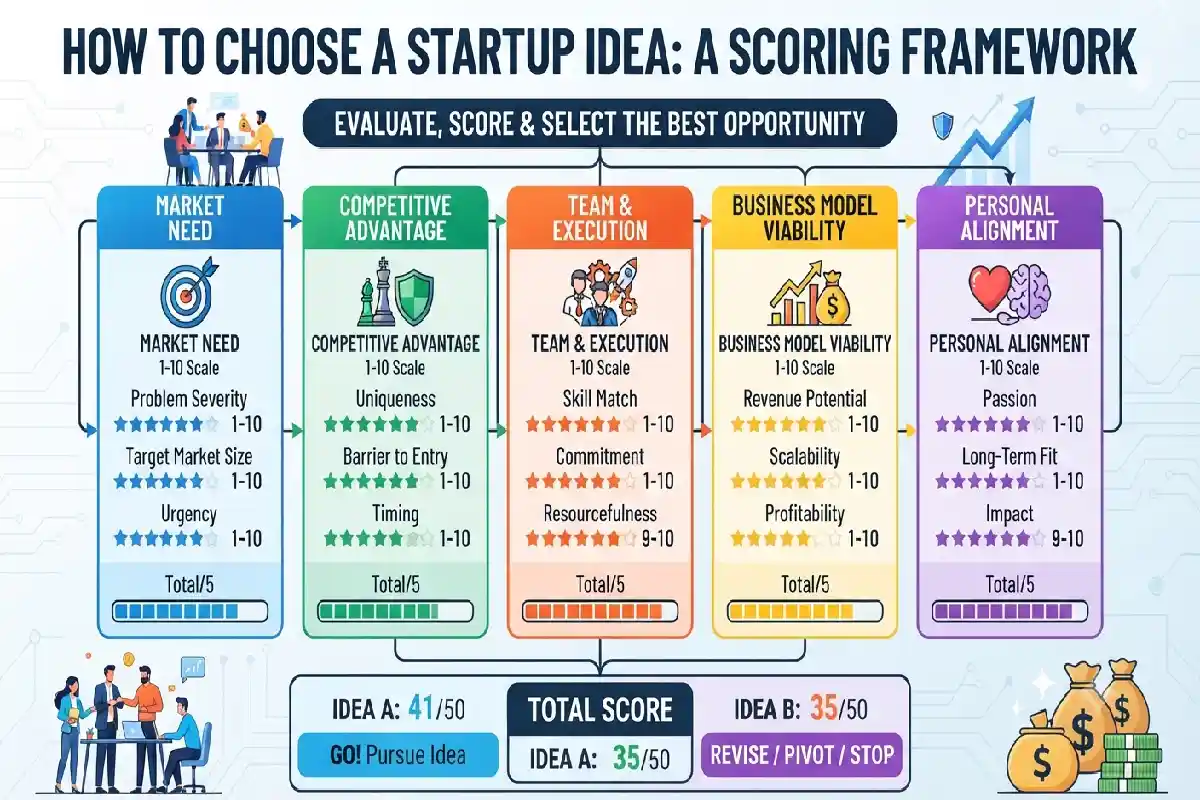
A scoring framework can make nebulous ideas tangible by assigning different weighed factors in assessing opportunities. This replaces” Is this a good idea “by measuring each out in terms of:
We don‘t seek a great idea that will get a perfect score on paper. We want only a few great ideas, promising enough to test on actual customers.
Set Your Personal and Business Constraints
Before scoring individual startup ideas, establish your boundaries. A business idea that requires $100,000 in funding may be unrealistic if you have a $5,000 starting budget. Similarly, a business requiring full-time attention may not work if you can only dedicate evenings and weekends.

Consider your personal constraints first:
- How much money can you invest?
- How much time can you commit?
- Do you need immediate income?
- Are you comfortable with financial risk?
- Do you want a local, online, or location-independent business?
- What industries or customer groups do you understand?
- Do you want to build a lifestyle business or pursue rapid growth?
Finally, think about constraints related to business such as licenses, machinery, staff members, technological needs, stockpiles and legislations.
A lot of constraints you may be able to assign a simple score from 1 to 5, such as 1 being poor fit of the idea; 5 being a very good fit.
If your startup budget is 10, 000USD, an idea that costs 50, 000USD should get a very low affordabilty score regardless of the fact that the idea might theoretically generate 999, 999, 999USD in gross rev…
This first filter avoids wasting too much time analyzing those ideas that are not relevant for your situation.
Score Problem Severity and Buyer Access
A startup becomes much easier to build when it solves a problem customers genuinely care about.
Problem severity should therefore be one of the most important parts of your scoring framework.
Ask:
- How frequently does the problem occur?
- How expensive is the problem?
- How much time does it waste?
- What happens if customers do nothing?
- Are customers already paying for an alternative?
- Is the problem becoming more important over time?
A minor inconvenience may generate limited willingness to pay. A problem that costs a business thousands of dollars or causes significant operational disruption may have much stronger commercial potential.
Buyer access is equally important. Even if a problem is serious, reaching the people who experience it can be difficult.
Evaluate how easily you can reach potential customers through:
- Existing professional networks
- Online communities
- Search engines
- Social media
- Industry associations
- Local businesses
- Partnerships
- Cold outreach
- Marketplaces
You can score problem severity and buyer access separately. An idea with a severe problem but extremely difficult customer acquisition may require a different strategy from an idea with moderate demand but easy access to buyers.
Assess Founder Skills and Competitive Advantage
Your ability to execute matters as much as the idea itself. Two founders can evaluate the same market and reach very different results because their skills, networks, and experience are different.
List the capabilities required to make each startup work.
For example, a software startup may require product development, UX design, sales, customer support, and technical maintenance. A consulting business may depend more heavily on industry expertise, communication, relationships, and credibility.
Compare those requirements with your existing capabilities.
Score areas such as:
| Factor | Question |
| Industry knowledge | Do you understand the customer’s problem? |
| Technical skills | Can you build or deliver the solution? |
| Sales ability | Can you reach and convert customers? |
| Network | Do you already know potential buyers or partners? |
| Credibility | Can you establish trust quickly? |
| Unique insight | Do you understand something competitors overlook? |
Competitive advantage does not necessarily mean having a patented technology. It could come from specialized knowledge, a strong distribution channel, a trusted reputation, proprietary data, a valuable network, or a better understanding of a specific customer segment.
A startup idea that closely matches your strengths may be easier to execute than an apparently attractive opportunity that requires capabilities you do not possess.
Compare Cost, Complexity and Revenue Potential
Once you understand the customer problem and your own capabilities, evaluate the economics of each idea.
Start with startup costs. Consider software, equipment, inventory, marketing, professional services, employees, contractors, insurance, and other initial expenses.
Then estimate ongoing operating costs.
A useful framework is:
Startup Cost + Monthly Operating Cost + Delivery Complexity = Execution Burden
An idea with low startup costs but extremely complicated delivery may still be difficult to scale.
Next, consider revenue potential. Ask:
- What could customers realistically pay?
- Is the purchase one-time or recurring?
- How many customers could the market support?
- Can prices increase as value increases?
- Are there opportunities for additional products or services?
Recurring revenue should make financial planning simpler and should not necessarily create a need to automatically consider an idea more favorably. Subscription service requires delivering good value to customers on a sustainable basis.
Another factor to take into account is how scalable the service is. For example a service that requires one employee to service every customer may have a different economics of growth to software that can service thousands of customers in at relatively low cost to delivery.
Score each idea on cost, complexity, revenue opportunity, and scalability. More balanced than a focus on potential sales:
Shortlist Ideas for Customer Validation
After scoring your ideas, resist the temptation to immediately build the product. The next step should be validation.
Choose perhaps three to five ideas with the strongest overall fit and test them with potential customers.
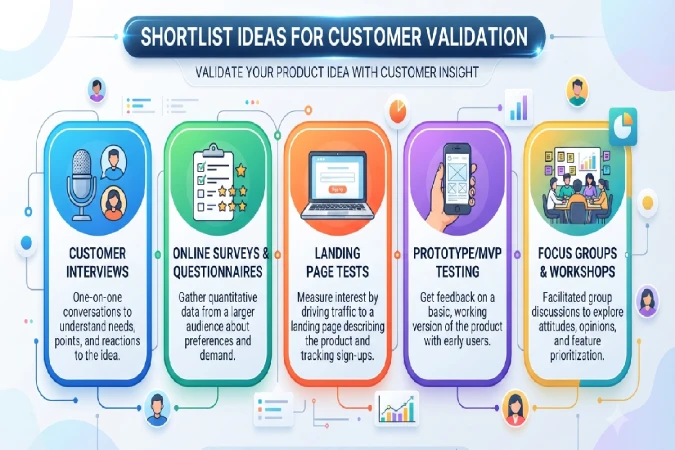
Customer validation can include:
- Interviews
- Surveys
- Landing pages
- Prototype demonstrations
- Pre-orders
- Paid pilot projects
- Consulting engagements
- Manual versions of the proposed service
The objective is to discover whether customers actually experience the problem and whether they are willing to take meaningful action to solve it.
During interviews, avoid asking only whether people “like” your idea. Positive opinions are easy to obtain and do not necessarily translate into purchases.
Instead, ask about existing behavior:
- How do you currently solve this problem?
- How often does it happen?
- What does the current solution cost?
- What do you dislike about the existing approach?
- Who makes the purchasing decision?
- What would make you switch providers?
Actual behavior is generally more useful than hypothetical enthusiasm.
After testing, update your scores based on evidence. An idea that initially looked promising may lose its appeal when customers reveal weak demand. Conversely, a less exciting idea may become more attractive after several buyers demonstrate willingness to pay.
Build a Simple Startup Idea Scorecard
You can combine the framework into a simple scorecard:
| Criterion | Score 1–5 |
| Personal fit | /5 |
| Problem severity | /5 |
| Buyer access | /5 |
| Founder skills | /5 |
| Competitive advantage | /5 |
| Startup cost | /5 |
| Operational simplicity | /5 |
| Revenue potential | /5 |
| Scalability | /5 |
| Customer validation | /5 |
Give each idea a score for every category and add the totals. You can also assign greater weight to factors that matter most to your situation.
For instance, a bootstrapped founder might care more about startup cost and buyer access, whereas a founder building a venture scale tech company might care more about size and scalability.
Keep in mind that the score is only a decision-support device, not an evidence that the concept will work.
Conclusion
Reading your opportunities in order helps simplify the process of coming up with a startup idea. Consider your constraints first, then understand how serious the problem is, and how well you can reach your customers.
Next, think about whether this idea fits you and whether you have any truly significant competitive advantage. Make a comparison of startup expenses, the level of business complexity, ability to generate revenue, and scalability.
Most importantly, bring your best concepts to real customers. The conversations with customers, live pilots, pre-orders, and initial sales that these engagements produce are something no spreadsheet can anticipate.
You can have all the great startup ideas in the world, but the best-to-be-picked one to take to market is the one that passes an array of the toughest possible tests, not necessarily the one that seems juiciest at the start.