

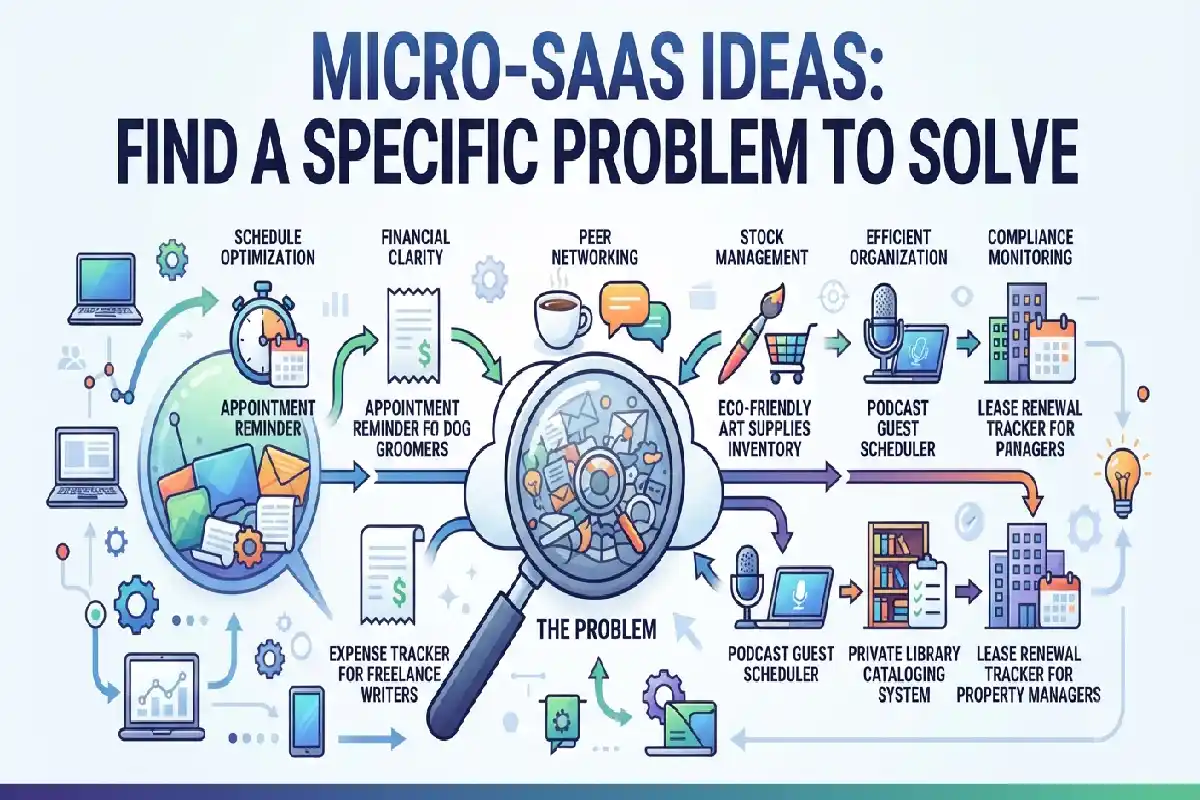
Micro-SaaS Ideas: Find a Specific Problem to Solve
Last Updated: September 23, 2026
Micro-SaaS is often attractive for founders looking to build a dedicated piece of software, without evolving into a huge tech company. As opposed to tackling one of the big players by conquering a massive customer base, a Micro-SaaS business concentrates on a small target group and offers a single, specific solution.
The benefit of this approach is focus. Having fewer customers and use cases makes for an easier software to develop, sell, support and enhance.
But a small product still requires paying customers. The objective should not be “build it because it‘s technically interesting”. A much better idea is “find a recurring problem, learn how your customers deal with it today, and ask yourself whether they will pay for an easier or improved solution”.
What Defines a Business as a Micro-SaaS?
Micro-SaaS is an umbrella term for a small SaaS business that is problem-, customer or workflow focused.
A traditional SaaS company has a broad target audience which can be serviced in a single product, whereas a Micro-SaaS product is far more focused in the scope it covers.
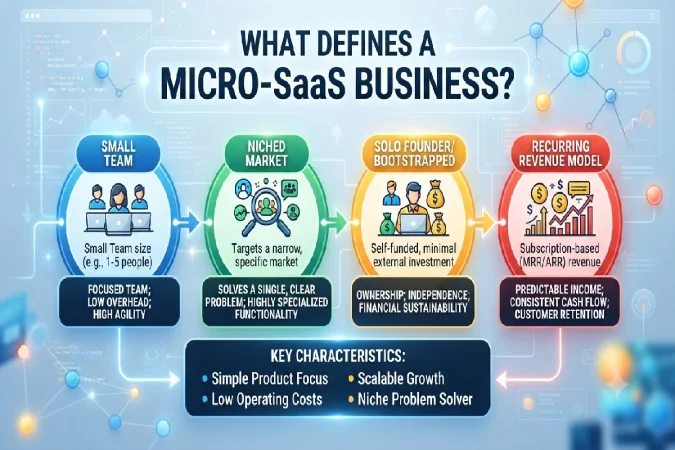
Typical characteristics include:
- A clearly defined target audience
- A focused feature set
- Subscription or recurring revenue
- A small founding team, sometimes just one person
- Relatively low operating overhead
- Online product delivery
- A narrow and specific use case
- Potential for automation and self-service
For example, a general project management platform might serve businesses across many industries. A Micro-SaaS alternative could focus specifically on project status reporting for small marketing agencies.
Another potential example could be an appointment managing system aimed at only one category of professional service provider.
A niche product may offer a workflow, integration, report or automation that a broader platform may not.
Find Gaps in Existing Software Workflows
The best approach to finding Micro-SaaS opportunities, perhaps, is to think about software that people already use.
Instead of asking, “What new app should I build?” ask:
What more frustrating task still remains after users buy the same software they use?”
Many applications are used together in a business. Data needs to be transferred from one system to another, reports may need to be generated manually or alerts handled by people.
The Gaps may offer opportunities here.
Look for Repetitive Manual Tasks
Suppose a company uses a CRM, accounting platform, email system, and spreadsheet. Employees may spend time moving information between them.
A Micro-SaaS product could automate one specific part of that workflow.
Look for Missing Reports
A platform may contain useful data but lack a report that a particular industry needs.
For example, an agency might need a recurring client performance report combining information from several marketing platforms.
Look for Integration Problems
Customers often use multiple tools that do not communicate smoothly.
A small integration product could connect two systems and automate a repetitive process.
Look for Industry-Specific Requirements
Large software companies generally prioritize broad markets. Smaller industries may have specialized requirements that are not adequately served.
A Micro-SaaS founder can potentially build around one of those overlooked workflows.
Study Complaints and Workarounds
Customer reviews, community discussions, support forums, professional groups, and conversations with business owners can reveal recurring frustrations.
Pay particular attention to comments such as:
- “We still have to do this manually.”
- “There is no easy way to…”
- “We export this into a spreadsheet every week.”
- “We use three different tools for this.”
- “The software does not support our workflow.”
These statements can point toward potential product ideas, although each opportunity still needs customer validation.
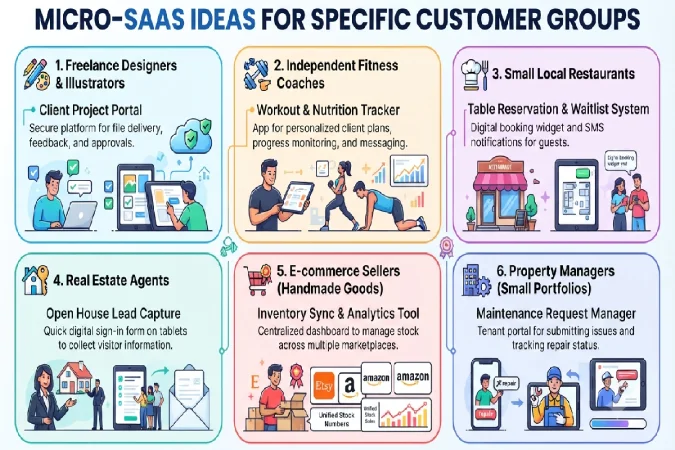
Micro-SaaS Ideas for Specific Customer Groups
The best Micro-SaaS opportunities are often highly specific. Here are several categories worth exploring.
Marketing Agencies
Marketing agencies manage multiple clients, campaigns, platforms, reports, and deadlines.
Potential Micro-SaaS products could include:
- Automated client reporting
- Campaign approval workflows
- Content approval tracking
- Client onboarding systems
- Marketing task reminders
- Cross-platform performance summaries
The key is to solve a narrow agency workflow rather than build another complete project-management platform.
Ecommerce Sellers
Online sellers deal with inventory, orders, returns, product information, customer messages, and marketing.
Potential products could focus on:
- Inventory alerts
- Product data synchronization
- Return tracking
- Margin reporting
- Order exception notifications
- Automated operational reports
Freelancers and Consultants
Independent professionals often need lightweight tools for proposals, onboarding, invoices, project tracking, scheduling, and client communication.
A focused product could automate one repetitive administrative task rather than attempting to replace every tool they use.
Property Managers
Property managers tend to have repetitive daily activities. For example, handle recurring communication, maintenance requests, inspections, paperwork and schedule.
A Micro-SaaS can focus on one particular workflow for example, follow-up after maintenance, reminders of inspections, document traffic.
Recruiters
The recruiters are responsible for supplying candidates, the interview process, correspondence, the job specifications and the funnel of hiring.
Candidate follow-up reminder, interview scheduling, reporting, or Streamlines a specific workflow.
Professional Service Businesses
Accountants, consultants, agencies, advisors, and other professional firms often each have repeatable client workflows.
A targeted product might also be able to automate onboarding, document collection, reminders, status reporting, or ongoing reporting.
The most powerful concepts often seem to come from a close analysis of the work of a single group.
Assess Integrations, Support and Maintenance Needs
Launching the MVP (minimum viable product) of your Micro-SaaS is just the beginning of your business.
Once your customers have started using your software, it‘s on you to keep it dependable.
Integrations
Integrations can make a product much more useful, but they also introduce dependencies.
Before building an integration, consider:
- Does the target platform provide an API?
- What access permissions are required?
- Are there usage limits?
- Could the API change?
- What happens if the external service is unavailable?
- How difficult is authentication?
- Will customers need technical setup?
A product dependent on several third-party platforms may require more maintenance than expected.
Customer Support
Even a simple application can generate support requests.
Customers may need help with:
- Account setup
- Billing
- Integrations
- Permissions
- Data imports
- Errors
- Workflow configuration
Estimate how much support each customer might require. If every account needs personal assistance, the business may behave more like a service company than a highly automated software business.
Maintenance
Software requires ongoing attention.
Potential maintenance activities include:
- Security updates
- Bug fixes
- Infrastructure management
- Database maintenance
- API changes
- Browser compatibility
- Backup systems
- Performance improvements
- Monitoring
A small product should therefore have a deliberately limited feature set.
Every additional feature increases development, testing, documentation, and support requirements.
Data Security
If your software handles customer information, financial records, business documents, employee information, or other sensitive data, security needs to be considered from the beginning.
Use appropriate access controls, secure authentication, encryption where applicable, reliable backups, and clear data-handling practices. Depending on the market and information involved, additional legal or regulatory obligations may apply.
Choose an Idea with a Clear Paying Customer
A technically interesting idea is not automatically a good business opportunity.
Before building, identify exactly who would pay for the product.
Ask:
Who experiences the problem?
Be specific. “Businesses” is too broad. “Small accounting firms with five to twenty employees” is a much more useful starting segment.
What is being done about it now?
They could be using spreadsheets, email, legacy programs, menial manual labor, or a flexible combination of all of these.
What is the present cost of the current solution?
The cost can be monetary but it can also be staff hours, mistakes, delays or lost opportunities.
Who manages the finances?
User may not be the buyer. Find out the buyer: is the adopter an owner, department manager, operations controller, development or other department manager, etc.
How often does the problem happen?
Is a problem you experience every day really more pressing than a once-a-year problem?
What is the customer aiming for?
So the ultimate customer might not even care about the technology, but what they want to achieve. They may need fewer errors, report faster, lower admin costs or better response times to their customers or more visibility.
Validate Before Building
One of the biggest mistakes in Micro-SaaS is spending months developing a product before confirming demand.
Instead, test the idea early.
You can:
- Interview potential customers.
- Demonstrate a simple prototype.
- Create a landing page describing the proposed solution.
- Offer a manual version of the service.
- Ask potential customers about their current workflow.
- Collect expressions of interest.
- Test whether businesses are willing to pay.
A manual service can be particularly useful. If you believe customers need automated reporting, manually create the report for several businesses first. This can help you understand what information matters before investing in automation.
How to Evaluate a Micro-SaaS Idea
Create a simple evaluation framework for each potential idea.
| Factor | Key Question |
| Problem | Is the problem frequent and meaningful? |
| Customer | Can you clearly identify the target buyer? |
| Existing solution | What do customers use today? |
| Willingness to pay | Is there evidence customers will spend money? |
| Competition | How are competitors solving the problem? |
| Development | Can you build a useful first version? |
| Integrations | Does the product depend on external platforms? |
| Support | How much assistance will customers need? |
| Retention | Will customers continue needing the product? |
| Scalability | Can revenue grow without costs increasing equally? |
You do not need perfect answers before testing an idea. The purpose of the framework is to identify assumptions that need validation.
Final Thoughts
This is basically about solving a particular problem for a particular customer segment. It is usually a small product but the customers should find the problem worth paying for to solve.
Identify repetitive tasks, inefficient processes, lack of integrations, manual reports, and industry-specific needs. Understand how prospects are currently solving problems and what will still be a source of frustration.
Next, think about the invisible or behind-the-scenes parts of the business: integrations, security, customer support, maintenance and ongoing infrastructure.
Most of all, know who is paying and do not get too far ahead of yourself. A straight forward product with an obvious customer can be a much better reference point than a sophisticated application looking for a customer.
Start small, prove the problem, do only the core work, and extend when actual customer use confirms what needs to be added.