

Startup Team Structure: Roles for Your First Small Team
Last Updated: September 25, 2026
Starting a startup is not all about a great idea and a great product. Someone has to know the customers, someone has to build and refine the product, someone has to make money, and someone has to keep the books and operations in order. In the first stage, all these roles are played by the founders and a small team.
The difficulty is how to identify who owns what without setting up a hierarchy of nothingness.
An ideal startup team structure will answer five questions. What functions do we need in the business? Who owns those functions? What work stays inside, and what work is outsourced? Who is in charge of each decision? And when will responsibility shift?
Identify the Functions Your Startup Needs
Begin by defining the functions rather than the titles. Not all five-person startups require five separate departments. Think about the work that is required for the business to function.
Most startups need some combination of:
Leadership and strategy: vision, priorities, fund-raising, partnerships and key decisions.
Product: Customer research (eyes on the customer), product roadmap, features and user experience.
Development of the technology: infrastructure, security and technical support
Sales: Generate leads, conduct sales conversations, proposals and close.
Marketing: Positioning, messaging and content, social media and advertising, demand generation.
Operations: Processes suppliers administration and daily operation.
Finance: (Budgeting, book keeping, payments and cash flow and, financial reporting)
Customer support/success: Providing support to customers and collecting feedback from them.
Not every function requires a dedicated employee immediately. One who leads sales & marketing and another over product and technology. Marketing & finance can be initially outsourced.
The trick is to ensure that every important function has an owner to fit the job, even if they are wearing five hats. First hires should be tied to a particular business necessity, not an org chart that sounds good.
Assign Founder Responsibilities Clearly
Not so easy to use where several founders are involved. Don‘t settle for a vague “everyone does everything” approach. While being flexible is good, not knowing who owns what can make of decisions a nightmare.
Distribute responsibilities according the founders skills and experience and level of commitment.
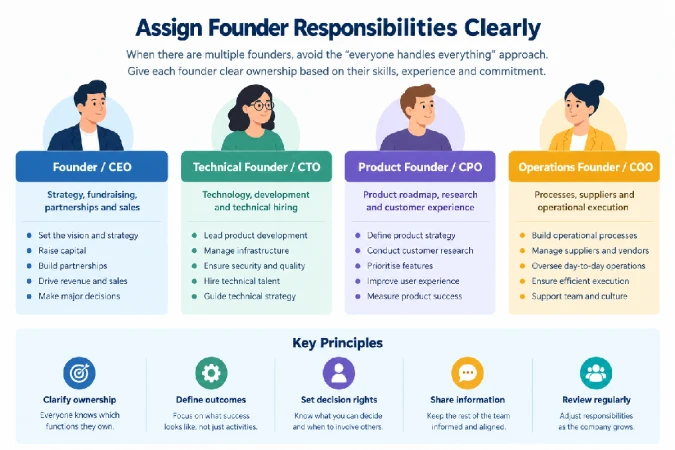
For instance, the following:
| Founder | Primary responsibility |
| Founder/CEO | Strategy, fundraising, partnerships and sales |
| Technical Founder/CTO | Technology, development and technical hiring |
| Product Founder/CPO | Product roadmap, research and customer experience |
| Operations Founder/COO | Processes, suppliers and operational execution |
A two-founder startup might simply have a CEO + technical lead, while another company might divide responsibilities between a commercial founder and an operations/product founder.
Titles are less important than ownership. Each founder should know:
- Which functions they own
- What outcomes they are responsible for
- Which decisions they can make independently
- Which decisions require discussion with other founders
- What information they must communicate to the rest of the team
Major strategic decisions can remain collaborative, while routine decisions should normally have a clearly designated owner. Documenting these responsibilities early can reduce duplicated work and disagreements.
Decide Between Employees, Freelancers and Agencies
Not every capability needs to become a permanent position.
The choice between an employee, freelancer or agency should depend on how important the function is, how frequently the work occurs and whether the knowledge needs to remain inside the company.
Employees
Employees make sense when a responsibility is ongoing and central to the startup.
For example, a SaaS company may eventually need an internal engineer because product development is a continuous core activity. A company whose growth depends heavily on direct sales may similarly need an internal sales team.
Advantages include:
- Long-term ownership
- Greater product and company knowledge
- Easier collaboration
- Stronger integration with company culture
However, employees also create ongoing salary and employment-related costs, so founders should define the role and business need before hiring.
Freelancers
Freelancers can be useful when you need specialized or project-based work without a permanent position.
Examples include:
- Logo and brand design
- Website copywriting
- Video editing
- One-time development tasks
- Market research
- Specialized technical work
A freelancer can fill a temporary capability gap while the founders determine whether the work eventually justifies a full-time hire.
Agencies
Agencies can be appropriate when the startup needs an entire service rather than one individual specialist.
For example, an agency might handle:
- Public relations
- Paid advertising
- Web development
- Specialized SEO
- Recruitment
- Accounting or legal support
The trade-off is that an external provider requires clear briefs, communication and oversight. The startup should still retain internal ownership of the outcome.
A useful rule is: keep strategic, recurring and core capabilities close to the company; outsource specialized or temporary work when doing so is more practical.
Map Decision Rights and Reporting Lines
An org chart should do more than show who reports to whom. It should clarify who can make decisions.
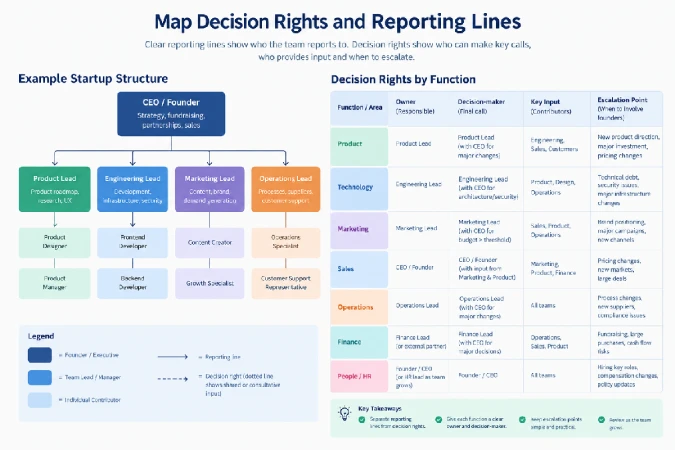
For each important area, identify:
- Owner: Who is accountable?
- Decision-maker: Who makes the final call?
- Contributors: Who provides input?
- Escalation point: When does the decision need founder-level involvement?
For example:
| Decision | Owner | Input |
| Product priorities | Product lead | Engineering, sales, customers |
| Technical architecture | CTO/technical lead | Engineers |
| Marketing campaigns | Marketing owner | Sales, product |
| Customer pricing exceptions | CEO/sales lead | Finance |
| Hiring | Relevant functional lead | Founder/CEO |
This distinction is important because reporting lines and decision rights are not the same thing. A designer might report to a product lead while still having substantial authority over design decisions.
In a very small startup, most employees may report directly to a founder. As the team grows, introducing managers or team leads can reduce the founder’s workload—but additional layers should solve a real coordination problem rather than simply make the company look more established.
Review Roles as the Company Grows
Your first organizational structure should not be permanent.
A structure that works with four people can become inefficient with fifteen. As the company grows, founders should periodically review whether responsibilities are still realistic.
Watch for signs such as:
- One person owns too many unrelated functions.
- Employees regularly ask multiple people for approval.
- Important decisions are repeatedly delayed.
- Founders have become bottlenecks.
- A freelancer is effectively performing a permanent core role.
- A team needs specialized expertise that no current employee has.
- Managers spend more time coordinating than executing.
- Employees are unclear about their priorities.
Growth may eventually justify dedicated functions such as sales, marketing, engineering, finance, HR or customer success. But specialization should follow actual workload and business needs.
For example, an early marketing employee might handle content, email, social media and basic analytics. Later, these responsibilities could split among content, performance marketing and growth specialists.
Similarly, founders may initially manage recruitment themselves. As hiring volume increases, a dedicated recruiting function can become worthwhile.
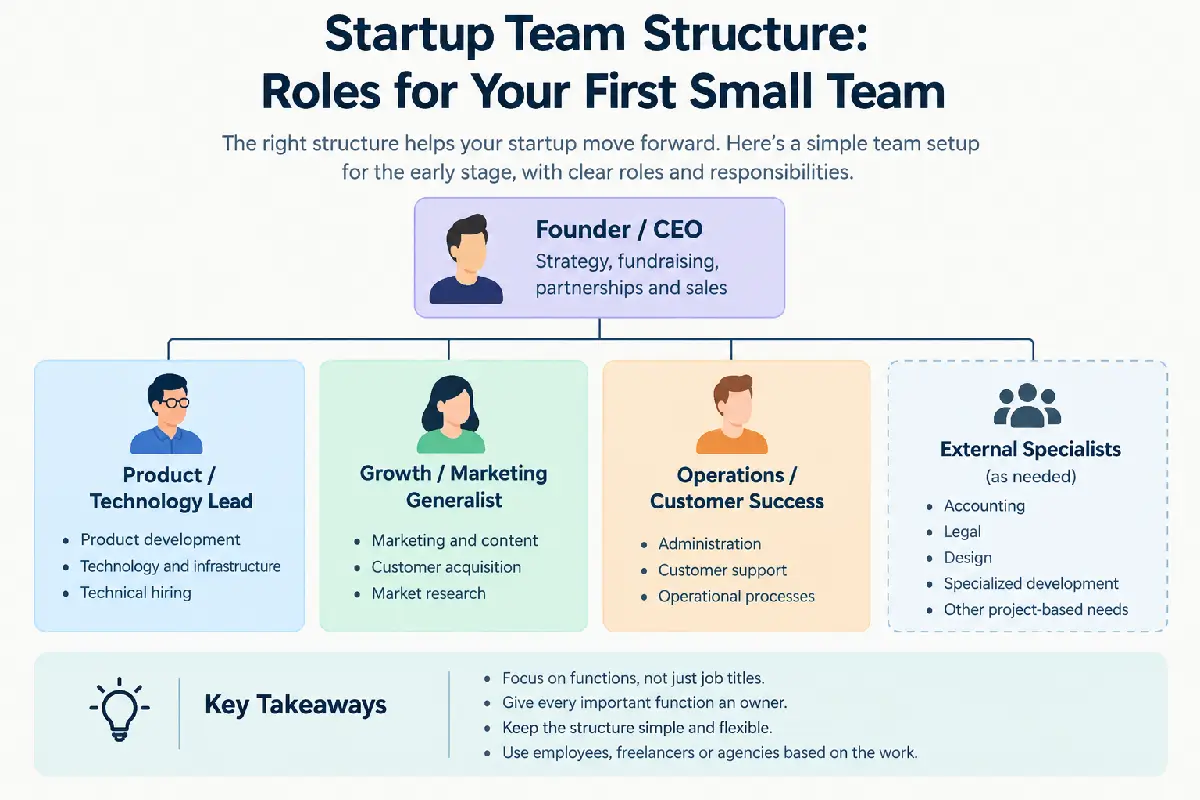
A Simple First-Team Structure
For many small startups, the structure can remain remarkably simple:
Founder/CEO
Strategy, sales, fundraising and partnerships
Product/Technology Lead
Product development, technology and technical execution
Growth/Marketing Generalist
Marketing, content, acquisition and customer research
Operations/Customer Success
Administration, support and operational processes
External specialists
Accounting, legal, design, specialized development or other project-based needs
This is only a starting framework. A technology startup, consulting company, marketplace and consumer brand will require different capabilities.
Conclusion
There is no universally right startup team structure. Simply having the most roles or the greatest hierarchy of titles is not the ideal. The ideal structure is one which facilitates accountability, powers and dialogue while maximizing team flexibility.
First, figure out what functions your business really requires. Assign an owner to each critical function, cover all clear founder stakeholdings explicitly, and utilize employees, freelance workers, or agencies as the tasks command; finally, put processes and decision rights in the most efficient place possible.
As your company matures, most importantly, continually evolve your structure by, for instance, reviewing it once you achieve a significant growth, develop a new product, expands to new markets or repeatedly get confused with ownership.
A small team can do a lot when you‘ve got everyone clear on their possessions, their authority to make decisions and their requirement to call in assistance. That transparency is often more useful at that stage than an intricate organizational diagram.