

Startup Management: Teams, Goals and Daily Operations
Last Updated: September 24, 2026
Startups management is the science of transforming an inception phase startup into a well-structured, self-sufficient and scalable business. Informed and motivated people are not required. Many things are involved in it such as people management, goal setting, resources allocation, process designing, progress monitoring and adapting to volatile environment.
Startups have few resources and very high expectations. Small teams have to take up everything: designing the product, generating sales, supporting customers, marketing, fundraising, hiring staff, running the business. Without management systems in place, even the best teams can become overwhelmed by competing demands and unclear roles.
Good management of the startup build a framework that enables people to work towards the same goals with minimum administrative requirements. You should not aim to make a startup company behave like a big company. But by providing some structure to ensure that everybody all moving in the same direction, you speed to market.
This guide provides an understanding of the basic tenets of startup management such as clarifying founder roles and responsibilities, creating objectives, organising team delivery, establishing repeatable processes, and evaluating performance, risks and resources.
What Startup Management Covers
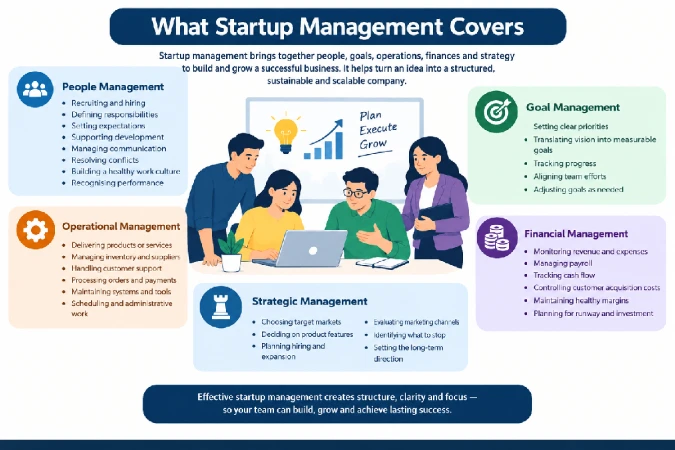
Management of startups is the set of systems, decisions, people, and processes necessary for the operation and scale of an early-stage business. Since startups often pivot, management must be balanced with.
A startup manager or founder may be responsible for several areas at once.
1. People management
People are one of the most important resources in a startup. Management involves:
- Recruiting employees and contractors
- Defining responsibilities
- Setting expectations
- Supporting employee development
- Managing communication
- Resolving conflicts
- Building a healthy working environment
- Recognising strong performance
Early hires can have an especially significant impact because small teams depend heavily on individual contributors.
2. Goal management
A startup needs clear priorities. They are the foundation of any business. Without them, teams are stuck using precious time to go around in circles on actions that are not truly moving things forward.
Management has to be able to elaborate the general vision into concrete achievable goals.
For example, instead of saying:
“We need more customers.”
A startup could establish a goal such as:
“Acquire 500 qualified trial users during the next quarter while maintaining a defined customer acquisition cost.”
Specific goals make it easier to determine what needs to happen and whether the team is making progress.
3. Operational management
Daily operations include the activities required to deliver products or services to customers.
Depending on the business, this might include:
- Processing orders
- Managing inventory
- Responding to customers
- Delivering services
- Maintaining software
- Processing payments
- Managing suppliers
- Scheduling employees
- Handling administrative work
Good startup management makes recurring work easier to execute consistently.
4. Financial management
A startup must understand where its money comes from and where it goes.
Important areas include:
- Revenue
- Operating expenses
- Payroll
- Cash flow
- Customer acquisition costs
- Gross margins
- Runway
- Investment requirements
A business can have an attractive product and growing revenue but still experience financial problems if expenses and cash requirements are poorly managed.
5. Strategic management
Startup management also involves deciding what the company should do next.
Founders may need to evaluate questions such as:
- Which customer segment should we target?
- Which product features should we build?
- Should we hire now or later?
- Should we enter another market?
- Which marketing channel deserves more investment?
- Which activities should we stop?
Because startups have limited resources, choosing what not to do is often as important as choosing what to pursue.
Define Founder Roles and Decision Ownership
One of the most common management problems in startups is unclear ownership.
Two founders may both assume that the other person is responsible for an important decision. Alternatively, several people may become involved in every decision, slowing the business down.
Clear ownership helps prevent these problems.
Divide responsibilities according to strengths
Founders should identify their individual strengths and assign primary responsibility accordingly.
For example:
A Founder
- Product strategy
- Technology
- Product development
- Technical hiring
B Founder
- Sales
- Marketing
- Partnerships
- Customer relationships
C Founder
- Finance
- Operations
- Administration
- Human resources
The exact structure will vary by company. The important principle is that each major area should have a clearly identified owner.
Separate responsibility from consultation
Ownership does not mean making every decision alone.
A founder responsible for product strategy may consult the sales team before prioritising features. Similarly, the person responsible for finance may seek input from other founders before making a major spending decision.
The distinction is:
Owner: ultimately responsible for the decision and result.
Contributor: provides information, expertise, or recommendations.
Approver: required to authorise certain high-impact decisions.
Informed stakeholder: needs to know what was decided.
This approach can reduce unnecessary meetings and prevent decision-making from becoming a group exercise for every issue.
Create decision boundaries
Not every decision requires founder involvement.
For example, a customer support manager may be permitted to authorise refunds of a fixed value. A marketing manager may be permitted to modify the advertising budget to within an acceptable range. A product manager may be permitted to modify the user interface without prior approval from the founders.
With the decision boundaries, employees can make independent decisions and safeguard the business from ill-advised actions.
Use a simple responsibility framework
A responsibility matrix can help clarify ownership.
| Activity | Founder | Manager | Team |
| Company strategy | Owns | Advises | Provides input |
| Product roadmap | Owns | Executes | Contributes |
| Marketing campaigns | Oversees | Owns | Executes |
| Customer support | Reviews | Owns | Executes |
| Financial planning | Owns | Supports | Reports data |
| Daily operations | Oversees | Owns | Executes |
The framework does not need to be complicated. Its purpose is to eliminate ambiguity.
Establish escalation rules
Employees should also know when an issue requires escalation.
For example:
- Customer complaints above a defined threshold
- Security incidents
- Major financial losses
- Legal concerns
- Serious employee disputes
- Significant product failures
- Critical supplier problems
Clear escalation rules prevent small issues from becoming major problems while avoiding unnecessary interruptions for leadership.
Set Goals and Organise Team Delivery
A startup can be busy but not actually advancing. Perhaps one is having numerous meetings, sifting through a sea of email, working on the product, marketing, and talking with customers.
Goal management offers a perspective of how to prioritize important events.
Start with company-level objectives
Begin with a small number of meaningful business objectives.
Possible objectives include:
- Increase recurring revenue
- Reach product-market fit
- Improve customer retention
- Reduce operational costs
- Launch a new product
- Expand into a new customer segment
- Improve gross margins
Avoid creating dozens of major objectives simultaneously. Limited resources require prioritisation.
Convert objectives into measurable targets
A useful goal should provide enough specificity to determine whether progress has been made.
For example:
Weak goal:
Improve customer retention.
Stronger goal:
Increase monthly customer retention from the current baseline to a defined target by the end of the quarter.
The second version provides a measurable destination.
Use quarterly or monthly planning
Many startups benefit from working in short planning cycles.
A quarterly structure could look like this:
Week 1: Define priorities.
Weeks 2–10: Execute and monitor.
Weeks 11–12: Review results and prepare the next cycle.
Smaller teams may use monthly planning, particularly when the business is changing rapidly.
Break goals into projects
Large objectives should be translated into specific projects.
For example:
Objective: Increase online sales.
Possible projects:
- Improve product pages.
- Launch a referral programme.
- Test paid search advertising.
- Improve abandoned-cart recovery.
- Introduce customer reviews.
Each project should have an owner, deadline, expected outcome, and relevant measurement.
Organise work by priority
A practical priority system might classify work as:
P1 – Critical: Business continuity, major customer issues, security incidents, or urgent deadlines.
P2 – Important: Work directly linked to current business objectives.
P3 – Useful: Improvements that provide value but can wait.
P4 – Optional: Ideas that may be considered when resources become available.
This prevents every task from being treated as urgent.
Limit work in progress
Teams sours when there are too many projects in a pipeline.
Rather than planning for ten projects with a few people, management could prioritize two or three large projects and complete them before starting anything new.
This can help to increase focus and visualisation of key bottlenecks.
Create a rhythm of Communication
A startup does not require a plethora of meetings.
A practical schedule could include:
Daily or twice-weekly: Short team coordination.
Weekly: Progress and priority review.
Monthly: Business performance review.
Quarterly: Strategic planning and goal-setting.
The exact schedule should match the company’s size and operating model.
Make meetings outcome-oriented
Every meeting should have a purpose.
A useful meeting agenda might include:
- What changed?
- What has been completed?
- What is blocked?
- Which decisions are needed?
- What happens next?
Avoid meetings that exist simply because they have always been scheduled.
Create Repeatable Operating Processes
A startup often begins with informal processes. Someone remembers how to perform a task, customers contact the founder directly, and important information exists in individual employees’ heads.
That approach may work with two or three people. It becomes increasingly risky as the company grows.
Repeatable processes make operations more predictable.
Identify recurring activities
Start by listing activities that happen repeatedly.
Examples include:
- Onboarding new customers
- Processing orders
- Issuing invoices
- Handling refunds
- Publishing content
- Responding to leads
- Deploying software
- Hiring employees
- Managing suppliers
- Closing monthly accounts
If a task occurs frequently and follows a similar pattern, it may benefit from documentation.
Create simple standard operating procedures
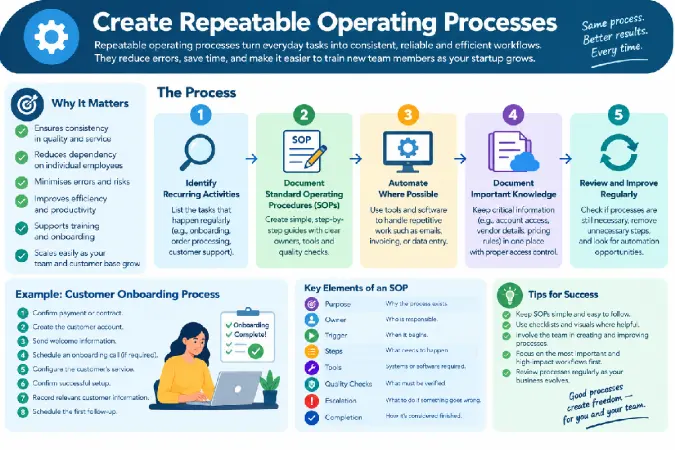
A standard operating procedure, or SOP, explains how a recurring task should be completed.
A basic SOP can contain:
Purpose: Why the process exists.
Owner: Who is responsible.
Trigger: When the process begins.
Steps: What needs to happen.
Tools: Systems or software required.
Quality checks: What must be verified.
Escalation: This is when things go wrong.
Completion: in what way the task is viewed to be complete.
A SOP does not have to be a twenty page document. For many of the start up processes, a short checklist will be the most practical.
Example: customer onboarding
A basic onboarding process could be:
- Confirm payment or contract.
- Create the customer account.
- Send welcome information.
- Schedule an onboarding call if required.
- Configure the customer’s service.
- Confirm successful setup.
- Record relevant customer information.
- Schedule the first follow-up.
Once documented, the process can be trained to another employee rather than remaining dependent on one founder.
Automate repetitive work
Automation can reduce administrative workload.
Possible areas include:
- Email notifications
- Appointment reminders
- Invoice generation
- Lead assignment
- Customer onboarding
- Data entry
- Reporting
- Inventory alerts
However, startups should automate processes that are already reasonably understood. Automating a badly designed process can simply make the problem happen faster.
Document important knowledge
Critical operational knowledge should not exist only in one employee’s memory.
Document:
- Account access procedures
- Vendor information
- Customer workflows
- Technical procedures
- Pricing rules
- Internal policies
- Reporting processes
- Emergency procedures
Access should be managed appropriately, especially for confidential information.
Review processes regularly
Processes become outdated as companies change.
A startup should periodically ask:
- Is this process still necessary?
- Can any steps be removed?
- Is there unnecessary approval?
- Can software automate part of it?
- Are errors occurring repeatedly?
- Does the current owner still make sense?
Process improvement should be ongoing rather than a one-time documentation project.
Review Performance, Risks and Resource Needs
Startup management requires continuous feedback. Leaders have a necessity to know what is working, what is not working or what is being used up.
Performance reviews should be searching for relevant business information and not just throwing in metrics because they are easy to measure.
Track other relevant key performance indicators
The right metrics depend on the startup’s business model.
Potential metrics include:
Revenue metrics
- Total revenue
- Monthly recurring revenue
- Average transaction value
- Revenue growth
Customer metrics
- New customers
- Customer retention
- Churn
- Customer acquisition cost
- Customer lifetime value
Product metrics
- Active users
- Feature adoption
- Conversion rates
- Product usage
- Defect rates
Operational metrics
- Order processing time
- Delivery time
- Support response time
- Error rates
- Productivity
Financial metrics
- Gross margin
- Operating expenses
- Cash flow
- Burn rate
- Cash runway
Do not track every available metric. Choose indicators that help management make decisions.
Distinguish leading and lagging indicators
Lagging indicators show what has already happened.
Examples:
- Revenue
- Profit
- Churn
- Completed sales
Leading indicators provide signals about future performance.
Examples:
- Qualified leads
- Product demos
- Trial registrations
- Customer engagement
- Sales pipeline
Both can be useful.
For example, revenue may be stable today while qualified leads are declining. That information may indicate a future sales problem that management can investigate before revenue is affected.
Review financial resources
Cash management is particularly important for startups.
Management should regularly examine:
- Current cash balance
- Monthly expenses
- Expected revenue
- Upcoming liabilities
- Payroll requirements
- Capital expenditures
- Financing requirements
A basic cash-flow forecast can help identify periods when additional capital may be required.
Monitor team capacity
Growth can create resource problems.
Lets assume sales rise by 50%, but support staffing stays the same. The effects may include longer feedback times, poorer quality of service and an unsustainable rate of work for your staff.
Management should therefore examine:
- Current workload
- Available employee capacity
- Hiring requirements
- Contractor requirements
- Skills gaps
- Upcoming project demands
Hiring should be connected to a specific business need rather than simply following the assumption that growing companies should continuously add employees.
Maintain a startup risk register
A risk register is a simple way to identify potential problems before they become emergencies.
| Risk | Potential Impact | Likelihood | Owner | Response |
| Major customer loss | High | Medium | Sales lead | Diversify customer base |
| Cash shortfall | High | Medium | Finance owner | Maintain forecast and contingency |
| Key employee departure | High | Medium | Founder | Document processes and succession |
| Security incident | High | Low/Medium | Technical lead | Strengthen controls |
| Supplier disruption | Medium | Medium | Operations | Develop alternatives |
The purpose is not to predict everything. It is to make important vulnerabilities visible.
Conduct regular management reviews
A weekly management review can remain lightweight.
Consider discussing:
Results
- What did we accomplish?
Metrics
- Which numbers changed?
Problems
- What is blocked?
Customers
- What are customers telling us?
Cash
- Are financial assumptions still valid?
People
- Are workloads and responsibilities manageable?
Risks
- What new threats or dependencies have appeared?
Priorities
- What matters most next?
This creates a feedback loop between strategy and daily execution.
Build a Startup Management System That Can Scale
Good startup management should evolve with the company.
A two-person startup does not need the same management structure as a 100-person organisation. Introducing excessive bureaucracy too early can slow decision-making and consume valuable time.
Instead, build management systems progressively.
Stage 1: Founder-led startup
At the earliest stage, founders may manage most activities themselves.
The priority should be:
- Clear responsibilities
- Basic financial tracking
- Customer feedback
- Simple task management
- Short planning cycles
- Essential process documentation
The goal is visibility, not bureaucracy.
Stage 2: Growing team
As employees are added, founders need to delegate.
Management priorities become:
- Defined roles
- Team-level goals
- Managers or functional owners
- Documented workflows
- Regular performance reviews
- More formal financial reporting
Founders should gradually move from doing every task to building systems that allow others to execute effectively.
Stage 3: Scaling organisation
As the company grows, management needs stronger systems.
These may include:
- Department-level objectives
- Formal budgeting
- Workforce planning
- Structured hiring
- Management reporting
- More detailed risk management
- Internal controls
- Cross-functional planning
The challenge is maintaining speed while adding enough structure to coordinate a larger organisation.
Common Startup Management Mistakes
Even well-funded startups can experience management problems. Several mistakes appear repeatedly.
Micromanaging employees
Founders who remain involved in every decision can create bottlenecks.
Instead, define outcomes, boundaries, and accountability, then allow capable employees to execute.
Changing priorities constantly
Frequent changes make it difficult for employees to finish meaningful work.
New information should sometimes change priorities, but changes should be deliberate rather than impulsive.
Hiring without clear responsibilities
Adding employees without defining the problem they are expected to solve can increase costs without improving performance.
Before hiring, identify:
- What work needs to be done?
- Why can’t the existing team handle it?
- What skills are required?
- What outcome should the role produce?
Measuring activity instead of results
Level of participation (Number of meetings attended or hours worked).
Relate work to meaningful outcomes whenever possible.
Neglecting workers’ opinions
Employees tend to notice operational issues before founders are (busiest!): operating at the point of contact with customers, systems and processes.
Develop mechanisms through which employees can voice concerns and offer recommendations for enhancement.
Not recording process in some way.
This is a dependency risk if only one employee knows how an important process works.
Save when urgent. Record essential processes before they require immediate attention.
Fast growth over and above what operations can bear.
Explosion of sales its chinks.
Management should prepare operational capacity alongside revenue growth.
(FAQs)
1. What is startup management?
Startup management involves organizing the team, objectives, funds, activities and resources around to create and develop the new company. Decision making, team management, strategic planning, process design, performance management and risk mitigation are some of the activities conducted.
2. Why is startup management important?
Good startups management enables founders to have better control of scarce resources, such as time, money, and human capital. In addition, it also clarifies of role, keep the team on a Log scale, decreases operation inconvenience, and give up principles of sustainable development.
3. What are the main responsibilities of a startup manager?
A startup manager may in charge of team management in the organization, set the goal, daily operation, budgeting, recruitment, customer service, monitor result, how to maximized the efficiency of the process, risk management… It all depends on the size and the business of startup.
4. How should startup founders divide responsibilities?
Founders should allocate roles based on their expertise, experience, and ownership.15 Each line of business should have an explicit owner, with other founders and employees contributing ideas when relevant.16
5. How do startups set effective goals?
A startup should identify a few clear, measurable objectives related to business priorities. For each one assign a custodian, a deadline, and the measure of success so it can be monitored.
Conclusion
Managing Startups Good managerial practices within a startup enable the company to develop a sufficient infrastructure so that a team can perform without restricting the levels of agility that make startups successful.
Start with clarity of ownership. Founders need to clarify accountability, set decision limits and make it as explicit as possible who owns what critical end results. Clarity then allows the company to set measurable goals and structure team delivery and focus on a handful of meaningful priorities.
Repeatable operating processes will further minimize reliance on individual employees, and help make the delivery of day-today work more straightforward. Record-keeping, automation and ongoing analysis of processes could enable the company to continue managing growing complexity without increasing bureaucracy.
Lastly, continuous performance and risk monitoring. The key performance and risk indicators include; numbers, customer and operational indicators, team capacity and new risks identified.
The strongest startup management systems are not necessarily the most complicated. They are systems that answer a few essential questions consistently:
What are we trying to achieve?
Who owns each outcome?
What work needs to happen next?
How should recurring work be completed?
How do we know whether we’re making progress?
What resources or risks could prevent success?
When these questions have clear answers, founders and employees can spend less time dealing with confusion and more time creating value for customers. As the company grows, these management practices can evolve into a scalable operating system that supports people, processes, performance, and long-term business growth.