

GST and Sales Tax Compliance: A Complete Guide for Small Businesses
Last Updated: September 21, 2026
The collection and transfer of GST or sales tax is a critical aspect of owning a legally compliant small business. This applies whether you sell online, have a bricks-and-mortar operation, provide specialist services, or are an e-commerce entrepreneur.
Application of GST and sales tax rules differ from country to country and jurisdiction. India uses GST which is a broad applicable indirect tax levied on supply of wide range of goods and services whereas other countries use of federal, state, provincial and local sales tax.
Below is a summary of the GST/sales tax registration process, filing returns, input tax credits, GST/sales tax rates and penalties.
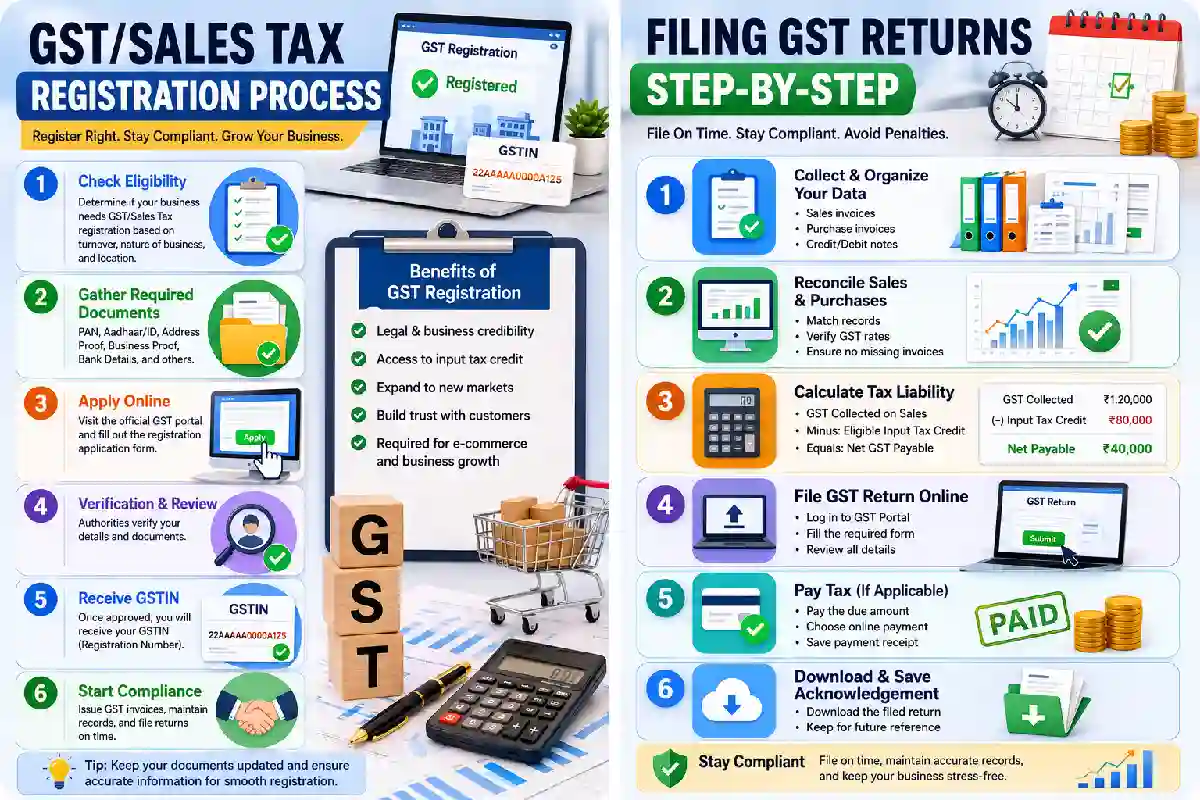
1. GST/Sales Tax Registration Process
The initial step in gathering information about the GSIRS is deciding if your business must register either for the GST or sales tax.
In India, the GST registration number (which is a 15 digit number) is sometimes based on turnover, supplies type, location of the business, activities or other various parameters. The following business entities are required to get GST registered irrespective of turnover.
Before registering, determine:
- Your business’s legal structure
- Annual turnover
- State or territory of operation
- Products or services sold
- Whether you sell across state borders
- Whether you sell through online marketplaces
- Whether special registration rules apply
GST Registration in India
Businesses that need to register for GST generally apply through the government’s online GST portal.
The process commonly involves:
- Providing business and promoter information.
- Verifying identity and contact details.
- Providing the principal place of business.
- Uploading required supporting documents.
- Completing verification.
- Receiving a GSTIN after successful registration.
GSTIN Goods and Services Tax Identification Number The GSTIN identifies the registered taxpayer.
Business is also obliged to issue proper tax invoices and records, and toif applicablefurther charges to the customer; n collect GST n file returns.
For countries other than India, the registration process would be similar but with the concerned sales-tax or GST authority of that country.
2. Filing GST Returns Step-by-Step
Input Tax Returns are used to notify tax on taxable supplies, purchases, and the tax amount charged and due to the tax office.
The specific forms and how often they must be filed are determined by the type of registration the taxpayer holds and the state in which it is registered.
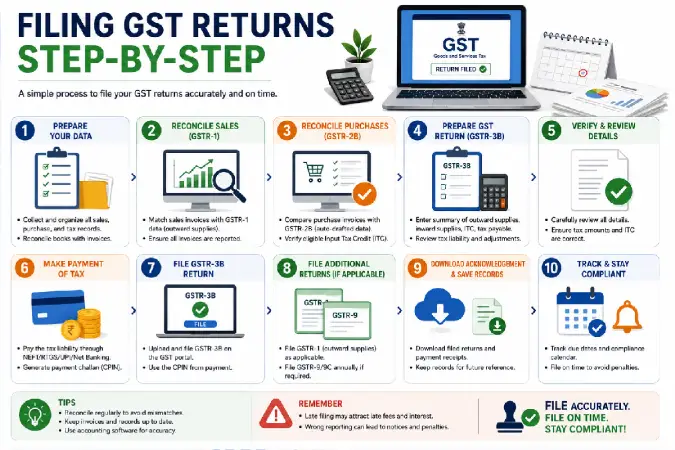
A practical GST return process can be broken into five steps.
Step 1: Maintain Accurate Records
Keep organized records of:
- Sales invoices
- Purchase invoices
- Credit and debit notes
- Tax collected
- Eligible input tax
- Expenses
- Payments
- Export or interstate transactions where applicable
Good bookkeeping makes GST reconciliation much easier.
Step 2: Reconcile Sales
Compare your accounting records with invoices and applicable GST reporting data.
Check for:
- Missing invoices
- Duplicate invoices
- Incorrect GST rates
- Incorrect customer information
- Cancelled transactions
- Credit notes
Step 3: Reconcile Purchases and Input Tax
Review purchase records to determine which input tax credits are eligible.
Do not automatically claim credit for every tax amount appearing on a supplier invoice. Eligibility requirements and documentation rules must be satisfied.
Step 4: Calculate Net Tax Liability
In a simplified example:
GST collected on taxable sales − eligible input tax credit = net GST payable
The actual calculation can involve additional adjustments, exemptions, reverse-charge provisions, and other jurisdiction-specific rules.
Step 5: File and Pay on Time
Submit the appropriate return and pay any resulting tax liability by the applicable deadline.
Keep evidence of the filing and payment for your records.
3. Input Tax Credit Rules
One of the major benefits of GST systems is the ability for eligible registered businesses to claim input tax credit (ITC) on qualifying business purchases.
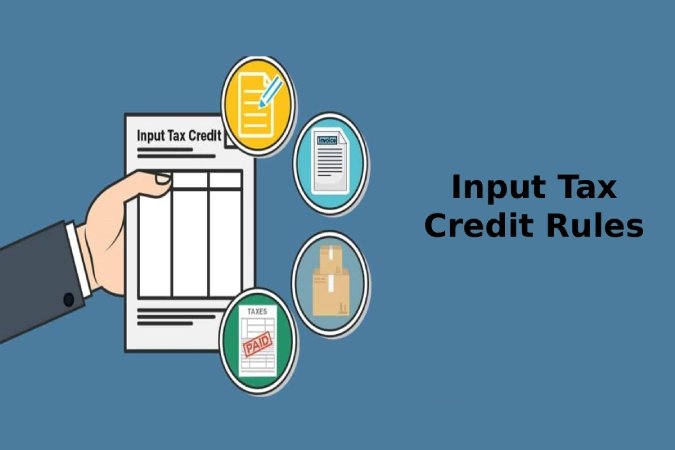
For example, suppose a business purchases equipment for ₹100,000 and pays eligible GST on that purchase. If the relevant legal requirements are satisfied, the business may potentially use the eligible input tax against GST collected on taxable sales.
However, input tax credit isn’t automatically available for every business expense.
Common ITC Considerations
A business should generally check:
- Whether the purchase is related to business activities
- Whether the supplier has issued a valid tax invoice
- Whether the transaction meets applicable documentation requirements
- Whether the goods or services have been received
- Whether the credit is permitted under the applicable GST rules
- Whether the claim is made within the relevant time limits
Certain goods or services may have restricted or blocked credits depending on the jurisdiction and circumstances.
Keep Strong Documentation
Maintain:
- Supplier invoices
- Purchase records
- Payment evidence
- GSTIN details
- Import documentation where applicable
- Credit and debit notes
Regular reconciliation between purchase records and tax records can help identify discrepancies before they become larger compliance problems.
4. GST/Sales Tax Rates by Product Category
GST and sales-tax rates aren’t necessarily the same for every product or service.
In the case of India, the GST rates depends on classification of goods or services. Whether the GST rate falls under the category of common rates 0%, 5%, 12%, 18%, and 28%; or whether the goods or services are subject to special rate; exemption; compensation-related or other treatment.
For example, broad categories can include:
| General Category | Possible GST Treatment |
| Exempt/essential items | 0% or exempt, depending on the item |
| Selected goods and services | 5% |
| Certain products | 12% |
| Many standard goods and services | 18% |
| Selected luxury or specified goods | 28% |
| Special categories | Specific rates or rules may apply |
These are illustrative categories rather than a substitute for checking the current classification of a particular product. GST rates can change, and the precise rate depends on the applicable tariff classification and current government notifications.
For businesses selling internationally, rates can be even more complicated. A product might be subject to different sales taxes depending on the customer’s location.
Why Correct Classification Matters
Using the wrong tax rate can result in:
- Underpayment of tax
- Overcharging customers
- Incorrect invoices
- Return mismatches
- Interest
- Penalties
- Additional administrative work
Businesses should verify the applicable tax classification before setting prices or configuring accounting software.
5. Penalties for Non-Compliance
GST and sales-tax authorities can impose penalties when businesses fail to meet their obligations.
Potential compliance problems include:
- Late registration
- Late return filing
- Late tax payments
- Incorrect returns
- Under-reporting taxable sales
- Claiming ineligible input tax credits
- Issuing incorrect invoices
- Failing to maintain required records
- Collecting tax but failing to remit it
Depending on the jurisdiction and violation, consequences may include interest, monetary penalties, notices, assessments, restrictions, or other enforcement measures.
Late Filing
Missing a filing deadline can result in late fees and interest. Even when a business has little or no tax payable, filing obligations may still apply.
Incorrect ITC Claims
Claiming input tax credit without satisfying eligibility requirements can result in reversal of the credit and potentially additional interest or penalties.
Tax Evasion
Deliberately concealing sales, creating false invoices, or manipulating records is significantly more serious than an accidental bookkeeping error and can lead to substantial financial and legal consequences.
How Small Businesses Can Stay GST Compliant
You don’t need an overly complicated system to improve compliance. Establish a consistent process.
Monthly or Regular Checklist
- Record every taxable sale.
- Issue appropriate invoices.
- Categorize purchases correctly.
- Reconcile sales records.
- Reconcile purchase records.
- Check input tax credit eligibility.
- Review tax rates.
- Reconcile accounting software with tax records.
- Monitor filing deadlines.
- Set aside funds for tax payments.
- Keep supporting documentation securely.
Some portion of all this can be automatically done by accounting and GST software, but even when the computer does it, the business owner should periodically see that the transactions are being coded and accounted for correctly.
Final Thoughts
GST/sales tax compliance should be one business process dealing with groups of records throughout the normal course of business operations rather than just recording requirements when it is time to lodge a return.
Firstly, you should identify if you business is required to register, then you should know your taxable products and services, keep good invoices and records, reclaim input tax credits accordingly and on time submit the returns and payments.
Since rules on GST and sales-tax are specific to each country and subject to change, check the current rates, exemption limits, deadlines, exemption requirements, penalties, etc., with the local revenue department or an experienced tax advisor.
The solution for small businesses is pretty straightforward keep good books, be sure you‘ve categorized your income correctly and file and reconcile on time. Doing so can minimize exposure to compliance risks and put you in a much better position to truly know how your business is doing.