
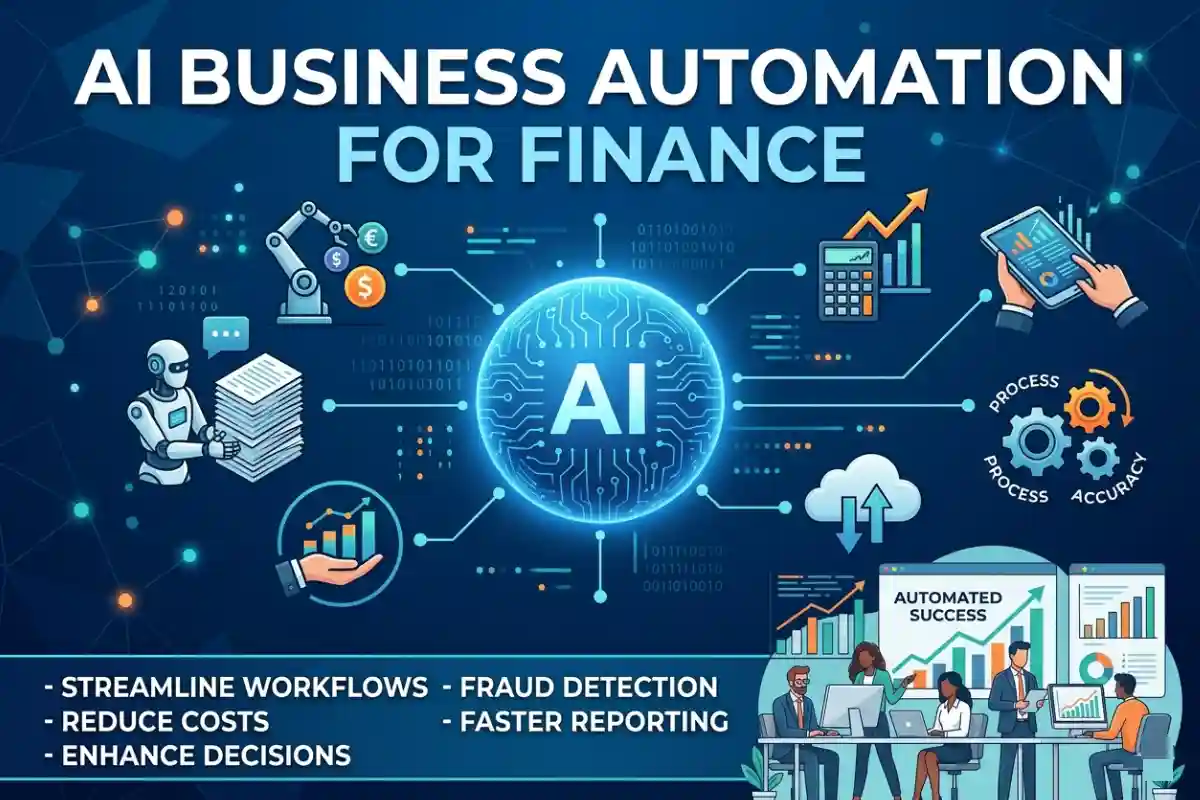
AI Business Automation for Finance: Transforming Financial Operations
Last Updated: June 20, 2026
The use of AI in finance is altering the financial management techniques of corporations. The AI Business Automation for Finance offers businesses the automatic implementation of financial job tasks such as accounting, expense management, forecasting, reporting and compliance with little human input. Various firms, whatever their size, rely on AI based financial solutions to save money, increase reliability and receive immediate financial information.
With AI capability progressing by 2026, finance teams will move away from manual data entry and mundane activities to smart automation systems capable of processing huge volumes of financial data instantaneously. As a result, the onus of routine administrative tasks will be reduced and more time will be directed towards strategic financial planning.
It doesn’t matter whether you are a startup owner, accountant, CFO, finance manager; knowing about AI-powered financial automation can aid in profitability and efficiency enhancement.
What Is AI Finance Automation?
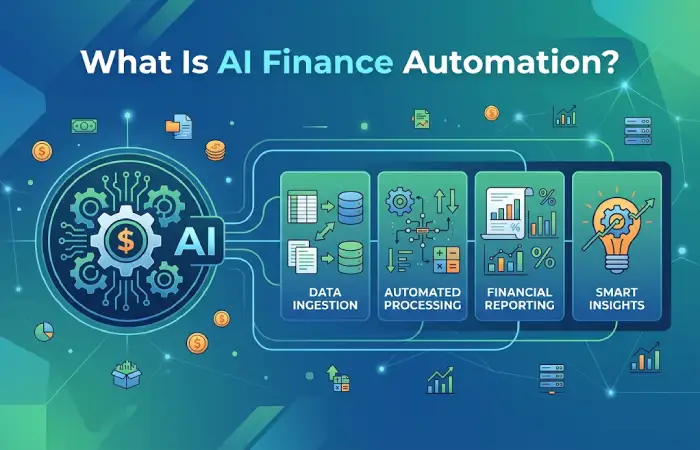
Automating financial processes using AI finance automation is the application of AI technologies, such as machine learning, natural language processing (NLP), and predictive analytics, to financial workflows.
One of the key advantages of an AI system is that it can be used to automate many of the jobs performed by employees in a finance department. For example, traditional finance systems employ staff to enter invoices, reconcile accounts, produce reports, and manage budgets. AI systems can automate a lot of this work and evolve over time to become more accurate.
Common Finance Processes Automated by AI
- Invoice processing
- Accounts payable and receivable
- Bank reconciliation
- Payroll management
- Tax preparation
- Fraud detection
- Financial forecasting
- Budget planning
- Cash flow analysis
Business automation of repetitive activities minimizes human error and makes financial activity faster.
AI vs Traditional Finance Management
| Feature | Traditional Finance | AI Finance Automation |
| Data Entry | Manual | Automated |
| Reporting Speed | Hours or Days | Real-Time |
| Error Rate | Moderate | Low |
| Forecasting | Historical Analysis | Predictive Analytics |
| Fraud Detection | Reactive | Proactive |
| Scalability | Limited | High |
Automating Business Accounting Tasks
Accounting departments can be burdened with time-consuming routine processes. Integrating AI-enabled accounting software will automate bookkeeping processes and enable better margins of financial accuracy.
Key Accounting Automations
Automated Bookkeeping
AI sorts transactions, journals and bank statements.
Invoice Processing
To process an invoice today for instance we could use an OCR (Optical Character Recognition) system to extract the data from a robot and then route approvals automatically.
Accounts Payable Automation
Save time and money by automating vendor payment, approval flows, and scheduling payments.
Financial Reporting
Machine intelligence provides Management with real-time summaries, reports and dashboards which enable the faster decision making.
Business Impact of Accounting Automation
| Metric | Before Automation | After AI Automation |
| Invoice Processing Time | 15-20 Minutes | 1-2 Minutes |
| Reconciliation Accuracy | 90-95% | 98-99% |
| Reporting Time | Several Hours | Minutes |
| Administrative Costs | High | Reduced |
AI Tools for Expense Management
Cost management has emerged as one of the fastest growing applications of AI in the finance industry. Companies find it difficult tracking manual receipts, enforcing policies and reimbursement.
An automatic expense management system ( AI is used for capturing, sorting, confirming, and authorizing expenses.)
Top AI Finance Automation Tools (2026)
| Tool | Best For | AI Features | Pricing Model | Official Resource |
| QuickBooks Online | Small Businesses | Automated bookkeeping | Subscription | https://quickbooks.intuit.com |
| Xero | SMEs | Smart reconciliation | Subscription | https://www.xero.com |
| Zoho Books | Growing Companies | Expense categorization | Subscription | https://www.zoho.com/books |
| Sage Intacct | Enterprises | Predictive reporting | Custom Pricing | https://www.sage.com |
| Oracle NetSuite | Large Organizations | AI forecasting | Custom Pricing | https://www.netsuite.com |
Features Businesses Should Look For
- Receipt scanning
- Smart categorization
- Policy compliance checks
- Automated approvals
- Real-time dashboards
- Forecasting capabilities
- ERP integration
- Fraud monitoring
Organizations using AI expense management may benefit from more efficient reimbursement cycles and greater transparency in their spend.
Benefits of Financial Automation
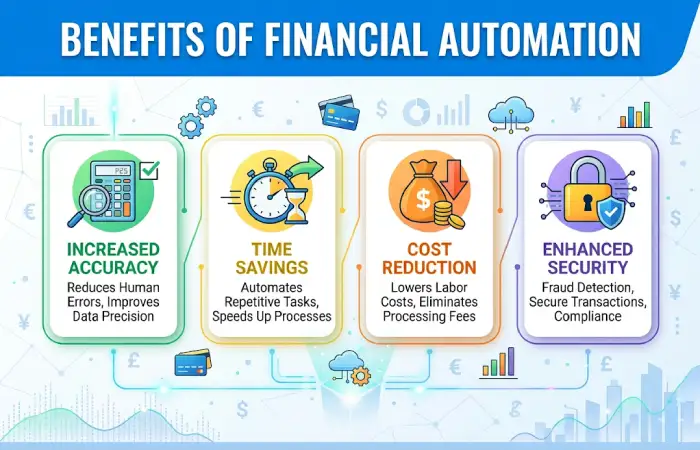
All business finance metrics are affected positively by automation of financial processes.
- Increased Accuracy
AI systems prevent a great deal of transcription errors found in accounting procedures.
- Reduced Operational Costs
Automation alleviates teams from boring, repetitive tasks which is less expensive in terms of administration.
- Faster Decision-Making
Real Time reporting allows the analysis of financial performance to take place in real time.
- Improved Compliance
AI actively monitors transactions and flags suspiciousness indicating compliance issues.
- Better Cash Flow Management
Predictive analytics assist businesses in more accurate predictions of revenue and expenditure.
2026 Business Benefits Comparison
| Benefit Category | Typical Improvement |
| Processing Speed | 60-90% Faster |
| Reporting Time | Up to 95% Reduction |
| Data Accuracy | 98%+ Accuracy |
| Compliance Monitoring | Continuous |
| Financial Visibility | Real-Time |
| Cost Savings | 20-40% Reduction |
ROI Example
What if you re-engineered the invoice process? For example, a mid-size business that handles 5,000 invoices per year can see a tremendous reduction in manual labor costs through the use of invoice automation with artificial intelligence. Along with the faster approvals and fewer errors, most companies see positive ROI after the first year.
Future of AI in Business Finance
The next wave of finance automation will not just automate human processes it will be more predictive, more intelligent, and more autonomous.
Emerging Trends for 2026 and Beyond
Autonomous Finance Operations
Recurring transactions, approvals and reconciliations will be taken care of by the AI system.
Predictive Cash Flow Intelligence
Machine learning predictions of future cash flow disruptions will be made months ahead of time.
AI-Powered CFO Dashboards
Executives will be guided by AI on strategic decisions provided by algorithm in accordance with instantaneous business data.
Conversational Finance
Financial systems will be queried using normal business language by the finance departments.
Example:
“Display forecast Q4 revenue and compare to last year.”
The platform can immediately provide the analysis.
Enhanced Fraud Prevention
Machine learning algorithm will continuously analyze transactions and raise alerts of fraudulent activity before losses happen.
Frequently Asked Questions
Is AI finance automation suitable for small businesses?
Yes. Several cloud solutions will have economical, small business AI automation services.
Can AI replace accountants?
No. Though AI replaces human work in routine and repeated tasks, accountants are irreplaceable for planning, compliance and decision making.
What is the biggest benefit of AI finance automation?
Often the greatest gains are to be made in increased efficiency and accuracy, and enhanced financial visibility in the present.
How secure are AI finance platforms?
Most of the leading providers utilise enterprise level encryption, access controls and various compliance certifications to secure finanicial data.
Which finance process should businesses automate first?
Most of the time, expense management and invoice processing are the easiest and highest-leverage opportunities to begin.
Conclusion
Business automation powered by AI in finance is quickly shifting from a competitive advantage to a necessity. Whether it‘s automating bookkeeping, managing expenses, forecasting future trends, or spotting fraud, AI is helping businesses become more efficient and have greater visibility into their company‘s finances. Those who automated their finances with AI in 2026 will be best prepared to cut costs, operate with higher accuracy, and make smarter strategic moves.