
AI-Powered Decision Making: How Businesses Use AI to Make Smarter Decisions
Last Updated: June 20, 2026
AI-Driven Decision Making is revolutionizing the process of how business analyze data, discover opportunities and make a decision. Instead of drawing upon experiences, these days the business world employs artificial intelligence to analyze vast quantities of data, spot trends, forecast and advise.
By 2026, AI has already gone well beyond automation. Today‘s organizations utilize AI systems to enable executives, managers and teams to make smarter, faster decisions for finance, marketing, operations, customer service and supply chain. Many organizations that have implemented an ‘AI-powered decision framework’ have gained competitive advantage via increased efficiency, cost savings and more effective forecasting.
Industry studies indicate that enterprise organization adoption of AI Analytics & Decision Intelligence platforms is growing quickly to provide real-time insights and efficiency.
What Is AI-Powered Decision Making?
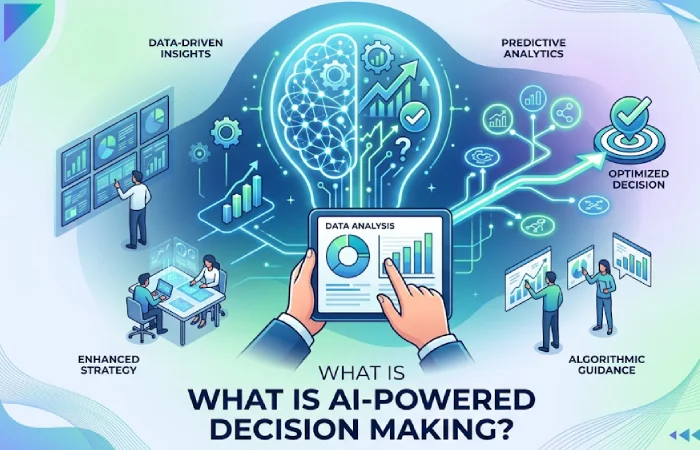
It use of AI methods (e.g., machine learning, predictive analytics or utilization of data-based insights) to support improved decisions in a faster timeframe.
Replace human intuition, human experience and human brain. Predicting future events, providing the most appropriate recommendation by taking into account to the data and calculating the similarities and patterns between data.
The business environment of today is electronically driven. Business managers have to capture, analyze, and efficiently control this large amount of heterogeneous data from all sources including customers, sales, websites, social media, all sensors, and internal management systems.
Manually analyzing this data could be a lengthy and tedious task. However, AI would be able to overcome this challenge by processing enormous amounts of data at a speed which is impossible for humans allowing organizations to discover invaluable insights in real time.
The process generally follows these steps:
- Collect data from multiple sources
- Analyze patterns using AI algorithms
- Generate predictions and recommendations
- Present insights to decision-makers
- Continuously improve through feedback loops
As other reporting tools, the AI can find implicit relationships in data, and who recommend an action before events happen.
Example
A retail company can use AI to:
- Predict inventory shortages
- Forecast product demand
- Optimize pricing strategies
- Recommend marketing campaigns
As more companies take their digital transformation journey in 2026 and beyond, the use of decision making on AI is the business intelligence and competitive strategy.
With integrating AI into their decision making processes, organizations will be able to react much quicker to changes in the market and are likely to have better customer experiences and more efficient operations giving the an advantage over their competitors.
Benefits of Data-Driven Business Decisions
More and more enterprises are adopting AI as data analytics, decision made out of it, tend to be more successful than those made by intuition.
Key Benefits
Improved Accuracy
AI that can read upon billions of data points simultaneously, reduces human errors.
Faster Decision-Making
AI-based analytics is able to discover insights in seconds, not days.
Better Forecasting
Predictive models help companies predict:
- Sales trends
- Customer behavior
- Market changes
- Operational risks
Cost Reduction
Business can improve the efficiency of resource allocation by removing inefficiencies.
Competitive Advantage
Businesses using AI well are more agile when it comes to reacting to market opportunities.
2026 AI Decision-Making Statistics
| Metric | 2026 Data |
| Organizations using AI in analytics workflows | 73% |
| Faster insight generation using AI | Up to 5x |
| Organizations using AI for decision optimization | 46% |
| Companies planning AI decision optimization adoption | 43% |
| Decision Intelligence Market Size (2026) | $20.7 Billion |
Sources
| Resource | Link |
| Decision Intelligence Market Report | https://www.grandviewresearch.com/industry-analysis/decision-intelligence-market-report |
| AI Analytics Statistics | https://adai.news/resources/statistics/ai-data-analytics-statistics-2026/ |
| S&P Global Research | https://www.spglobal.com/market-intelligence |
Is evidence that AI decision engines are for business and not just a high-tech, experiment.
AI Analytics Tools for Companies
These packages use AI algorithms and most of them are made into be accessed in the cloud and not downloaded to a PC. Sure there are market leading AI packages in 2026.
AI Decision-Making Platform Comparison
| Platform | Best For | AI Features | Ease of Use |
| Microsoft Power BI | Business Intelligence | Predictive Analytics, Copilot | High |
| Tableau | Data Visualization | AI Insights, Forecasting | High |
| ThoughtSpot | Search Analytics | Natural Language Queries | Very High |
| IBM Watsonx | Enterprise AI | Decision Intelligence | Medium |
| Google Cloud Vertex AI | Machine Learning | Predictive Models | Medium |
Evaluation Criteria
When selecting an AI analytics platform, consider:
- Data integration capabilities
- Predictive analytics features
- Explainable AI functionality
- Scalability
- Security and compliance
- Total cost of ownership
Real-World AI Decision-Making Examples
Artificial Intelligence is already impacting decisions of business in many industries.
Finance
Financial institutions use AI to:
- Detect fraud
- Assess risk
- Approve loans
- Forecast cash flow
Healthcare
Healthcare providers leverage AI to:
- Assist diagnoses
- Predict patient outcomes
- Optimize staffing
Retail
Retail organizations use AI for:
- Demand forecasting
- Inventory management
- Dynamic pricing
- Customer personalization
Manufacturing
Manufacturers implement AI for:
- Predictive maintenance
- Production scheduling
- Quality control
Marketing
Marketing teams use AI to:
- Predict customer behavior
- Optimize advertising spend
- Generate audience insights
- Improve campaign performance
Many organizations are already progressing from trial and error with AI toward enterprise-wide deployment, as tangible productivty benefits become apparent.
Challenges of AI Adoption
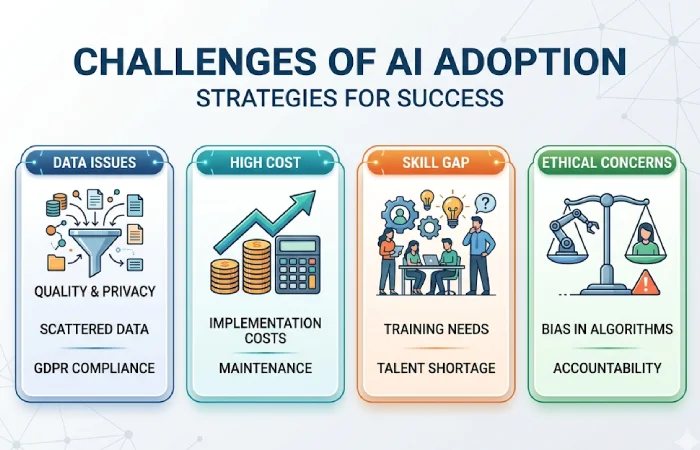
However, there are some challenges to the adoption of AI technology too.
Data Quality Issues
AI-models can only be as good as the data you feed them.
Common problems include:
- Incomplete datasets
- Duplicate records
- Inaccurate information
Trust and Transparency
Business executives tend to be reluctant to act on the “black box” advice.
Validating AI for Trustworthiness Explains AI‘s contribution to confidence, indicating ‘reason for recommending decision’.
Governance and Compliance
Organizations must establish:
- Data governance policies
- Security frameworks
- Ethical AI guidelines
Talent Gaps
Many businesses struggle to find professionals with expertise in:
- Data science
- Machine learning
- AI strategy
Integration Complexity
Integration of AI systems with legacy systems. Will be an ongoing challenge.
According to research, many companies had successful AI projects but started to struggle implementing them because of governance, infrastructure, and trust issues.
FAQ
Is AI-powered decision making replacing human managers?
No. Human decisions are being back up by AI. We still need human to make the fundamental decisions about strategy, ethic, and so on.
What industries benefit most from AI-powered decision making?
Currently, the penetration has been the deepest in the area of finance, health care, retail, manufacturing, logistics and marketing.
What is decision intelligence?
Decision intelligence is the combination of AI, analytics, machine learning and business rules to give better decision-making to organizations.
How much does AI decision-making software cost?
Costs could range from relatively inexpensive subscription for a small business for a cloud hosted solution through to enterprise level implementation costing hundreds of thousands of pounds per annum.
What is the biggest challenge in AI adoption?
Data quality, governance and organisational trust are common themes that are consistently cited as the main challenges faced in successful AI implementations.
Conclusion
AI decision making has become an increasingly valuable asset for today’s business. With the integration of sophisticated analytics, machine learning technologies, and decision intelligence platforms, companies are able to improve business performance and accelerate their strategic decision processes.
Although the road to adopting AI decision making will inevitably entail governance issues, trust issues, and data quality issues, the benefits seem to outweigh the potential risk. Companies who are willing to invest in an AI decision support framework will have the upper hand in the future decision driven economy.