

Business Development Strategy Framework
Last Updated: June 13, 2026
Business Development Strategy. A good framework for a business development strategy can enable a company to identify new areas for growth, develop strong strategic alliances, and convert market insights into tangible results. It is effective when linked to specific objectives and enables an iterative process of research, outreach, relationship management, and results monitoring.
Business development involves the creation of long-term value for a company from customers, markets, new partnerships, and new revenue opportunities. Implementing an effective business development strategy makes you grow on purpose rather than by chance due to daily random sales or short-term tactics.
What is Business Development?
Business development is defined as the achievement of long-term value. This is set by customers, markets, and relationships. Business development is not just about closing the sale but also uncovering opportunities, developing deals, entering new markets and enabling growth. It also looks to it for long-term value rather than just for a quick deal. So, an effective strategy should help increase revenues, improve positioning, and deliver repeatable results.
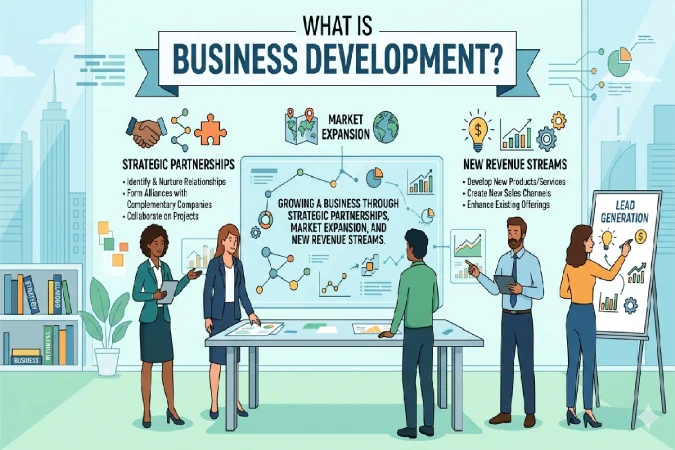
A business developer. Is a person whose job it is to help a business find growth opportunities and build relationships. Their goal is to increase the revenue of the company.
Key roles and responsibilities
- Innovate new markets, customers, and business.
- Build and maintain strategic alliances and client relationships.
- Investigate the market trends and activity of the key competitor.
- Design business strategies, marketing plans and growth action plans.
- Support revenue growth through prospecting, pitching, and negotiations.
- Results are monitored and tracked in the form of reporting, monitoring, and performance review.
Creating a Strategy
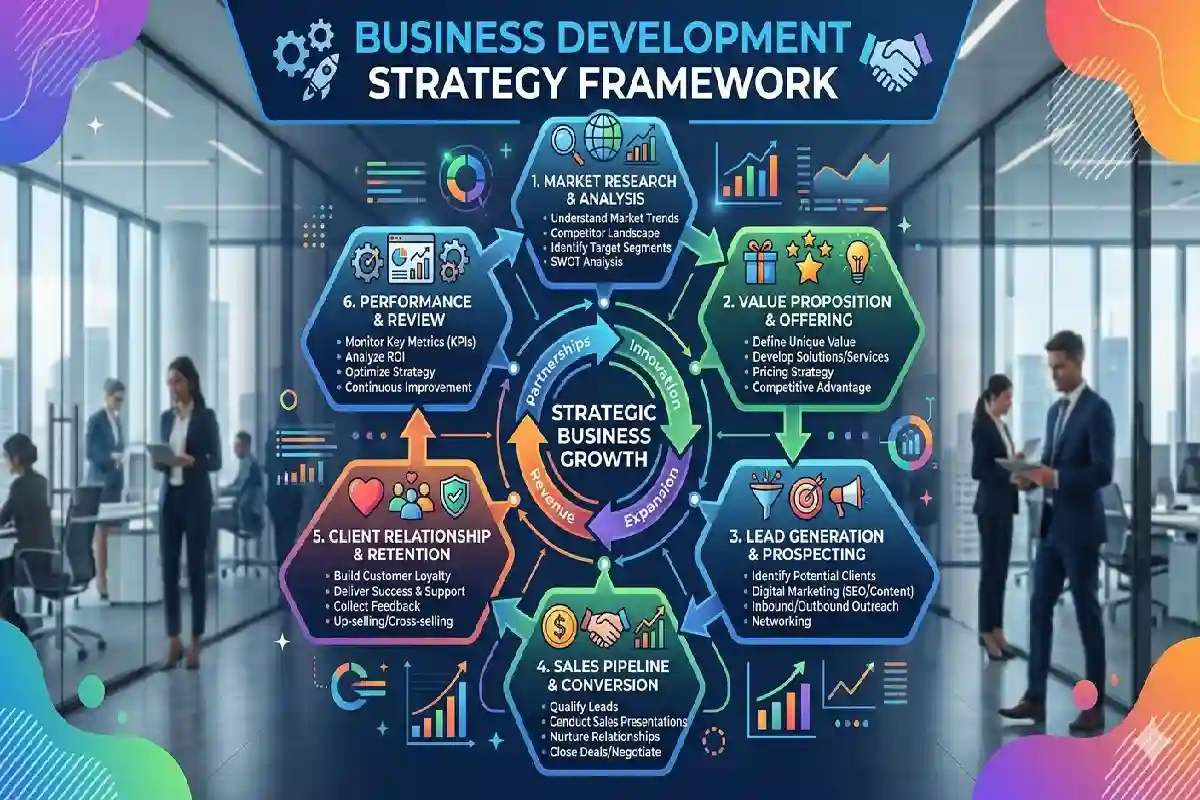
One effective business development technique is to work out the business goals, do the market research, then define the target customers and plan how to launch there. This plan should contain resource planning, KPIs, and a review cycle so that the team can change as real performance progresses.
A simple framework looks like this:
- Define growth objectives.
- Identify target markets and customer segments.
- Analyze competitors and current position.
- Choose channels, partnerships, and offers.
- Set metrics and ownership.
- Review and improve regularly.
This structure allows business development to be focused, rather than reactive. It is also easier to align sales, marketing, product, and leadership behind similar growth priorities.
Identifying New Markets
When seeking new market opportunities, start by learning about your current clients, dividing audiences into categories, and evaluating buying patterns. Next, consider direct and indirect competitors, complementary or related products, and nearby industries to identify new avenues.

A practical opportunity scan should answer:
- Who in the market is already buying from us?
- What customer groups’ services are insufficient?
- What aren’t we solving well?
- What industries or regions?
- Which trend is likely to reverse and increase demand?
Here’s what it does for you: It prevents you from guessing. To the contrary, you are looking to customer behavior and market clues to make realistic leaps.
Building Partnerships
Strategic alliances operate most effectively when both parties share common goals, there is a clear consensus of benefit, and they have an operating framework. A general outline of how successful strategic alliances are developed can be seen in the diagram below:
A strong partnership framework includes:
- When selecting a partner, seek complementary capabilities.
- A willingness to: Come together to agree on common aims and measures of success.
- Governance: the rules of communication and structure of decision-making.
- Continued tracking of customers’ usage and relationship cultivation.
Partnerships should not be treated as one-off transactions; they are best dealt with as longer-term relationships with ongoing dialogue and expansion.
Measuring Results
Business development measures should be constantly monitored (otherwise it becomes hard to figure out what really works): pipeline generated, conversion rate, partnership revenue, qualified opportunities, market penetration, and customer lifetime value.
A strong measurement system should track:
- Leading indicators that are being monitored include the volume of outreach and the quality of meetings.
- Key mid-stage indicators like partnership discussions and proposal conversion.
- Outcome indicators, referred to as such, for example, revenue, retention, and market growth.
Measuring results all the time allows teams to fine-tune tactics, shift resources from weak channels to working ones, and concentrate on the channels that garner the biggest bang for the buck. It also makes buying into business development much more palatable internally, because hard evidence of accomplishments is readily apparent.
Practical Framework
A practical framework is an easy, organized guide that is easy to follow and provides a broad set of steps and/or principles to help overcome an issue or accomplish a task in practical situations. It makes implementing theories easier.
Here are a few practical frameworks in business development you can use:
- SWOT use it to identify your company’s strengths, weaknesses, opportunities and threats before you plan a period of growth.
- TAM-SAM-SOM assists in determining the size of the total market, the segment you should initially target and the market share.
- Porter‘s Five Forces helps you understand the forces that affect competition in a market.
- Ansoff Matrix guides in selecting the right combination of market development, market penetration, product development or diversification.
- SMART Goals guide you in defining clear measurable objectives in business development.
- Role and Responsibility model Race Matrix – helps determine the roles and responsibilities for the growth projects.
- Balanced Scorecard – provides development tracking results in the formation of the business development not only a result of revenue.
FAQ
Is business development?
Business development is defined as those activities and initiatives that help to develop and improve the business.
What should be covered in a business development strategy?
Must contain objectives, market research, target segments, tactics, resources, KPIs, and review process.
Finding your new market opportunities.
Some of the ways that you can do this are by analysing current customers, dividing the different markets into segments, working out who your competitors are, and analysing other, related markets or industries.
What does it take for a strategic alliance to work well?
Shared objectives, win-win situation, trust, communication, and measurable results are the essentials.
What is the measure of business development success?
Track pipeline growth, conversion rates, revenue generation through partnerships, market penetration, and other business results that are related to growth.
Conclusion
A business development strategy framework can give your business form, focus, and direction. By setting clear goals, exploring market potential, developing fruitful alliances and tracking outcomes, you establish a repeatable growth model. To get positive results, use plain language, set concrete objectives and apply uniform measurements.