

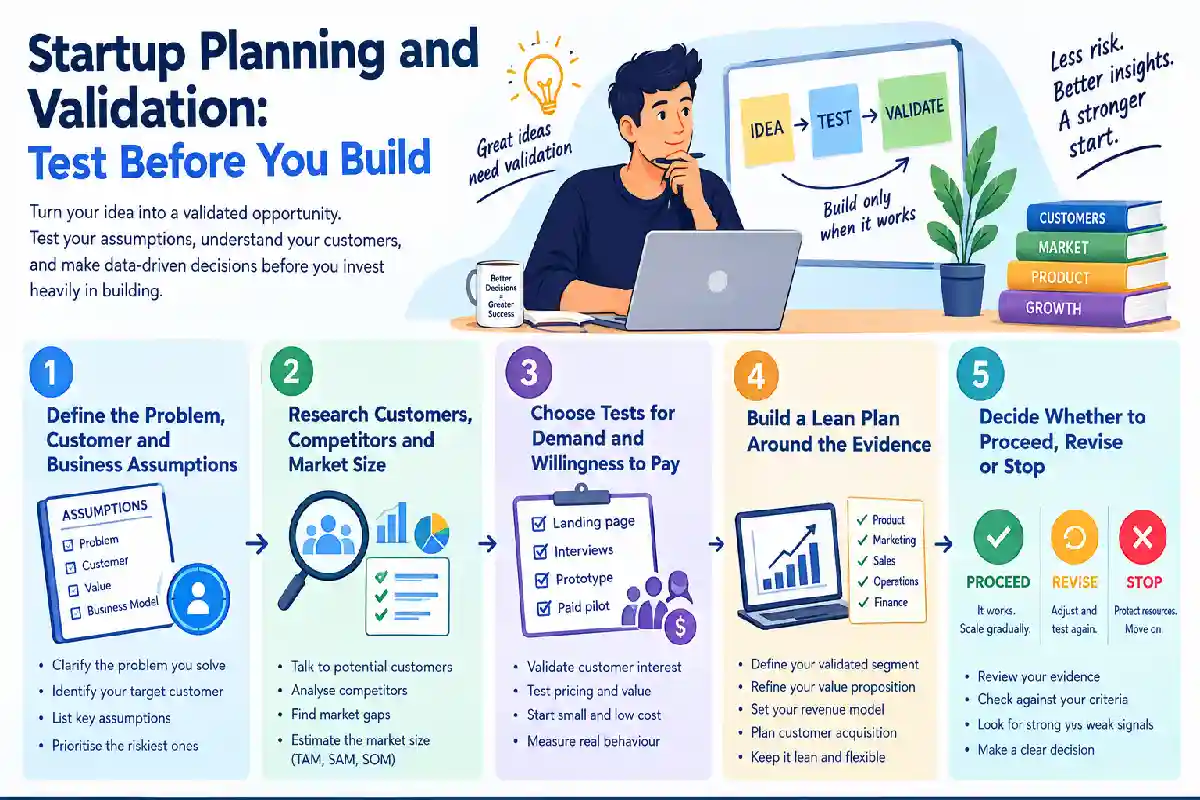
Startup Planning and Validation: Test Before You Build
Last Updated: September 28, 2026
Four out of five start-ups begin with an idea: a product that could be made, a service that a potential customer might buy, or a problem that has a “logic” to its solution. But that idea is not a validated business opportunity.
Various startups spend in product, branding, website, software, people and marketing before making sure there is still demand for whatever they are going to sell. When the assumptions of their idea turn out to be false, they could switch directions quite late in the game.
Startup planning and validation provide a more disciplined alternative.
Instead of asking, “How can we build this?” founders first ask, “Is this problem important enough to solve, who experiences it, what alternatives already exist, and will customers pay for a better solution?”
Validation does not require certainty. No research process can guarantee that a startup will succeed. Its purpose is to reduce avoidable uncertainty and identify the assumptions that need to be tested before major commitments are made.
A practical validation process can be built around five stages:
- Define the problem, customer, and business assumptions.
- Research customers, competitors, and market size.
- Choose tests for demand and willingness to pay.
- Build a lean plan around the evidence.
- Decide whether to proceed, revise, or stop.
This approach allows founders to learn quickly while keeping early investments relatively small.
Define the Problem, Customer and Business Assumptions
The first step is to turn a broad business idea into a clearly defined problem and customer.
“I’m going to build an app for businesses” is not a sufficiently precise starting point. It does not identify which businesses, which problem, how serious the problem is, or why customers would use the proposed solution.
A stronger starting point might be:
“Independent retailers with small teams struggle to maintain accurate inventory records across physical and online sales channels.”
Now the problem, audience, and context are easier to investigate.
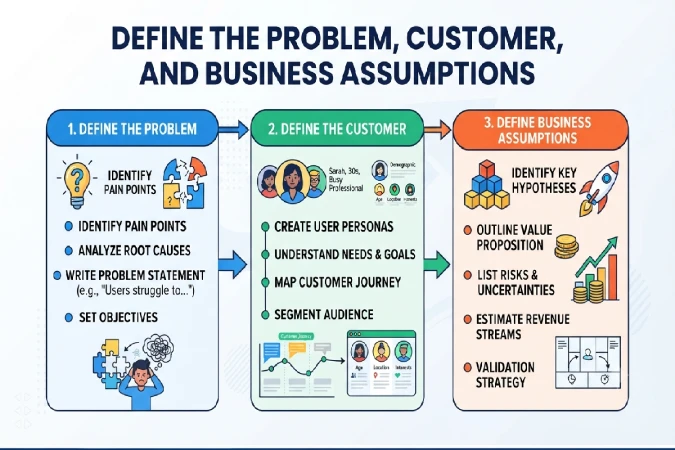
Define the problem clearly
A useful problem statement should explain:
- Who experiences the problem?
- What happens?
- How frequently does it occur?
- What causes the problem?
- What does the problem cost the customer?
- How are customers solving it today?
- Why might existing solutions be inadequate?
Avoid describing the solution too early.
For example, “Small businesses need an AI inventory platform” is a solution statement.
“Small retailers frequently lose sales because inventory records are inaccurate across multiple sales channels” describes a problem that can be investigated.
This distinction matters because customers may agree that the problem exists while disagreeing with the proposed solution.
Identify the target customer
A startup cannot validate an opportunity effectively if its customer definition is too broad.
Instead of targeting “small businesses,” define a narrower initial segment.
Consider:
- Industry
- Company size
- Location
- Revenue range
- Business model
- Job role
- Purchasing authority
- Technology usage
- Frequency of the problem
- Existing solutions
For a B2B startup, the user of the product may not be the buyer.
An inventory management platform could be used by store employees, managed by an operations manager, and purchased by the business owner.
Understanding these different roles helps founders design better research and tests.
Separate assumptions from facts
Every early startup plan contains assumptions.
Examples include:
- Customers experience the problem frequently.
- The problem is expensive or frustrating.
- Customers are actively looking for solutions.
- Existing solutions are insufficient.
- Customers have purchasing authority.
- Customers are willing to pay.
- The startup can reach potential customers efficiently.
- The product can be delivered profitably.
- Customers will continue using the solution after purchase.
Write these assumptions down instead of leaving them implicit.
A simple assumption table can help:
| Assumption | Why It Matters | Evidence Needed |
| Customers experience the problem weekly | Indicates recurring demand | Customer interviews |
| Existing tools are difficult to use | Creates an opportunity | Competitor research |
| Customers will pay monthly | Supports revenue model | Pricing tests |
| Customers can be reached through partnerships | Supports acquisition | Outreach experiments |
| Product can be delivered profitably | Supports business model | Cost analysis |
The most important assumptions are those that could cause the business to fail if they are wrong.
Prioritise risky assumptions
Not every assumption needs immediate testing.
Suppose a startup assumes that customers will pay $50 per month for its product. It also assumes that customers prefer a blue interface rather than a green one.
The pricing assumption could materially affect the business model. The colour preference probably does not.
Validation should focus first on assumptions with high uncertainty and high potential impact.
A useful framework is:
Risk = uncertainty × business impact
Test high-risk assumptions before spending significant resources on lower-risk details.
Define what validation would look like
Before conducting an experiment, decide what evidence would change your decision.
For example:
“If at least 10 of 30 qualified prospects agree to a product demonstration and at least three are willing to discuss a paid pilot, we will continue testing.”
The exact threshold depends on the business, customer segment, price, and sample quality.
The important principle is to establish criteria before seeing the results. This reduces the temptation to reinterpret weak evidence as success.
Research Customers, Competitors and Market Size
After the problem and assumptions are decided, research can give support and explain topic, and the field that we haven‘t knew clearly.
Customer research can be used to assess whether the problem exists and how customers currently solve it. Competitor research can inform on available alternatives. Market research assists in assessing whether the potential market is big enough for the proposed venture.
Conduct customer interviews
Customer interviews can provide insights that cannot be obtained through keyword research and market reports.
We need to try and understand how the customer experinces it rather thantrying toconvince them that our idea is a good one.
Ask questions such as:
- Tell me about the last time you experienced this problem.
- How do you currently handle it?
- What makes the current process difficult?
- How often does this happen?
- What happens when the problem is not solved?
- Have you tried other solutions?
- What did you like or dislike about them?
- Who is involved in choosing a solution?
- How much does solving the problem currently cost?
- What would make you change your current approach?
Questions about actual past behaviour are generally more useful than questions about hypothetical future behaviour.
For example:
Weak question:
“Would you use an app that automatically manages your inventory?”
Stronger question:
“How did you manage inventory the last time you had stock discrepancies?”
The second question focuses on something the customer actually did.
Look for patterns instead of isolated opinions
One customer saying “That’s a great idea” does not validate a market.
During interviews, look for repeated patterns:
- The same problem appears frequently.
- Customers describe similar consequences.
- Existing solutions have consistent weaknesses.
- Customers have already spent money trying to solve the problem.
- The problem receives budget or management attention.
- Customers actively search for alternatives.
These signals are more useful than compliments about the concept.
Research competitors
Competitors are not limited to businesses offering an identical product.
A customer may solve the problem through:
- A direct competitor
- Another software product
- An agency
- A freelancer
- An internal employee
- Spreadsheets
- Manual processes
- A combination of tools
- Doing nothing
The last few categories are especially important.
If customers currently use spreadsheets to solve a problem, the startup is competing against a familiar process, not merely against other software companies.
Research competitors based on:
- Target customers
- Features
- Pricing
- Positioning
- Distribution channels
- Customer reviews
- Strengths
- Weaknesses
- Onboarding experience
- Customer complaints
Read customer reviews where available. They can reveal recurring frustrations and unmet needs.
Identify the gap
Competitive research should not be used simply to create a list of competitors.
The important question is:
What opportunity exists despite the alternatives already available?
Potential gaps may involve:
- A specific customer segment
- An underserved geographic market
- A particular use case
- Pricing
- Simplicity
- Integration
- Customer support
- Implementation speed
- Specialised functionality
- Better workflow
A startup does not necessarily need to invent an entirely new category. It may create value by solving an existing problem for a specific audience in a better or more convenient way.
Estimate market size realistically
Market size estimates help founders understand the potential scale of an opportunity.
A common framework is:
TAM — Total Addressable Market
The broadest potential market if the startup could serve every relevant customer.
SAM — Serviceable Available Market
The portion of the market the startup can realistically target based on its product, geography, customer segment, or business model.
SOM — Serviceable Obtainable Market
The portion the startup could realistically capture within a defined period.
For example, it can be dangerous to immediately treat the value of the whole global restaurant industry as the realistic market for a startup to serve only independents.
Begin by focusing on the problem segment the startup truly could address.
Combine top-down and bottom-up estimates
A top down estimate could draw on published industry figures.
A bottom-up estimate could calculate:
Target customers (number of) x expected annual revenue per customer = potential annual revenue
Consider a start-up that, having found 20,000 appropriate firms, estimates an average annual revenue per customer of $1,200:
20,000 x $1,200 = $24 million
This is not to be read as a projection of actual revenue. This simply provides a scale for the size of the target segment.
The assumptions should be kept in writing so they can be changed when the evidence changes.
Choose Tests for Demand and Willingness to Pay
Research can establish that a problem exists, but founders also need evidence that customers will take action.
Demand testing moves validation closer to actual market behaviour.
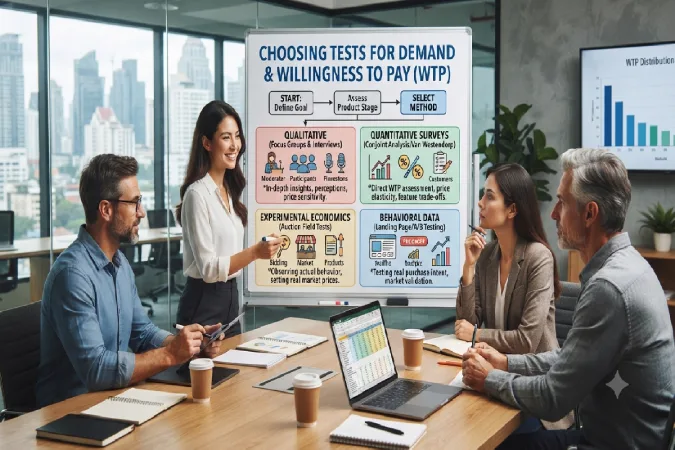
Use a validation ladder
Different experiments provide different levels of evidence.
A possible validation ladder is:
Level 1: Problem evidence
Customers confirm that the problem exists.
2: Engagement evidence
People willingly spend time learning about the proposed solution.
3: Intent evidence
Potential customers request more information, join a waitlist, request a demo, or agree to a pilot.
4: Commitment evidence
Customers provide a deposit, sign a letter of intent where appropriate, start a paid pilot, or otherwise make a meaningful commitment.
Level 5: Repeat behaviour
Customers continue using and paying for the solution.
The strongest evidence generally comes from behaviour rather than stated enthusiasm.
Test demand with a landing page
A simple landing page can explain:
- The problem
- The target customer
- The proposed solution
- Main benefits
- Example use cases
- A clear call to action
The call to action could be:
- Join the waitlist
- Request a demo
- Book a consultation
- Start a trial
- Request early access
Measure the completion of events connected with a page, not just page visits.
A heavy number of more uninterested visitors may be less evidential than a smaller number of relevant visitors requesting information.
Execution of a concierge test
A concierge MVP is a service that at the first stage is carried out manually, before fully automating it.
Imagine, for instance, that a company founder is interested in creating an automated reporting platform.
The founder could create a small handful of customer reports without any write code at all, by actually creating them manually.
This can reveal:
- Which reports customers actually use
- Which information matters most
- How often customers need reports
- What customers are willing to pay
- Which tasks should eventually be automated
Manual work can therefore become a learning mechanism rather than merely an inefficient version of the final product.
Use prototypes
A prototype can test whether customers understand and value a proposed experience before the full product exists.
Depending on the idea, a prototype could be:
- Wireframes
- Interactive mockups
- Product screenshots
- A clickable interface
- A sample report
- A service workflow
- A physical prototype
Ask potential customers to complete realistic tasks using the prototype.
Observe where they hesitate, what they misunderstand, and which functions they consider valuable.
Test willingness to pay
Interest and willingness to pay are different.
Someone may say:
“I would definitely use this.”
That does not establish that they will purchase it.
Pricing experiments can include:
- Asking customers about current spending
- Testing different pricing pages
- Offering paid pilots
- Accepting deposits where appropriate
- Presenting different packages
- Testing monthly versus annual plans
- Comparing different service levels
Early pricing should be treated as a hypothesis rather than a permanent decision.
Test demand with pre-sales
For some businesses, pre-sales can provide particularly useful evidence.
A founder might offer early access at a clearly defined price and delivery timeline.
However, the offer should be honest about what currently exists. Do not represent an unfinished product as fully operational.
Pre-sales can test several assumptions simultaneously:
- Problem relevance
- Offer clarity
- Price
- Buyer confidence
- Sales process
- Delivery expectations
Run small experiments
Validation experiments should be inexpensive enough that failure is acceptable.
Examples include:
- 20 customer interviews
- A targeted outreach campaign
- A landing-page test
- A webinar
- A manual service pilot
- A small advertising experiment
- A prototype usability test
- A paid consultation
- A limited geographic launch
The objective is learning, not creating the appearance of traction.
Build a Lean Plan Around the Evidence
Once research and experiments produce evidence, update the business plan.
Any lean startup plan is bound to be brief. To be effective, it shouldn‘t be a lengthy document that you create and then neglect. It should be a working model that evolves in response to the evidence gathered.
Define the validated customer segment
Update the customer profile based on research.
You may discover that the original target market was too broad.
For example, instead of:
“Small businesses”
the validated segment might become:
“Independent online retailers with five to twenty employees that manage inventory across multiple sales channels.”
Greater specificity can make product development, messaging, sales, and marketing more focused.
Clarify the value proposition
The value proposition should explain:
- Who the product is for
- What problem it solves
- What outcome it provides
- Why customers should consider it
A useful structure is:
For [target customer], who struggle with [problem], our solution helps them [desired outcome] by [key approach].
Avoid vague statements such as “innovative platform for modern businesses.”
Specificity makes the proposition easier to test.
Define the minimum viable offer
An MVP does not necessarily mean a basic version of every planned feature.
It means the smallest version of the offer that can test the most important business assumptions.
For a software startup, this might be a narrow product with one critical workflow.
Service startup, it might be a manually delivered service.
For a physical product, it could be a small production run.
The MVP should answer a meaningful question.
Build the revenue model
Identify how the business expects to generate revenue.
Possible models include:
- One-time purchases
- Subscriptions
- Usage-based pricing
- Transaction fees
- Commissions
- Licensing
- Consulting
- Service packages
- Advertising
- Freemium upgrades
Then estimate basic economics.
Important variables may include:
- Average revenue per customer
- Gross margin
- Customer acquisition cost
- Retention
- Churn
- Payback period
- Operating costs
Early estimates will contain uncertainty. The purpose is to identify which assumptions require additional testing.
Plan customer acquisition
A startup also needs a realistic method for reaching customers.
Potential channels include:
- Search
- Content marketing
- Founder-led sales
- Partnerships
- Communities
- Referrals
- Events
- Marketplaces
- Paid advertising
- Outbound sales
Do not assume every channel will work.
Test acquisition channels in small batches and compare the quality and cost of the resulting leads.
Establish a simple operating plan
A lean plan should also address how the business will deliver its promise.
Consider:
- Who performs the work?
- What technology is required?
- Which activities can be automated?
- What suppliers are needed?
- What support will customers require?
- What happens after purchase?
- What regulatory or contractual requirements apply?
A business can validate demand and still discover that delivery is too expensive or complex.
Therefore, operational feasibility should be tested alongside customer demand.
Decide Whether to Proceed, Revise or Stop
Validation is useful only when evidence influences decisions.
At the end of a testing cycle, founders should review what they learned and determine what happens next.
There are three broad possibilities:
Proceed: Evidence supports continuing with the current direction.
Revise: Some assumptions are supported, but important changes are needed.
Stop: The evidence does not justify continued investment in the current concept.
Stopping an idea is not necessarily a failure. If a low-cost experiment prevents a large investment in an unattractive opportunity, the experiment has generated valuable information.
Establish decision criteria
Before evaluating results, define criteria such as:
- Number of qualified customer interviews completed
- Percentage reporting the problem
- Number requesting a solution
- Number agreeing to a pilot
- Conversion rate from relevant traffic
- Willingness to pay
- Retention during an initial trial
- Cost of acquiring a customer
- Gross margin potential
The criteria should match the business model.
A consumer mobile application and a B2B consulting service will require different evidence.
Distinguish weak signals from strong signals
Not all evidence has equal value.
Weak signals may include:
- Social media likes
- Compliments
- Survey responses
- Casual interest
- Website visits without action
Stronger signals may include:
- Customers sharing detailed problems
- Existing spending on alternative solutions
- Demo requests
- Pilot participation
- Paid trials
- Deposits
- Repeat purchases
- Referrals
This does not mean weak signals are useless. They can help generate hypotheses, but stronger behavioural evidence is generally more useful when making significant business decisions.
Know when to revise the idea
A validation process may reveal that the problem is real but the proposed solution is wrong.
For example:
- Customers need the service but prefer a managed solution.
- Customers want the product but only at a different price.
- The original customer segment is not the strongest buyer.
- One feature is much more valuable than the rest.
- Customers prefer an existing workflow with a small improvement rather than a completely new system.
These findings can lead to a pivot or refinement.
The objective is not to protect the original idea. It is to identify a business model supported by evidence.
Create a validation scorecard
A simple scorecard can make the decision process more structured.
| Area | Evidence | Status | Next Action |
| Customer problem | 25 interviews confirmed recurring issue | Strong evidence | Continue |
| Target segment | Two segments showed interest | Unclear | Test segment priority |
| Willingness to pay | Several prospects accepted pilot pricing | Early evidence | Expand paid pilot |
| Acquisition | Outreach generated qualified conversations | Early evidence | Test larger sample |
| Delivery cost | Manual process is expensive | Risk | Simplify delivery |
| Retention | Too little usage data | Unknown | Run longer pilot |
The purpose is not to assign an arbitrary overall score. It is to make uncertainty visible and identify the next experiment.
Set a validation budget
Validation itself should have boundaries.
Decide how much money and time can be invested before the business reaches a decision point.
For example:
- Four weeks of customer research
- A defined number of interviews
- A fixed prototype budget
- A limited advertising test
- A small paid pilot
This prevents an experiment from continuing indefinitely without producing a decision.
A Practical Startup Validation Workflow
Founders can turn the framework into a repeatable process.
Step 1: Write the problem statement
Describe the customer, problem, frequency, and consequences.
2: List assumptions
Identify assumptions about customers, demand, pricing, acquisition, delivery, and economics.
3: Rank risks
Prioritise assumptions that are both uncertain and capable of materially affecting the business.
4: Research customers
Conduct interviews and observe actual behaviour.
5: Research alternatives
Identify direct competitors, indirect alternatives, manual processes, and current spending.
6: Estimate the market
Use realistic customer segments and transparent assumptions to estimate market opportunity.
7: Design small experiments
Choose the cheapest credible test for each major assumption.
8: Measure behaviour
Look for actions such as enquiries, pilots, payments, registrations, or repeat usage.
9: Update the business model
Change the customer segment, offer, pricing, channel, product scope, or operating model based on evidence.
10: Decide
Proceed, revise, or stop based on predefined criteria and what the evidence actually shows.
Step 11: Repeat
Validation does not end after the first experiment. New assumptions appear as the startup moves from concept to product, launch, and growth.
Common Startup Planning and Validation Mistakes
Building before validating
A founder may spend months developing a product before speaking to potential customers.
Early conversations and experiments can reveal whether the proposed solution deserves that investment.
Asking leading questions
Questions such as “Wouldn’t this save you a lot of time?” can encourage positive answers.
Neutral questions about real experiences provide better information.
Treating surveys as proof
Surveys can be useful for collecting information at scale, but stated intentions do not necessarily translate into purchases.
Use behavioural tests when possible.
Confusing competitors with market validation
Competitors might be a sign that there are customers who are paying for something, but it is not necessarily a sign that there is a new entrant opportunity.
Investigate the reasons why consumers select current products and identify unmet needs.
Too many variables tested. This increases the chance of finding a statistically significant relation just due to chance.
If a startup alters its audience, price, product, message, and acquisition channel simultaneously, it is hard to tell which one leads to what.
Keep experiments focused where practical.
Continuing because of sunk costs
Money and time already invested should not determine whether a startup continues.
The relevant question is whether future investment is justified by current evidence.
Assuming validation is permanent
Changes in the markets.
Customer requirements, competitors, technology, regulations, and price may evolve. It is important for a business to keep getting feedback after launch.
Conclusion
Startup planning and validation is about making better choices with less risk. Entrepreneurs can‘t remove risk, but they don‘t have to spend a lot on bases that haven‘t been tested.
Identify the customer problem and label assumptions and facts separately. Investigate customer behaviour, competitors, competition, and market size. Use a series of small experiments to test demand, price, acquisition, and delivery.
Evidence should inform how the lean business plan looks not be used to the shape it. If customers reacted positively then keep testing and increase your investment incrementally. The evidence was uncovered that showed weaknesses, then change your customer segment, offer, price, channel or product. If an important assumption consistently fails, stopping can protect resources for a stronger opportunity.