

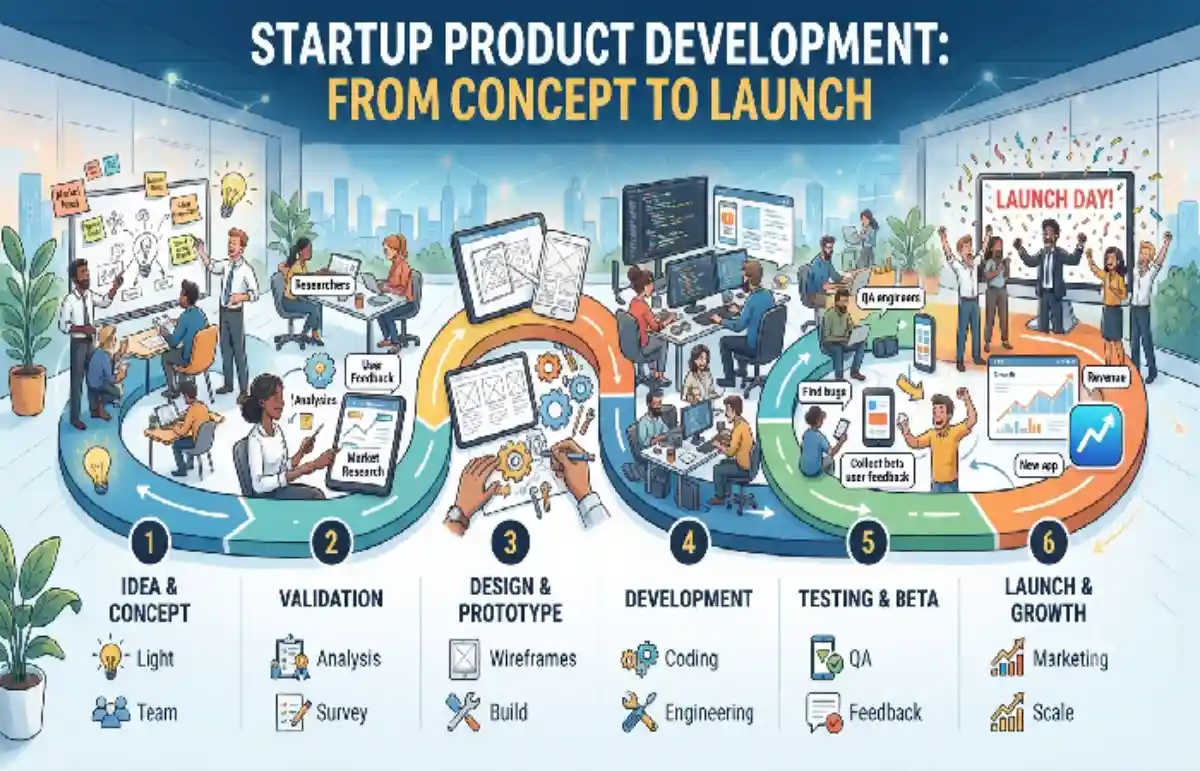
Startup Product Development: From Concept to Launch
Last Updated: September 29, 2026
The journey from validated customer problem to used, understood, paid for product is startup product development. It is the process that takes insights derived from customer discovery on one end, through product conception, using evidence-based assumptions, to customer validation on the other end.
Another mistake is to assume that product development is a competition to put on as many features as possible. A typical startup does not have very much money, time or people, therefore each feature has an associated opportunity cost. Building something that users do not want or use quickly uses up the budget without necessarily decreasing the risk of the business.
An improved method is to build your product by solving the key customer problem. First establish proof of concept, then create a minimum viable product (MVP), prototype the fundamental experience and test with the right customers and put in place the operational capabilities needed for completion.
Use the product as a learning system, not merely as an end. Creating the initial version doesn‘t mark the end of development. Gather customer feedback, monitor usage, look at support requests and business metrics and build on what you‘ve got.
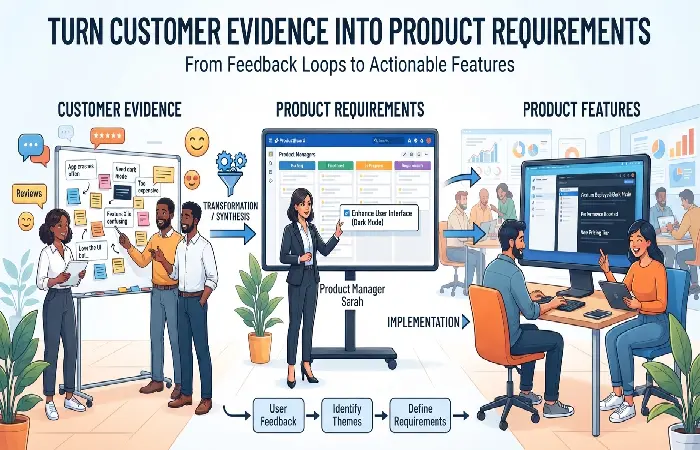
Turn Customer Evidence into Product Requirements
Product development starts with what you’ve learned about the customer, not a wish list of features that you‘d like to build.
Customer interviews/surveys/experiments/usability tests and early sales conversations can reveal pain points, workflows, preferences and limitations. However, customer research alone is not enough to become a product spec. Startups must interpret what they learn to articulate explicit product requirements.
Start by identifying the core customer problem.
For example, imagine a startup researching independent fitness studios. Interviews reveal that studio managers spend significant time manually coordinating class bookings, attendance and customer reminders.
The initial product idea might be:
A simple platform that helps independent fitness studios manage bookings and customer communication.
The research should then be converted into requirements.
Separate problems from requested features
Customers may suggest specific features during interviews:
- “We need an automated reminder.”
- “Can you add a calendar?”
- “We need WhatsApp notifications.”
- “I want a mobile app.”
These requests are useful, but they should not automatically become development requirements.
Ask what problem sits behind each request.
If customers request reminders, the underlying problem may be missed appointments. If they request a mobile app, the underlying need may simply be convenient access while they are away from a desk.
This distinction helps founders focus on outcomes rather than copying every suggested feature.
Create user-focused requirements
A useful product requirement describes what the user needs to accomplish.
For example:
Weak requirement:
Build a notification system.
Stronger requirement:
Customers should receive an appointment reminder before their scheduled class so they have an opportunity to confirm or cancel.
The second version describes the user outcome and provides clearer criteria for evaluating the product.
You can organise requirements into categories such as:
- Customer problem
- User goal
- Required workflow
- Functional requirement
- Usability requirement
- Technical constraint
- Business requirement
- Compliance or security requirement
Prioritise requirements
Not every requirement deserves equal attention.
A simple prioritisation framework is:
Impact × importance × evidence
A requirement deserves greater attention when it solves a significant problem, affects the core customer experience and is supported by strong evidence.
You can also classify requirements as:
- Must have: Essential to the core use case
- Should have: Valuable but not essential for the first release
- Could have: Useful if resources allow
- Not now: Deliberately excluded from the current product
This prevents the product roadmap from becoming an uncontrolled collection of ideas.
Connect requirements to evidence
Keep track of why a requirement exists.
For example:
| Requirement | Evidence | Priority |
| Online class booking | Repeated customer interviews | High |
| Appointment reminders | Missed appointments reported by customers | High |
| Advanced reporting | Mentioned by two customers | Medium |
| Custom branding | One customer request | Low |
This creates accountability. When the product team asks why something is being built, it should always relate to a customer problem, business need or technical requirement.
Define Your Minimum Viable Product
A minimum viable product is a minimum set of features that will all-allow a startup to learn- deliver value to a specific set of users.
The extent of the product is not a quality issue of the product, MVP is simply to keep the scope low so the startup can learn the critical assumptions and not implementing features that are not needed yet.
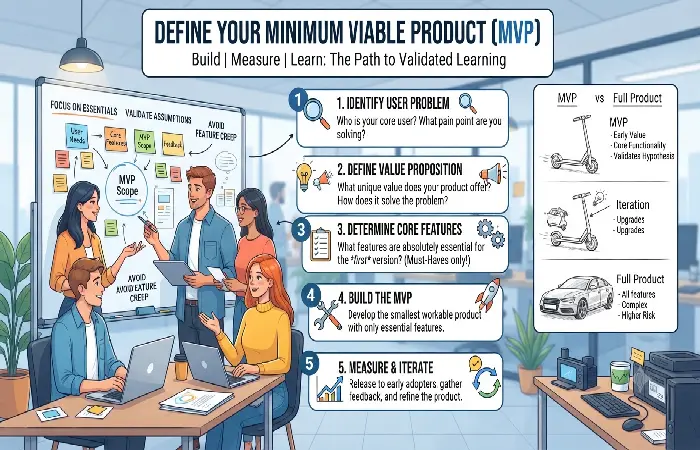
The central question is:
What is the smallest product that can solve the most important version of the customer’s problem?
Start with one core use case
A startup should be able to explain what the first product allows customers to accomplish.
For example:
“A small fitness studio can publish its class schedule, accept bookings and automatically notify customers.”
That may be enough to define the initial product.
Additional features such as loyalty programmes, advanced analytics, multiple payment currencies, complex permissions and extensive customisation may be useful later but could distract from the core experience.
Define the MVP boundary
Create three lists:
Included
Features required for the core customer outcome.
Excluded
Features that are deliberately postponed.
Unknown
Features where more evidence is needed before deciding.
For the fitness-studio example, an MVP might include:
- Studio account creation
- Class creation
- Online booking
- Basic customer records
- Booking confirmation
- Appointment reminders
- Simple administration dashboard
It might exclude:
- Advanced analytics
- Loyalty rewards
- Multi-location management
- Complex marketing automation
- Extensive visual customisation
The purpose of exclusion is important. If you do not explicitly define what will not be built, new requests can continuously expand the project.
Avoid solving several problems at once
Many startup products become too broad because founders attempt to solve multiple customer problems in the first release.
Suppose the target customer has problems with booking management, accounting, marketing, employee scheduling and inventory. A founder may be tempted to create an all-in-one platform.
That increases development complexity and makes it harder to determine which part of the product creates value.
A focused product can provide a clearer learning loop:
Problem → product → customer behaviour → evidence → improvement
Once the core use case is validated, additional capabilities can be added based on customer demand.
Define MVP success criteria
Before development begins, decide what you want to learn from the MVP.
Possible metrics include:
- Activation rate
- Number of users completing the core workflow
- Time to first successful outcome
- Trial-to-paid conversion
- Repeat usage
- Retention
- Customer support requests
- Task completion rate
- Customer acquisition cost
The appropriate metrics depend on the product.
A product that customers use once may require different measures from software expected to be used every day.
The MVP should therefore have both a product scope and a learning objective.
Prototype, Build and Test the Core Experience
Once the MVP is defined, move from requirements into design and development.
A useful product development process usually progresses through increasingly realistic versions rather than immediately building the full product.
Start with a prototype
A prototype allows founders to explore the user experience before committing significant development resources.
Depending on the product, a prototype could be:
- Paper sketches
- Wireframes
- Clickable screens
- Interactive mock-ups
- A manually operated service
- A basic technical proof of concept
The prototype should focus on the most important customer journey.
For a booking platform, this might be:
Find class → select time → enter details → confirm booking → receive confirmation
Testing this journey can reveal usability problems before engineering work becomes expensive.
Test the workflow, not just the design
A visually attractive interface does not guarantee that users can complete the intended task.
Give test users a realistic goal:
“You want to book a yoga class for Saturday morning. Show me how you would do it.”
Then observe what they do.
Look for:
- Where they hesitate
- What they misunderstand
- Which labels confuse them
- Where they expect something to happen
- What information they need
- Where they abandon the task
- Which steps feel unnecessary
Avoid immediately explaining how the interface works. If users repeatedly need assistance, the product may need improvement.
Build the smallest useful version
After prototype testing, development can focus on the core experience.
Break the product into manageable components:
- User entry
- Core workflow
- Data handling
- Confirmation or output
- Basic account management
- Support and error handling
The exact architecture depends on the product, but the principle remains the same: build around the validated workflow.
Make technical decisions based on the stage of the startup
Early startups often face a choice between building custom technology and using existing tools or services.
Existing services can reduce development time and allow the team to test demand faster. Custom development may become necessary when the product requires unique functionality, performance, security or control.
Consider:
- Development cost
- Time to launch
- Reliability
- Integration requirements
- Data ownership
- Security
- Scalability
- Vendor dependency
- Maintenance requirements
Avoid building complex infrastructure simply because it may be needed someday. At the same time, do not ignore technical constraints that could make later development unnecessarily difficult.
Test continuously
Testing should not happen only immediately before launch.
Use multiple levels of testing:
Functional testing: Does the feature work as intended?
Usability testing: Can customers understand and use it?
Compatibility testing: Does it work across relevant devices and environments?
Performance testing: Does it remain responsive under expected usage?
Security testing: Are customer accounts and information appropriately protected?
Regression testing: Did a new change break an existing workflow?
The level of testing should reflect the product’s risks. A consumer productivity tool and a product handling sensitive financial or healthcare information may require very different testing and controls.
Prepare Product Quality, Support and Release
The fact that the core features function properly is not enough to make a product marketable.
Customers see the complete service, such as implementation, documentation, customer service, billing, error message and communication.
Prepare a launch-readiness checklist
Before release, verify:
- Core workflows work correctly
- Important bugs are resolved
- Sign-up and login function properly
- Payment processes work if applicable
- Emails or notifications are configured
- Privacy and terms information is available
- Customer support channels are ready
- Analytics are working
- Error handling is tested
- Backup and recovery processes are understood
- Relevant security controls are in place
- Documentation or onboarding material is available
The exact checklist depends on the product and industry.
Prepare customer onboarding
A new customer should understand what to do after signing up.
A simple onboarding flow could include:
- Create an account
- Complete essential setup
- Add required information
- Perform the core action
- See the expected result
- Receive guidance on the next step
Measure time to first value where possible.
If customers need twenty minutes of instructions before experiencing the product’s benefit, the onboarding process may need improvement.
Build support before launch
Support should not be treated as something to add after customers complain.
Prepare:
- Frequently asked questions
- Help documentation
- Contact channels
- Support response procedures
- Bug-reporting process
- Escalation rules
- Customer communication templates
Early customers may report problems that the development team never anticipated. Make it easy for them to communicate those problems.
Create a release process
A repeatable release process reduces avoidable mistakes.
For each release, establish:
- What is changing
- Why it is changing
- What has been tested
- Who approves the release
- How the change will be monitored
- What happens if something goes wrong
For larger products, a staged rollout can reduce risk. A new feature might first reach a small group of users before becoming widely available.
Monitor the first release
Launching does not mean switching off observation.
Monitor:
- Product usage
- Errors
- Performance
- Customer support requests
- Conversion
- Retention
- Feedback
- Infrastructure costs
In the beginning, there is a high chance to see some gaps between the assumption of the team and the reality of customers.
Use Customer Feedback to Plan Improvements
The development, then, enters into an iterative cycle from this point on.
The product team now has several sources of evidence:
- Customer interviews
- Support requests
- Product analytics
- Sales conversations
- Reviews
- Feature requests
- Churn reasons
- Retention patterns
- Usability tests
The challenge is deciding which feedback deserves action.
Do not treat every request equally
One customer requesting a feature does not automatically mean it should be added.
Evaluate feedback using questions such as:
- How many customers experience this problem?
- How important is the problem?
- How frequently does it occur?
- Does it affect activation or retention?
- Is the request connected to the core customer segment?
- Does solving it support the product strategy?
- How much will it cost to build and maintain?
A feature that helps one customer but creates substantial complexity may not be the right priority.
Look for patterns
Suppose ten customers independently report that they cannot easily modify bookings. That repeated problem may deserve more attention than ten unrelated feature requests.
Group feedback by underlying problem rather than by individual feature.
For example:
| Customer feedback | Underlying problem |
| “Add a reschedule button” | Customers need easier booking changes |
| “Let me move appointments” | Customers need easier booking changes |
| “I have to cancel and create another booking” | Existing workflow is inefficient |
Three feature requests may actually represent one product problem.
Combine qualitative and quantitative evidence
Customer comments explain why something is happening. Product analytics can help show how often it happens.
For example, users might complain about a complicated checkout process. Analytics may show that many users leave at the payment step.
Together, these signals provide stronger evidence than either source alone.
However, analytics also require interpretation. A high abandonment rate could result from confusing design, unexpected pricing, payment failures, lack of trust or another issue.
Use data to identify questions, then investigate the underlying cause.
Create a product improvement backlog
Organise potential improvements into a structured backlog.
Each item can include:
- Customer problem
- Evidence
- Proposed change
- Expected impact
- Development effort
- Dependencies
- Priority
- Success metric
Avoid filling the backlog with every suggestion without review. A large backlog can create the illusion of progress while making strategic priorities unclear.
Run improvement cycles
A practical product cycle might look like:
Collect feedback → identify pattern → define problem → prioritise → design change → build → test → release → measure
This process creates a continuous learning loop.
The product roadmap must therefore be agile in reacting to evidence, yet retain its focus on the larger customer and business objectives of the startup.
Manage the Product Development Process as a Startup
Startup product development is a balancing act between speed and quality.
Moving slow can eat up resources before having enough evidence to proceed. Moving too quickly with the benefit of testing can create customer issues, technical debt and damage to reputation.
The level of return should, of course, reflect the complexity and risk of the product.
Keep teams aligned around outcomes
Developers, designers, marketers and founders should understand the customer problem the product is intended to solve.
Instead of saying:
“Build a dashboard.”
Explain:
“Managers need to identify uncompleted jobs quickly without checking individual employee records.”
The second statement gives the team more context for making design and technical decisions.
Document important decisions
Maintain lightweight documentation for:
- Product requirements
- Customer assumptions
- Technical decisions
- Known limitations
- Release notes
- Research findings
- Important product metrics
Documentation becomes increasingly valuable as the team grows.
Manage technical debt deliberately
Technical shortcuts are sometimes reasonable during early experimentation. However, founders should distinguish between a deliberate temporary shortcut and an unknown structural problem.
Track important technical debt and decide when it needs to be addressed.
For example, a manually maintained process may be acceptable for ten customers but become unsustainable at one thousand.
The product team should periodically ask:
- What is slowing development?
- What creates reliability risk?
- What will become expensive at higher scale?
- Which shortcuts are now limiting the business?
This keeps technical decisions connected to business growth.
Prepare for Launch with a Controlled Experiment
A launch should be treated as a significant learning event rather than simply a marketing announcement.
Before launching broadly, consider starting with a small group of appropriate users.
A controlled early release can help the team identify:
- Onboarding problems
- Technical errors
- Customer misunderstandings
- Support requirements
- Pricing objections
- Unexpected use cases
- Missing core functionality
Use early customers to improve the product before increasing distribution.
Define launch goals
A launch may have several objectives, such as:
- Acquire the first paying customers
- Test activation
- Validate onboarding
- Measure retention
- Generate customer case studies
- Test pricing
- Identify technical problems
Choose measurable goals rather than relying entirely on traffic or publicity.
A large number of visitors does not necessarily indicate product-market fit. A smaller number of relevant customers completing the core workflow can provide more useful information.
Communicate limitations honestly
An early product may not have every feature. Tell customers what the product currently does and does not do.
Clear expectations can reduce support problems and help early users provide more relevant feedback.
If the product is experimental or offered as an early-access version, communicate that appropriately.
Measure What Happens After Launch
The first release generates real-world evidence that should influence future development.
A useful measurement framework covers four areas:
Acquisition
How are people discovering the product?
Examples include:
- Organic search
- Referrals
- Partnerships
- Paid advertising
- Direct sales
- Social media
Activation
Do new users reach the product’s core value?
Possible metrics include:
- Account completion
- First key action
- Trial activation
- First successful transaction
Retention
Do customers continue using the product?
Depending on the business, measure:
- Repeat usage
- Subscription renewal
- Customer retention
- Churn
- Returning users
Revenue
Does product usage translate into business value?
Track metrics such as:
- Conversion to paid
- Average revenue per customer
- Recurring revenue
- Customer acquisition cost
- Gross margin
- Lifetime value estimates
Do not attempt to optimise every metric simultaneously. Identify the current bottleneck and focus product improvements around it.
Avoid Common Startup Product Development Mistakes
Several mistakes repeatedly create unnecessary complexity.
Building before validating
A startup can spend months developing a product before discovering that the underlying customer problem is weak.
Customer evidence should influence the product before major development investment.
Feature overload
Adding features can make a product harder to build and harder to understand.
A smaller product with a strong core workflow may provide more useful learning than a large product with many incomplete capabilities.
Ignoring usability
Even a technically working product can fail if consumers cannot figure how to use it.
Users should be tested early and often.
Addressing feedback as strategy
Customers can give useful feedback, but are unlikely to be aware of the long-term product strategy.
Identify trend and root cause rather than desperate to provide everything requested.
What are vanity metrics?
Interesting numbers are units such as downloads, page views, registrations etc. which, without corroborating evidence of substantial product value, give a false impression of success.
Connect the metrics to customer behaviour and your business.
Launching without support
Customers may encounter questions, errors or unexpected situations immediately after launch.
Support processes should be ready before the first significant group of customers arrives.
Conclusion
In startups product development is an ongoing process of translating evidence from a customer into a target product, observing how the product performs in reality and incrementally improving it. The most effective development process starts early on before the coders begin understanding what the customer problem is and evidence for it.
Begin with customer research to generate well-articulated product requirements. Establish the minimum viable product by identifying the minimum subset of features essential to achieving the primary customer intent. Develop prototypes of key workflows and test them before strong investment in build, then build and test iteratively.
Product launch and launch readiness encompasses more than just technical function. Onboard, support, analytics, security, documentation and release management all factor into the customer experience.
After product launch, monitor customer feedback and how the product is used to discover ongoing issues and direct the development of enhancements. Not all customer requests are worth the effort of development so look for trends that impact the customer and fit with the concept.
The objective is not simply to launch quickly. It is to create a repeatable learning cycle:
Customer evidence. Product requirements. Minimum viable product. Prototype. Build. Test. Launch. Measure. Improve.
In the context of the repeated loop of a startup, developing new products becomes both a structured method of cutting down uncertainty and learning from customers, and of constructing something that addresses a real and valuable problem.