

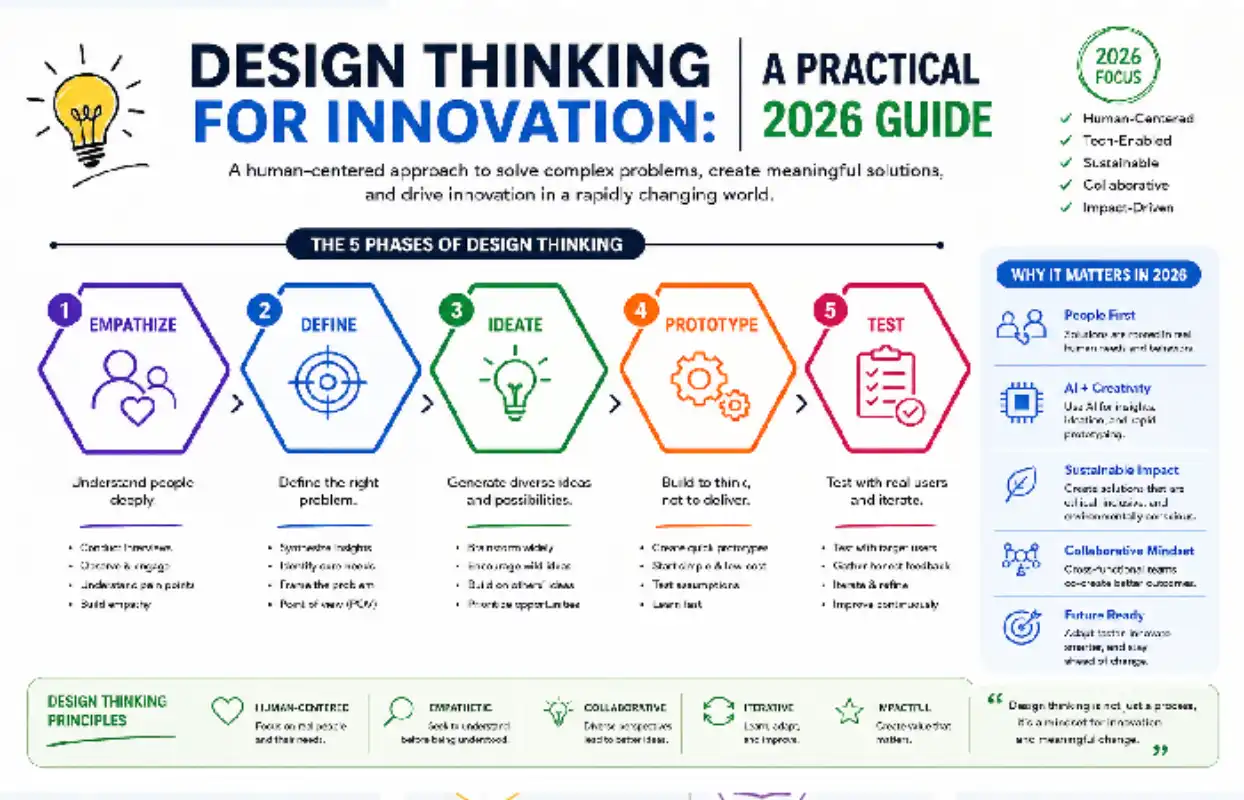
Design Thinking for Innovation: A Practical 2026 Guide
Last Updated: August 3, 2026
ItDesign Thinking for Innovation. 2026 No longer are the technology companies or the design studios the alone ones to carry out innovation. Organizations all over the health care, education, finance, manufacturing, retail and government industries are now using design thinking to find more humanistic and creative solutions for these challenges.
The design thinking process is a shift from focusing on either technology or business objectives to focusing instead on people. It helps organizations understand user needs thoroughly, establish real problems, test concepts and designs quickly, and iterate based on feedback to make better solutions.
What is Design Thinking?
Designing a human-centered approach to problem solving through creativity, research and prototyping A team takes time understanding behaviours, feelings, frustrations, and motivations.
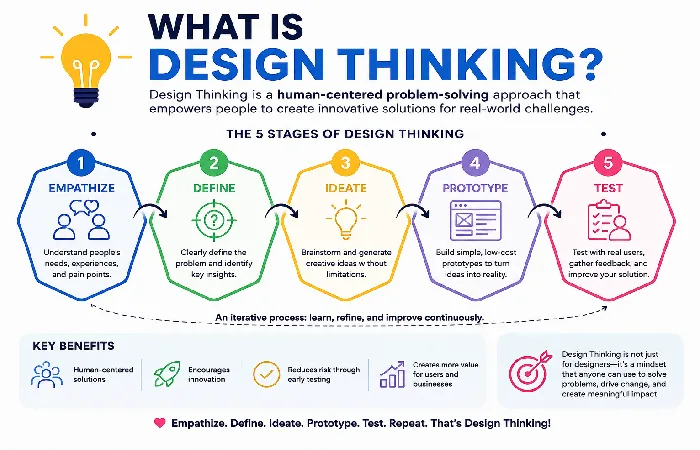
In doing so, the solutions come after having already put people first (as apposed to jumping the gap and building something based on assumptions).
Simple Definition
Design Thinking is a process that innovation method guided from a strong User focus in each decision point to deliver products, services and experiences people love.
Instead of asking:
- “What product should we build?”
- Design thinking asks:
- “What problem are people actually trying to solve?”
- That simple shift changes everything.
Why Design Thinking Matters in 2026
These days the rate of change in today’s competitive marketplace is snowballing at a frantic clip. Thanks to technologies such as artificial intelligence, automation, remote working, bespoke customer service, elevated customer expectations, etc, today business leaders are facing increasingly larger variable quantities of complex data factors than ever before.
Organizations that know how to institutionalize sustained innovation thrive than the firms that depend completely upon past conventional business planning practices and frameworks.
Design thinking helps organizations:
- Reduce development risks
- Discover unmet customer needs
- Improve user experience
- Encourage innovation
- Build better digital products
- Increase customer loyalty
- Shorten product development cycles
Instead of spending years building something customers might not want, businesses validate ideas early.
Characteristics of Design Thinking
Good design thinking includes several important characteristics.
- User-first mindset
- Creative problem solving
- Collaboration across teams
- Rapid experimentation
- Continuous learning
- Iterative improvements
- Evidence-based decisions
- Open communication
Together, these principles create an environment where innovation becomes repeatable instead of accidental.
Design Thinking vs Traditional Problem Solving
| Feature | Design Thinking | Traditional Approach |
| Focus | User needs | Business requirements |
| Research | Deep customer understanding | Limited upfront research |
| Process | Iterative | Linear |
| Failure | Encouraged for learning | Often avoided |
| Testing | Continuous | Usually at the end |
| Innovation | High | Moderate |
| Collaboration | Cross-functional | Department-based |
Design Thinking Process
It is usually involves five related stages. Though listed below, as teams get to know their users better, they tend to jump back and forth.
1. Empathize
Everything begins with understanding users.
Customer care Designers do not take the user for granted rather watch how user behaviours and interview and learn about how customer acts or feels.
Questions include:
- What frustrates users?
- What motivates them?
- What are their goals?
- What challenges do they experience?
- What factors influence feelings and decisions?
The objective is understanding—not selling.
2. Define
Next stage to collect findings. Then. Put that on an easy to understand statement, what is our problem?
Rather than saying:
“We need a better app.”
The team might define:
Most busy professionals find it challenging to record expenses on a daily basis simply because most existing apps would involve too much manual input.
A well-defined problem leads to better solutions.
3. Ideate
This stage encourages creativity without judgment.
Teams brainstorm many ideas before choosing one.
Common techniques include:
- Brainstorming
- Mind mapping
- Crazy 8s
- SCAMPER
- Reverse thinking
- Storyboarding
The goal isn’t finding one perfect idea.
It’s generating many possibilities.
4. Prototype
Ideas become tangible through simple prototypes.
A prototype can be:
- Paper sketches
- Wireframes
- Clickable app mockups
- Physical models
- Service blueprints
- Role-playing exercises
The prototype doesn’t need perfection.
It simply needs to communicate an idea.
5. Test
Users interact with prototypes while designers observe.
Testing reveals:
- Confusing features
- Missing functionality
- Unexpected behavior
- User preferences
- Improvement opportunities
Rather than fighting ideas, designers learn from users-18
Design Thinking Examples
How is it helping to change the way we get to experience the goods and services we currently have under every industry?
Healthcare
A hospital’s patients’ experiences become re-designs of patient experience watching the following:
- Waiting room anxiety
- Appointment scheduling
- Medical communication
- Navigation inside hospitals
These insights lead to smoother healthcare journeys.
Banking
Banks make mobile apps easier by focusing on what people do like the money transfers,bill payments and account management
Rather than addding features and making it more complicated, Banks take features out
Education
What we do Schools redesign teaching and learning using student interviews, in-school observation and shared professional development workshops.
Our approach is inclusive and makes learning fun and effective.
Retail
Retail brands improve shopping experiences by analyzing:
- Customer movement
- Checkout behavior
- Product discovery
- Digital interactions
Small improvements often increase customer satisfaction significantly.
Technology
Software companies frequently release beta versions to collect user feedback before launching final products.
This iterative approach reduces expensive redesigns later.
Empathy Mapping
Empathy mapping is perhaps one of the more important tools in design thinking. What empathy mapping does is help take that user research and consolidate into actionable and valuable information.
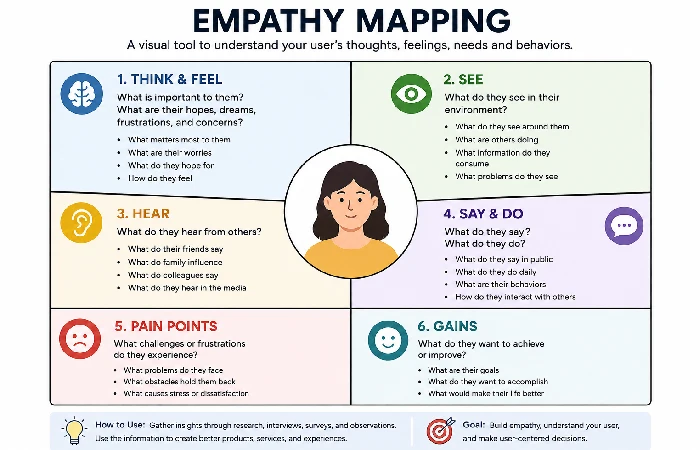
Instead of just viewing users as people who fall into certain demographics, designers also begin to think about those individuals from a more human perspective.
The Empathy Map uses visuals to translate what your users are thinking, feeling, saying and doing in their experience of a touchpoint.
It translates what you research into useful understanding.
Typical Empathy Map Sections
Think
What occupies the user’s mind?
Examples:
- “Is this worth my money?”
- “Will this save time?”
Feel
What emotions influence decisions?
Examples:
- Frustration
- Excitement
- Anxiety
- Confidence
Say
What users express verbally.
Examples:
- “This process is confusing.”
- “I expected something easier.”
Do
Observed behaviors.
Examples:
- Comparing products
- Leaving websites
- Asking questions
- Reading reviews
Benefits of Empathy Mapping
Empathy mapping helps organizations:
- Discover hidden pain points
- Improve communication
- Build better products
- Reduce assumptions
- Understand emotional behavior
- Improve customer experiences
The better teams understand people, the more useful their solutions become.
Prototype Testing
Prototypes let you see if an idea makes sense before spending hours/ money.
Rather than building a total product team would build learning an an experience instead of total product
Prototype testing the early and quick creation of a sample product to be tested by a selected group of real users in the early days of testing a products design
Types of Prototypes
Low-Fidelity
Simple sketches.
Examples:
- Paper drawings
- Whiteboard concepts
- Wireframes
These are quick and inexpensive.
Medium-Fidelity
More detailed interactive models.
Examples:
- Digital wireframes
- Clickable screens
- Process simulations
High-Fidelity
Almost identical to the final product.
Examples:
- Interactive mobile apps
- Functional websites
- Physical product models
What to Observe During Testing
Instead of asking users what they like, observe:
- Where they hesitate
- Where confusion occurs
- Which features they ignore
- Unexpected behaviors
- Emotional reactions
Observation often reveals more than interviews.
Benefits of Prototype Testing
Organizations benefit by:
- Reducing development costs
- Discovering usability issues
- Improving customer satisfaction
- Testing assumptions
- Increasing confidence before launch
- Accelerating innovation
Human-Centered Design
Underpinning Design Thinking is the ideology of the human-centred approach. Design thinking believes technology should adapt to people rather than people adapting to it.
Definition
Human-centered design: A process to design a product, service, or system in a way which people’s true needs, behaviors, attitudes and feelings are captured.
“Understand users, then decide on everything else.”
Core Principles
Empathy
Understand people’s lives before designing solutions.
Inclusion
Design for diverse users with different backgrounds and abilities.
Collaboration
Engineers, designers, marketers, researchers, and customers work together.
Iteration
Continuous improvement replaces one-time perfection.
Accessibility
Solutions should work for everyone whenever possible.
Benefits of Human-Centered Design
Organizations often experience:
- Better customer experiences
- Higher adoption rates
- Increased loyalty
- Lower redesign costs
- Improved accessibility
- Stronger brand reputation
- Better innovation outcomes
Common Design Thinking Tools
Several practical tools support each stage of the design thinking journey.
| Tool | Purpose |
| Empathy Maps | Understand users |
| Customer Journey Maps | Visualize experiences |
| Personas | Represent target users |
| Brainstorming | Generate ideas |
| Storyboards | Visualize scenarios |
| Wireframes | Early interface design |
| User Interviews | Collect insights |
| Usability Testing | Validate solutions |
These tools complement one another throughout the design process.
Advantages of Design Thinking
Organizations adopting design thinking often notice improvements beyond product design.
Better Innovation
Fresh ideas emerge naturally.
Lower Costs
Problems are identified before expensive development.
Faster Learning
When tested, faster improvement.
Improved Collaboration
Collaboration between departments is enhanced.
Higher Customer Satisfaction
The product matches the demands of its users.
Better Decision Making
Use of research over assumption.
Challenges of Design Thinking
Powerful, but you have to stick to implementation, though. Some frequently encountered issues:
- Resistance to organizational change
- Limited user research
- Time constraints
- Poor collaboration
- Inadequate testing
- Fear of experimentation
We will consider every hurdle as part of the learning curve instead of seeing it as a stopper in our way.
How Businesses Can Implement Design Thinking
Organizations beginning their design thinking journey should focus on gradual adoption.
Start With Real Problems
Avoid solving imaginary issues.
Talk to Customers Frequently
Regular interviews provide valuable insights.
Encourage Cross-Functional Teams
Different perspectives create stronger ideas.
Prototype Quickly
Don’t wait for perfection.
Test Early
Feedback reduces expensive mistakes.
Learn Continuously
Every prototype teaches something valuable.
Future of Design Thinking in 2026 and Beyond
Innovations like artificial intelligence, data analytics and immersive technologies are disrupting fields – yet design thinking is now more vital than ever. AI can find trends and streamline processes – but it cannot simulate human empathy, foresight, or a nuanced understanding of the context in which solutions are used.
Combining AI-derived intelligence and human-centered design is now an everyday affair for most organisations to develop more intelligent, and ultimately more human solutions.
Emerging trends include:
- AI-assisted ideation and research
- Sustainable and ethical product design
- Inclusive and accessible digital experiences
- Personalized customer journeys
- Remote collaborative design workshops
- Data-informed human-centered innovation
Organizations of the future will connect technology and a real human understanding to people.
Best Practices for Successful Design Thinking
- To maximize results, follow these practical recommendations:
- Listen more than you speak in the research.
- Focus on the user problem and not the solution you like the best.
- Build basic prototypes before spending too much money on one.
- Don’t take criticism of your ideas to heart, they are information for a better solution.
- Make it safe for diverse ideas and opinions to emerge from your team.
- Iterate based on evidence.
- Document your findings along the way. Always make the user the center of every decision.
These habits create a culture where innovation becomes consistent rather than occasional.
Conclusion
In my opinion, the design thinking model is maybe one of the biggest and best innovation frameworks in all the worlds, that take any company from making decisions on assumptions over assumptions, into human desires and frustrations. Using a holistic approach that involves the following techniques, organisations can feel more confident while innovating even to solve very complex issues and bring valuable solutions into people’s lives : empathy, creativity, experimentation and learning – that may be continuous learning as is the nature of this process.