

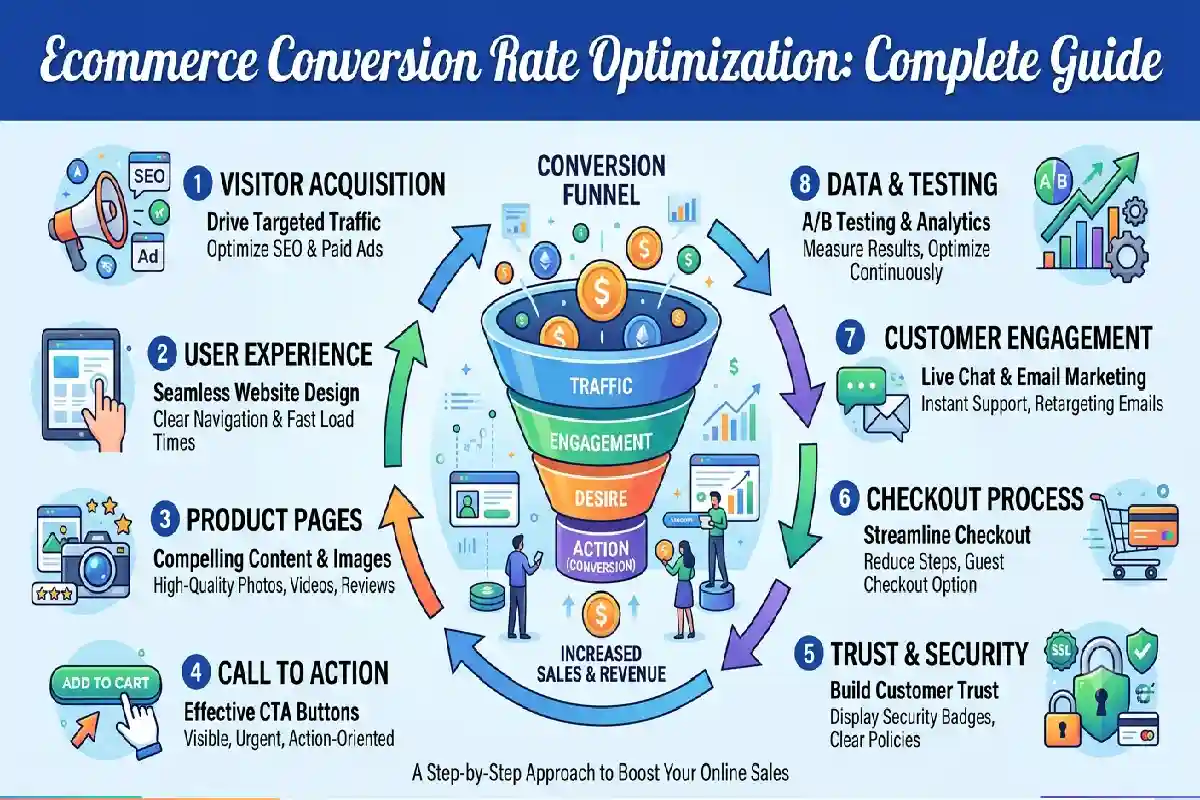
Ecommerce Conversion Rate Optimization: Complete Guide
Last Updated: September 13, 2026
Ecommerce Conversion Rate Optimization (CRO) is the behavior of designing your site to convert more of your visitors into buyers by reducing friction, enhancing the shopping experience, building trust and experimenting to discover what really works.
When you are driving traffic to your store but a number of orders isn‘t following through at the same pace, utilizing CRO can frequently be an initiative with higher leverage than increasing your ad expenditure.
Gets 100,000 visitors per month 100,000 visitors get (at 1% conversion rate) then it‘s has over 1,000 order. Now if the same store gets 1.5 % without change in traffic then it‘s over 1,500 order. It has increased its order number by 50% using the same set of traffic.
This is the fundamental promise of ecommerce conversion rate optimization.
But effective in CRO is not about shampooing buttons colors until you get 1 conversion. It s a succession of steps:
Define Mg.→ Measure Mg.→ Diagnose Mg.→ Prioritize Mg.→ Hypothesize Mg.→ Test Mg.→ Analyze Mg.→ Implement Mg.→ Repeat Mg.
This is the one to tell you how to build that process from scratch.
What‘s Ecommerce Conversion Rate Optimization?
Ecommerce conversion rate optimization (CRO) is the practice of enhancing an online store so that more of those visits result in the take-up of a goal most typically a sale.
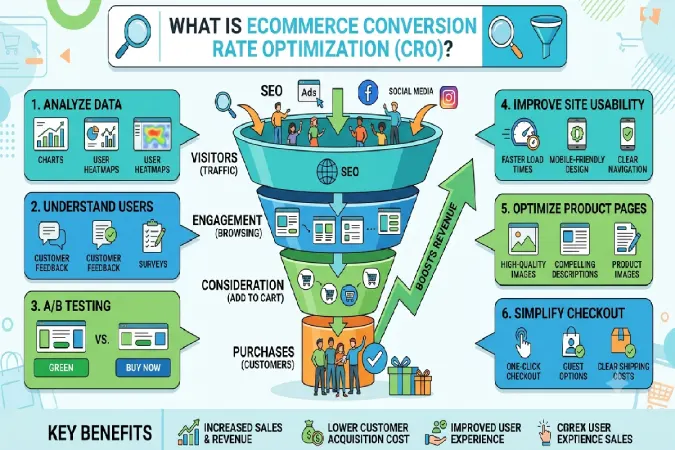
It involves analyzing:
- Website analytics
- Product-page behavior
- Search and navigation
- Mobile experience
- Site speed
- Product information
- Pricing and shipping
- Reviews and trust signals
- Cart behavior
- Checkout usability
- Customer feedback
- A/B testing
- Post-purchase behavior
It‘s about not just raising the conversion-rate percentage!
The key, then, is growing profitable conversions while safeguarding against lowering average order value, margin, customer satisfaction, and lifetime customer value.
That distinction matters.
A popup might increase email signups while reducing purchases. A discount might increase conversion rate while destroying profit. A shorter checkout might increase completed orders but also increase payment fraud.
Good CRO considers the entire business outcome—not one metric in isolation.
Ecommerce CRO in 2026: What the Data Says
There is no one critical conversion rate that every online shop should shoot for.
Table4 from spkS‘s benchmarking guide to 2026, shows a large variation across categories. SpkS‘s June 2026 screens show an estimated 5.32% for beauty & personal care, 4.58% for food & beverage, 2.77% for fashion & apparel, 1.76% for consumer goods, 1.29% for home & furniture and 0.63% for luxury & jewellery.
That range demonstrates why blindly comparing your store with a generic “2% average” can lead to poor decisions.
2026 Ecommerce Conversion Benchmarks
| Ecommerce category | Approx. June 2026 Shopify benchmark |
| Beauty & personal care | 5.32% |
| Food & beverage | 4.58% |
| Pet care & veterinary | 5.70% |
| Fashion, accessories & apparel | 2.77% |
| Consumer goods | 1.76% |
| Home & furniture | 1.29% |
| Luxury & jewelry | 0.63% |
Source: Shopify’s 2026 ecommerce conversion-rate benchmark data.
Why You Should Not Chase an Industry Average
Conversion rate is influenced by:
- Product price
- Product category
- Brand awareness
- Traffic source
- Returning vs. first-time visitors
- Mobile vs. desktop traffic
- Geographic market
- Seasonality
- Purchase frequency
- Subscription vs. one-time purchases
- Shipping costs
- Payment methods
- Customer intent
For example, a luxury store selling a $2,000 product cannot reasonably use the same conversion target as a snack subscription selling a $25 product.
A more useful question is:
“Is my store converting better than it was before, and are the improvements generating profitable incremental revenue?”
What is Ecommerce Conversion Rate Optimization?
CRO is the discipline of improving the percentage of visitors who take a desired action.
For ecommerce, the primary conversion is usually a completed purchase.
However, there are smaller micro-conversions throughout the customer journey.
For example:
Landing page → Product view → Product interaction → Add to cart → Checkout started → Payment → Purchase
Each step provides diagnostic information.
Suppose 50,000 people visit your store:
- 20,000 view a product
- 5,000 add an item to cart
- 3,000 begin checkout
- 1,000 purchase
Your overall conversion rate is 2%.
But the 2% headline number doesn’t tell you why the other 49,000 visits didn’t buy.
That is where CRO begins.
How to Calculate Your Ecommerce Conversion Rate
The basic formula is:
Ecommerce conversion rate= (Number of orders /Number of session) x 100.
For example:
- 20,000 sessions
- 400 orders
400 ÷ 20,000 × 100 = 2%
Your ecommerce conversion rate is therefore 2%.
Shopify’s current benchmark guidance similarly defines ecommerce conversion rate using completed orders divided by website visits/sessions.
Sessions vs. Users: Which Should You Use?
Be consistent.
If your analytics platform reports conversion rate based on sessions, use sessions when comparing periods.
Do not compare:
- January orders ÷ January sessions
against:
- February orders ÷ February unique users
and assume the difference represents CRO performance.
The denominator matters.
A Better Ecommerce Measurement Framework
Track at least these metrics:
| Metric | What it tells you |
| Conversion rate | Overall purchase efficiency |
| Add-to-cart rate | Product-page buying intent |
| Checkout-start rate | Cart-to-checkout progression |
| Checkout completion | Checkout friction |
| Cart abandonment | Potential purchase leakage |
| AOV | Revenue generated per order |
| Revenue per session | Commercial value of traffic |
| Refund rate | Quality of acquired conversions |
| Customer lifetime value | Long-term value |
| Gross margin per order | Profitability of conversion improvements |
One particularly useful metric is revenue per session.
A conversion-rate increase is not automatically a win if average order value falls sharply.
Why Conversion Rate Alone Can Mislead You
Imagine two versions of a store.
Store A
- Conversion rate: 3%
- AOV: $40
- Revenue per 1,000 sessions: $1,200
Store B
- Conversion rate: 2.5%
- AOV: $60
- Revenue per 1,000 sessions: $1,500
B converts fewer visitors but generates more revenue.
This is why CRO should ultimately connect to business metrics.
A strong CRO program asks:
Did more people buy?
Then:
Did they buy enough to improve revenue and profit?
And finally:
Did the change improve the customer experience without creating a downstream problem?
How to Identify Why Ecommerce Visitors Aren’t Buying
This is the most important part of ecommerce CRO.
Do not start by changing your homepage.
Start by finding the biggest leak.
Step 1: Build Your Conversion Funnel
Your first diagnostic funnel might look like this:
Sessions
↓
Product views
↓
Add to cart
↓
Checkout started
↓
Payment submitted
↓
Purchase
Track each stage separately.
Example Funnel
| Funnel stage | Visitors | Conversion from previous stage |
| Sessions | 100,000 | — |
| Product views | 55,000 | 55% |
| Add to cart | 8,000 | 14.5% |
| Checkout started | 5,000 | 62.5% |
| Purchases | 2,000 | 40% |
The overall purchase conversion rate is 2%.
But the biggest diagnostic opportunity may be the product-view-to-cart transition.
That is much more actionable than simply saying:
“Our conversion rate is low.”
Step 2: Segment Your Data
Never analyze your ecommerce conversion rate as one giant number.
Break it down by:
Device
- Mobile
- Desktop
- Tablet
Traffic source
- Organic search
- Paid search
- Paid social
- Organic social
- Direct
- Referral
New vs. returning
Returning visitors often behave differently from first-time visitors.
Product
A store-wide average can hide a serious problem with one product category.
Geography
Shipping availability, taxes, currency, payment methods, and delivery expectations can affect conversion dramatically.
Landing page
Your homepage visitors may behave very differently from shoppers arriving directly on a product page through Google Shopping or paid advertising.
Step 3: Use Behavioral Evidence
Analytics tells you what happened.
Behavioral tools can help explain why.
Useful evidence includes:
- Heatmaps
- Session recordings
- Scroll-depth analysis
- On-site search terms
- Exit surveys
- Customer-support conversations
- Review analysis
- Post-purchase surveys
- Usability testing
For example:
This could be due to the fact that the analytics shows 80% got through to a product, but only 4% actually put it into their shopping carts.
A recording may show that mobile users repeatedly scroll trying to find delivery details.
A customer survey may show that the customer doesn‘t know whether or not a return is free.
Now you have a hypothesis:
People are reluctant to buy because all details about delivery and return are not available soon enough.
That is much stronger than:
“Make the Add to Cart larger.”
Step 4: Look for Intent Mismatch
Not every visitor is ready to buy.
Someone searching:
“best running shoes for flat feet”
Someone searching:
Nike Pegasus Size 10 Price
Is way more in the direction of purchase intention.
If your traffic strategy delivers high numbers of low-intent visitors, your conversion rate could be low even with an optimised product page.
Thus, CRO isn‘t enough to balance bad traffic quality.
Always ask:
Are the right people arriving on the right page with the right expectations?
Step 5: Check Technical Problems
Before redesigning anything, check for obvious technical failures.
Test:
- Mobile checkout
- Add-to-cart functionality
- Product variants
- Coupon codes
- Payment methods
- Shipping calculation
- Search
- Filters
- Broken links
- Images
- JavaScript errors
- Browser compatibility
- Form validation
- Currency selection
- Inventory messaging
Technical problems are not A/B-test opportunities.
If your checkout button does not work on iPhone Safari, fix it immediately.
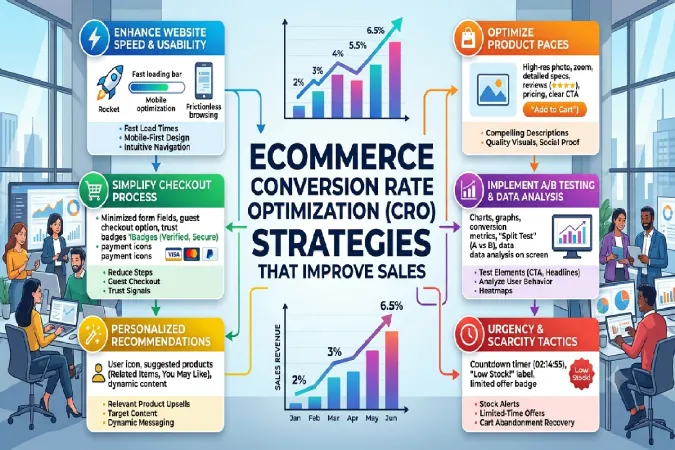
Ecommerce Conversion Rate Optimization Strategies That Improve Sales
1. Improve Your Value Proposition
Visitors should understand three things almost immediately:
- What are you selling?
- Who is it for?
- Why should they buy from you?
A vague headline creates cognitive work.
Weak
Premium Products for Modern Living
Stronger
Ergonomic Office Chairs Designed for 8+ Hours of Comfortable Work
The second version communicates the product, audience, and benefit much faster.
2. Optimize Product Pages First
For most ecommerce businesses, the product page is one of the most important conversion assets.
A strong product page should answer:
- What is this?
- Why should I want it?
- How much does it cost?
- What does it look like?
- How big is it?
- What materials are used?
- How does it work?
- When will it arrive?
- Can I return it?
- What do other customers think?
- Is payment secure?
Product Page Comparison
| Weak product page | CRO-focused product page |
| Generic product title | Specific descriptive title |
| One small image | Multiple high-quality images |
| Generic description | Benefits + specifications |
| Hidden shipping information | Delivery information near CTA |
| No reviews | Relevant customer reviews |
| Unclear returns | Visible return policy |
| Weak CTA | Clear Add to Cart action |
| No product demonstration | Video or interactive media |
| Limited size information | Detailed sizing guide |
| No reassurance | Trust signals and guarantees |
The objective isn’t to make the page longer.
It is to remove unanswered questions.
3. Use Better Product Images
Product imagery is especially important because online shoppers cannot physically touch the product.
Use:
- Front views
- Side views
- Close-ups
- Scale references
- Lifestyle photography
- Product-in-use images
- Packaging images where useful
- Size comparisons
- Short demonstration videos
For certain products, video can answer questions that text cannot.
For example, clothing shoppers may want to see movement and fit.
Furniture shoppers may want to see scale.
Electronics shoppers may want to see how the product actually works.
4. Put Reviews Near the Decision Point
Reviews work best when they answer purchase objections.
Instead of displaying only:
⭐⭐⭐⭐⭐ 4.8/5
show useful evidence:
- Verified purchase
- Review date
- Product variant
- Customer photos
- Specific benefits
- Common complaints
- Fit information
- Use case
A review saying:
“Looks great.”
is less useful than:
“I bought the medium for a 38-inch chest and the fit was accurate. After washing it twice, the fabric still feels the same.”
Specificity creates credibility.
5. Make Pricing Easy to Understand
Unexpected costs are one of the biggest conversion killers.
According to the latest Baymard shopping cart abandonment research, the average documented rate of cart abandonment was 70.22% over 50 studies. For non-browsing/not ready reasons, 40% of shopping cart abandonments were due to high extra costs, 20% due to slow delivery, 19% due to lack of trust, 18% due to forced creation of accounts and 17% due to length or complexity of checkout.
This substantiates making Price Transparency a CRO priority.
Show where possible:
- Product price
- Shipping cost
- Taxes
- Delivery estimate
- Duties
- Subscription terms
- Minimum order requirements
Do not wait until the final payment screen to reveal major costs.
6. Reduce Checkout Friction
Checkout should have one job:
Help the customer complete the purchase.
Remove unnecessary distractions.
Consider:
- Guest checkout
- Autofill
- Express payment options
- Fewer form fields
- Clear error messages
- Multiple payment methods
- Mobile-friendly inputs
- Visible order summary
- Clear shipping information
- Simple returns information
- Progress indicators where appropriate
Baymard’s extensive checkout research has identified thousands of usability issues across leading ecommerce checkout experiences.
7. Don’t Force Account Creation
Forcing registration before purchase creates unnecessary friction.
Instead:
Buy as guest → offer account creation after purchase
The customer has already demonstrated trust by completing the transaction.
You can then offer:
“Create an account using your order details to track future purchases faster.”
That is a much more natural proposition.
8. Optimize for Mobile
Mobile deserves its own CRO strategy.
Shopify’s 2026 benchmark guide reports that mobile devices accounted for 69.9% of website visits in 2026, making mobile experience impossible to treat as a secondary consideration.
Check:
- Navigation
- Search
- Product images
- Sticky Add to Cart
- Variant selection
- Form fields
- Keyboard behavior
- Payment experience
- Popups
- Chat widgets
- Page speed
One interesting 2026 performance study using Chrome UX Report data found that only 36% of the largest online stores in its sample passed Core Web Vitals on mobile, compared with about 65% of smaller stores.
The lesson isn’t simply “make your site fast.”
It is:
Measure real-user performance instead of assuming a large ecommerce site automatically provides a good mobile experience.
9. Improve Site Search
Search is especially important for visitors who already know what they want.
A useful ecommerce search experience should support:
- Typo tolerance
- Synonyms
- Product suggestions
- Filters
- Categories
- Availability
- Relevant sorting
- Useful zero-result pages
Track what people search for.
If hundreds of visitors search for a product you sell but the search system returns zero results, you have discovered a CRO opportunity without running an A/B test.
10. Improve Navigation and Product Discovery
Visitors should not need to understand your internal catalog structure.
Organize categories around how customers think.
For example, a fashion store might offer:
Women → Dresses → Occasion → Wedding Guest
rather than forcing customers through complicated product taxonomy.
Use:
- Clear categories
- Useful filters
- Breadcrumbs
- Search
- Sorting
- Recently viewed products
- Related products
11. Use Trust Signals at the Right Moment
Trust is contextual.
Place reassurance where hesitation occurs.
Examples include:
Product page
- Reviews
- Warranty
- Returns
- Product certifications
- Secure payment messaging
Cart
- Delivery estimate
- Shipping cost
- Return policy
Checkout
- Payment security
- Accepted payment methods
- Customer support
- Clear refund/return terms
Avoid filling the page with meaningless badges.
Five credible trust signals are usually better than twenty generic icons.
12. Make Your CTA Clear
Your CTA should tell the visitor what happens next.
Depending on the context:
- Add to Cart
- Buy Now
- Start Free Trial
- Choose Your Size
- Subscribe & Save
Do not rely on color alone to communicate importance.
CTA clarity includes:
- Text
- Placement
- Size
- Contrast
- Whitespace
- Mobile usability
- Proximity to product information
13. Show Delivery Information Earlier
Delivery uncertainty can stop a purchase.
Instead of:
Shipping calculated at checkout
consider:
Free delivery arrives by September 18
or:
Order within 4 hours for dispatch today
Only use urgency statements when they are accurate.
False scarcity may produce short-term clicks but can damage customer trust.
14. Make Returns Easy to Understand
A customer may ask:
“What happens if I don’t like it?”
Answer that question before they have to search for it.
Explain:
- Return window
- Eligibility
- Return shipping
- Refund timing
- Exchange policy
- Exceptions
For higher-priced products, this can be especially important.
15. Use Personalization Carefully
Personalization can help shoppers discover relevant products faster.
Examples:
- Recently viewed items
- Recommended products
- Location-based shipping information
- Personalized offers
- Relevant category suggestions
- Returning-customer recommendations
But personalization should improve relevance—not create creepy experiences.
Use customer data responsibly and transparently.
16. Recover Abandoned Carts
Not every abandonment can or should be recovered.
Baymard’s research notes that 42% of US online shoppers reported abandoning a cart because they were simply browsing or weren’t ready to buy.
That means a cart-recovery campaign should not assume every abandoned cart represents a lost sale.
Useful recovery approaches include:
- Email reminders
- Saved carts
- Retargeting
- Back-in-stock notifications
- Price-drop alerts
- Customer-support follow-up
Avoid immediately offering a discount to everyone.
You may train customers to abandon their carts intentionally.
17. Test Offers Without Destroying Margin
CRO is not synonymous with discounts.
Test:
- Free shipping threshold
- Bundle pricing
- Volume discounts
- Gift with purchase
- Subscription savings
- Extended warranty
- Loyalty rewards
Measure both:
Conversion rate
and
Contribution margin
A promotion that increases conversion from 2% to 3% but cuts profitability by 40% may be a terrible CRO experiment.
18. Improve Product Comparison
When shoppers are choosing between products, make the decision easier.
For example:
| Feature | Basic | Premium | Pro |
| Core function | ✓ | ✓ | ✓ |
| Advanced feature | — | ✓ | ✓ |
| Warranty | 1 year | 2 years | 3 years |
| Best for | Occasional use | Regular use | Heavy use |
| Price | $ | $$ | $$$ |
This reduces comparison effort.
For complex products, a comparison table can be more persuasive than another paragraph of marketing copy.
19. Use FAQs to Remove Objections
Product FAQs should come from real customer questions.
Useful sources include:
- Customer service tickets
- Live chat
- Product reviews
- Search queries
- Sales calls
- Returns
- On-site search
Examples:
- Does it fit X?
- How long does shipping take?
- Can I return it?
- Is this compatible with X?
- What is included?
- How does the warranty work?
The best FAQ is not generic SEO filler.
It answers real objections.
20. Optimize the Post-Purchase Experience
CRO should not stop when the order is placed.
Post-purchase experience affects:
- Refunds
- Reviews
- Repeat purchases
- Referrals
- Customer lifetime value
Improve:
- Order confirmation
- Tracking
- Delivery updates
- Product education
- Review requests
- Cross-sells
- Replenishment reminders
- Loyalty programs
A loyal customer who repurchases can have a higher value than that associated with attracting a new first-timer.
How to Prioritize Ecommerce CRO Tests
There are just not enough hours in the day (to test everything).
Apply a face management model prioritization model.
One practical approach is:
Priority Score = Impact × Confidence × Reach ÷ Effort
In accordance with the available literature and the experiences I have encountered in dealing with children of various age ranges I have made an attempt to rate these factors on a scale of 1–5. The scale would be as:
Example
| CRO idea | Impact | Confidence | Reach | Effort | Priority |
| Show shipping cost earlier | 5 | 5 | 5 | 2 | High |
| Redesign footer | 1 | 2 | 4 | 3 | Low |
| Improve mobile checkout | 5 | 5 | 5 | 4 | High |
| Change CTA color | 2 | 2 | 5 | 1 | Medium |
| Add product video | 4 | 4 | 4 | 3 | High |
This spares the CRO team two weeks of testing inconsequental design details while the badly broken checkout experience sits in the forefront.
How to Test and Measure Conversion Rate Improvements
Step 1: Establish a Baseline
Record:
- Conversion rate
- Revenue
- Orders
- AOV
- Add-to-cart rate
- Checkout completion
- Device split
- Traffic sources
Do this before making major changes.
Step 2: Write a Hypothesis
Avoid:
“Let’s improve the product page.”
Write:
“Because mobile shoppers cannot easily see delivery information near the purchase CTA, adding a delivery estimate above Add to Cart will increase mobile add-to-cart rate without reducing AOV.”
Now you have:
Problem → Evidence → Change → Expected result → Guardrail
That is a testable hypothesis.
Step 3: Choose the Right Test
A/B testing
Best when:
- You have enough traffic
- The change can be isolated
- You can run the experiment for an appropriate period
Usability testing
Best when:
- You don’t know why users struggle
- The site has complicated interactions
- You need qualitative insight
Heatmaps
Best for:
- Scroll behavior
- Click patterns
- Attention
- Dead areas
Session recordings
Best for:
- Navigation problems
- Form errors
- Rage clicks
- Mobile behavior
- Unexpected interaction patterns
Surveys
Best for:
- Purchase objections
- Customer motivation
- Missing information
- Perceived barriers
Analytics
Best for:
- Funnel leakage
- Segmentation
- Trends
- Revenue impact
The strongest CRO programs combine these methods.
Step 4: Define Primary and Guardrail Metrics
Your primary metric might be:
Purchase conversion rate
But also track guardrails:
- AOV
- Revenue per session
- Gross margin
- Refund rate
- Cancellation rate
- Customer complaints
- Checkout errors
This prevents false wins.
Step 5: Don’t Declare Victory Too Early
A small conversion-rate increase may simply be random variation.
Avoid ending an experiment because:
“Version B is 12% higher after two days.”
Give experiments enough time and sample size to produce meaningful evidence.
For stores with limited traffic, consider whether a formal A/B test is appropriate at all. Small samples can make statistical conclusions unreliable.
In lower-volume stores, fixing obvious usability problems and monitoring performance before and after implementation may be more practical than continuously running underpowered experiments.
A Practical 90-Day Ecommerce CRO Roadmap
Days 1–30: Diagnose
Week 1
Audit:
- Analytics
- Tracking
- Checkout
- Mobile UX
- Site speed
- Product pages
Week 2
Analyze:
- Conversion funnel
- Device
- Traffic source
- Product
- Geography
- New vs. returning users
Week 3
Collect qualitative evidence:
- Session recordings
- Heatmaps
- Reviews
- Customer support questions
- Surveys
Week 4
Create:
- Problem backlog
- CRO hypotheses
- Impact/effort scores
- Testing roadmap
Days 31–60: Fix and Test
Prioritize obvious problems first.
Examples:
- Broken checkout
- Hidden shipping costs
- Missing product information
- Poor mobile layout
- Confusing navigation
- Weak search
- Unclear returns
Then begin controlled experiments on uncertain changes.
Days 61–90: Scale What Works
For successful experiments:
- Validate the result.
- Monitor revenue and margin.
- Roll out the winner.
- Document what happened.
- Add the learning to your CRO knowledge base.
- Find the next largest funnel leak.
CRO becomes powerful when it becomes a continuous operating process rather than a one-time website redesign.
Ecommerce CRO Troubleshooting Guide
Problem: High traffic but very few purchases
Check:
- Traffic quality
- Landing-page relevance
- Product-market fit
- Pricing
- Product-page clarity
- Trust
- Shipping costs
- Mobile experience
Do not immediately assume the website design is the problem.
Problem: Product views are high but add-to-cart rate is low
Investigate:
- Product images
- Price
- Reviews
- Product description
- Variant selection
- Shipping information
- Delivery estimates
- CTA visibility
- Product-market fit
This usually points toward the product-detail stage of the funnel.
Problem: Lots of carts but few checkouts
Investigate:
- Shipping surprises
- Taxes
- Delivery times
- Coupon problems
- Cart usability
- Account requirements
- Trust
Baymard’s 2026 research specifically highlights extra costs, slow delivery, trust concerns, forced account creation and complicated checkout among major abandonment reasons.
Problem: Checkout starts are high but completed orders are low
Focus heavily on:
- Payment failures
- Form complexity
- Mobile checkout
- Guest checkout
- Payment methods
- Error messages
- Shipping surprises
- Technical bugs
Do not redesign your homepage until this problem is understood.
Problem: Desktop converts but mobile doesn’t
Compare:
- Page speed
- Navigation
- Product images
- Sticky CTA
- Forms
- Payment experience
- Popups
- Cookie banners
- Chat widgets
- Variant selectors
Test the actual mobile experience on physical devices.
Problem: Conversion rate increased but revenue did not
Check:
- AOV
- Discount usage
- Product mix
- Refunds
- Cancellation
- Margin
- Customer acquisition source
The conversion rate may have improved while the economics deteriorated.
Ecommerce CRO Tools and What Each Is For
You don’t need every CRO tool.
Build a stack around the questions you need answered.
| Tool type | Main question answered |
| Analytics | What happened? |
| Funnel analysis | Where did users drop? |
| Heatmaps | Where did users interact? |
| Session recordings | What did users actually do? |
| Surveys | Why did users hesitate? |
| A/B testing | Which version performs better? |
| Speed monitoring | Is performance hurting UX? |
| Customer support data | What questions keep appearing? |
| Product analytics | Which products/categories perform best? |
The tool is less important than the question.
A sophisticated analytics platform cannot compensate for poor measurement.
What Makes a Good Ecommerce CRO Program?
A mature CRO program has five characteristics.
- It starts with evidence
Not opinions.
- It focuses on revenue impact
Vanity metrics no
- It prioritizes the biggest problems
Not the easiest design changes.
- It tests uncertainty
Obvious bugs are fixed; uncertain ideas are tested.
- It documents learning
Every test should teach the team something.
Even a failed experiment can be valuable if it eliminates a bad assumption.
2026 Ecommerce CRO Trends to Watch
The CRO landscape is moving beyond simple button and layout testing.
AI-assisted personalization
AI can help personalize product discovery, recommendations and customer experiences.
But personalization should be measured against business outcomes rather than implemented simply because it is fashionable.
First-party data
Voyado’s 2026 ecommerce research reports that 57% of surveyed ecommerce leaders plan to build strategies around first-party data, while 68% identify conversion as a top priority for 2026.
This increases the importance of:
- Customer profiles
- Purchase history
- Consent-based personalization
- Loyalty data
- Email engagement
- On-site behavior
Mobile-first optimization
Mobile is no longer simply one channel among many.
For many stores, it is the dominant browsing environment.
Experimentation beyond the website
CRO increasingly overlaps with:
- SMS
- Product recommendations
- Search
- Merchandising
- Pricing
- Loyalty
- Checkout
- Retention
The modern CRO question is becoming:
How can we remove friction from the entire customer journey?
Ecommerce CRO Checklist
Use this checklist before launching a CRO program.
Measurement
- Purchase tracking works
- Revenue tracking works
- AOV is tracked
- Add-to-cart events work
- Checkout events work
- Device segmentation is available
- Traffic-source segmentation is available
Product pages
- Clear product title
- Strong product images
- Useful product description
- Reviews
- Pricing clearly displayed
- Shipping information
- Returns information
- Product specifications
- Clear CTA
- Mobile-friendly layout
Cart
- Shipping costs are transparent
- Delivery estimate is visible
- Quantity editing is easy
- Remove item works
- Discount codes work
- Checkout CTA is obvious
Checkout
- Guest checkout available
- Mobile-friendly forms
- Multiple payment methods
- Clear error messages
- No unnecessary fields
- Order summary visible
- Shipping information clear
- Trust information available
Testing
- Hypothesis documented
- Primary metric selected
- Guardrail metrics selected
- Test duration planned
- Test result documented
- Winner validated
- Learning recorded
Frequently Asked Questions
What does ecommerce conversion rate optimization mean?
Ecommerce conversion rate optimization is the science of converting as many of your website visitors as possible into customers, or persuading them to take a desired action, such as buying. It applies analytics, user research, customer feedback and testing to eliminate obstacles and enhance the buying process.
So what is a good ecommerce conversion rate?
If a “good” conversion rate does exist, it will be different according to the sectors. As of 2026, the conversion rate for Shopify, there is a wide variation according to the ecommerce sectors, from below 1% in some luxury categories to over 5% in some beauty, food and pet related categories.
Best proxy: a similar segment and your personal historical data.
How do we compute ecommerce conversion rate?
Use:
Conversion Rate = Orders Sessions100.
For instance, 100 orders from 5,000 sessions gives you a conversion rate of 2%.
How should I improve my ecommerce conversion rate?
Identify point 1largest funnel leak. Then increase product-page understanding in
- pricing translucency
- trust
- mobile UX
- site speed
- checkout usability
- shipping information
- payment options.
Then test change counters based on data, not assumptions.
What is the average ecommerce cart abandonment rate?
As of now, the average research covered for documented online shopping cart abandonment rate is 70.22%, as reported by Baymard. For the 50 research covered, is the documented average online shopping cart abandonment.
However, not all deserted shopping carts indicate missed sales, since some users may be browsing, doing price comparisons, or just not in their buying decision at the moment.
A/B test all CRO changes?
No. [Insert any other comments here]
Address clear technical and usability issues as soon as possible. For decision uncertain decisions, where you have sufficient traffic to gather conclusive proof, carry out A/B tests of those changes.
Is mobile Optimization important for ecommerce CRO?
Yes. As mobile was 69.9% of store visits in the 2026 benchmark reference given by Shopify, the mobile experience should be a crucial CRO factor for the majority of ecommerce players.
Is it not the case here! In principle, particularly with the online steel, the higher conversion rate, the better revenues.
None.
A better conversion rate can go hand in hand with a lower AOV, larger discounts, larger refunds or a lower margin. Compare conversion rate with revenue per session, AOV, profit and customer lifetime value.
What should I optimize first?
Start with the largest measurable source of customer drop-off.
For many stores, that means checking:
- Product pages
- Cart
- Checkout
- Mobile UX
- Shipping and pricing transparency
But your own funnel data should determine the priority.
Final Takeaway
The biggest mistake in ecommerce CRO is asking:
“What should we change?”
before asking:
“Where are customers dropping out, and why?”
Start with your data.
Find the largest leak.
Investigate the reason.
Create a hypothesis.
Make the smallest meaningful change.
Test when appropriate.
Measure revenue—not just conversion rate.
Repeat.
This is what makes ecommerce conversion rate optimization not just a haphazard list of random “CRO tips” but a proven system to growth.
The top ecommerce brands in 2026 will not be those who run the most experiments. They will be those who understand their customers, spot friction early, make the right trade-offs, and use evidence to work on experiences.