

Ecommerce Inventory Management: Complete Guide
Last Updated: September 15, 2026
The term ‘e-commerce inventory management’ refers to the procurement, receiving, tracking, selling, and stockkeeping of merchandise. For e-commerce entrepreneurs, effective inventory management systems can prevent overselling goods, reduce storage costs, boost order processing, and ensure customer satisfaction.
Whether you have a large-scale e-commerce business or you simply run a very small online store, accurately recorded data is crucial for keeping your inventory organized to show you exactly what product you have on hand, what product sells fast, when it is to be replenished, and when items aren’t earning any money for you.
What is Ecommerce Inventory Management?
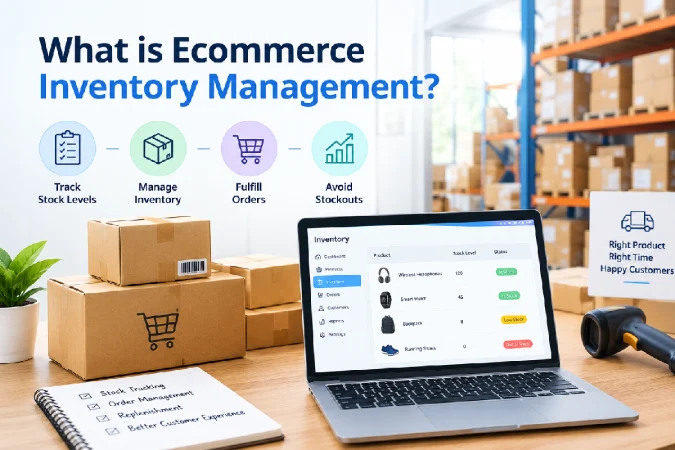
Inventory management in ecommerce accounts for the tracking of products, from purchase from a supplier to the selling and shipment to consumers.
It differs from traditional retailers as ecommerce outlets have product listings across numerous selling platforms-their own website, various marketplaces (e.g., eBay, Amazon), and/or Social Media or mobile apps- each selling the same products. This increases the complexity of tracking.
Key Elements of Ecommerce Inventory Management
| Inventory Element | What It Means | Why It Matters |
| Stock levels | Quantity currently available | Prevents unexpected shortages |
| Inventory tracking | Monitoring stock movement | Keeps product counts accurate |
| Reordering | Purchasing new inventory | Maintains sufficient stock |
| Warehousing | Storing products efficiently | Reduces storage costs |
| Order management | Tracking incoming and completed orders | Prevents overselling |
| Demand forecasting | Estimating future sales | Helps plan inventory purchases |
| Returns management | Recording returned products | Keeps inventory records accurate |
A good inventory system should provide a clear view of available, reserved, damaged, returned, and incoming stock.
How to Track Ecommerce Inventory Accurately?
The first step in effective tracking is the development of an accurate inventory system. Each product carried needs an SKU number, and it’s a record of stock coming in, going out, or being returned due to damage.
1. Use SKU Numbers
A SKU, or “stock-keeping unit,” is an identifier for any particular product (or version of a product). For instance, a black t-shirt in medium should have a different SKU from a black t-shirt in large. This helps you to keep track of a specific product easily.
2. Track Every Inventory Movement
Your inventory records should be updated any time there is a change in inventory. A simplified formula for inventory is as follows:
Ending Inventory = Beginning Inventory + Purchases – Sales + Adjustments
The adjustments may consist of defective merchandise, sales returns, product shortages or pilfering, and physical inventory count corrections.
3. Use Barcode Scanning
Manual entry errors in data input will be removed through barcode systems. When a product arrives in store or is on its way from one position to another or to a customer, it can be scanned.
4. Synchronize Sales Channels
If your product is sold across more than one e-commerce platform, your stock must be in sync automatically.
For example, if your stock level is twenty and somebody orders 3, stock should reduce to 17 across your sales channels.
5. Conduct Regular Inventory Counts
Inaccuracies can even arise with automated systems. Physical inventories help find shortages, damage, or improper product placement
| Tracking Method | Best For | Main Benefit |
| Spreadsheets | Small stores | Low cost |
| Barcode systems | Growing businesses | Faster counting |
| Inventory software | Medium-sized stores | Automation |
| Real-time systems | Large ecommerce businesses | Multi-channel visibility |
| Periodic physical counts | All businesses | Identifies discrepancies |
How to Calculate Ecommerce Reorder Points?
An order point simply allows you to know when an item needs to be reordered before you run out.
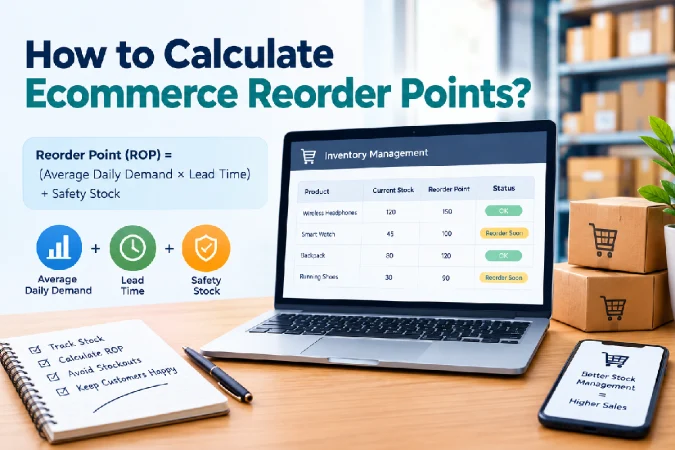
One basic formula for an order point:
Reorder Point = Average Daily Sales × Lead Time + Safety Stock
Let’s imagine that your store receives 10 products daily from your supplier whose lead time is 5 days and that you hold 20 products of safety stock:
Reorder Point=10*5 + 20 = 70 products
Once the available inventory gets close to 70 products, you might have to submit new orders.
What Is Safety Stock?
Safety stock is the extra quantity of inventory held in stock for unplanned increases in demand or supplier delivery delays. For instance, a normally sold item might sell for 10 a day but perhaps as many as 15 on special offer. The safety stock level provides this buffer.
Factors That Affect Reorder Points
| Factor | Effect on Reorder Point |
| Higher daily sales | Increases reorder point |
| Longer supplier lead time | Increases reorder point |
| Unpredictable demand | May require more safety stock |
| Reliable suppliers | May allow lower safety stock |
| Seasonal demand | Requires demand-based adjustments |
| Frequent promotions | Can increase required stock |
Reorder points should never be set in stone. Monitor them when sales trends, suppliers, and customer demand fluctuate.
How to Prevent Overstocking and Stockouts?
The top two most detrimental ecommerce inventory issues are overstocking and stockouts. Overstocking is when you buy more than can realistically be sold, which means high storage costs and your cash locked up in your product. Stockouts mean that if someone wants to buy something, the products aren’t there, resulting in loss of sales and anger among customers.
Use Demand Forecasting
It’s all about learning from past performance. Analyze historical sales trends to predict demand:
- Historical sales
- Seasonal trends
- Upcoming holidays
- Promotions
- Product launches
- Supplier lead times
- Changes in customer behavior
Identify Fast- and Slow-Moving Products
But not every product needs the exact same inventory strategy.
Fast-moving products need a lot more monitoring; ordering is essential for this. Slow-moving products will benefit more from smaller purchases, special offers, etc.
| Product Type | Recommended Strategy |
| Fast-moving | Maintain higher availability |
| Seasonal | Plan inventory before peak demand |
| Slow-moving | Reduce future purchases |
| High-value | Monitor closely and avoid excessive stock |
| New products | Start with controlled quantities |
| Promotional products | Forecast expected demand carefully |
Consider the ABC Inventory Method
ABC analysis: this classifies stock into three categories based on importance or value.
A items: These are important or high-value items, and the majority of time is spent managing them.
B items: These are medium-value items that need routine management.
C items: These are lower value items and need more basic control.
This allows a business to utilize time efficiently
Ecommerce Inventory Management Best Practices
Good inventory management doesn’t mean only knowing what you’ve got; it’s a practice to have your stock updated as needed for your business needs and a system to increase sales and maximize profits:
1. Determine minimum stock levels and maximum stock levels:
Define a minimum stock quantity that you must have at all times for the key products and a maximum level of stock required to avoid over-purchasing.
2. Automate updates to inventory levels:
It is possible to automate updates to inventory levels upon receiving orders, product returns, or order arrivals, thus removing manual work and errors from the process.
3. Calculate Inventory Turnover Rate:
This measures how often you sell and replace your stock. A simplified calculation is: Inventory Turnover = Cost of Goods Sold /Average Inventory. It gives an indication that products may not be in the highest demand (when the number is low), but this also depends on the industry.
4. Monitor Dead Stock:
Dead stock comprises those products which haven’t remaind purchased for a long time now. The company can try selling the dead stock through markdowns, products at a special price/bundle, campaigns, or decreasing future stock purchasing.
5. Keep product data up to date:
Each SKU must have accurate values of data such as:
- Product name
- SKU
- Size or variation
- Supplier
- Purchase cost
- Selling price
- Quantity available
- Reorder point
- Warehouse location
6. Maintain records of suppliers’ lead times, order accuracy, prices, and dependability:
Alternative suppliers for key items would provide a cushioning effect to any unforeseen problems.
7. Maintain an up-to-date inventory report and utilization;
It can shed light on slow-moving goods, popular items, and also on inventory inconsistencies.
| Best Practice | Business Benefit |
| Use unique SKUs | Better product identification |
| Automate updates | Fewer manual errors |
| Set reorder points | Fewer stockouts |
| Maintain safety stock | Protection against demand changes |
| Analyze sales data | Better purchasing decisions |
| Track dead stock | Lower storage costs |
| Count inventory regularly | More accurate records |
| Synchronize sales channels | Prevents overselling |
| Review supplier performance | More reliable replenishment |
Final Thoughts
Managing the inventory of an ecommerce store helps to maximize profits and enhance customer service, which can keep an online business running smoothly and ensure its continued success. Keeping an inventory log of the items in your store enables you to see exactly how much of a certain product you actually possess, and reorder points coupled with demand forecasting help you determine how much of a product to buy, and when.
The most efficient way possible is the perfect combination of an accurate product log and an up-to-date inventory update that is verified with routine stock counts. With supplier checks and an analysis of sales, you should be able to stop holding onto excess stock and stop losing business due to stockouts by reducing costly situations for a much less hassled online shopping customer.