

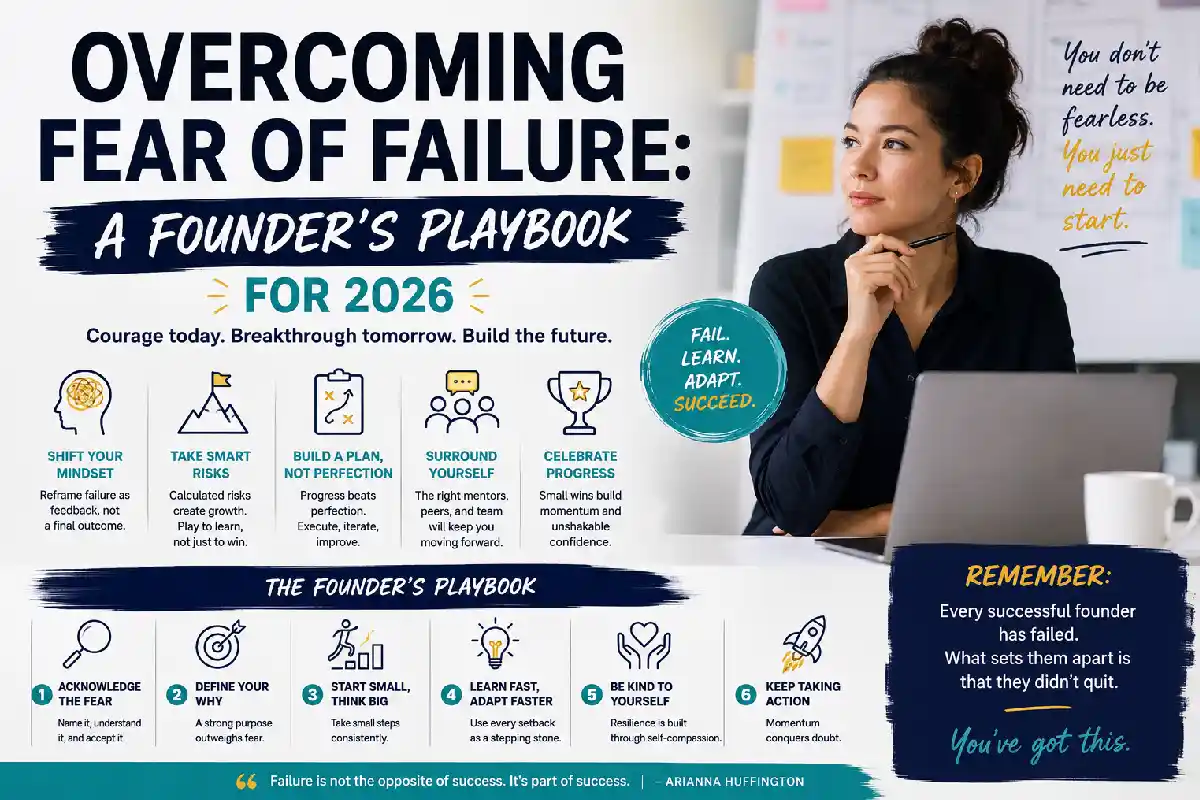
Overcoming Fear of Failure: A Founder’s Playbook for 2026
Last Updated: September 20, 2026
All founders have a vision, an idea, but not all do something about it. More often than lack of money, background or technology, it is out of fear of failing that new entrepreneurs don’t take the first step or even make some courageous initiatives.
In the swirling, busy startup environment of today and 2026. There’s always an element of the unknown. Over a matter of hours, markets shift and consumer demands change; new innovations, such as AI, dynamically redesign entire sectors. The successful entrepreneurs of 2026 will be the ones who learn the quickest.
The fear of failure does not get less with company growth. While there is a general feeling that successful founders still suffer from self-doubt at product launch, hiring of the top executives, or when contemplating breaking into a new market, they don‘t allow the fear to hold them back.
Why Fear of Failure Is Common Among Founders
Starting a business involves processing decisions and ambiguity constantly. Each new product launched, each new ad placed, and each new employee hired involves taking on some risk.
Founders commonly worry about:
- The depletion of personal savings
- Disappointing investors
- Harm their reputation.
- Dampening employee enthusiasm
- Public criticism
- Business failure equates to personal failure.
Fear of Failure in Business
Starting a Business: The fear of failure is usually related to their business is a reflection of someone personal inability. If a business infant is not successful, the founder often perceives themselves as failing.
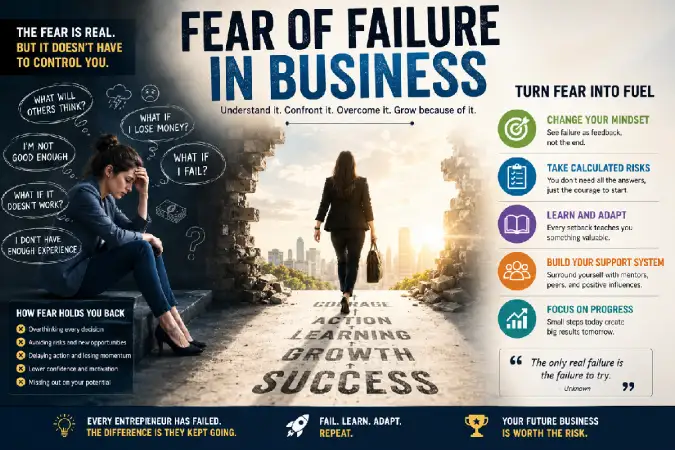
But businesses are experiments. They change: products undergo customization, markets expand or contract and customers’ expectations are constantly shifting. Anyone successful has had failures along the way.
Common symptoms include:
| Fear Response | Business Impact |
| Delaying decisions | Missed opportunities |
| Perfectionism | Slow product launches |
| Avoiding risk | Limited innovation |
| Constant overthinking | Decision fatigue |
| Fear of criticism | Reduced creativity |
Why Entrepreneurs Experience Imposter Syndrome
Imposter Syndrome Founders Face Every Day
“Many entrepreneurs are secretly convinced they don’t deserve their success.
Impostor syndrome to which some founders succumb, leads founders to believe they’re weaker than they actually are.
It can appear even after:
- Gathering venture capital
- Hiring a rapidly expanding team
- Winning industry awards
- Building a profitable business.
Founders experiencing imposter syndrome often:
- Lack of experience.
- Think that they were lucky not to have succeeded.
- Fear they’ll at some point be “discovered”.
- Pass on opportunities because they are underprepared.
Paradoxically, the high flyers are the ones most vulnerable to imposter syndrome as they set such high standards for themselves.
Understanding Fear of Failure in Business
Business failure from fear is perhaps the greatest obstacle a would-be entrepreneur will face. Be this an initial start-up or an expansion to an existing business. The fear of making potentially costly mistakes can hold you back and cause procrastination. This can be in the form of risks to finances, reputation, your company’s investors or employees.
While it is healthy to hold some caution, bringing that fear into every decision you make can halt innovation and progress. The most successful founders accept that starting a business is a process of entrepreneurial identity transition that involves mistakes and set backs. They accept risk, figure it out, see what the results are and improve.
How Imposter Syndrome Affects Founders
Many entrepreneurs face imposter syndrome even after that first win. Imposter syndrome is a term used to describe entrepreneurs who do not believe they are capable: that they do not truly deserve their success, or that one day they will be discovered as ‘not good enough’.
For startup founders, imposter syndrome can appear in several ways:
- Always in competition with other business owners.
- Doubts about your leadership while achievement is being made.
- Hesitant to pitch investors or go for larger opportunities.
- Working extra hours to demonstrate your value.
- Bragging on accomplishments as luck not skill.
Reframing Failure as a Growth Opportunity
A winning mindset shift for business is when entrepreneurs change their perception about failure from permanent loss to a learning opportunity. Top entrepreneurs do not consider failure as failure.
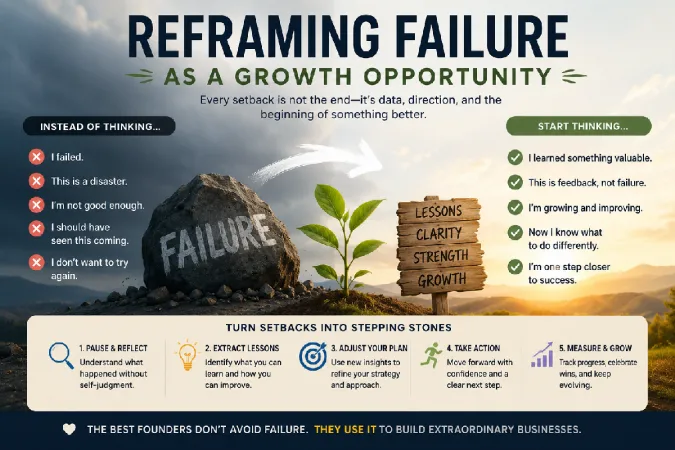
Every failed product launch, refuted investment pitch, or missed target offers learning that can allow for easier future decisions. Don‘t ask, ‘Why did I fail?’, instead ask, ‘What can I learn?
Practical ways to reframe failure include:
| Traditional Mindset | Growth Mindset |
| Failure means I’m not capable. | Failure provides valuable feedback. |
| Mistakes should be avoided. | Mistakes reveal opportunities to improve. |
| Success should happen immediately. | Progress comes through consistent learning. |
| Setbacks define me. | Setbacks develop resilience. |
Failing Forward Why Every Successful Founder Learns by Doing
Failing forward means that entrepreneurs utilize failure as a learning opportunity rather than a roadblock. For many entrepreneurs, starting a company and bringing a product to market is a process of significant learning, not a one-shot event. Innovation is anything but linear, and numerous successful firms have been built by trial and error, refinement.
Failing forward means:
- Taking calculated risks instead of avoiding uncertainty.
- Testing ideas quickly and gathering real customer feedback.
- Learning from unsuccessful outcomes without dwelling on them.
- Adjusting strategies based on evidence rather than assumptions.
- Maintaining momentum even when progress feels slow.
Continuous experimentation can lead to better products, improved business models, and new market opportunities. It‘s not that you don‘t want to fail. You want to fail intelligently. The key is failing fast, learning fast, and iterating.
Overcoming Self-Doubt as an Entrepreneur
Entrepreneurs are plagued by self-doubt. I experienced doubts and questions while the company was growing fast, and I am sure even experienced entrepreneurs ask themselves questions like “Is this the right path to take?”, “Can I really run this company?”.
Developing confidence doesn’t entail trying to eradicate doubt. Confidence is about developing positive habits that result in improved decision-making in the long term, and embedded confidence in your life.
Consider these strategies:
- Set achievable, measurable goals and take time to celebrate small achievements.
- document success to combat negative self-talk.
- Consult with persons you trust for constructive criticism on your ideas.
- emphasis on lifelong learning rather than finishing.
- Practice resilience seize opportunities to succeed.
Each time you act, you strengthen your confidence. With every problem you overcome, every customer you serve and every lesson you learn your confidence to have a go at the next one grows and grows.
Conclusion
Every entrepreneur has their own little moments of doubts, of fears and of insecurities. The one that succeed are not those who will never failed but those who, like any brave person, continue to learn and to keep walk their way.
A deep understanding of the work on the psychology of failure reveals that entrepreneurs who accept failure in business, remain themselves from working on impostor syndrome, view failure as something to learn from, navigate the concept of fail forward, and combat self-doubt as an entrepreneur will remain best equipped to develop the resilience needed to succeed in the current friction-filled and highly competitive environment. The best entrepreneurial journeys are not those for which failure has been spared, but those for which every failure has remain embraced as fuel for development.