

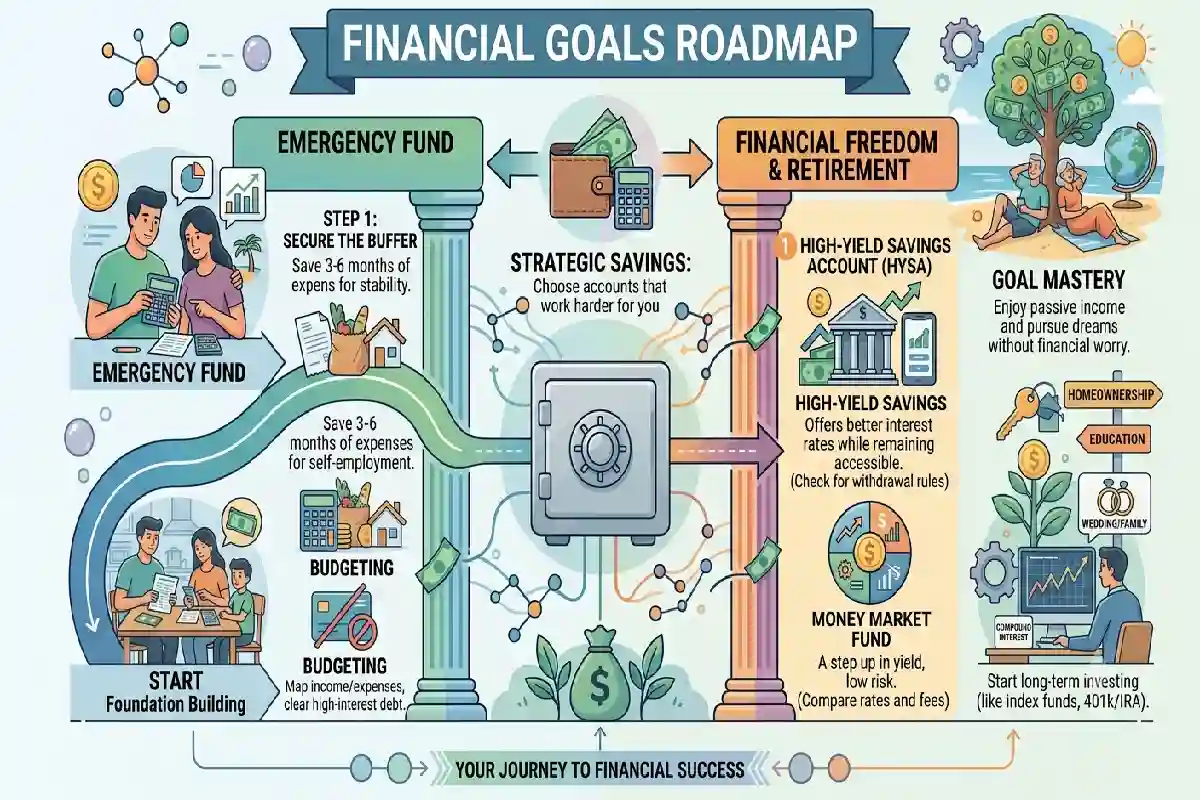
Financial Goals Roadmap: How to Set, Track, and Achieve Your Money Milestones
Last Updated: September 21, 2026
Establish your financial goals To begin your path toward financial security. It is essential that you are able to identify your goals and be specific about them. If your goal is to build an emergency savings account, eliminate or reduce debt, save for a deposit on a house, prepare for your child‘s college education or retirement, have a plan to get there.
In order to have a good financial plan it needs to be practical, flexible and easy to monitor. Set simple goals. It is important to separate being able to achieve its goals from now, and being able to put them off until later when necessary. Also to have a method of checking, and changing your plan if the situation demands it.
Setting SMART Financial Goals
The most useful way that you can make financial goals is SMART. These are:
- Clear: Make sure what you are providing is specific:
- Measurable: Define a quantity or measurable goal.
- Realistic: Ensure that the goal seems attainable given your income and outgoings.
- Relevant: Relate the goal to your other financial objectives.
- Time-bound: Define a time frame for achieving the goal.
Define what you are going to do? Why not try: Instead of “I want to save more money”, this goal: “I will save $6000 within 12 months to create an emergency fund.

This will give you a specific goal and will enable you to work out the monthly amount you need to put away.
Prioritize Your Goals
You may have several financial goals at the same time. Prioritize them according to urgency and importance.
A common order might include:
- Covering essential expenses
- Building an emergency fund
- Paying down high-interest debt
- Saving for major purchases
- Investing for long-term goals
- Increasing retirement savings
Your priorities may differ depending on your circumstances.
Short-Term vs Long-Term Goals
Financial goals can generally be divided into short-term, medium-term, and long-term goals.
Short-Term Goals
Short-term goals typically involve expenses or targets you expect to address within the next few months or several years.
Examples include:
- Building an emergency fund
- Paying off a credit card
- Saving for a vacation
- Creating a vehicle repair fund
- Catching up on overdue bills
These goals usually benefit from accessible savings rather than investments that may fluctuate significantly in value.
Long-Term Goals
Long-term goals may take many years to achieve.
Examples include:
- Buying a home
- Funding a child’s education
- Building retirement savings
- Becoming financially independent
- Leaving an inheritance
For more long term goals this will involve regular investments and addressing issues like investment risk, inflation and consideration of time horizon.
Balance Multiple Goals
You can also work on multiple objectives simultaneously. For instance, you can build an emergency savings fund while paying down debt as required and saving a modest sum toward retirement.
The key is to create a system that fits your available income without overextending your budget.
Tracking Financial Progress
Setting goals is only the beginning. Regularly monitoring your progress helps you determine whether your financial strategy is working.

Start by establishing a baseline. Record your current:
- Savings balances
- Debt balances
- Monthly income
- Regular expenses
- Investment contributions
- Net worth
Then compare your current numbers with your targets periodically.
Use Milestones
By breaking a big goal into several steps/ milestones will help one to stay motivated easily.
Dividing a big aim into a lot of little ones will act as a boost.
For example, a $10,000 savings goal could be divided into:
- $ 1,000 milestone
- 2,500 dollar milestone
- $5000-dollar achievement.
- $7,500 milestone
- final target $10,000
We will set the final target of $10,000 so that we can pay the amount of money to business plan. Moreover we will also paid for the refreshments, gifts, local transportation and taxis and paying to the guardian.
Celebrate progress without using celebrations as an excuse to undermine the goal financially.
Review Your Budget Regularly
During a budget review you‘ll identify whether your current habits either aid or hinder your progress toward your goals. There are often ways to trim or cut extra income to use it toward your top priority.
Adjusting Goals to Life Changes
Financial planning should be flexible as your situations are changing.
A new job, changing your career, getting married, having children, moving to a new location, the unpredicted expense or change in income can all change your set financial priorities.
Repurpose your plan. Don‘t give up on your plan if issues or problems start occurring. Re-evaluate what you wanted to accomplish.
Ask yourself:
- Has my income changed?
- Have my essential expenses increased?
- Do I have new financial responsibilities?
- Has the deadline for my goal changed?
- Should I temporarily reduce contributions to one goal?
- Are my priorities still the same?
For example, if an unexpected expense reduces your savings, you may need to temporarily slow down a long-term investment goal while rebuilding your emergency fund.
Adjusting a goal doesn’t mean failing. It means keeping your financial plan aligned with your current reality.
Tools and Apps for Goal Tracking
It can be easier to track your financial goals with the help of technology. Budgeting applications, excel sheets, banking tools and investing platforms are some of the means to manage financial data and tracking of it.
Useful features to look for include:
- Budget tracking
- Savings-goal monitoring
- Expense categorization
- Debt tracking
- Net-worth calculations
- Account synchronization
- Progress reports
- Alerts and reminders
A simple spreadsheet will work just as well as a dedicated financial app if you update it on a regular basis.
For any financial app you select, think about: types of privacy practices used, security features available, fees charged, types of accounts accessed, and if the app provides access to the financial accounts you use.
Create Your Personal Financial Roadmap
After you have defined your goals, set them as a plan.
Step 1: What do you what to achieve define your aims.
Write down your financial goals.
Step 2: Assign each goal a dollar value.
Determine how much you need to fund.
Etapa 3: Time Limits.
Set target dates and give each goal an achievable deadline.
Step 4: Determine your necessary contribution.
Decide the amounts to save, invest or pay toward the goal from time to time.
Step 5: Automate where possible. This is not always feasible, but it should be considered wherever tempting.
Automatic transfers can reduce the chance of inconsistent saving & investing.
Step 6: Keep track of how you are doing.
Review your figures frequently.
Step7: Any adjustments, if needed.
Adjust your roadmap along with your income, expenses, priorities and situations.
Conclusion
Financial objectives road map Develop a straightforward plan to actualize your financial aspirations. Achieve them through defining each goal explicitly using SMART objectives.
Differentiate between medium term & long term objectives to establish how to allocate the resources.
Your progress should be tracked regularly. It will hold you to account and allow you to change your plan if life throws you a curve ball. You can track it on a spreadsheet, budgeting tool or use a financial program but be consistent.