

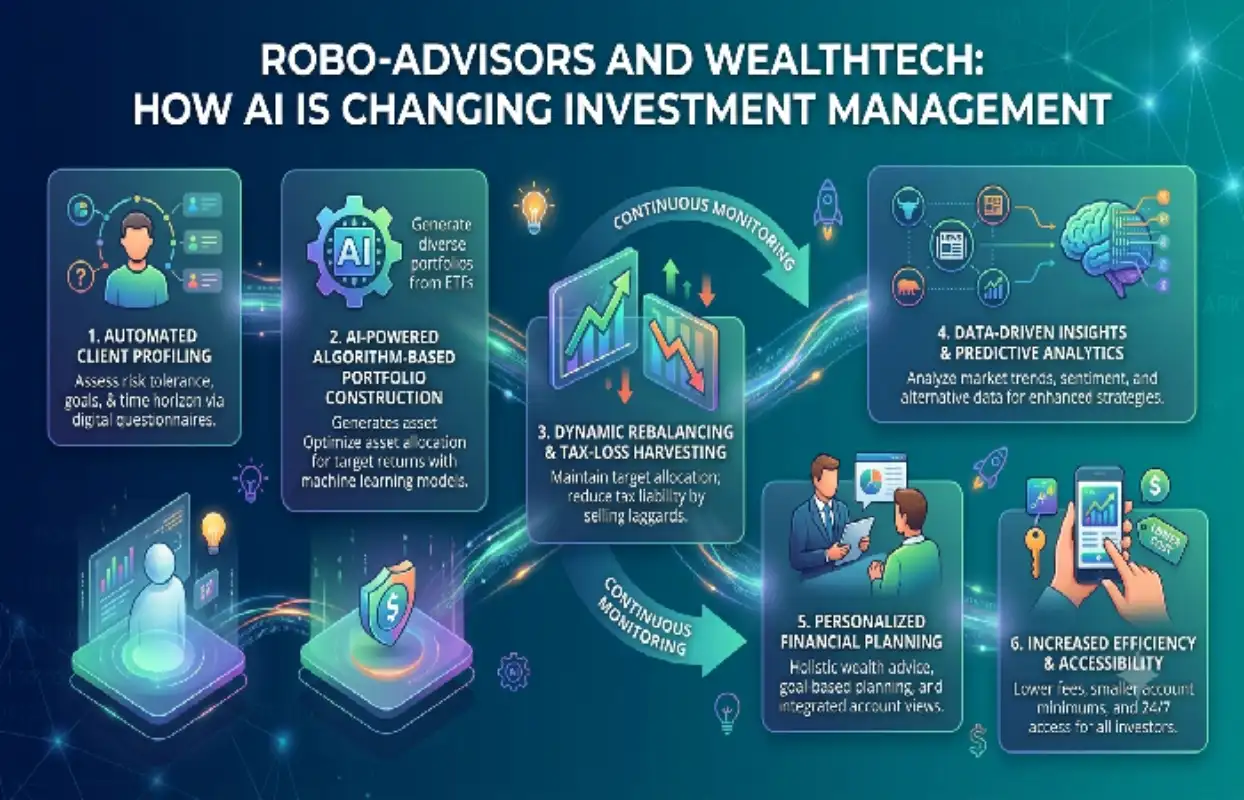
Robo-Advisors and WealthTech: How AI is Changing Investment Management
Last Updated: September 21, 2026
Robo-Advisors and WealthTech. Artificial intelligenceis being programmed into almost everything, and for that reason, money is being revolutionised how we save, invest, and manage our wealth is being totally altered. Robo-advisors are one example.
If you don‘t know the space, Robo-advisors are a product of the WealthTech sector. WealthTech is a general term for the application of technology to enhance financial services. Instead of meeting a financial advisor once a year, a robo-advisor automates many tasks for you: portfolio creation, rebalancing, taxes, and other investment tasks.
When faced with a choice between robos, investment managers, or a combination of both, many people may opt for a service that meets their expectations at a reasonable price. But robo-advisors don‘t obviate the need for a human advisor; they change the expectations.
How Robo-Advisors Work
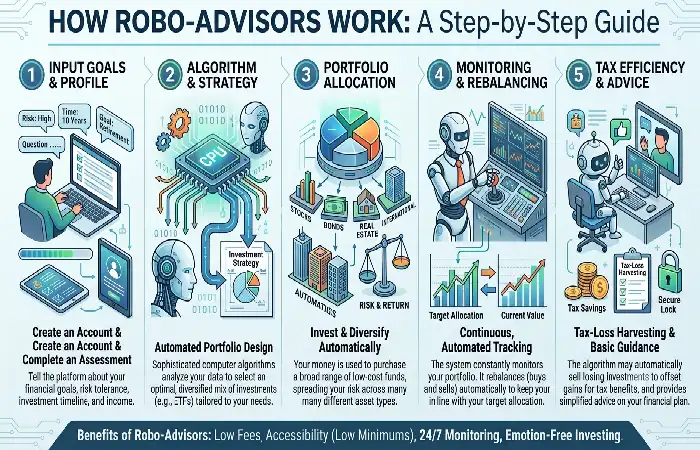
A robo-advisor typically starts with a digital questionnaire. Investors provide information such as:
- Investment goals
- Age and expected retirement date
- Income and financial situation
- Risk tolerance
- Investment time horizon
- Existing assets
- Preferred account type
For example, a long-term investor with a relatively high risk tolerance might receive a larger allocation to stocks in their portfolio, while a more risk-averse investor nearing retirement might have a higher allocation to bonds.
Most robo-advisors use ETFs (Exchange Traded Funds) for managing your money. If you don‘t know what ETFs are, they are basically packages of different stocks, bonds, or even metals.
However, since we now have our entire portfolio and automated this, we don‘t have to constantly worry about things happening or manually perform actions.
Automated Rebalancing
The market will move your portfolio‘s asset allocation in different directions over time, and then a robo-advisor will step in to bring your portfolio back into alignment with your targets.
Tax-Loss Harvesting
On some platforms, you may get the option of automating your tax loss harvesting in your eligible taxable accounts. The platform would handle much of the tax loss harvesting process on its behalf.
Goal-Based Investing
WealthTech platforms are taking a different approach that emphasizes organizing investments around your goals. This may include retirement, college education, building an emergency fund, and purchasing a house.
Ultimately, my result is an investing experience for myself that‘s way more automatted and accessible.
Best Robo-Advisor Platforms
There‘s not really a “best” robo-advisor, rather it just depends on who is best at satisfying different types of investors’ needs, rather than solely which is cheapest.
Some of the popular U.S. services, including Betterment, Wealthfront, Schwab Intelligent Portfolios, and Fidelity Go, are briefly mentioned below, but you‘ll want to research each one yourself because, like all services of this kind, pricing, minimums, features and availability do change.
Betterment
As you can see, Betterment offers automated investing in a wide variety of assets, goal-based planning tools, a whole array of tax-management benefits, and the option of speaking with a licensed financial professional.
Wealthfront
Wealthfront wants people to know all of their financial situations at all times. Automation of the planning makes Wealthfront quite appealing to that type of customer.
Schwab Intelligent Portfolios
The company doesn‘t need to innovate their automated investing service, because it‘s been built inside the Schwab ecosystem and their investment methodology is already very sound.
Fidelity Go
The new tool, which is part of a growing number of robo-advisor options, is essentially automated portfolio management that lets the user connect directly to the broader Fidelity platform.
You want to focus on current fees, account minimums, investment offerings, tax loss harvesting, customer support levels, withdrawal rules and whether or not human advice is available when choosing a robo-advisor not a comparison chart from years ago.
While I can only give details on platforms that operate in the USA and how to navigate them, do research what‘s available to you in your country and make sure you understand investor protection and tax rules that would apply.
Hybrid Robo + Human Advice Models
This is a developing middle ground that is rapidly gaining popularity.
Hybrid platforms combine automated portfolios with the ability to access human financial professionals. They use an algorithm for most investment tasks, but allow clients to tap into an advisor for specific questions or for more personalized guidance.
I thought the best way forward was to combine both methods, hence the model.
For example, an investor might receive:
- Automated portfolio construction
- Algorithmic rebalancing
- Digital financial-planning tools
- Tax-management technology
- Periodic access to a human advisor
- Personalized retirement or financial-planning guidance
We also offer personalized advice about managing finances in retirement or making other financial decisions, so you can confidently set and attain your financial goals.
We also like hybrid financial advice models. Investors often don‘t need an advisor for every transaction, but would welcome a human partner when making important decisions.
How AI Is Changing Wealth Management
AI is more than just taking automated portfolios and investing them for you – AI is beginning to reshape the WealthTech Landscape.
As for how the money being invested in financial platforms is used, the technologies being implemented for more efficient data analysis, personalized financial journeys, and automated administration includes machine learning and AI.
However, at the same time, many people are worried about it.
If a platform makes recommendations, it‘s important to understand how they do it. You want to know what data they use, what they do with it and how they protect it. You also want to know whether humans have review capability on important decisions.
The results produced by AI cannot be mistaken for personal finance advice in any case. Not only is this a terrible idea it can potentially lead to costly financial blunders.
The Future of Robo-Advisors and WealthTech
More specifically, the Robo-advisors change investment management by providing you with a personalized set of investments, diversified according to your financial goals.
The future isn‘t fully AI or all human; it‘s more likely going to exist in the grey area where the AI handles the rote stuff and humans handle the subjective pieces.
You can always turn to a robo-advisor if you‘re not sure what you‘re doing and prefer to keep things simple. However, if you have more complicated needs, working with a human financial advisor might provide more bang for your buck.
In conclusion, the “best” WealthTech solution isn‘t simply the cheapest or most sophisticated. It‘s the one that best fits your needs, combining reasonable cost, tailored strategies, robust security, transparent fees, and the level of personal attention you need.