

Innovation & Growth: A Complete 2026 Playbook for Business Leaders
Last Updated: September 15, 2026
Innovation & Growth is executives are required to act with increased alacrity, apply AI to a broader scope and refresh their advantages over competitors. Strategies have shorter horizon than the planning cycle being adopted and should be consistently modified and renamed. Innovation & growth in general terms is the development , acceptance and deployment of ideas, products, services or business methods (Innovation) to achieve sustained increases in revenue, market share, profitability, customer base or organizational power (Growth).
The Two Components
Innovation
Innovation means introducing something new or substantially improving on what already exists and might comprise:
The creation of new products and services
Enhance existing items; for example, red top milk could be available as semi-skimmed. Improve services and consulting; for example, providing existing services on the internet or offering consultation online.
- Developing new products or services
- Improving existing products
- Streamlining business processes
- Adopting new technologies such as AI or automation
- Creating new business models
- Enhancing customer experiences
Innovation should not only be regarded as radical inventions. Innovations can be accumulated as small, continuous improvements and still generate quantifiable value in the long term.
Growth
Growth defined as, i.e. the observed improvements in a business resulting from effective innovation and execution. It can be measured as:
- Higher revenue
- More profits
- Customers more information.
- To increase market share
- Geographical expansion
- Efficiencies in production
- Improved brand awareness
Why Innovation and Growth Go Together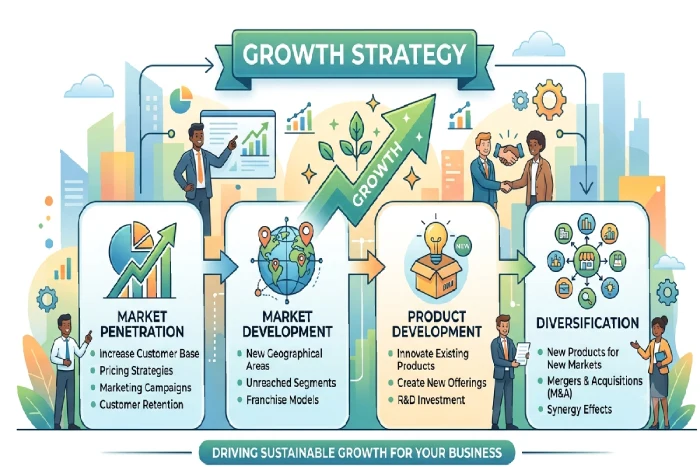
Innovation offers the means for businesses to respond and adapt to new customer needs, advances in technology or increased competition. If innovations are to be successful they must address real problems and/or support improved experiences, thereby allowing them to grow sustainably by:
- Growing customer satisfaction and loyalty
- Improve operational efficiency of your business
- Discovering additional sources of revenue
- “Enhancement of competitive advantage”
- Going to new markets
Without innovation, companies become less competitive. Without growth, innovation might not necessarily create long-term value.
Examples of Innovation Driving Growth
| Innovation | Growth Outcome |
| Launching an AI-powered product | Higher customer acquisition and recurring revenue |
| Automating repetitive workflows | Lower operating costs and improved productivity |
| Introducing a subscription business model | Predictable recurring income |
| Creating an eco-friendly product line | Access to new customer segments |
| Improving the online shopping experience | Higher conversion rates and increased sales |
Types of Innovation That Support Growth
- Product Innovation:new or improved product.
- Innovation in Service: Better experiences for the customer or new services.
- Process Innovation: opportunities to increase the speed, lower cost or enhance efficiency of operations.
- Business Model Innovation: A business model describes the way a firm creates and captures value. Business model innovation involves changes in these activities.
- Digital Innovation: Using tools like AI, Cloud Computing, data analytics. New emerging ways of innovate through digital.
Key Benefits of Innovation & Growth
- Is more competitively
- Satisfies and improves customer satisfaction
- Contributes to the long-term profitability.
- Improves operational efficiency.
- Support developmental of flexibility and persistence.
- Provides new market opportunities
- Helps to drive the sustainable success of the business
Business Innovation
Business innovation involves the implementation of a new or significantly improved idea, product, service, process, technology or business model in order to create value for targeted customers and gain competitive advantage and long term development of a business organization.

Why Business Innovation Matters
In the fast changing markets of today, expectations of the customers, technological improvements and competition are building quickly. Companies which are able to that to adapt will more likely be:
- stay one step ahead of the competitors
- To increase income and profit.
- Increase the level of customer satisfaction and loyalty
- Enter new markets, market penetration; market development
- Adapt to economic and industry change
- developing the capacity for building resilience to adversity in the longer term
If businesses do not innovate, they are likely to become uncompetitive, as others will be creating superior products, more appealing services or a more satisfying experience for their customers.
Types of Business Innovation
Product Innovation
The design and development of new products or the modification of existing products.
Example: A cell phone maker introduces AI-enhanced camera capabilities.
Service Innovation
Improve customer service or move toward new services.
Example: A bank offers a round-the-clock AI-based service to its customers.
Process Innovation
Streamlining internal processes for greater efficiency and lower costs.
Very simple example:Creating software that automates critical business process such as order-taking, inventory management, etc.
Business Model Innovation
Innovation by a firm in how it creates, delivers, or captures value.
E.g. shifting from a one-off purchase of software towards a subscription service.
Digital Innovation
AI, cloud computing, data analytics, automation, etc. for business performance enhancement.
For example: a website retailer offers recommendations on customizing products.
Examples of Business Innovation
| Innovation | Business Benefit |
| AI-powered customer support | Faster response times and lower support costs |
| Mobile banking apps | Greater customer convenience and engagement |
| Subscription pricing | Recurring and predictable revenue |
| Automation in manufacturing | Higher productivity and fewer errors |
| Eco-friendly packaging | Stronger brand reputation and customer appeal |
Key Benefits of Business Innovation
- Drives business growth
- Creates competitive advantage
- Improves customer experience
- Increases operational efficiency
- Encourages employee creativity
- Opens new revenue streams
- Strengthens long-term sustainability
Challenges of Business Innovation
Although innovation offers many benefits, businesses may face challenges such as:
- Resistance to change
- Limited budgets
- Technology adoption issues
- Market uncertainty
- Skill gaps
- Managing innovation risks
Top-performing organizations succeed in the face of these obstacles by enabling a learning organization, encouraging organizations to experiment and conducting most of its decisions on the information gained from its customers.
Growth Strategy
A growth strategy is the long-term direction of a business concerning increasing revenues, customer numbers, market shares and profits. It spell out what needs to be done, how and when and through which opportunities to achieve sustainable growth and a competitive advantage.
Common Growth Strategies
- Market Penetration:Grow share in current markets.
- Market Development: Access new geographic or customer segments.
- Product Development: New or enhanced products are launched.
- Diversification: Expand into new industries or markets with new products.
- Strategic Alliances: Work together with other firms to speed the progress.
- Digital Growth: Use of SEO, content marketing, automation, AI & ecommerce to expand customer outreach.
Innovation Management
Innovation management is the controlled flow of ideas through the stages of creation, deliberation, development, implementation and commercialisation in a way that has value for customers and business results. Here it makes sure innovation doesn‘t happen by chance but becomes a natural element in one‘s organization strategy and culture.
Key Components
- Creative Generation.
- Market research.
- Development of the Product:
- Project management
- Risk assessment,
- Cross-team collaboration
- Measuring outcomes of innovation
- On-going improvement
Benefits
- Quicker product development
- Enhanced customer experiences.
- Higher efficiency
- More sustainable competitive advantage
- Sustainable Business Growth Developing
Disruptive Innovation
Disruptive innovation is a term that describes the initiation by acompany, of a new product, service, technology or business model that causes an industry to change by providing a better solution that issimpler, cheaper or more accessible thanthe predecessor for what is available at present. The innovations are the innovations that begin by targeting the least gainful customers into a market.
Characteristics
- Provides solutions to a customer in an innovative manner
- Reduces the costs of time or moves.
- Utilize new technologies or business model
- Creates new markets or redefines existing markets
- Established companies move with the market
Scaling a Business
A business scaling is about trying to grow a business‘s revenues, customers and markets faster than its costs. The main aim of it is to grow in the most efficient way possible by upgrading systems, technology, processes and teams so that the business is able to cope with greater demands profitably.
How Scaling Differs from Growth
Although the terms are often used interchangeably, they are not the same.
| Business Growth | Business Scaling |
| Revenue and costs increase together | Revenue grows faster than costs |
| Often requires hiring more employees | Relies on efficient systems and automation |
| May reduce profit margins | Aims to improve profitability |
| Focuses on getting bigger | Focuses on becoming more efficient while expanding |
Example:
- A restaurant opens a second location and hires another full staff. This is growth.
- A software company serves 10,000 new customers using the same cloud infrastructure with only minor cost increases. This is scaling.
Key Elements of a Scalable Business
Successful scaling usually involves:
- Automated: Employed software to perform repetitive functions.
- Reusable Processes: Developing processes that can be used repeatedly.
- Technology: buying into the cloud, digital platforms, and AI.
- Strong Team: Assigning tasks to efficient leaders and members of staff.
- Customer Acquisition: Developing marketing and sales infrastructure to adequately support significant growth.
- Strategies to reduce risk, Financial Planning- Keeping cash flow in shape and handling growth with great care.
Benefits of Scaling a Business
Scaling helps businesses:
- Increase revenue without a proportional increase in expenses
- Improve profit margins
- Reach new markets and customers
- Handle higher demand efficiently
- Strengthen competitive advantage
- Build long-term sustainability
Signs Your Business Is Ready to Scale
A business is often ready to scale when it has:
- Consistent revenue growth
- Strong customer demand
- A proven product or service with market fit
- Efficient operational processes
- Positive cash flow
- Systems that can support additional customers
Common Challenges
Businesses may encounter obstacles such as:
- Cash flow constraints
- Hiring and retaining skilled employees
- Maintaining product or service quality
- Managing rapid operational complexity
- Adapting technology to support expansion
Addressing these challenges requires careful planning, investment in scalable systems, and continuous monitoring of performance.
What is Disruptive Innovation?
Disruptive innovation” means that the creation of a new product, service, technology, or business model has transformed an industry by replacing earlier technologies, businesses or alliances and have constituted a new market and value network that eventually displaces an earlier technology, or service.
Disruptive innovation differs from incremental innovation in the fact that the disruptive innovation offers something quite different from the current product or service to change the way that the business operates and thus how the customer consumes a product/ service.
Key Characteristics of Disruptive Innovation
- Disruptive innovations typically:
- Designs and products that provide simpler or cheaper alternatives
- Begin with underserved or neglected customers.
- Use novelty technologies or business models
- Improves quickly with time
- Dare to challenge the current market leaders.
- Establish new standards and customer expectations.
Examples of Disruptive Innovation
- Streaming platforms took the place of ordinary DVD rental stores by having movies or shows available online 24/7.
- Ridesharing Applications are one of the nice innovations in city transportation, which introduced direct contact between users and drivers.
- Cloud computing has revolutionized the way organizations have stored data by allowing accounting data to be transferred to the “cloud” instead of having to utilize complex expensive servers on premises.
- Artificial intelligence solutions are streamlining processes like customer service, content generation, and data visualization.
Benefits of Disruptive Innovation
- Provides fresh market opportunities
- Makes products or service more affordable and easily accessible
- Enhance customer experiences
- The drives competition across the industry
- Promoting persistent innovation in technology
- Achieves sustainable long-term business growth
- Challenges of Disruptive Innovation
While disruptive innovation offers significant opportunities, it also presents challenges:
- High scepticity and financial risk
- From the resistance of existing companies
- Customer behaviors are changing.
- Keen investment in technology and talent.
- Regulator yand compliant issues in some industries
- How Businesses Can Embrace Disruptive Innovation
Organizations can prepare for disruption by:
- Keep abreast of new technologies and market trends
- Investing in research and development
- Foster: Promote experimentation with new, innovative ideas.
- Listening to the customer feedback
- Implementation of agile business Practices.
- Willingness to challenge the status of traditional business models
What are the four types of disruption?
Each of the four categories of disruption outline the primary ways in which companies innovate and change the game. Though there are many ways to analyze how disruption occurs, the four categories listed below are among the most commonly referenced in business and innovation literature.
Low-End Disruption
Low end disruption also refers to how a provider may introduce a product or service that is more basic and less expensive to individual or even mass market, customers who don‘t require every feature and performance of an existing high-end product. As the new approach or offering gets better over time, it is able to face off against current market leaders.
Characteristics:
- Reduced prices
- Easier selectors
- Focus on customers who are price-sensitive
- Improves gradually
E.g. Budget airlines that provide cheap flights but with less amenities.
New-Market Disruption
New-market disruption offers demand that didn‘t exist before by making a product or service affordable and accessible to a different set of consumers. It doesn‘t battle existing competitors to steal customers, but rather grows the market by drawing new consumers in.
Characteristics:
- Reaches non-consumers
- More accessible to buy made products
- Opens up new markets that were not accessible before.
- Implements creative business models.
E.g.: Devices such as smartphones making the internet available for hundreds of millions of first time users.
Technological Disruption
Technological disruption when technological advancements fundamentally alter the way products are created, delivered or used in a way that makes previous technologies less viable.
Characteristics:
- Techno-oriented Motivated by development in technologies
- Enhanced Efficiency and performance
- Changing customer expectations
- Has the ability to totally revolutionize industries.
Examples:
- Artificial Intelligence (AI)
- Cloud computing
- Engine directions
- Blockchains
Business Model Disruption
Business model innovations challenge the way value is produced, delivered or captured by a firm instead of challenging the product directly. Innovations within business models are more frequently found to change the experience for the customer and affect the way a firm generates revenue:
Characteristics:
- Comment on the introduction of new pricing or delivery models
- Enhances convenience
- Provides a way of generating repeat revenues
- Challenges traditional business practices
Examples:
- Subscription based software.
- Ride-sharing websites.
- Online streaming services.
- Direct-to-consumer brands.
| Type | Primary Focus | Typical Outcome |
| Low-End Disruption | Affordable alternatives | Attracts cost-conscious customers and gradually competes with premium providers |
| New-Market Disruption | New customer segments | Expands the market by serving non-consumers |
| Technological Disruption | New technologies | Changes how products and services are created or delivered |
| Business Model Disruption | New ways of delivering value | Transforms revenue models and customer experiences |
Conclusion
For companies to be competitive in the fast-changing nowadays marketplace, the need for innovation and growth is critical. Innovation is about delivering new value through new and better products, services, processes and business models. Growth is the tangible results of the delivery of this value. Building innovation mindsets, implementing growth strategies, managing innovation systematically and growing operations systematically are critical success factors in achieving long-term resilience.
For founders and entrepreneurs and all business leaders alike, the mindset of continuous improvement and customer oriented innovation will keep your business responding to change grabbing opportunities and gaining sustainable competitive advantages. The companies who innovate now are those who will have dominated the future markets.
Frequently Asked Questions
1. What is innovation and growth in business?
Innovation & Growth Innovation and growth are all about developing new or improved products, services, process or business models that add value and help grow the business sustainably. Innovation creates potential for growth and growth looks at the business outcomes of this potential.
2. Why is innovation important for business growth?
Innovation provides a way for business to remain competitive, adapt to changing market conditions, meet customer demands and expectations, maximize efficiency, create new revenue sources and increase profitability.
3. What is the difference between innovation and growth?
Innovation is the production and improvement of ideas that add value. Growth is the proportional increases in revenue, customers, profits, or market share achieved through good innovation and business execution.
4. What are the main types of business innovation?
The most common types include:
- Innovations in the product.
- Service innovation
- Process innovation.
- Business model innovation.
- Digital Innovation.
They focus on the technology (the digital part) which drives the innovation process (“for innovation without limits). As such, they tap into the current trend on the diffusion of innovations to technology, a direction that has proved to be very successful in the past.
Each of these types gives companies a way to improve performance, and hence to gain a competitive advantage.
5. What is a growth strategy?
A growth strategy is a comprehensive plan a business adopts which enables it to grow revenue, add more customers, reach new markets, develop new product lines and perform all this in a profitable and sustainable manner.
6. What does scaling a business mean?
Scaling a business is about growing the revenues and demands for your products and services without incurring disproportionately higher operating costs. Businesses are scalable when they leverage systems, automation, technology and operational efficiencies.
7. What is disruptive innovation?
Disruptive innovation occurs when a new product, service or business model suddenly changes the rules of competition within an industry by creating more affordable, accessible or straightforward options.
8. How can businesses encourage innovation?
Innovation is stimulate in firms by fostering a culture of collaboration investing in human capital, paying attention to customer voice, adopting new technology, rewarding creativity, and encouraging new idea experimentation with reasonable risks.
9. What are the biggest barriers to business innovation?
Stakeholders’ resistance to change, poor IT infrastructure, lack of leadership commitment and ill-equipped employees are examples of obstacles that local governments often encounter. However, these can be removed through effective leadership and planning processes.