

Stock Market Investing for Beginners: How to Start Building Wealth Step by Step
Last Updated: September 21, 2026
Investing in stocks is by far the best way to a lifelong financial abundance. Yet all these terms like stocks, indexes, dividends, brokerage accounts, diversification or the volatility of the market will seem very confusing.
Fortunately, you don t need to be a trader to invest. A simple but effective long term strategy can be implement without being a trader.
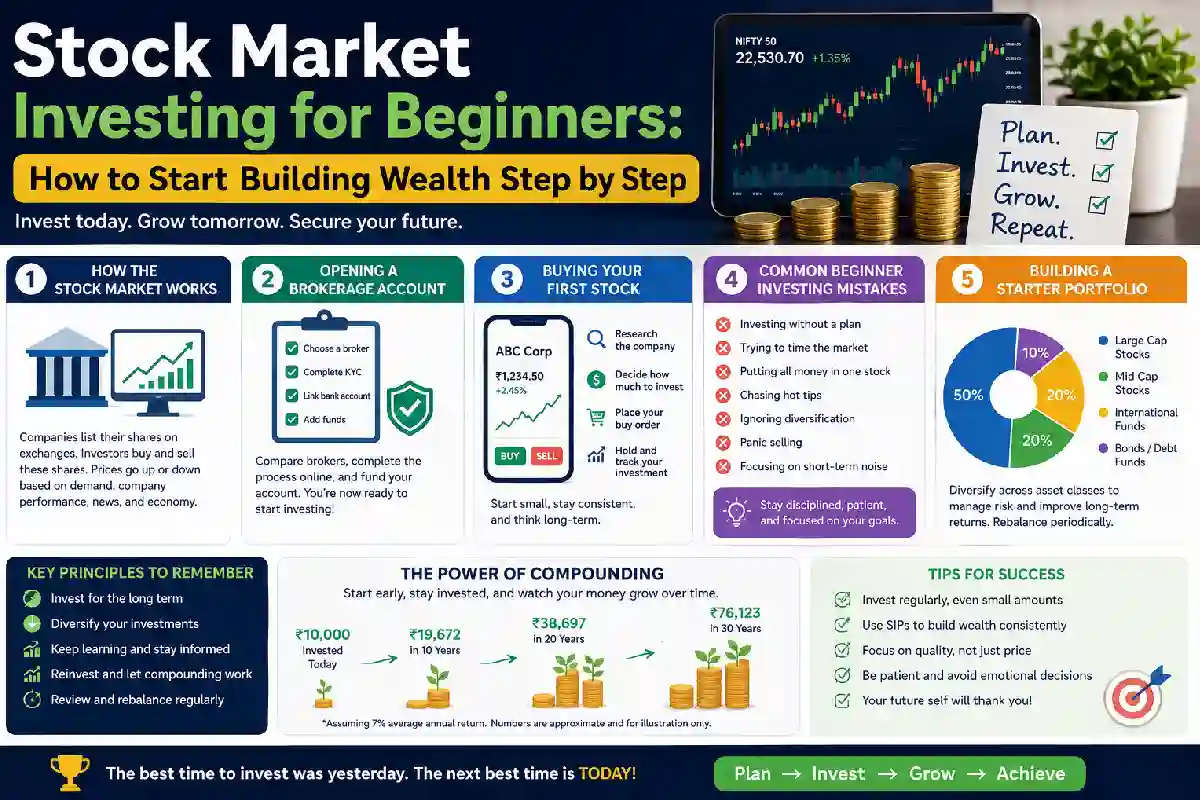
I am giving a brief illustrated lesson on how the stock market works, opening a brokerage account, buying your first stock, pitfalls to look out for, and setting up a starter portfolio.
Please be aware that investing involves risk and investment values can fluctuate. The following examples are only for generic illustration and should not be considered as financial advice relevant to the individual reader.
How the Stock Market Works
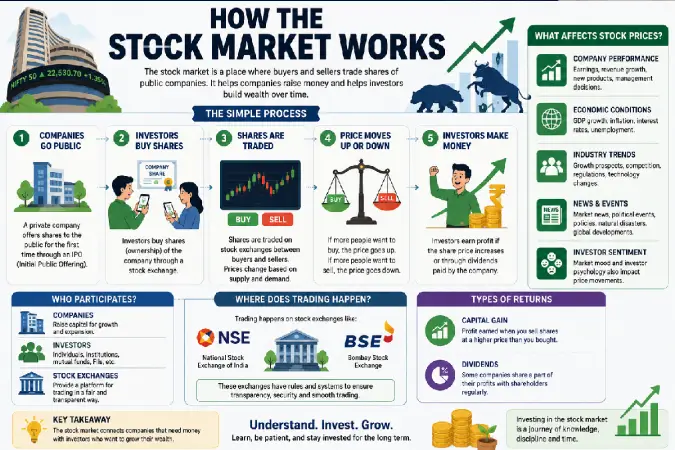
The stock market is the market in which investor buy and sell shares of companies listed to be traded.
You purchase shares in a company. Should the company prosper and increase in value, it is more probable that the value of its stock will also increase. Every so often, certain companies share a percentage of their earnings with their shareholders using dividends.
How Stock Prices Change
Stock prices are influenced by supply and demand, but many factors affect that demand, including:
- Company earnings
- Revenue growth
- Economic conditions
- Interest rates
- Industry trends
- Investor expectations
- News and market sentiment
- Government policies and regulations
For instance if investors start to expect a substantial increase in a firm‘s profits then demand for its shares will tend to rise. If expectations deteriorate the value of that shares will tend to fall.
Exchanges and Indexes
Shares are traded on exchanges. In the U.S., each of us might be trading on the NYSE, the NASDAQ, or the OTC. The U.K. investors have the choice between the London Stock Exchange, while the Indian investor can choose between the NSE and the BSE.
The index of the stock exchange shows the selected firms and thus we can track indices as a kind of an average of a market segment
Examples include:
- S&P 500
- Nasdaq-100
- Dow Jones Industrial Average
- Nifty 50
- Sensex
Indexes are most useful for beginners. They allow one to get access to several companies in one product such as an index fund or an ETF.
Stocks vs. Bonds vs. Funds
Before you start investing, learn about the distinctions between a few types of investments.
| Investment | What You Own | Typical Role |
| Individual stock | Shares of one company | Growth potential |
| Bond | Debt issued by a government or company | Income and diversification |
| Mutual fund | Pool of investments | Diversification |
| ETF | Basket of investments traded on an exchange | Diversification and flexibility |
| Index fund | Fund designed to track an index | Broad market exposure |
Individual stocks can offer significant growth potential but expose you to company-specific risk.
Funds can spread your money across many investments, reducing the impact of a single company’s poor performance.
Opening a Brokerage Account
A brokerage account is the facility you use to buy and sell investments. At present, a large proportion of brokerage platforms permit investors to establish the account through online system or mobile applications.
What to Look for in a Brokerage
When comparing brokers, consider:
- Account fees
- Trading commissions
- Investment choices
- Research tools
- Customer support
- Account security
- Ease of use
- Minimum investment requirements
- Currency conversion or international-investing costs where applicable
- Tax reporting and documentation
Don’t choose a brokerage simply because its app looks attractive. Consider whether it provides the investments and features you actually need.
Information You May Need
The account-opening process generally requires identity and financial information. Requirements vary by country and broker.
Depending on your location, you may be asked for:
- Government-issued identification
- Tax identification information
- Bank account details
- Contact information
- Employment information
- Financial information
Always use the broker’s official website or application and verify that it is properly regulated in your jurisdiction.
Choosing Between a Taxable Account and Retirement Account
Depending on your country, you may have different types of investment accounts.
A taxable brokerage account generally allows flexible access to your investments but may have tax consequences when you sell investments for a profit or receive taxable income.
A retirement account may provide tax advantages in exchange for restrictions or rules surrounding contributions and withdrawals.
The specific options differ substantially by country. Investors should understand the tax treatment and withdrawal rules before choosing an account.
Buying Your First Stock
Once your brokerage account is established and funded, you can begin researching investments.
Step 1: Understand What You’re Buying
Before purchasing a stock, learn:
- What the company does
- How it makes money
- Its major products or services
- Revenue and earnings trends
- Debt levels
- Competitive position
- Industry outlook
- Valuation
- Major risks
Don’t buy a company simply because it is popular on social media.
Step 2: Determine How Much to Invest
Your first investment doesn’t need to be large.
A beginner might start with an amount that allows them to learn without creating significant financial stress.
More important than the initial amount is developing a sustainable investing habit.
Step 3: Find the Stock
Every publicly traded stock has a ticker symbol, which identifies it on an exchange.
Search for the company in your brokerage platform and verify that you’ve selected the correct security before placing an order.
Step 4: Choose an Order Type
Two common order types are:
Market order: An instruction to buy or sell at the best available price. The exact execution price can vary, particularly in volatile or less-liquid markets.
Limit order: An instruction to buy or sell only at a specified price or better.
Beginners should understand how their brokerage handles each order type before using it.
Step 5: Review Before Confirming
Before submitting an order, verify:
- Company name
- Ticker symbol
- Number of shares
- Order type
- Price, if applicable
- Estimated transaction costs
Then confirm the transaction.
Fractional Shares
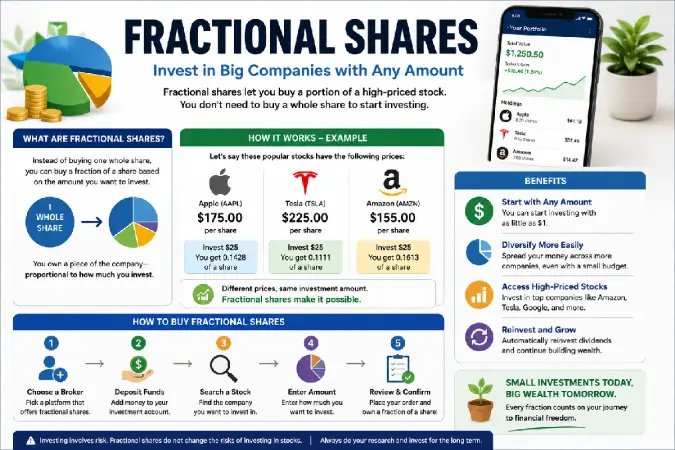
Some brokerages permit fractional-share investing; you can acquire less than a full share.
Take the instance of buying stocks trading at $500 a share – fractional share platforms will allow you to invest just $50 instead of needing to spend $500 on one stock.
This could make diversification of investment portfolios for novices with a limited capital simpler.
Availability, charges and conditions vary among brokerages.
Common Beginner Investing Mistakes
Knowing what not to do can be just as important as knowing how to invest.
1. Investing Money You Need Soon
Stocks can experience substantial short-term price movements.
Money needed for near-term expenses generally shouldn’t be exposed to unnecessary market risk.
Maintain appropriate emergency savings before taking significant investment risk.
2. Trying to Time the Market
Some beginners attempt to predict when the market will rise or fall.
The problem is that consistently predicting short-term market movements is extremely difficult.
A long-term strategy based on regular investing may be more practical than constantly attempting to identify the perfect entry and exit points.
3. Investing Without Research
Owning a company means accepting its business risks.
Before buying an individual stock, understand what you’re investing in and why.
4. Panic Selling
Market declines are uncomfortable, particularly for new investors.
Selling solely because prices have fallen can turn temporary market declines into permanent losses.
Your response should depend on your financial plan, investment horizon, and the underlying reasons for the market movement.
5. Ignoring Fees and Taxes
Even seemingly small fees can affect long-term returns.
Taxes can also influence investment outcomes.
Understand the costs and tax implications associated with your investments.
6. Checking Your Portfolio Constantly
You can easily be caught up in the emotions of the moment and try to make rush responses for your stocks.
The long-term investor, however, is well advised simply to stick to his long-term strategy, rather than obsess about short-term market movements.
Building a Starter Portfolio
Your starter portfolio should best meet your financial needs, time frame, risk appetite, and ability to weather some rain.
Most beginners are more interested in diversifying their investments rather than trying to pinpoint the next big winner in the market.
Consider Broad Diversification
Investors may want to use as well as these diversified funds, which have hundreds of companies from the same industry.
For example, a broad-market index fund can give you a single step that invests in hundreds or thousands of companies.
This may help to smooth the management of a portfolio, and also help to reduce the specific risk of the company.
There isn’t one portfolio that is right for every investor.
A hypothetical long-term portfolio might emphasize:
- Broad-market equities
- International equities
- Bonds or other fixed-income investments
- Cash or cash equivalents
The appropriate allocation depends on the investor.
Someone with decades before retirement may have a greater ability to tolerate stock-market volatility than someone who needs the money in a few years.
Asset Allocation
Asset allocation refers to how your investment capital is divided among different asset classes.
For example:
70% equities + 25% bonds + 5% cash
is an asset-allocation decision.
Another investor may make quite an alternative investment.
The key question isn‘t simply “What investment will make the most money?” Instead, ask:
What portfolio can enable me to achieve my goals and stay invested during a volatile period?
Dollar-Cost Averaging
Dollar-cost averaging (DCA) is defined as buying a fixed dollar amount of stock at regular intervals.
For example, it might invest $200 per month whether markets are going up or down.
When prices are higher, the contribution purchases fewer shares. When prices are lower, it purchases more shares.
DCA can help create investing discipline and reduce the temptation to wait indefinitely for the “perfect” time to invest.
However, it does not guarantee profits or eliminate investment risk.
Dividends and Dividend Investing
Some companies distribute part of their earnings to shareholders through dividends.
Dividend-focused investors may seek companies with established histories of paying or increasing dividends.
However, a high dividend yield doesn’t automatically make a stock attractive.
Before investing, consider:
- Dividend sustainability
- Company profitability
- Cash flow
- Debt
- Payout ratio
- Business outlook
- Valuation
Total return includes both changes in investment value and income received, rather than focusing exclusively on dividends.
How Much Should a Beginner Invest?
There is no universal minimum amount that every beginner should invest.
Your starting amount should fit your financial situation.
Before investing heavily, consider whether you have:
- An emergency fund
- Manageable high-interest debt
- Stable cash flow
- Appropriate insurance
- Clearly defined financial goals
Then determine how much you can invest consistently without interfering with essential financial obligations.
How to Monitor Your Investments
Investing doesn’t mean you need to constantly trade.
Instead, establish a review process.
You might review your portfolio periodically to evaluate:
- Asset allocation
- Investment performance
- Fees
- Diversification
- Changes in financial goals
- Changes in risk tolerance
- Tax considerations
Rebalance to your normal target allocation if its calibration has drifted sharply away from it into areas where you may not wish to be invested.
Frequently Asked Questions
Whether or not to begin investing in stocks?
Investing in the stock market could be suitable for beginner investors once they are prepared to accept the risks, have the proper financial basis and invested based on a long-term strategy.
What resources are yet. It is possible that this is scaled once a minimum initial sum is necessary to begin investment.
The minimum differs with your brokerage and with the access you choose. Some portals allow very small investments and fractional holdings.
Am I better off purchasing by stock or index funds?
Index funds give you exposure to a wide range of stocks, and maybe a little easier to get started. Single stocks will need more research, and subject the investor to more company specific risk.
How many stocks a beginner should own?
There‘s no fixed number. Concentrate on well-founded diversification among companies, sectors, regions and asset classes when it makes sense and avoid a specific number of stocks in the equity part of the portfolio.
Final Thoughts
You don‘t have to be a rocket scientist with a Ph.D. in numismatics to start investing in the stock market.
Achieve a strong financial base, define clear aims, select an suitable broker account, understand the mechanics of how an investment functions and begin with an affordable sum.
To most beginners, however, a more diversified and cost effective method may be of less effort to sustain than trying to pick individual stocks that will do better than the market.
The following factors are the key: discipline, diversification, patience and willingness to keep learning.
You shouldn‘t expect your first investment to make you rich. Simply aim to develop the right money habits that will compound over time.