

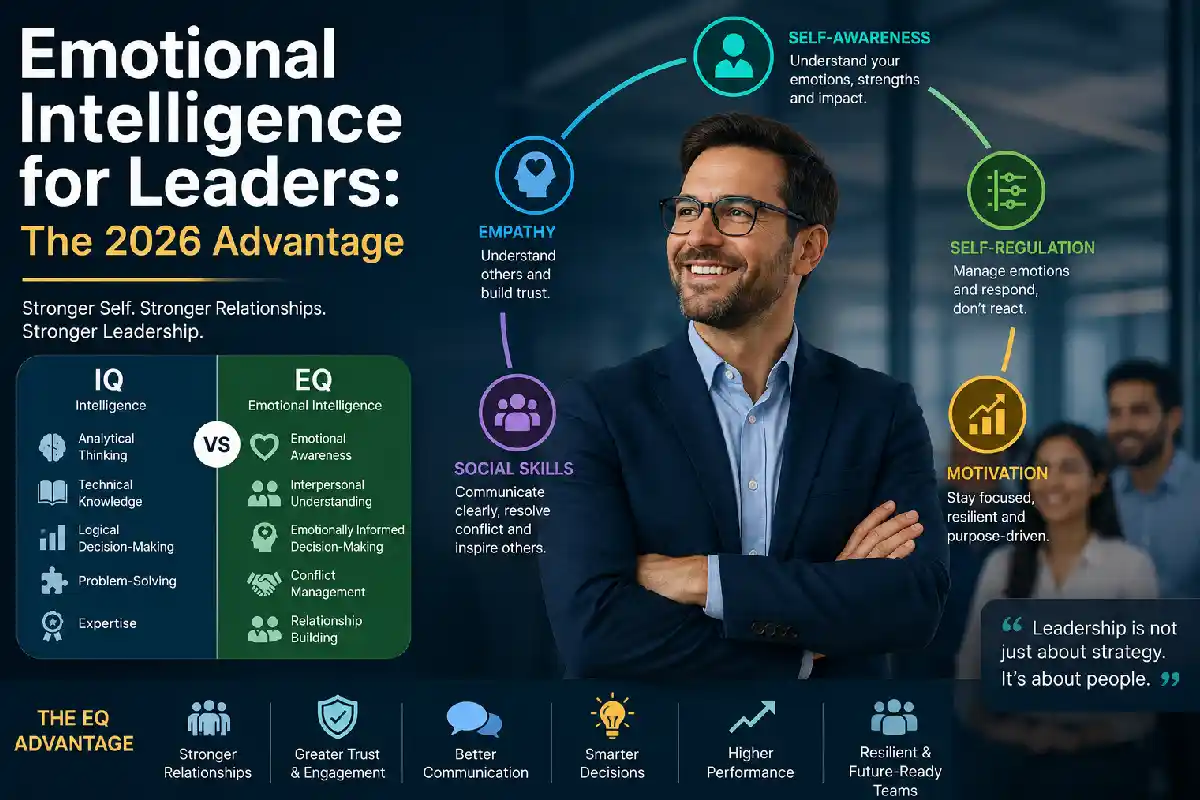
Emotional Intelligence for Leaders: The 2026 Advantage
Last Updated: September 15, 2026
Emotional Intelligence for Leaders. Leadership in 2026 is no longer defined solely by technical expertise, strategic thinking, or the ability to make fast decisions. As workplaces become more hybrid, AI-driven, diverse, and constantly changing, leaders need another critical skill: emotional intelligence (EQ).
The other important qualities of leaders and managers are, the ability to be self aware and and to have empathy with others, good communication skills and the ability to negotiate differences and build trust in relationships, which in turn can influence engagement, team work, performance and culture.
What is the Emotional Intelligence in Leaders?
The capacity to identify, interpret, express, manage and use emotions constructively such as to communicate effectively with other people, understand and to manage, and respond appropriately to emotions themselves and those of other people.
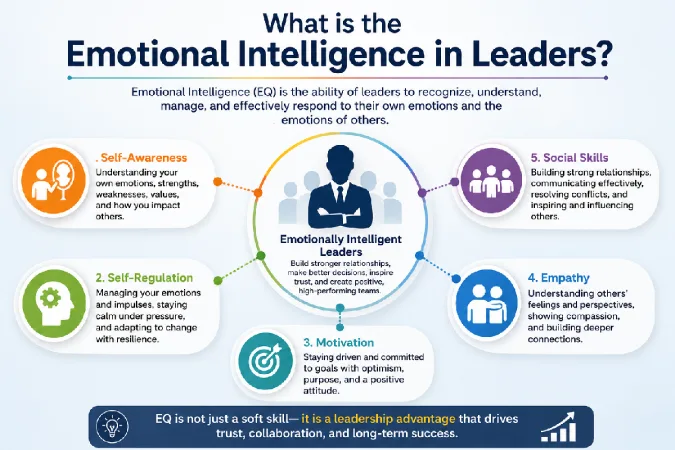
In leadership, emotional intelligence typically involves five interconnected capabilities:
- Self-awareness- Knowing your emptions, weaknesses, strengths, triggers, and patterns of behaviour.
- Self-regulation – not having your emotions manipulate the choices you make.
- Motivation to stay focused, persistent, and committed at times when it is most difficult.
- Empathy – The capacity to understand how other people think and feel.
- Social skills – relating to others, effective self-presentation and communication, conflict resolution, cooperation and influence.
A leader who exercises emotionally intelligent leadership is not oblivious to the presence and influence of emotions. Rather, they understand how and why emotional information can be used to enhance decision making and foster improved and more effective workplace relationships.
EQ vs IQ Leadership: Why Both Matter
In leadership, the common perception often considers IQ as dominance logical thinking, factual knowledge, problem identification, and understanding of techniques.
This is where EQ out wins over IQ in leadership.
| IQ | EQ |
| Analytical thinking | Emotional awareness |
| Technical knowledge | Interpersonal understanding |
| Problem-solving | Conflict management |
| Logical decision-making | Emotionally informed decision-making |
| Expertise | Relationship building |
| Cognitive ability | Self-management |
The greatest leaders don‘t pick how much EQ they‘ll need and how much IQ they‘ll need. The people that rank highest blend the two.
Eg-an individual, such as a manager, may have the technical knowledge of why a project is failing. But emotional intelligence will enable him to communicate the problem without incurring unnecessary fear, defensiveness or blame.
IQ can enable a leader to choose the right solution. EQ can enable them to take people with it.
Self-Awareness Leadership: The Foundation of Strong Management
Self-awareness is an essential part of emotional intelligence.
A self-awareness leader is one that is aware of the impact their emotions have on behavior, communication, decision making and relationships.
For instance, a leader might suddenly become a defensive or dismissive if criticized in an important meeting without the insight of self-awareness.
How Self-Awareness Improves Leadership
Self-awareness helps leaders:
- Recognize personal strengths and limitations
- Accept constructive criticism
- Reduce impulsive reactions
- Recognize feelings and emotional triggers.
- Make more balanced decisions
- Communicate with greater authenticity
One practical approach is to regularly ask yourself:
- What sort of feelings do I have right now?
- What caused this reaction?
- What would my team make of my actions?
- Is this based on facts or speculation?
- How can I do better next time?
The aim is by no means to suppress these feelings. It‘s to bring them to your attention.
Empathy in Management Builds Stronger Teams
Management empathy involves an active process of trying to understand the other‘s situation, perspective and feelings.
This is not about giving in to everyone‘s demands or lowering our achievement standards.
Instead, leaders who are empathetic put empathy and responsibility together.
If a staff member performance dips dramatically an emotionally intelligent manager would perhaps not jump to the conclusion that the person has become lazy and unmotivated. They would probe.
The employee might be battling with a lack of clarity of objectives, unbearable amount of work, unsupportive team environment, or the absence of.
The manager is able to handle the actual problem when comprehend what the root of the problem is.
Empathy Can Improve
- Employee trust
- Psychologically safe
- Communication
- Team collaboration
- employee engagement
- Conflict resolution
- Retention
In a work culture where employees are expecting more of the leaders to understand their experiences, ‘mercy’ can be found ‘a critical source of competitive advantage.
Emotional Regulation at Work: Staying Composed Under Pressure
Leadership by necessity includes situations of stress.
Assumptions are violated. Deadlines are missed. Customers start complaining. Employees bicker. Projects go off course. Unforeseen problems come into view.
The maintenance of emotional regulation during work enables the leader to react constructively instead of impulsively.
Emotion regulation is not just about smoothing things over and making everything ok; it‘s creating a gap between being triggered and having a reaction to it, so you can choose your action consciously.
A Simple Emotional Regulation Technique
When you experience a strong emotional reaction:
PAUSE -> DETECT -> SUSPICIOUS -> ACT
Pauses: Do not rush to email, make the announcement, or approach the employee.
Identify: What are you feeling? Label your feelings anger, frustration, anxiety, disappointment, fear.
Assess: Try to determine if the feeling is based on facts, assumptions, or incomplete data.
Respond: Take an action that aligns with the overarching goal of leadership.
A basic process which is quite easy to apply that can stop a temporary emotional response from turning into a leadership issue.
Why EQ Matters More in the 2026 Workplace
The workplace in contemporary society is growing more complex.
Leaders could oversee employees in multiple locations, cultural backgrounds, generations of people, communication styles. AI is disrupting roles, workflows and expectations quickly.
These findings give rise to new kind of emotional challenges.
Workers tend to have questions about automation, fear of losing their jobs, information overloading, fatigue of communication, and lack of connectivity in dispersed team.
The leaders need to be familiar with how people react to uncertainly and assist the team in coping with changes.
An emotionally intelligent leader can communicate:
Consequently, the process of transformation involves.
- How are they changing?
- In what way could employees be affected?
- What Available Support is there?
- What can we do now
That blend of understanding and candor can really lessen the frustration of organizational change.
The art of developing EQ as a leader
Fortunately, emotional intelligence isn‘t static; it can be developed with directed effort.
1. Practice Daily Self-Reflection
At the end of each day, take three minutes and go over your days conversations that are important.
Ask:
- What worked?
- In what areas did I respond emotionally?
- Was I a good listener?
- Was my communication clear or confusing?
- What should I do differently the next day?
Taking small reflections can sometimes go a long way in showing behavioral patterns over period of time.
2. Become a Better Listener
Listening is the easiest way to enhance EQ.
Don’t start writing your answer as the other person is talking. Instead, pay attention to what they really want to convey.
Try asking:
- What can you tell me about that?
- What do you think is to blame for the problem?
- A good listen can find information otherwise unheard.
3. Ask for Honest Feedback
Ask trusted colleagues or team members:
“Is there something I could have done differently to be a better leader?”
The hard thing is not to ask, but to listen without being defensive.
4. Learn Your Emotional Triggers
There are some situations that are always (more likely) to generate some stronger reactions.
Maybe you get irritated with late deadlines. Maybe you get more uncomfortable because you are being questioned.
If you identify these trends, it means you can anticipate them.
5. Practice Empathy Without Losing Accountability
Empathy doesn‘t mean not having the tough conversations.
Precisely! But instead of shutting him out when you don‘t like what he has to say, make your point to where he can understand you. Simply put! Tell him what you expect instead.
For example:
I know you‘ve got a lot of competing demands. And this particular deadline is as important as the rest. So let‘s talk about how I can help you meet it.
A marriage of compassion and responsibility.
6. Improve Your Communication
Emotionally intelligent communication is: honest, respectful and well thought-out.
Before delivering difficult feedback, consider:
- What is the person attempting to comprehend?
- How could they twist my words.
- Is my message directly related to the question?
- Am I complaining about one‘s behavior rather than criticizing the individual?
- Have I given him them? a chance to reply?
It‘s not about delivering a message. It‘s about creating an understanding.
EQ and AI: Why Human Leadership Still Matters
As AI takes over many repetitive analytical and administrative tasks, skills that are uniquely human will become more valuable.
AI is able to process large differences of data to identify trends and patterns, generate content and automate workflows. Leadership is completely different. It is about people building trust, managing relationships, leading a team, and making difficult choices in conflicting human interests.
Of course that makes emotional intelligence more important.
The leaders who thrive alongside AI will likely be those who can combine:
Technology + strategic thinking + emotion intel
Emotionally intelligent leaders do not have to compete with the technology. They can use it and concentrate their energies on the people end of leadership.
The Business Impact of Emotionally Intelligent Leadership
It shouldn‘t just be seen as a concept in personal-development.
The behavior of leaders has an effect on organizational outcome.
Over time, this can contribute to:
- Improved communication channels.
- More robust employee relationships
- A better mediator more effective at resolving conflicts.
- Higher degrees of trust
- Improved change management
- Enhanced credibility of the leadership
- More adaptable teams
The impacts might not always show up instantly on a spreadsheet, but they could influence how well an organization functions.
Conclusion
One quality that will set the best leaders of 2026 apart will be the fact that their levels of emotional intelligence will be soaring.
IQ provides the analysis of the problem and EQ the understanding. EQ helps the two form a leadership team, which is put in place to allow ‘reasoned decisions, enabled by trust, resilience and the human touch.
Developing EQ is a process that takes time and require practice: self-awareness, managing emotional response, listening, having empathy, receiving feedback, communicating purposefully etc.
If anything, in this more automated workplace, these human skills are not disappearing they‘are becoming increasingly valuable. Tomorrow‘s leaders will not be only those who are most aware of information and facts. Tomorrow‘s leaders will be those who will be most aware of themselves, of others and of how to co-create purpose with others.