

Marketing 101: The Complete Guide to Marketing Strategies in 2026
Last Updated: September 15, 2026
Marketing is about planning and executing the conception, pricing, promotion and distribution of ideas and goods to create exchanges that satisfy individual and organisational needs. In the year 2026 great marketing uses fundamentals from marketing theory with the power of artificial intelligence, informed by analytics and customer insights and an authentic brand story to break through the deluge of AI content.
This article guide is the single best and most definitive overview of all things modern marketing from the very basics through to extremely advanced techniques that deliver results in a search environment being revolutionized by AI. Being a business owner, marketing professional or entrepreneur you can learn practical frameworks, real-world examples and 2026 data to create campaigns that will convert.
What Is Marketing? Definition & Core Concepts
Marketing takes place on many levels including planning, designing, pricing, and promoting. Marketing is about discovering and satisfying customer needs.
The 4 Ps of Marketing (Updated for 2026)
The classic marketing mix has evolved but remains foundational:
| Element | Traditional Definition | 2026 Adaptation |
| Product | What you sell | Solutions + customer experience + ongoing value |
| Price | Cost to customer | Transparent pricing + flexible payment options + perceived value |
| Place | Distribution channels | Omnichannel presence (online, offline, mobile, social) |
| Promotion | Advertising & communication | Content marketing + AI-personalized messaging + community building |
Marketing vs. Advertising vs. Sales
All three terms are often used interchangeably, but getting them mixed up can cost your business time, money, and customers.
Quick Comparison Table
| Aspect | Marketing | Advertising | Sales |
| Definition | The overall strategy to attract, educate, and build relationships with customers | Paid promotion to amplify your marketing message | The direct process of converting interested people into paying customers linkedin+1 |
| Scope | Comprehensive (includes advertising, sales, branding, pricing, product development) | Narrow (one tactic within marketing) | Specific (one function within marketing) marketingprofs+1 |
| Goal | Build long-term relationships, create value, generate demand | Create awareness, capture attention, drive immediate action linkedin+1 | Close deals, generate revenue through direct transactions |
| Timeline | Long-term (months to years) | Short to medium-term (campaigns) | Immediate (transaction-focused) |
| Cost Structure | Ongoing investment (strategy, content, research) | Paid media spend (per impression, click, or conversion) | Commission or salary-based |
| Examples | Brand positioning, content marketing, SEO, email campaigns, market research | Facebook ads, Google Ads, billboards, sponsored posts, TV commercials hispano-enterprise+1 | Sales calls, demos, consultations, closing conversations, negotiations |
| Customer Journey Stage | Top to bottom (awareness → consideration → decision → retention) | Top to middle (awareness → interest) linkedin+1 | Bottom (decision → purchase) |
| Success Metrics | Brand awareness, customer lifetime value, market share, engagement rates | Impressions, clicks, CTR, CPC, ROAS | Revenue closed, conversion rate, average deal size, sales cycle length |
Why Marketing Matters in 2026: Data & Trends
The marketing world has been turned on its axis. Here is what 2026 paints as the picture:
Key Marketing Statistics 2026
| Metric | 2026 Statistic | Implication |
| Zero-click searches | ~60% of Google searches end without a click | Content must earn clicks with unique value |
| AI Overview adoption | 2+ billion monthly users | Optimize for AI citations, not just rankings |
| LLM traffic growth | 527% year-over-year | ChatGPT, Gemini are new discovery channels |
| Marketing ROI from AI | 68% report improved ROI | AI integration is now table stakes |
| Word-of-mouth growth | 53% of small businesses cite as top strategy | Authenticity beats paid ads |
| Social media presence | 35% cite as growth driver | Platform-specific strategies essential |
hubspot+3
The AI Content Challenge
As an example, Google‘s algorithms released in 2026 eliminate what they define as “commodity content”, or AI-generated bottom-of-the barrel content that offers nothing to the reader. HubSpot CMO Kipp Bodnar said of current-content that Such content now needs to clear six hurdles to be ranked:
- Proprietary evidence: Original data, research, or case studies
- Firsthand experience: “I did, I saw, I built” perspectives
- Specificity: Replace adjectives with numbers, names, dates
- Point of view: Take stands instead of hedging
- LLM test: Could ChatGPT have written this? (If yes, revise)
- Information gain: Google your headline—if top 3 results say the same thing, add unique angles.
Marketing Strategies That Work in 2026
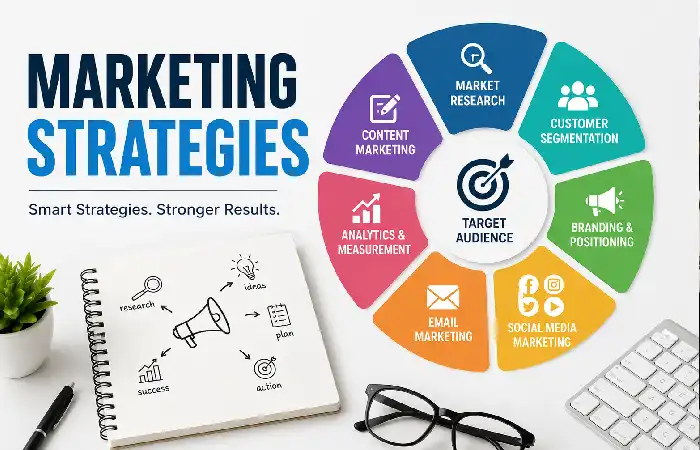
Here are the profitable strategies, as identified by review of over 22 of the most successful strategies.
-
Content-Led SEO (The Pillar-Cluster Model)
What it is: Make “pillar” pages to be tried and true hubs for overarching themes, then fill-in with numerous more specific ‘cluster’ blogs linking bakc to the pillar site.
Why it works in 2026:
- Establishes topical authority Google‘s trusting.
- Build internal linking structure
- RANKS for multiple keyword variations
- Perfect for AI Overview citations
How to implement:
- Define central themes (e.g. “marketing,” “SEO,” “email marketing”)
- Create 3,500-5, 000 word pillar guides
- Write 10-20 cluster articles (800-1,500 words each)
- Connect Interlink (cluster –> pillar , pillar –> cluster) strategically, is to set the means to link of Interlink items by cluster and pillar
- Brings up to date quarterly with new data
Example: This article is a pillar page. Cluster articles would include:
- “Marketing for small business 2026”
- “How to Make a Marketing Plan (Step-by-Step)”
- Types of Marketing: 20+ Described with Examples
- “Marketing Examples: 15 Campaigns That Crushed It”
-
Loop Marketing (HubSpot‘s 2026 Framework)
- What it is: A four-stage approach that replaces linear funnels with continuous loops:
- Express: Deliver your unique brand POV (not generic content)
- Engage: Design interactive environments (games, tools, communities)
- Convert: Leverage AI to offer the right products to the right consumers in the right channels at the right time at scale.
- Amplify: Leverage fans to spread the word (UGC, referrals, reviews)
- Effective because: 68% of marketers see better ROI from AI-enabled loop marketing.
-
Hyperlocal +
Community Marketing
What it is: Focus on dominating your local market before scaling, using:
- Google Business Profile optimization
- Other local seo considerations (geo-tagged-content, local keywords)
- Community partnerships and events
- Nextdoor, Facebook Groups, local influencers
2026 data: 53% of small businesses say word of mouth is their number one vehicle for growth. Concentrate on your local niche: target local customers micro-you-know-it and you will be trusted much faster than you ever will on a national level.
-
First-Party Data Marketing
What it is: With third-party cookies dying, collect and use your own customer data:
- Email lists (offer lead magnets)
- SMS users You should be aware that, as of April 2015, the method to opt-out of receiving SMS messages was to send ‘STOP’ to the sender.
- History of purchase
- Behavioral data from your website/app;
Why it matters: You hold an ownership in this data. No alterations in the algorithms can deprive you of this ownership.
-
Authenticity-First Content (Anti-AI Slop)
What it is: Content that passes Google‘s “non-commodity” test:
- Genuine screen shots and photographs (not using stock images)
- Quantifiable info (know the specific time, place, people involved. Names not vague claims)
- Personal experience (“I tested this for 30 days…”.
- Contrarian takes (not “both sides”)
- Original research and/or case study
Use Examples. For instance, if you claim Email marketing is effective then provide real proof, perhaps, Our email campaign brought in $12,847 in 14 days, with a CTR of 3.2% – here‘s the actual template;
Marketing Plan (Complete Guide 2026 Template)
A marketing plan is your roadmap. Here‘s the exact framework:
Step 1: Executive Summary (Write Last)
- One-page overview including
- Top business objective
- Important marketing activities.
Introduction Budget allocations B-udget allocations are the basic starting point of the policy making process. It is the decision on the proportion of resources to be allocated to different policy instruments within the policy package.
Expected results
Step 2: Situation Analysis (Where You Are Now)
SWOT Analysis:
- Strengths: What you do well that the competition does not.
- Weaknesses- missing areas to overcome
- Opportunities: Market dynamics, unconquered channels
- Threats: Competition hustles, economic factors
Competitive Benchmarking:
- Use tools like SEMrush, Ahrefs, or SimilarWeb to analyze:
- Top 5 competitors. Where is their traffic?
- The works that has proven to be the most effective on them are…
- Keywords gaps to take advantage of
- Backlink opportunities
Step 3: Define SMART Goals
Goals must be Specific, Measurable, Achievable, Relevant, Time-bound:
The AWL: Don‘t use goals alone. Bad Goal: “Increase sales”
SMART Goal: “Target a growth of 27% in online sales for Q3 2026, by introducing 3 new product categories to the mix and raising checkout conversion from 2.1% to 3.5%”.
Step 4: Target Audience & Personas
Create 3-5 detailed buyer personas:
| Persona Element | Example: “Sustainable Sarah” |
| Demographics | 28-42, urban, college-educated, $75k+ income |
| Psychographics | Values eco-friendly products, researches before buying |
| Pain Points | Overwhelmed by greenwashing, wants transparent brands |
| Buying Journey | Discovers via Instagram → reads blog reviews → compares prices → purchases |
| Preferred Channels | Instagram, Pinterest, email newsletters, Google Search designrush+1 |
Step 5: Channel Mix & Tactics
Allocate budget and effort across channels:
| Channel | Budget % | Key Tactics | Owner | KPI |
| Content/SEO | 35% | Pillar pages, blog posts, video | Content Manager | Organic traffic, keyword rankings |
| Paid Ads | 25% | Google Ads, Meta Ads, retargeting | PPC Specialist | ROAS, CPA |
| Email Marketing | 15% | Automated sequences, newsletters | Email Marketer | Open rate, CTR, revenue per email |
| Social Media | 15% | Reels, LinkedIn posts, community | Social Media Manager | Engagement, followers, traffic |
| Influencer/PR | 10% | Micro-influencers, press releases | Partnerships Lead | Mentions, referral traffic |
Step 6: Budget Allocation
2026 Benchmarks:
- B2C SMBs: 7-12% of revenue on marketing
- B2B SMBs: 5-10% of revenue on marketing
- High-growth startups: 20-50% of revenue (investment phase)
Step 7: Calendar & Execution
Map out campaigns by month/week:
| Week | Content Type | Channel | Topic/Campaign |
| 1 | Blog Post | Website | “Top 5 Marketing Trends 2026” |
| 2 | Reel/Video | Instagram, TikTok | “How to Create a Marketing Plan in 60 Seconds” |
| 3 | Webinar | “Marketing Strategies for Small Business” | |
| 4 | Email Newsletter | “Exclusive: Marketing Plan Template Download” | |
| 5 | Case Study | Website, LinkedIn | “How [Client] Increased Sales 47% with Content Marketing” |
Step 8: Measurement & KPIs
Track these metrics monthly:
| Goal Type | Primary KPI | Secondary KPI | Tool |
| Brand Awareness | Organic traffic, social reach | Share of voice, branded search | Google Analytics, SEMrush |
| Lead Generation | Lead volume, cost per lead | Lead quality score, conversion rate | HubSpot, CRM |
| Sales/Revenue | Revenue from marketing, ROAS | Customer lifetime value (LTV) | Google Analytics, Stripe |
| Customer Retention | Repeat purchase rate, churn | NPS, email engagement | Klaviyo, Delighted |
Marketing for Small Business: 2026 Playbook
Despite constraints facing small businesses (small budget, small team), what small businesses stand to gain (agility, local). Here’s what works:
Low-Cost Marketing Ideas (Under $500/Month)
| Strategy | Cost | Time Required | Expected ROI |
| Google Business Profile optimization | Free | 2-4 hours setup | High (local SEO) |
| Email marketing (Mailchimp/Klaviyo free tier) | $0-50/mo | 3-5 hrs/week | Very High ($36-42 per $1) |
| Social media organic (Reels, carousels) | Free | 5-7 hrs/week | Medium-High |
| Content marketing (blog posts) | Free (time) or $100-300/article | 5-10 hrs/week | High (long-term) |
| Referral program | $0-100/mo (incentives) | 2-3 hrs/week | Very High |
| Local partnerships/cross-promotions | Free | 3-5 hrs/week | Medium-High |
| User-generated content campaigns | Free (incentives) | 2-4 hrs/week | High |
5 Marketing Strategies Every Small Business Should Use
- Partner with Other Small Businesses
- Co-host webinars or events
- Cross-promote on social media
- Offer bundled deals
- Swap email list shout-outs
- Guest on each other’s podcasts
- Collect & Showcase Customer Feedback
- Request reviews on Google, Yelp, industry sites
- Feature testimonials on website and social
- Create case studies from happy customers
- Use feedback to improve products/servicesthemediaant+1
- Optimize for Local SEO
- Complete Google Business Profile (photos, hours, services)
- Create location-specific landing pages
- Use local keywords (“best [service] in [city]”)
- Get listed in local directoriesadwave+2
- Create a Memorable Visual Identity
- Invest in professional logo design (Canva Pro or Fiverr: $50-300)
- Use consistent colors, fonts, and style across all channels
- Create branded templates for social posts, emails, presentations.
- Offer Free Samples or Trials
- Product samples (if physical goods)
- Free consultations (if service-based)
- Freemium tier (if SaaS)
- Discount codes for first-time buyers the mediant.
Types of Marketing: Complete Breakdown
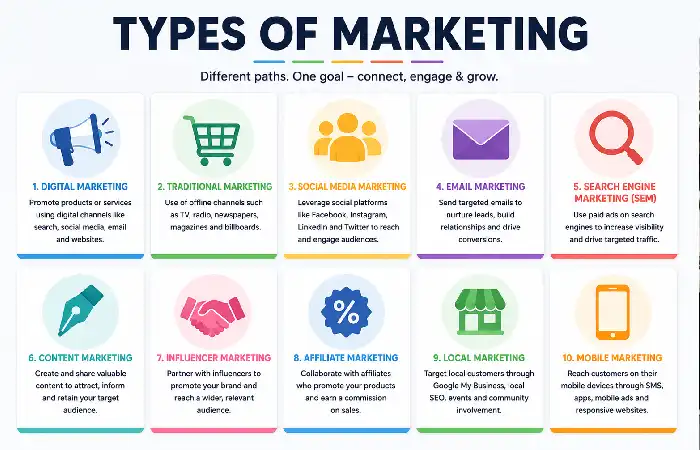
Marketing isn‘t one-size-fits-all. Here are the primary types you need to know:
Digital Marketing Types
| Type | Best For | 2026 ROI Potential | Example |
| Content Marketing | Building authority, SEO | High (long-term) | Blog guides, case studies, videos neilpatel |
| Social Media Marketing | Brand awareness, engagement | Medium-High | Instagram Reels, LinkedIn articles |
| Email Marketing | Retention, conversions | Very High ($36-42 per $1 spent) | Automated sequences, newsletters |
| SEO (Search Engine Optimization) | Organic traffic | High (compounding) | Keyword-optimized content, technical SEO wordstream+1 |
| PPC (Pay-Per-Click) | Immediate traffic | Medium (depends on niche) | Google Ads, Meta Ads |
| Influencer Marketing | Trust-building, reach | Medium-High | Micro-influencer partnerships |
| Video Marketing | Engagement, education | High | YouTube tutorials, TikTok shorts |
| Affiliate Marketing | Performance-based growth | High (low upfront cost) | Commission-based partnerships |
Traditional Marketing Types
| Type | Best For | 2026 Relevance |
| Print Advertising | Local businesses, older demographics | Low-Medium |
| TV/Radio Ads | Mass market brands | Medium (declining) |
| Direct Mail | Local services, high-value offers | Medium (surprising ROI) |
| Events & Trade Shows | B2B, networking | High (post-pandemic rebound) |
| Outdoor (Billboards, Transit) | Brand awareness in specific geos | Medium |
Emerging Marketing Types (2026)
| Type | Description | Why It Matters |
| GEO (Generative Engine Optimization) | Optimizing content to be cited by AI (ChatGPT, Gemini, Perplexity) | 527% traffic growth from LLMs |
| Community-Led Growth | Building engaged communities (Discord, Slack, Facebook Groups) | Trust > ads in 2026 |
| Personalization at Scale | AI-driven 1:1 messaging across channels | Customer expectation, not nice-to-have |
| Sustainability Marketing | Highlighting eco-friendly practices | 73% of consumers willing to pay more |
| Interactive Content | Quizzes, calculators, AR experiences | 2x engagement vs. static content |
Marketing Examples: Real Campaigns That Worked
Example 1: Local Fitness Studio (Bengaluru, India)
Challenge: New studio competing with 15+ established gyms
Strategy:
- Instagram Reels showing 60-second workout tips
- Google Business Profile optimization with before/after photos
- Partnership with nearby health food stores (cross-promotion)
- Referral program: “Bring a friend, get 1 month free”
Results (6 months):
- 340% increase in Instagram followers
- #1 ranking for “gyms near me” in local area
- 127 new members from referrals
- 42% of new customers cited Instagram as discovery channel
Example 2: Sustainable Clothing Brand (E-commerce)
Challenge: Breaking into crowded sustainable fashion market
Strategy:
- Content marketing: “Behind the Seams” blog series showing supply chain transparency
- User-generated content: Customers post outfit photos with #TransparentFashion
- Email marketing: Weekly newsletter with styling tips + sustainability facts
- Influencer partnerships: 15 micro-influencers (5k-50k followers) in eco-lifestyle niche
Results (12 months):
- 890% organic traffic growth
- Email list grew from 0 to 12,400 subscribers
- 34% of revenue from repeat customers
- 23% conversion rate from influencer traffic (vs. 2.1% industry average)
Example 3: B2B SaaS Startup (Marketing Automation Tool)
Challenge: Competing with HubSpot, Mailchimp, Klaviyo
Strategy:
- Created “Marketing Automation ROI Calculator” (interactive tool)
- Published original research: “2026 State of Marketing Automation” (surveyed 1,200 marketers)
- LinkedIn thought leadership: CEO posted 3x/week with contrarian takes
- Webinar series: “Marketing Automation Mistakes Costing You $10k+/Year”
Results (9 months):
- Calculator generated 3,400 leads (42% conversion to demo)
- Research report earned 127 media mentions
- LinkedIn following grew from 800 to 23,000
- $2.3M ARR from inbound marketing alonehubspot+1
Marketing Tools Comparison 2026
Choosing the right tools matters. Here’s a breakdown:
Content & SEO Tools
| Tool | Best For | Pricing | Key Features |
| Ahrefs | Keyword research, backlink analysis | $99-999/mo | Largest backlink database, rank tracking |
| SEMrush | All-in-one marketing suite | $129-499/mo | Competitive analysis, content tools, ads research |
| Moz Pro | SEO audits, local SEO | $99-599/mo | Domain Authority metric, local pack tracking |
| Surfer SEO | Content optimization | $89-299/mo | AI content editor, SERP analysis |
| Frase | AI content + SEO | $15-115/mo | Content briefs, AI writing, optimization |
Email Marketing Tools
| Tool | Best For | Pricing | Key Features |
| Klaviyo | E-commerce brands | Free-$175+/mo | SMS + email, advanced segmentation |
| Mailchimp | Small businesses, beginners | Free-$350+/mo | Easy UI, templates, basic automation |
| HubSpot | B2B, all-in-one CRM | Free-$3,600+/mo | CRM integration, advanced workflows |
| ConvertKit | Creators, bloggers | Free-$89+/mo | Simple automation, landing pages |
Social Media Management
| Tool | Best For | Pricing | Key Features |
| Buffer | Small teams, simplicity | Free-$120/mo | Scheduling, basic analytics |
| Hootsuite | Enterprise, multi-platform | $99-599/mo | Advanced analytics, team collaboration |
| Later | Instagram, visual brands | Free-$80/mo | Visual planner, Instagram features |
| Sprout Social | Agencies, detailed reporting | $249-499/mo | Social listening, CRM integration |
Budget-Friendly Alternatives (Under $50/Month)
- Canva Pro: $12.99/mo (graphics, social templates)
- Ubersuggest: $29/mo (keyword research, basic SEO)
- Mailchimp Free Tier: Up to 500 contacts, 1,000 sends/mo
- Buffer Free Plan: 3 channels, 10 scheduled posts per channel
- Google Analytics 4: Free (comprehensive website analytics)
- Google Trends: Free (keyword trend analysis)
FAQ: Marketing Questions Answered
What is the best marketing strategy for startups?
For startups with limited budgets, focus on:
- Content-led SEO: Build authority organically
- Community building: Engage directly with target audience
- Partnerships: Leverage other brands’ audiences
- Email marketing: Highest ROI channel ($36-42 per $1 spent) designrush+1
Avoid expensive paid ads until you have product-market fit and can measure ROI.
How much should I spend on marketing?
General benchmarks:
- B2C SMBs: 7-12% of revenue
- B2B SMBs: 5-10% of revenue
- High-growth startups: 20-50% (investment phase)
- Established enterprises: 10-20% of revenue.
Start small, track ROI carefully, and scale what works.
What’s the difference between B2B and B2C marketing?
| Aspect | B2B Marketing | B2C Marketing |
| Decision Process | Multiple stakeholders, longer sales cycle | Individual, faster decisions |
| Content Style | Educational, data-driven, case studies | Emotional, lifestyle-focused, visual |
| Channels | LinkedIn, email, webinars, whitepapers | Instagram, TikTok, email, influencers |
| Messaging | ROI, efficiency, business outcomes | Benefits, feelings, personal transformation |
| Sales Cycle | Weeks to months | Minutes to days |
Is marketing still worth it in the age of AI?
Yes—but the approach has changed. Generic, AI-generated content is being penalized. Marketing that works in 2026 requires:
- Unique perspectives and original data
- Firsthand experience and real examples
- Community building and authentic relationships
- AI as a tool to enhance (not replace) human creativity
Conclusion
Marketing in 2026 is fundamentally different from even two years ago. The rise of AI-generated content, Google’s algorithm updates targeting “commodity content,” and the explosion of AI-powered search (ChatGPT, Gemini, Perplexity) have created a new landscape where only authentic, experience-driven, data-backed marketing survives.
The key takeaways:
- Generic content is dead. AI can write “marketing is important” a million times. What ranks now is proprietary data, firsthand experience, specific numbers, and contrarian viewpoints.
- Pillar-cluster strategy works. Building topical authority through comprehensive guides (like this one) supported by specific cluster articles is the most reliable path to sustainable organic growth.
- Small businesses have advantages. Limited budgets force creativity—word-of-mouth, community building, partnerships, and email marketing deliver outsized ROI when done authentically.
- AI is a tool, not a replacement. The marketers winning in 2026 use AI to enhance research, personalize at scale, and automate workflows—but the strategy, insights, and voice remain human.
- Measurement matters. Marketing without clear KPIs, regular tracking, and willingness to pivot based on data is just expensive guessing. Start small, track everything, double down on what works.