

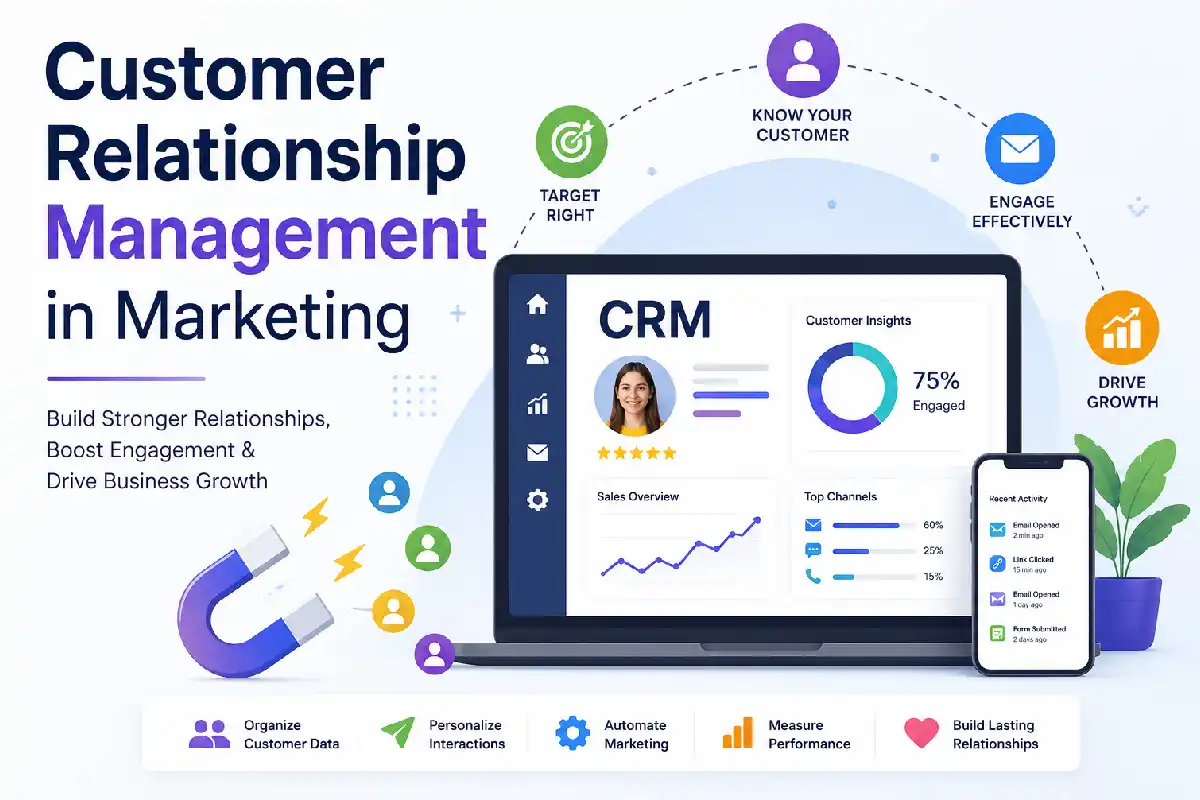
Customer Relationship Management in Marketing: Complete 2026 Guide
Last Updated: July 12, 2026
A Customer Relationship Management (CRM) in Marketing is one of the best ways for a business to foster stronger customer relationships, increase loyalty and sell more. It can enable a business to focus its attention more on valuable customers by collecting customer data, improving marketing messages, automating communication and measuring customer loyalty over time.
Whether you‘re a startup, eCommerce business or a large enterprise. Deploy the right CRM strategy to drive better customer understanding and craft memorable experiences to keep the customers coming back.
What Is CRM in Marketing?
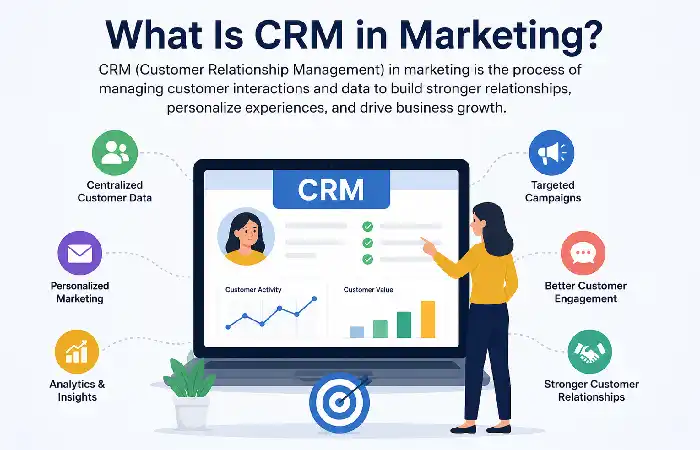
Customer Relationship Management (CRM) – marketing CRM is defined as the systematic collection, storage, use and presentation of customer information to enable a company to deliver personalized marketing campaigns.
A CRM system stores valuable customer information such as:
- Contact details
- Purchase history
- Website activity
- Email engagement
- Customer support interactions
- Social media engagement
Example
Instead of sending one email to every subscriber, a CRM can automatically send:
- Welcome emails
- Birthday offers
- Abandoned cart reminders
- Product recommendations
- Loyalty rewards
This personalisation greatly enhances the interaction with the customer.
Benefits of Customer Relationship Management
It enables organizations to build stronger customer relationships by increasing the efficiency and effectiveness of their marketing, selling and service processes (Christi, 2007). CRM databases unify prospect and customer information and integrate business processes to enable organizations to interact with prospects and customers more effectively.
CRM systems allow companies to make smarter decisions that lead to a higher lifetime value. From small companies to large organizations, a strong CRM system can produce the bottom-line results you‘re looking for.
Major Benefits
| Benefit | Marketing Impact | Business Result |
| Customer Segmentation | Personalized campaigns | Higher conversions |
| Marketing Automation | Saves time | Increased productivity |
| Better Lead Management | Improved nurturing | More qualified leads |
| Customer Retention | Repeat purchases | Higher revenue |
| Analytics | Better decision-making | Improved ROI |
| Omnichannel Communication | Consistent customer experience | Stronger brand loyalty |
2026 CRM Adoption Statistics
| Metric | 2026 Data | Source |
| Businesses using CRM | 91% | Salesforce State of Sales Report |
| Higher customer retention | Up to 27% | HubSpot Research |
| Sales productivity improvement | 34% | Salesforce |
| Marketing ROI improvement | 25–40% | Gartner |
| Customer satisfaction increase | 35% | Microsoft Dynamics Research |
CRM Strategies for Customer Retention
Retaining existing customers is generally less costly than gaining new ones. CRM functions to support retention are therefore designed to aid automation and personalization.
- Audience Segmentation
Divide customers based on:
- Age
- Purchase history
- Location
- Interests
- Spending behavior
This will make the marketing campaigns more relevant.
- Marketing Automation
Automate repetitive marketing tasks:
- Email sequences
- Lead nurturing
- Follow-up reminders
- Customer onboarding
- Loyalty campaigns
Automation enables the saving of time, and the consistent communication.
- Personalized Recommendations
Use CRM data to recommend products based on:
- Previous purchases
- Browsing history
- Wishlist activity
- Seasonal interests
Personalized items will up-sell- and bundle sales at a higher rates.
- Loyalty Programs
Reward repeat customers with:
- Points
- Exclusive discounts
- VIP access
- Referral rewards
- Birthday gifts
It saves tracking rewards to the CRM software.
- Customer Feedback Collection
Gather customer feedback through:
- Surveys
- Reviews
- Net Promoter Score (NPS)
- Support tickets
Using feedback to analyze helps improve products and customer satisfaction.
Best CRM Tools for Marketing Teams
Choosing the right CRM gives opportunity for the company to manages leads, automate marketing campaigns and build long term relationships with its customers.
The most adaptable CRM solutions combine all the aspects of a good CRM (contact management, marketing automation, analytics, and customer support) in one package. The ideal CRM for you will simply depend on how big your business is, your budget and what marketing goals you want to achieve.
| CRM Platform | Best For | Key Features | Free Plan | Official Resource |
| HubSpot CRM | Small businesses | Email automation, lead tracking | Yes | https://www.hubspot.com |
| Salesforce | Enterprises | AI insights, advanced automation | No | https://www.salesforce.com |
| Zoho CRM | SMBs | Sales pipeline, workflows | Yes | https://www.zoho.com/crm |
| Microsoft Dynamics 365 | Large organizations | Microsoft ecosystem integration | No | https://dynamics.microsoft.com |
| Pipedrive | Sales-focused teams | Visual pipelines, automation | Trial | https://www.pipedrive.com |
CRM Feature Comparison
| Feature | HubSpot | Salesforce | Zoho | Dynamics | Pipedrive |
| Marketing Automation | Yes | Yes | Yes | Yes | Limited |
| Email Campaigns | Yes | Yes | Yes | Yes | Basic |
| AI Features | Good | Excellent | Good | Excellent | Basic |
| Reporting | Excellent | Excellent | Good | Excellent | Good |
| Ease of Use | Excellent | Moderate | Easy | Moderate | Easy |
Measuring CRM Success and Customer Loyalty
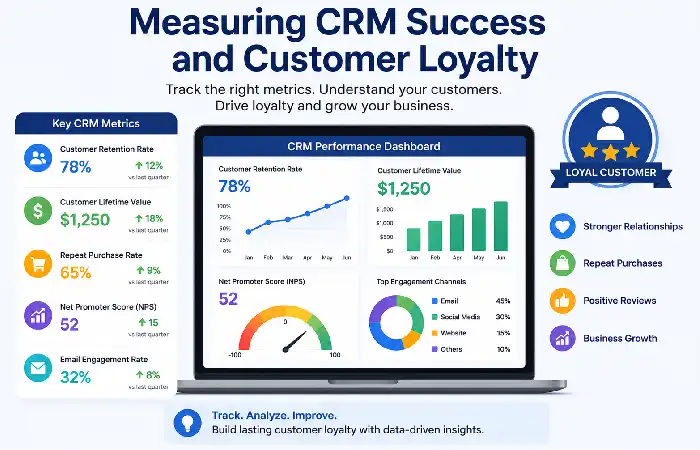
Crucially, con what is a crucial point in the use of Customer Relationship Management (CRM), is that it isn‘t the end. After you have proposed a viable CRM strategy then you must consider measuring the success of it with relevant Key Performance Indicators (KPI’s) which can be used to demonstrate to customers how the business is benefiting your relationship through such things as customer loyalty, to growing the business.
Important CRM KPIs
| KPI | Why It Matters |
| Customer Retention Rate | Measures customer loyalty |
| Customer Lifetime Value (CLV) | Estimates long-term revenue |
| Customer Acquisition Cost (CAC) | Tracks acquisition efficiency |
| Net Promoter Score (NPS) | Measures customer satisfaction |
| Conversion Rate | Evaluates campaign effectiveness |
| Email Open Rate | Indicates engagement |
| Repeat Purchase Rate | Measures customer loyalty |
CRM Performance Comparison
| Business Stage | Without CRM | With CRM |
| Lead Response | Slow | Automated |
| Customer Insights | Limited | Comprehensive |
| Campaign Personalization | Low | High |
| Sales Conversion | Moderate | Higher |
| Customer Retention | Lower | Higher |
| Marketing ROI | Average | Improved |
Common CRM Challenges
| Challenge | Solution |
| Poor data quality | Regular data cleaning |
| Low user adoption | Employee training |
| Limited integration | Use API-supported platforms |
| Over-automation | Maintain personalized communication |
| Privacy compliance | Follow GDPR and regional data regulations |
Frequently Asked Questions
What Is Customer Relationship Management in Marketing?
In marketing, Customer Relationship Management (CRM) is concerned with the targeted management, collection and utilisation of a database, the customer life-cycle experience and the customer-company interaction.
How important do you consider CRM to be in the context of marketing?
CRMs provide customizable marketing, an efficient way of removing work which does not add value, integrated or strengthen lead management and build customer loyalties thus providing benefits for ROI.
What is the most effective CRM application for novices?
Two of the most well-known beginner friendly CRM sectors are HubSpot CRM and Zoho CRM.
How does CRM work?
Customer Relationship Management (CRM) enables companies to personalize communication, follow-up automatically, operate loyalty programs and study customer behavior with a view to generate repurchase.
Which numbers should marketers know about in CRM?
Important measures of customer experience are retention rate of customer, customer lifetime value (CLV), customer acquisition cost (CAC), Net Promoter Score (NPS), conversion rate, repeat purchase rate, marketing ROI, among others.
Conclusion
Customer Relationship Management (CRM) in Marketing has emerged as an integral part of the contemporary business strategy in 2026. By effectively implementing the same, a firm can gain insight into the behavior of customers, automate the process of targeted marketing, increase retention and make acquisition focused decisions.
With the deployment of the right CRM platform and effective segmentation, automations and performance measurement, organizations will be able to develop deeper customer relationships and sustainable growth. To enrich this guide and help maximimize topical authority and SEO performance, back up with related cluster articles on marketing automation, analytics, customer journey mapping and retention strategies and ensure comparisons, statistics and best practices are current.