

Marketing Analytics & Reporting: The 2026 Complete Guide
Last Updated: September 15, 2026
Marketers need to act on information rather than assumption. Through marketing analytics and reporting, companies know exactly where they are getting traffic from, how they are getting leads and what channels are providing them with the best ROI. Regardless if you’re doing paid advertising, SEO, email marketing or social media marketing, this can help you tweak campaigns and keep getting better and better at marketing.
In this article, you’ll be able to find everything that you need to get started, all based on current best practices in 2026.
This article will cover everything including KPIs, the best attribution models and even the basics of marketing Dashboards as well as Marketing ROI.
What Is Marketing Analytics?
The practice of identifying, gathering, assessing, interpreting, and analyzing your marketing data with the intent of understanding how to strengthen your overall business operations.
It answers questions like:
- Which channel generates the most leads?
- Which campaigns convert best?
- What is customer acquisition costing?
- Where should the next marketing budget go?
Instead of relying on assumptions, businesses use analytics to optimize performance using real data.
What Is Marketing Reporting?
Marketing reporting is the presentation of analytics in an easy-to-understand format.
Reports help stakeholders monitor:
- Campaign performance
- Website traffic
- Revenue
- Conversion rates
- Customer acquisition
- Marketing ROI
Reports may be:
- Weekly
- Monthly
- Quarterly
- Executive dashboards
Why Marketing Analytics Matters in 2026
Marketing channels have become increasingly fragmented.
Today’s businesses collect data from:
- Websites
- Social media
- Email marketing
- CRM platforms
- Paid advertising
- Ecommerce stores
- Mobile apps
Without centralized reporting, valuable insights remain hidden.
Modern analytics helps marketers:
- Reduce wasted advertising spend
- Improve conversion rates
- Increase customer lifetime value
- Predict future performance
- Personalize campaigns using AI insights
Key Marketing KPIs to Track
Not every metric is important. Focus on KPIs that directly support business goals.
| KPI | Ideal Use | Why It Matters |
| Website Sessions | SEO & Content | Measures traffic |
| Conversion Rate | Landing pages | Measures effectiveness |
| Cost Per Lead (CPL) | Paid campaigns | Marketing efficiency |
| Customer Acquisition Cost (CAC) | Overall marketing | Sales performance |
| Customer Lifetime Value (CLV) | Retention | Long-term profitability |
| Return on Ad Spend (ROAS) | PPC | Paid campaign success |
| Marketing ROI | Executive reporting | Overall profitability |
| Bounce Rate | Website optimization | Content quality |
| Engagement Rate | Brand marketing | Social media performance |
| Organic Traffic Growth | Content strategy | SEO performance |
Google Analytics for Marketers

Google Analytics 4 (GA4) remains one of the most powerful free marketing analytics platforms.
It tracks:
- Users
- Sessions
- Events
- Purchases
- Form submissions
- Traffic sources
- Engagement
- Revenue
Essential GA4 Reports
- Acquisition Report
- Engagement Report
- Landing Page Report
- Conversion Events
- User Retention
- Ecommerce Revenue
- Real-Time Report
Recommended Setup
- Connect Google Search Console
- Link Google Ads
- Enable Enhanced Measurement
- Configure Conversions
- Create Custom Events
- Build Looker Studio dashboards
Marketing Attribution Models
Attribution determines which marketing channel deserves credit for conversions.
First Click Attribution
Gives all credit to the first interaction.
Best for:
- Brand awareness campaigns
Last Click Attribution
Credits the final interaction before conversion.
Best for:
- Short sales cycles
Linear Attribution
Distributes equal credit across every touchpoint.
Useful for:
- Multi-channel marketing
Time Decay Attribution
Recent interactions receive more credit.
Suitable for:
- Long buying journeys
Data-Driven Attribution
Uses machine learning to assign conversion value based on user behavior.
Recommended for businesses using GA4 with sufficient conversion data.
Attribution Comparison
| Model | Best For | Accuracy |
| First Click | Awareness | Medium |
| Last Click | Simple funnels | Medium |
| Linear | Multi-touch campaigns | High |
| Time Decay | Long journeys | High |
| Data-Driven | Advanced marketing | Very High |
Marketing Dashboard Examples
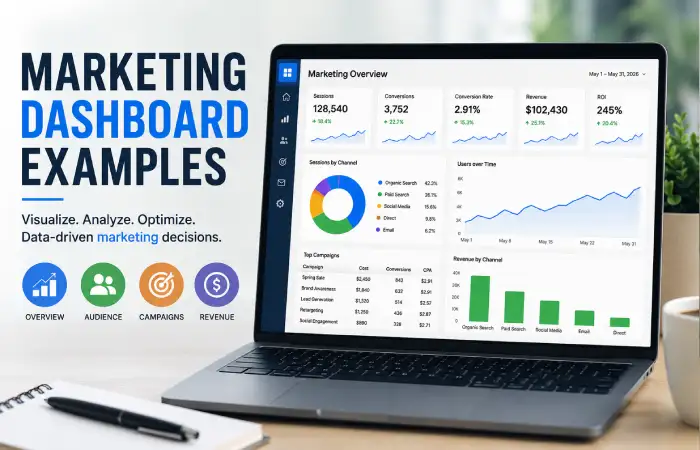
Dashboards transform raw data into visual insights.
A good marketing dashboard includes:
- Website traffic
- Lead generation
- Conversion rate
- Revenue
- Advertising performance
- SEO rankings
- Email performance
- Social engagement
Executive Dashboard
Tracks:
- Revenue
- ROI
- CAC
- ROAS
- Growth trends
SEO Dashboard
Shows:
- Organic sessions
- Keyword rankings
- Backlinks
- Top-performing pages
Paid Advertising Dashboard
Includes:
- Cost
- Clicks
- CTR
- CPC
- ROAS
- Conversions
ROI Calculation for Marketing
Calculation and significance of Marketing ROI We need to know how to calculate the marketing ROI in order to understand if your campaigns are bringing more money than they’re taking away. You don’t want to measure ROI by just clicks and impressions; instead, marketing ROI lets you measure the financial influence of your campaign.
What Is Marketing ROI?
Marketing ROI simply represents the profit made from a campaign versus what it’s cost. The higher the positive the ROI, the more profitable the campaign.
Marketing ROI Formula:
Marketing ROI (%) = ((Revenue Generated – Marketing Cost) ÷ Marketing Cost) × 100
Example of Marketing ROI
Imagine you launch a Google Ads campaign with the following results:
| Metric | Value |
| Marketing Spend | $5,000 |
| Revenue Generated | $18,000 |
| Net Profit | $13,000 |
| Marketing ROI | 260% |
Metrics That Influence Marketing ROI
Monitor these key metrics along with sales:
In order to correctly calculate your ROI, you will want to keep track of the following key performance indicators alongside your revenue figures:
Customer Acquisition Cost (CAC): It’s imperative to understand just how much each individual customer costs you.
Customer Lifetime Value (CLV): If you can project your customer value over their lifetime as a customer, then you’ll know where to best invest.
Conversion Rate: It shows you what percentage of users convert.
Average Order Value (AOV): For every sale that you make, the value of the Average Order Size shows you what your typical spend is for customers.
ROAS Returns Ad Spend: Shows you how much you’re making on any of your pay-per-click efforts.
Tips to Improve Marketing ROI
It is usually more successful to spend money more effectively on marketing instead of just boosting your overall marketing budget. Top-quality practices include:
- Direct your budget towards marketing networks performing the best.
- Enhance your landing page with a higher conversion rate.
- Audience-segmentation allows targeting your visitors for more relevant advertising.
- Regularly test A/B with headlines, ads and CTA.
- Make your emails better by making emails with personal content, and with an automatic trigger.
- Target and reach again visitors, which previously visited your website, but never buy something.
- Look at campaign results every week, and make rapid decisions about the advertisements that under-perform.
- Use marketing-attribution models to assess which marketing channels create most of your sales. (HubSpot)
Common ROI Calculation Mistakes
Many marketers misinterpret ROI because of incomplete or inaccurate data. Avoid these common pitfalls:
| Mistake | Better Approach |
| Tracking only clicks or impressions | Measure conversions and revenue instead |
| Ignoring recurring customer revenue | Include Customer Lifetime Value (CLV) |
| Excluding operational or software costs | Factor in all marketing expenses |
| Using only last-click attribution | Compare multiple attribution models for a fuller picture |
| Reviewing ROI only at campaign end | Monitor performance continuously and optimize in real time |
By tracking marketing ROI and pairing it with KPIs, you can take an evidence-based approach to your campaigns, spend your budget wisely, and strategically invest in business-driving marketing.
2026 Marketing Analytics Trends
| Trend | Business Impact |
| AI-powered reporting | Faster insights |
| Predictive analytics | Better forecasting |
| Privacy-first tracking | Cookieless measurement |
| Server-side tagging | Improved data quality |
| Unified customer data platforms | Better personalization |
| Real-time dashboards | Faster decision-making |
2026 Marketing Analytics Platform Comparison
| Platform | Best For | Free Plan | AI Features | Ease of Use |
| Google Analytics 4 | Website analytics | Yes | Yes | Excellent |
| Looker Studio | Reporting dashboards | Yes | Basic | Excellent |
| HubSpot | CRM + Marketing | Limited | Excellent | Excellent |
| Semrush | SEO analytics | Trial | Yes | Very Good |
| Databox | Executive dashboards | Limited | Yes | Excellent |
| Microsoft Power BI | Enterprise reporting | No | Excellent | Advanced |
Common Reporting Mistakes
Avoid these common issues:
- Tracking too many metrics
- Ignoring conversion events
- Failing to define goals
- Not validating data
- Missing UTM parameters
- Using inconsistent attribution
- Reporting without business context
Troubleshooting Marketing Analytics
| Problem | Solution |
| No conversion data | Configure GA4 events |
| Traffic suddenly drops | Check tracking code and filters |
| Duplicate conversions | Audit event setup |
| Dashboard mismatch | Verify data sources |
| Missing campaign tracking | Use consistent UTM parameters |
FAQ
What is Marketing Analytics?
Marketing analytics measures the performance of marketing in order to enhance campaigns and achieve business results with data.
What’s the difference between analytics and reporting?
Analytics is about finding insights, whereas reporting gives business people the latest performance information in dashboards or reports.
What metrics should a beginner track?
Start with:
- Sessions
- Conversion Rate
- Cost per Lead
- CAC (Customer Acquisition Cost)
- ROI (Return On Investment)
- Organic Traffic
What is an effective way to do marketing analytics?
A well-developed G.A 4 account (for many companies in small/medium business size range that may be paired with Data Studio) and integration of CRM data, Advertising data, and business intelligence tools will offer a strong reporting & analytics capability for larger enterprises.
What is the best marketing attribution model?
Data-driven if you have enough conversions, while Linear if it is used in multi-channel advertising.
Conclusion
As our marketing channels and landscape becomes ever-more complex, marketing analytics and reporting aren’t really a choice anymore. By monitoring valuable KPIs, setting up GA4 the right way, selecting the right attribution model, creating clean dashboards and measuring marketing ROI effectively, we can work out what to do, what not to do and what to do more of!