

How to Start a Home-Based E-Commerce Business Successfully
Last Updated: June 26, 2026
Introduction
Starting an online business from home allows you to offer products through the internet without the need to rent a real store or employ a large team. This makes it a very attractive choice for first-timers, side-hustle entrepreneurs, stay-at-home parents and small business owners wanting to test the waters before committing to more resources. However, “home” doesn’t equal “easy” and these businesses thrive when entrepreneurs plan seriously for branding, systems and marketing.
E-commerce enterprise home? What is it?
An online retailer based out of your home business that sells through your own website, online marketplace or a mix of both. Inventory can be kept in your house, dropshipped, manufactured or sourced.
The main advantage is set your own pace. Because it‘s not expensive to run a webstore, you can afford to start small, eliminate the risk and test if there is demand before expanding your business. The key disadvantages are: you have to wear many hats (sourcing, marketing, customer service, shipping, returns, listings)
Why This Model Works in 2026
Home commerce remains so popular in 2026 because online shopping habits are still settling in, so that people are ready to purchase from smaller brands provided the product, content and trust signals meet their expectations. Plus, at the same time, AI is allowing the production of product copy, customer support workflows and assets for marketing at an unprecedented rate.
However, AI also has increased competition because generic content is easier to produce. Market data from 2016 shows 61% of marketers believe AI is the biggest disruption in 20 years, and also that consumers favour human-created content and authentic brand voice over the generic. So, success will be combining efficiency and distinction.
Choosing the Right Products to Sell Online
The perfect products to sell on the internet will have all of these: real demand, great margins, affordable shipping and clear suitability to the target market. In 2026, prime groups of products will be digital, personalised, specialised purchases of consumables, and existing products that are useful in everyday life with possibilities for multiple purchases.
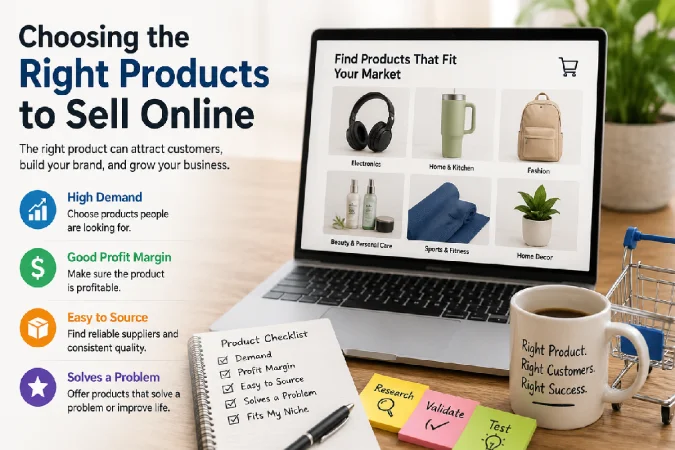
Practical tips about how to buying products prudently.
- Seek solid demand and not a decreasing trend.
- Opt would prefer products with a good margin after shipping & packaging
- Select items which the seller will be able to store, pack and post easily.
- Niche pick, a niche you are comfortable defining with one sentence.
- Confirm whether identical applications exist by search or by sale.
- Daim products that “deliver” substantial risk on the return are fragile and/or require excessive compliance.
Products to be supported in 2026
- Digital products here will also include templates, guides, and downloads.
- Personalised physical objects such as printed gifts/hard copy accessories.
- Other speciality consumables: likely to be beauty, wellness and food-adjacent items.
- Tech accessories 6 +, (like phone and wireless accessories).
- Articles for home and lifestyle are functionally beautiful.
Framework of simple selection
| Factor | What to check | Why it matters |
| Demand | Are people actively searching for it? | Confirms market interest sell.amazon+1 |
| Margin | Will you still profit after fees and shipping? | Protects business viability |
| Competition | Can you differentiate clearly? | Helps avoid copycat pricing |
| Repeat sales | Can customers buy again? | Improves long-term revenue |
| Logistics | Is it easy to ship and store? | Reduces operational problems |
Best beginner approach
Begin with just one niche, test 3–5 products in this niche, and pick the product that optimises the balance between demand and profit point. For example, a home seller can test 3 types of products, such as a downloadable product, a gift product, and a consumable, then go full force with the promising product.
Setting Up an Online Store Step by Step
The most successful way to get an online shop up and running is just to treat it exactly like a launch checklist. Decide upon a particular niche, pick a platform, create your products, set up payment and delivery engines, test everything intensively, then have a launch. All the best newcomer guides of 2026 follow this method for this very reason: it‘s such a simple task that it avoids most common mistakes.
1. Pick your niche
Choose a specific product category or client base at the very beginning. A narrow niche works makes branding easy, keeping competitive pricing low and a combination of the right product and messaging easy.
2. Define your audience
Define your target audience, find your “what”, ” how ”,” why ”, which will be solutions to your target audience’s problem. This step will help you to fine-tune your writing product page and choose the right marketing channels.
3. Choose your store platform
Select an e-commerce platform that is compatible with your budget, skills, and plans to grow. Most beginners are looking for such a platform that is easier to do design, checkout, product listing, and mobile optimisation.
4. Buy a domain and brand your store
Choose a catchy name for your shop, buy a domain and get an easy-to-use visual brand identity made for you. Having a consistent visual identity will develop trust and make your shop look professional.
5. Add products
Upload every product name, description, image, price, and options. Good product pages quickly raise the key questions in the buyer’s mind: what it is, why it matters, how much it costs and how it ships.
6. Set up payments
Set up secure payment methods and make sure the checkout is operational before the public launch. Customers won’t spend time checking out if the experience is painful.
7. Set up shipping and returns
Determine shipping zones, lead times, packaging requirements and return procedures. Providing clear shipping information minimises customer confusion, which could otherwise lead to support issues after launch.
8. Test the full customer journey
Complete the order trial, test confirmation email, follow through the payment, and make sure the shipping notices work fine. This is the last step to find out the problem for a real customer.
9. Launch and promote
Once your store is live, put post-marketing into it so as to build traffic to it naturally (Google search engine optimisation (SEO)), social media, et/cetera as a paid version of the same, utilising your email list. A sitting merchant will not sell.
Marketing Strategies for E-Commerce Success
2026‘s most successful e-commerce marketing strategies will be a combination of SEO and paid media, social commerce, email/SMS, retargeting and AI-driven personalisation. For a home-based or small online shop, the success “secret” won’t be to test everything at once, but to develop a simple system that will drive traffic, convert a good proportion of visitors and retain customers.
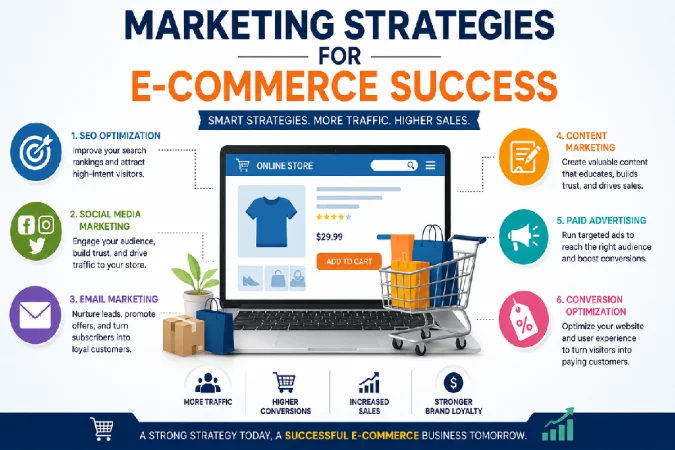
1. Prioritise search and discovery
Optimise your product pages around high-intent keywords, category terms and long-tail questions so shoppers find out what you have for sale when they’re ready to buy. Use good headings, benefits-focused copy, FAQ pages and schema markup to help search engines and customers understand your offering.
2. Use paid ads for fast testing
Show Google Ads to high-intent search traffic. Use Meta or TikTok ads for awareness/storytelling and retargeting. Use the small budget to test creatives and offers and scale the ad sets which receive the best RoAS, not clicks.
3. Build social proof and community
Consumers find trustworthy, active-looking stores most appealing, so add UGC, reviews, creator content, and short-form video that has genuine value. Utilising community-led efforts will also reduce the reliance on advertising by creating repeated brand awareness.
4. Retarget visitors and cart abandoners
Retargeting is one of the top ROIs in e-commerce methods because it retargets visitors who have already indicated an interest. Use product-view retargeting, abandoned-cart email drips and dynamic product ads to recapture revenue 24-72 hours.
5. Strengthen email and SMS
Use email and SMS for abandoned cart recovery, welcome flows, upsells, product launches and repeat sales. Set up automation for your most important flows so sales keep rolling in while you sleep.
Scaling Your E-Commerce Business from Home
Growth scaling a home business ecommerce involves increasing revenue or volume of sales without your operating systems, cash flow, or customer service breaking down. The safest advice we give out in 2026: lean into automation, retention, service, customer data, and tighter financial control as the business scales.
1. Automate repetitive work
Starts automating order-notification, abandoned-cart-notification, inventory alerts and customer-care responses where possible. Salesforce believes process automation is one of the early steps to scale, as it preserves resources and avoids errors that accrue with increased order volumes.
2. Focus on retention
A home business is more secure when customers are reselling the products back to them already, than simply getting new customers. As Mastercard mention, A core selling point to the consumer will be trust, community and repeat purchase behaviour, so growth is not simply dependent on the above ad spend
3. Tighten your numbers
Scaling fails when cash flow is ignored, even if revenue is rising. Mastercard notes that lack of cash flow kills many e-commerce businesses, so you need to track gross margin, contribution margin, CPA, ROAS, and daily cash movement as you grow.
4. Upgrade customer service
As orders increase, support requests will increase too. Salesforce recommends improving customer service as a scaling lever because faster responses and clearer policies protect reviews and repeat sales.
5. Build owned channels
Utilising email, SMS and community channels are beneficial because they are in your control. This reduces dependency on paid traffic by creating a direct means to market offers, recover abandoned carts and drive repeat business.
Conclusion
Starting a home-based e-commerce business to grow income in 2026 can be a very lucrative and flexible form of income; however, it involves planning when starting the business and not just jumping in. The most successful e-businesses tend to validate their chosen niche, manage startup expenses properly, select an appropriate e-commerce platform, develop trust through brand marketing and utilise AI while maintaining relatability.