

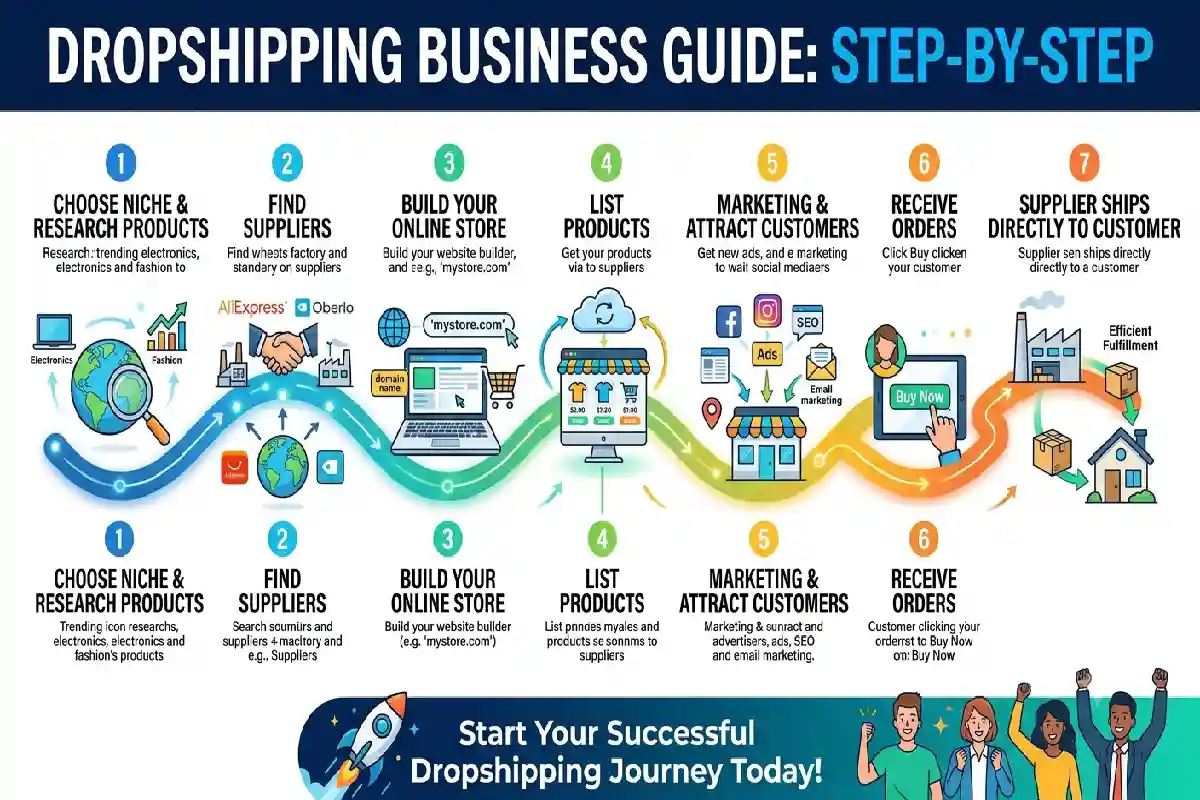
Dropshipping Business Guide: How to Start & Succeed in 2026
Last Updated: September 15, 2026
Here’s your guide to the 2026 dropshipping business. Therefore, if you want a complete, easy-to-follow tutorial to start your own dropshipping store in 2026, then rest assured, you’ve come to the right place. As more and more shoppers begin to purchase online, the global dropshipping industry is flourishing, and entrepreneurs are launching new online stores using a method that does not require a large upfront investment.
Here is what you need to know about what dropshipping is, how this business works, how to start a store step by step, how to find and choose the best products, how to find reputable suppliers, how to target your profitability, how to meet the legal requirements, and how to build a successful brand in the long-term.
Whether you’re just looking to set up a few side revenues or build a solid, full-time online enterprise, this guide will take you through exactly how dropshipping works and what pitfalls to avoid so you don’t get caught out leading to failure like 90% of the other new store owners.
What is Dropshipping?
Dropshipping is a form of online business where you sell products but never actually hold any stock. Whenever someone orders a product from you, you purchase the item from someone else and have it shipped directly to the customer.
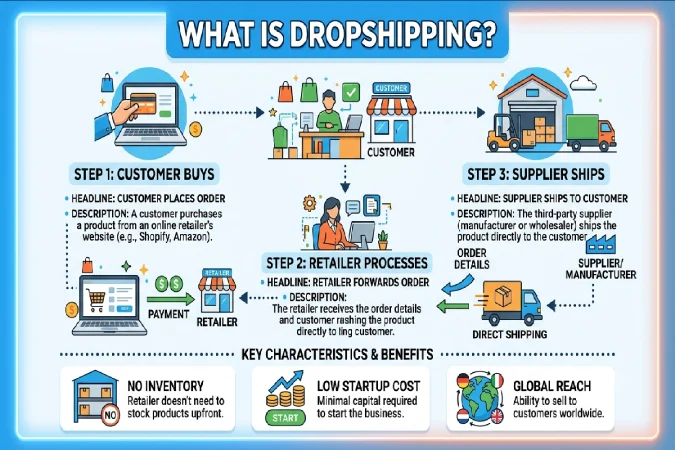
Here’s how it works:
- You then set up an online shop and publish your products to sell.
- The customer buys a product from your shop and backs you.
- You then pass the order onto your supplier and pay the wholesale price.
- The supplier has the products packaged and shipped directly to your customer.
- You hold the difference between the retail price and the supplier’s price as profit.
Example
- You have an online store and you offer a backpack for $50.
- A is priced at $50; a customer is willing to buy it.
- Your supplier will charge you $35 and he will send it to the customer.
- Your profit is 15 (before any expense such as advertising, payment processor fees, the platform‘s fees).
Advantages
- You don‘t have to invest in inventory. This means low startup cost.
- No need to worry about storage or shipping.
- Flexible and easy to start different products for proof-of-concept testing.
- Accessible wherever we are, as long as we have a network connection.
Disadvantages
- Reduced profit margins compared to having your own stock.
- Restricted authority over product quality and delivery schedules.
- Intense competition, as many sellers may have the identical article.
- Returns and customer service may be more complicated.
Dropshipping can be a legal way to run a business, but it‘s not a “get-rich-quick” scheme most people who want to succeed need patience, trial and error, hard work and the right marketing strategy.
How to Launch a Dropshipping Business in 2026
Step 1: Choose Your Niche and Business Model
Don’t sell “everything.” Focus on a specific audience or problem:
- Accessories for fitness home workouts
- Eco-friendly house products
- Gadgets for each particular breed of dog
- Similarly, beauty equipment for a certain skin type
In 2026, fashion leads the dropshipping with a market share of nearly 30%, closely followed by toys/hobby/DIY (22%) and then electronics/media (18%).
Action: Write down 3–5 niche ideas, then validate with:
- Google Trends
- TikTok/Instagram Hashtags
- Competitor stores and reviews
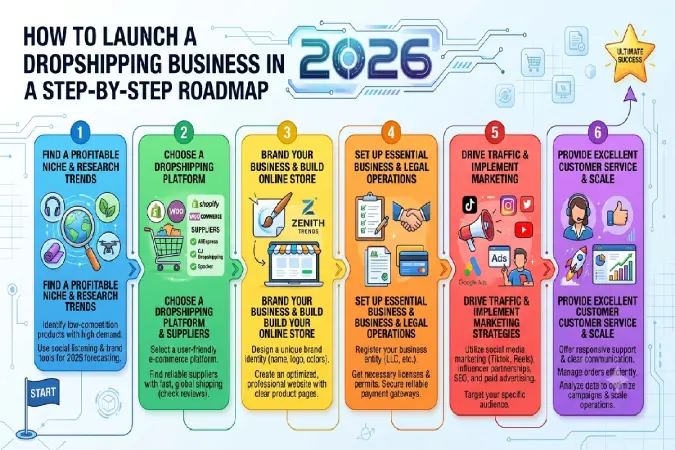
Step 2: Validate Winning Dropshipping Products
Winning dropshipping products in 2026 tend to have:
- Explicit problem/solution or persuasive emotional appeal
- Margins of 2.5–3x unpacked were provided.
- Light and easy to ship
- Not readily available locally.
Use tools like:
- TikTok Creative Center (trending ads)
- Meta Ads Library
- Supplier catalogs (CJ, Spocket, Zendrop)
AI product research tools from other platforms that can also be used directly on your website (most of the Shopify apps).
Step 3: Find Reliable Dropshipping Suppliers
Your supplier quality determines your reviews, refunds and reputation.
Common supplier types:
- Marketplace suppliers: AliExpress, 1688(through agents)
- Dropship platforms: CJ Dropshipping, Spocket, Zendrop, DSers, SaleHoo
- Printondemand: Printful, Printify (for custom products)
- Regional/regionalspecific: US/EU suppliers for faster shippings.
Checklist when vetting suppliers:
- Average shipping duration for destination you would like to ship to.
- Procedures for return and refund
- Speed of communication (a test with a few messages).
- Product quality (order samples)
Step 4: Set Up Your Online Store
Most beginners use:
- Shopify (allinone, too many apps)
- WooCommerce (WordPress, more control)
- The simple differences between 6 Wix / BigCommerce (and other options)
Key setup steps:
- Register a domain and link it to your platform.
- Select a clean, mobile-friendly theme.
- Install on important apps: reviews, email upsell, analytics.
- Write product pages elegantly: benefits, social proof, shipping.
- Configure Payments (Stripe, Payer, other local gateways).
Step 5: Price for Profit (Not “Cheapest”)
Use this simple formula:
- Profit = Selling Price Product Cost + Shipping Ads Platform Fees
- Aim for at least:
- Profit margin of 30-40% before the advertising cost
- 10–20% net margin after ads (depends on niche and efficiency of ads)
Factor in:
- Payment gateway expenses(2–3%)
- Subscription for platform and app fees
- Chargebacks and returns hold the following buffer
Step 6: Try to optimize for conversions and retention
To succeed long-term:
- Product pages improve (well lit pictures, benefits, FAQ).
- Add reviews and UGC(usergenerated content).
- Utilize post-purchase email flows (order updates, cross-sells).
- Use discounts and loyalty programs to stimulate repeat purchases.
It’s your customer’s lifetime value (LTV) that counts not just one sale.
Dropshipping or Affiliate Marketing: Which is Better for You?
A lot of newbies ask; dropshipping vs affiliate marketing who’s better?
| Aspect | Dropshipping | Affiliate Marketing |
| Control | Full control over store, pricing, and branding | Limited to merchant’s landing page & offer |
| Margins | Potentially higher (you set price) | Fixed commission (often 5–30%) |
| Customer data | You own emails, pixels, retargeting lists | Usually no direct access to customer data |
| Complexity | More operations (orders, support, refunds) | Simpler: focus on traffic & content |
| Brand building | You can build a real brand | You promote other people’s brands |
| Best for | Entrepreneurs wanting their own e‑com brand | Content creators, bloggers, niche site owners |
Best Dropshipping Companies (Comparison In 2026)
Supplier Best For Avg Shipping Time Key Pros Considerations
| Supplier | Best For | Avg Shipping Time | Key Pros | Considerations |
| CJ Dropshipping | Global catalog, customization | 7–20 days (varies) | Many products, warehousing options | Can be complex for beginners |
| Spocket | US/EU suppliers, faster shipping | 2–7 days (many items) | Quality suppliers, easy integration | Smaller catalog than AliExpress |
| Zendrop | US‑focused, simple UI | 5–12 days | Good for beginners, reliable | Fewer niche products |
| DSers (AliExpress) | Huge product range, low cost | 10–25 days | Massive choice, low prices | Quality varies; longer shipping |
| Printful / Printify | Custom apparel, mugs, posters | 3–10 days (POD) | Branding, no inventory | Lower margins on some items |
Dropshipping Profit Margins: Realistic Expectations
Based on 2026 data and seller reports:
- Average gross margins: 20–40%.
- Average net margins (after ads): 10 20% for healthy stores
- A few top performers: 25%+ net branded, bundling, repeat buyers
Example margin breakdown:
- Product cost + shipping: $12
- Sale price: $35
- Cost per order ads: $10.
- Platform+ payment fees: 2$
- Net profit: $35 $12 $10 $2 = $11 (approximately 31% net)
Your conversion rates will differ by niche, ad efficiency, and AOV.
Dropshipping Legal Requirements You Should Know
Laws vary by country, but these are common dropshipping legal requirements:
- Business registration: Register business entity (LLC, sole proprietor etc.).
- Tax compliance: Gathering and paying sales tax/VAT where required.
- Protection of consumer interests: Refund and return policy, shipping timelines, contact info
- Product compliance: safety standards ( especially for kids/ electronics/ cosmetics).
Always check local regulations and consider a quick consultation with a legal professional if you’re unsure.
FAQ
Q: How much money do I need for dropshipping in 2026?
A: $200–$1,000 can be your initial budget for basic store setup, apps and initial marketing campaigns. A higher budget will facilitate greater testing.
Q: Is dropshipping legal?
A: Yes. Dropshipping is legal. Many retailers and local stores also dropship, making the practice legal.
Q: Can I dropship with no money?
A: Not in real life. We will need some money for domain, platform, tests. Still, you can start out very tiny and get bigger gradually.
Q: How long will it take to earn money?
A: Several first sales can occur within a week; consistent profit must usually acquire 2–6 months of testing and optimization.
Conclusion
While 2026 dropshipping is very much a thriving, rapidly expanding business model the kind of thing that can be taken seriously as a real brand (and not a temporary gig) …we‘re anticipating this year, and beyond, to see a forecast rise toward the $600 billion+ level, and over the $2T in ten years time. So, while competition is increased, opportunity has expanded, also, and it all comes down to, this time around, savvy niche choice and stock sourcing, expected margins along with the legalese, and traffic, conversion, and retention.