


E-Commerce Business Ideas: Profitable Online Store Opportunities for 2026
Last Updated: June 20, 2026
Getting your E-Commerce Business Ideas project started has also become one of the most inexpensive methods to create a a revenue-generating online business by 2026. With these new exciting websites, AI-powered tools and expanding global online shopping, it is now possible for entrepreneurs to launch shops with minimal investment.
The world e-commerce industry has grown to be about $ 3.88 trillion dollars in sales during 2026, and it will keep grow through 2030. Mobile commerce, social commerce, and AI-driven personalisation all still attract web sales growth. Then 46.27% of that online shopping groups to be repeated daily in 2030.
No matter if you ‘re thinking about drop shipping, private-label, or building a DTC brand, selecting the best business idea is the key to long-term success.
Why E-Commerce Businesses Thrive?
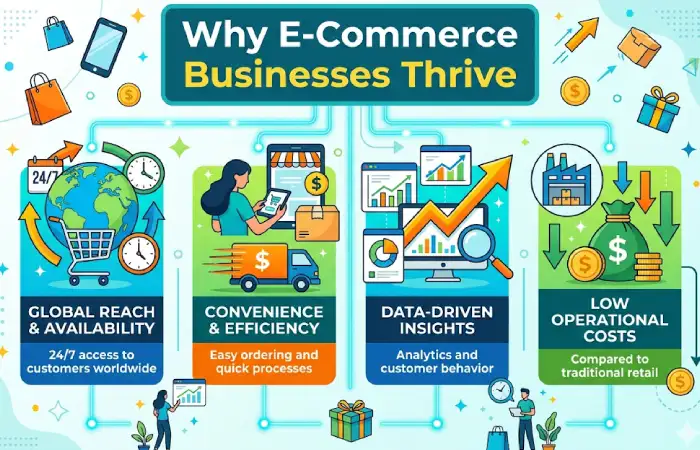
There are a number of reasons why, e-commerce represents one of the fastest-growing business areas worldwide.
Key Advantages
- Low startup costs
- Global customer reach
- 24/7 sales capability
- Automated operations
- Scalability
- Data-driven decision making
E-Commerce Market Growth (2026)
| Metric | 2026 Data |
| Global Market Revenue | $3.88 Trillion |
| Online Retail Share | 20.1% of Global Retail |
| Mobile Commerce Share | 59% |
| Expected Users by 2030 | 4.1 Billion |
| Market CAGR (2026-2030) | 6.84% |
Trending E-Commerce Business Ideas
| Business Idea | Startup Cost | Profit Potential |
| Eco-Friendly Products | Low | High |
| Print-on-Demand Store | Low | Medium |
| Subscription Boxes | Medium | High |
| Health & Wellness Products | Medium | High |
| Pet Products | Medium | High |
| Digital Downloads | Very Low | Very High |
| Personalized Gifts | Low | High |
| Smart Home Accessories | Medium | High |
Choosing the Right Product Niche
Poor selection of niche is one of the biggest reasons why online store fails.
Rather, sell to a particular crowd that has known problem or interest.
Characteristics of a Good Niche
Growing demand
Repeat purchases
Healthy profit margins
Passionate audience
Low competition opportunities
Popular Niches in 2026
| Niche | Growth Potential |
| Sustainable Products | High |
| Fitness Equipment | High |
| Home Office Accessories | Medium |
| Pet Care Products | High |
| AI Productivity Tools | High |
| Gaming Accessories | High |
| Organic Skincare | High |
| Personalized Products | High |
Some of the more successful stores are focusing on narrower niches than the general shop that is the norm in online shopping. narrow specialized stores tend to out-perform larger, more general marketplace stores because they enjoy fostered brand loyalty and a stronger customer base.
Dropshipping vs Inventory Models
Determining the appropriate fulfillment model influences profit.
Comparison Table
| Feature | Dropshipping | Inventory Model |
| Startup Cost | Low | Higher |
| Inventory Risk | None | High |
| Profit Margins | Lower | Higher |
| Shipping Control | Limited | Full Control |
| Branding Potential | Medium | High |
| Scalability | Easy | Moderate |
| Customer Experience | Supplier Dependent | Fully Controlled |
Dropshipping Pros
- Minimal investment
- Easy to launch
- No warehouse required
- Product testing flexibility
Dropshipping Cons
- Lower margins
- Supplier dependency
- Longer shipping times
Inventory Model Pros
- Better margins
- Strong brand control
- Faster fulfillment
- Improved customer experience
Inventory Model Cons
- Capital investment required
- Inventory management challenges
Most successful companies already have a hybrid strategy: dropshipping to first check a product before lifting it. Students are encouraged not to have all inventory for high-score items at hand.
Marketing an E-Commerce Store
Starting an internet shop is just the beginning of your online selling adventure. If your product is excellent, customers can’t buy it until they find your shop. That‘s why an effective marketing strategy is essential to bring visitors and boost your brand awareness, sales and make faithful customers.
By 2026, profitable e-commerce companies will have a mixture of SEO, Content Marketing, social media, email marketing and paid marketing to generate and maintain their customers.
A well-rounded marketing plan is one that directs traffic to your store from many different sources.
Top Traffic Sources in 2026
| Traffic Source | Primary Benefit | Best For | Resource |
| Organic Search (SEO) | Long-term sustainable traffic | All e-commerce businesses | SEO Statistics 2026 |
| Email Marketing | Highest ROI & repeat purchases | Customer retention | Ecommerce Email Marketing Strategy 2026 |
| Paid Search (Google Ads) | High-intent traffic | Product-focused stores | Ecommerce Conversion Rate by Traffic Source 2026 |
| Social Commerce | Product discovery & engagement | Consumer brands | Ecommerce Industry Benchmarks 2026 |
| Direct Traffic | Brand recognition & loyalty | Established brands | Traffic Sources Breakdown 2026 |
| Referral Marketing | Trust-based traffic | Niche stores & partnerships | Ecommerce Marketing Strategy 2026 |
| Influencer Marketing | Social proof & awareness | Fashion, beauty, & lifestyle | Marketing Channels Guide 2026 |
| AI Search & AI Overviews | Emerging traffic source | Content-driven brands | Conversion Rate Benchmarks 2026 |
SEO Best Practices
- Optimize product pages
- Target long-tail keywords
- Build topical authority
- Improve page speed
- Use schema markup
- Create buying guides
- Publish educational blog content
Growing an Online Brand
Sustainable success is achieved over the long term by establishing a well-known brand which the buyers are aware of and trust. Developing your online branded business will not only help you be distinguishable from your competitors but will also enable repeat customers and make your business less dependent on paid advertisements.
In 2026, consumers will be more inclined to buy from brands who have value, transparent practices and provide a consistent customer experience across several channels.
Brand Growth Framework
1st Phase: Launch
- Validate niche
- Build store
- Create content
- Start collecting emails
2nd Phase: Optimize
- Improve conversion rates
- Gather customer reviews
- Test paid ads
- Expand product range
3th Phase: Scale
- Build community
- Introduce loyalty programs
- Automate operations
- Expand internationally
Emerging Growth Trends
| Trend | Impact |
| AI Personalization | High |
| Social Commerce | High |
| Voice Search | Medium |
| Subscription Commerce | High |
| Mobile Shopping | High |
| AI Customer Service | High |
It will take time to build a robust online brand. By offering a better customer experience, employing the right marketing campaigns and tools, forming tight communities and combining business decisions with business information, ecommerce ventures will be able to enjoy longevity and think ahead for many years.
FAQ
What is the most profitable e-commerce business in 2026?
According to recent market trends, the most successful niches can be considered the specialized brands (apart from the large health & beauty category), subscription businesses, personalized products and digital products’ stores.
Is drop shipping still profitable?
Yes. Though it relies on niche-market, good suppliers and above all well-marketed product – not just common bagfuls.
How much money do I need to start an e-commerce store?
Starting up a simple store could cost less than $500 but with inventory-based businesses could need several thousands of pounds.
Which platform is best for beginners?
Out of the four options only Shopfiy and Woo Commerce are really suitable.
How long does it take to become profitable?
For most stores,it takes from 3 to 12 months to become profitable due to niche competition and effectiveness of marketing.
Conclusion
E-commerce trends are expanding in 2026. It is still a fabulous business model for entrepreneurs, part-timers, and businesses. Choosing between drop shipping, private-label products, subscription boxes, or a niche D2C business.
Entrepreneurs also need to identify the right market and its customer needs. The most successful e-commerce ventures do more than just sell. They write extended pages to attract organic traffic, hire writers for generating real page views, have a brand-building identity and rate collaborations for scaling up.
If you combine a high margin niche, a winning marketing plan and scalable plans, you will be able to build out a sustainable, growing ecommerce business.