

Customer Retention for Startups: A Practical Guide
Last Updated: September 22, 2026
Although getting customers is critical to every startup, longevity depends on the aftermath of the signup or purchase. Customer retention in startups determines the extent to which customers are retained, satisfied and loyal to a company‘s product.
High retention can lessen acquisition costs, enhance customer lifetime value and create opportunities for repeat purchase, cross/up-sell and recommendation. This is particularly important for startups constrained by Resource and Market constraints, knowing why to stay or to leave.
No single one method could master the retention; instead, the key of an effective retention strategy is a combination of successful implementation of onboarding, customer support and product enhancements, feedback, and continuous measurement.
How to Calculate Customer Retention
Customer retention shows the percentage of customers retained by a startup over a period of time.
A basic customer retention rate formula is:
Customer Retention Rate = [(ending number of customers (including new customers) minus the number of new customers who joined during the period)] divided by (number of customers at the beginning of a period) are remaining in the beginning of the period]
Say, for example, a startup begins the month with 500 customers, gains 100 new customers during the month, and ends the month with 540 customers. The calculation would be:
[(540 − 100) ÷ 500] × 100 = 88%
By doing so, the startup maintained 88% of its original customers.
Retention should be tracked uniformly, e.g., weekly, monthly, quarterly, or yearly, based on the business model being.
Startups can also track related metrics, including:
- Customer churn rate
- Repeat purchase rate
- Customer lifetime value
- Monthly active customers
- Product engagement
- Net revenue retention
- Expansion revenue
For subscription businesses, revenue retention can be particularly useful because losing a large customer has a different financial impact from losing a small customer.
Find Where and Why Customers Leave

A declining retention rate is a signal to investigate the customer journey rather than simply increase marketing efforts.
Begin with attrition points. Chart key moments in the journey, including acquisition, sign up, onboarding, activation, initial purchase, reuse, renewal, and expansion.
An example of how this scenario would vary: say most cancellations happen within the first 30 days then perhaps the problem is onboarding, the product not living up to customer expectations, getting to the first meaningful outcome is too difficult. If customers stay for say two months and then leave, the issues might be pricing, the product not delivering on possibility, the customer support experience, a change in customer needs.
Analyze churn by:
- Customer segment
- Acquisition channel
- Subscription plan
- Industry or use case
- Customer age
- Product usage
- Geographic market
- Account size
Then investigate why customers leave.
Exit surveys can provide direct feedback, while support tickets, cancellation forms, interviews, product analytics, and customer success conversations can reveal recurring problems.
Avoid assuming that every customer leaves for the same reason. A startup may discover that some customers churn because they do not use the product frequently, while others leave because a key feature is missing.
Once patterns appear, prioritize the causes that affect the largest or most valuable customer groups.
Improve Onboarding and Time to Value
The first experience a customer has with a startup can strongly influence future engagement. A complicated onboarding process can cause customers to abandon a product before they understand its value.
The goal should be to reduce time to value—the time between a customer’s initial signup or purchase and the moment they achieve a meaningful result.
An effective onboarding process should:
- Set clear expectations.
- Guide customers through important first steps.
- Help them complete a meaningful action quickly.
- Explain the features most relevant to their goals.
- Provide assistance when they encounter problems.
Learners are keen to have all features explained, although this is less likely to be helpful to new users if we overload them at once. We should concentrate on the things that will help them reach their first successful result.
Startups can track completion of onboarding, activation rate, time to first value, and early churn. Cross checking these figures can tell you if onboarding changes are improving the customer experience.
One-to-one onboarding can work by catering to different needs. Take for example a software company with to different client segments, freelancers and companies with big teams.
Build a Customer Feedback and Support Process
Customer retention is another indicator of the Customer Experience, and an area the startups should adopt to monitor. These can be maintained to be simple, and the feedbacks and solutions to customer problems should not be complex.
Useful feedback channels include:
- Customer surveys
- Support conversations
- In-app feedback
- User interviews
- Product reviews
- Cancellation surveys
- Customer success calls
Startups require a process for formatting and acting upon this information.
Organise feedback received from the group into categories (usability, price, feature requests, other technical issues, onboarding, and support). Group similar problems together, don‘t treat every request as an individual product feature request:
Customer service should also be tracked, and key metrics should include first- response time, ticket resolution time, ticket volume, level of customer satísfaction, and whether customers are requesting additional support for the same issues.
A quick reply can avoid the temporary issue becoming justification for abandonment.Customer support should also be measured. Important indicators can include first-response time, resolution time, ticket volume, customer satisfaction, and repeat support requests.
Measure Retention by Customer Cohort
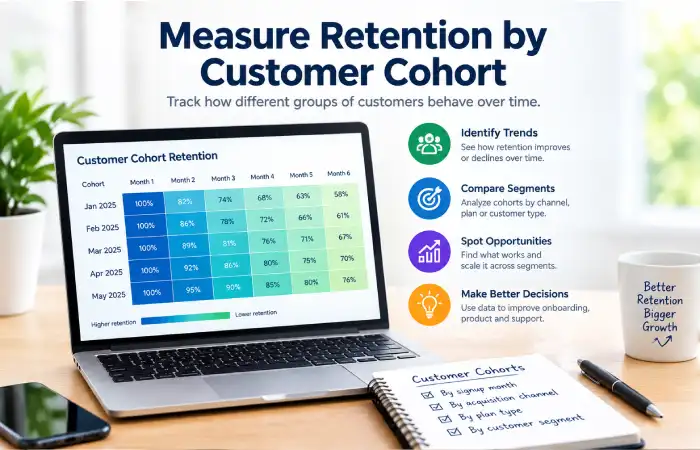
A widely used technique used to look at retention of a customer base is cohort analysis.
A cohort is a group of customers defined by a shared characteristic, such as a sign up during the same month. Rather than looking at a single overall retention value, startup companies can use cohort analysis to analyze how various groups perform over time.
For example:
| Customer Cohort | Month 1 | Month 2 | Month 3 | Month 6 |
| January | 100% | 82% | 74% | 61% |
| February | 100% | 86% | 78% | 68% |
| March | 100% | 89% | 81% | 72% |
By doing this you can assess whether retention for the newer customers is getting better.
March customers are holding onto their products more than January customers. Changes that occurred between January and March in the product, onboarding, pricing, or support might have, a positive impact on how customers turn out. The data on the cohort should be considered with all other information on the business before jumping to the conclusion that any particular change caused the uplift.
Startups may also generate cohorts by acquisition channel, plan, customer segment, or use case. This reveals which segments are keeping value longer and which segments need more care.
Create a Startup Retention Strategy
A practical customer retention strategy should connect measurement with action.
Start by establishing a baseline retention rate and churn rate. Then identify where customers are leaving and investigate the reasons behind those departures. Improve onboarding and reduce the time customers need to experience value.
Next, create reliable feedback and support processes. Finally, use cohort analysis to determine whether retention is improving over time.
A simple retention workflow might look like this:
Measure → Identify churn → Find causes → Improve experience → Monitor cohorts → Repeat
Retention should be linked to the company‘s overall growth metrics as well. Improving retention helps grow the business by growing the lifetime value of the existing customer base and reducing the churn rate.
Conclusion
In startups customer retention is not just about averting cancellations; it is about designing for the customer a benefit bundle that is substantial enough to keep the customer committed to use, buy, or grow with you.
Startups need to track retention at regular intervals, focus on when customers are lost, improve their onboarding process, solicit and act on relevant feedback and provide great customer support. Use cohort analysis to determine if these measures are raising retention among upcoming customer cohorts.
Over the long term, by approaching retention as a continuous effort (rather than a one-time effort), startups will deeply understand their customers and thus be better positioned to deliver sustainable growth.