

Startup Revenue Growth: Improve Pricing and Expansion
Last Updated: September 22, 2026
Revenue Growth. Sustainable revenue growth is one of the most important landmarks for any startup. While early traction is mostly based on validation of product-market fit and acquiring new users. Sustainable growth on the long tail has to be built on a very systematic, multi-cluster approach to optimize the value of each customer relationship. If not optimized for monetization, this is just a leaky bucket strategy chasing new sign-ups.
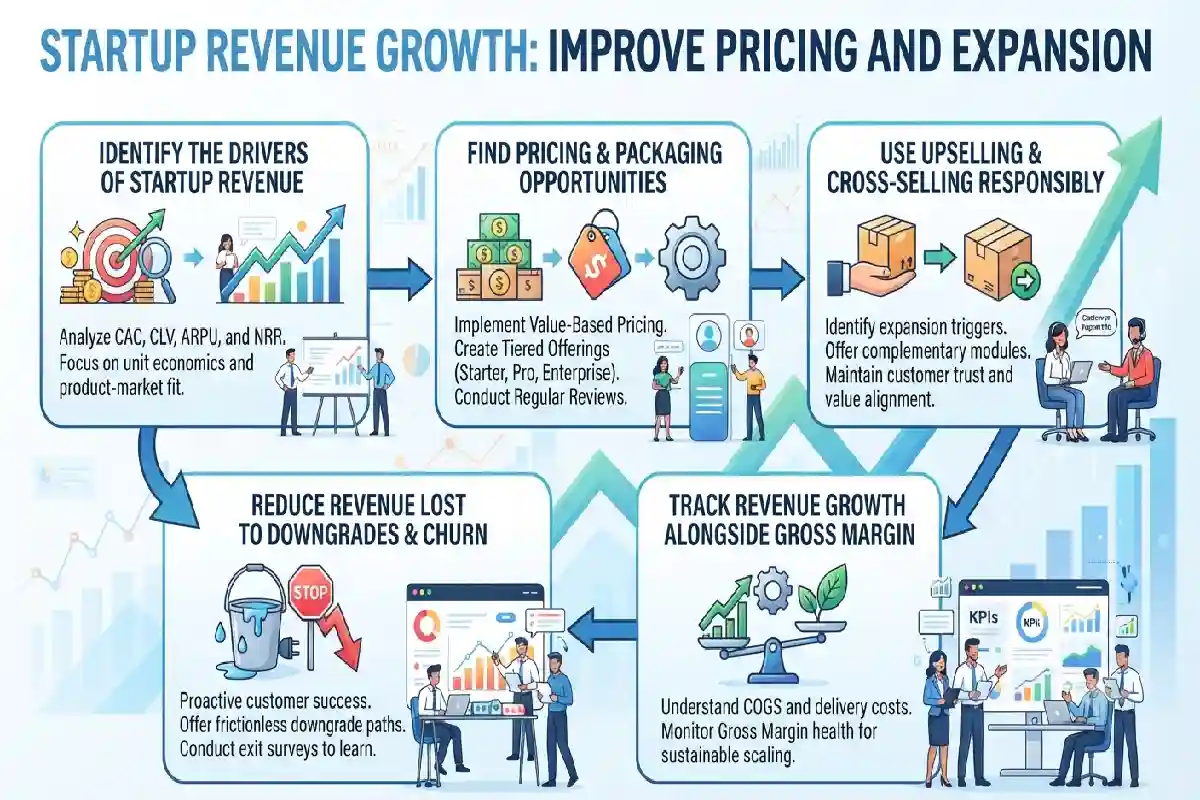
Identify the Drivers of Startup Revenue
To scale, founders and revenue leaders need to push beyond topline vanity metrics and identify the building blocks of genuine revenue acceleration. Revenue growth is seldom simple, it‘s a synergistic effect. Driven by a combination of customer acquisition, retention and utilization.
- Customer Acquisition Cost (CAC) against Customer Lifetime Value (CLV): This is the most basic metric as it defines the health of your start-up. If your CLV is not sufficiently larger than the CAC (usually a 3:1 ratio is the aim), then increasing acquisition will just put more pressure on cash burn.
- Average Revenue Per User (ARPU): Tracking ARPU gives you a sense of how you are winning financially with what you already have. The bottom line is that increasing ARPU means you are earning more per account from your installed user base over time through either upselling or simply raising prices.
- Net Revenue Retention (NRR): This will be the highest indicator of your product-market fit and revenue health. It is the percentage of dollar amount of your recurring revenue that is being retained in your existing customer accounts for a period of time (considering expansion, downgrade and churn). A good NRR greater than 100% means that your business is capable of expanding without any new logos.
Find Pricing and Packaging Opportunities
One of the biggest pitches a startup will fall for is to set their prices early and not go back to them ever again. Price is just not a one time thing to be set and forgotten it‘s a dynamic lever that must change as your product and your feature set matures.
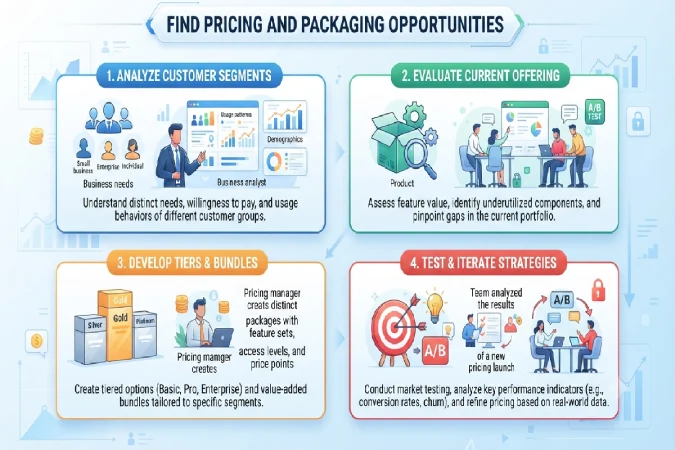
- Value-based pricing models: Abandon non-precise cost-plus-based strategies or line copying. Price your levels in terms of the individual value or utility (volume, seats, result-based, etc.) you are delivering to the customer.
- Tiered Packaging Strategies: Distinguish easily and convincingly between existing customer types (for example, Starter, Professional, Enterprise packages). Package features strategic, and the simple fact that users are using a lot of features and testing is what provides a natural pathway up through the package tiers.
- Price testing on an ongoing basis: the market will change, inflation will occur and your product will continue to become more and more awesome with time. However, indefinitely grandfathering early adopters may prevent you from growing. Bring in fresh cohorts frequently to try different price points through packaging audits.
Use Upselling and Cross-Selling Responsibly
Winning a new customer is often more costly than retaining and expanding an existing one. Expansion revenue derived from upselling higher plans or cross selling additional features is the word-of-mouth success story of successful SaaS and technology startups.
- Spot Expansion Triggers: Keep a watch on consumption metrics to identify if a customer is approaching the bounds of their plan be it storage, API requests, or team members. These friction points are the perfect moment to upsell.
- Additional Add-Ons: Offer one or more modular components or add-ons that address related circumstances for your main user base. Your customers can personalize their experience and higher your average contract value (ACV).
- Protect Customer Trust: Growing shouldn‘t come across as a “profits through fear” tactic. Make sure an upsell or cross-sell suggestion is true value for a customer‘s path to achieving their growth and success objectives, rather than simply bolstering your monthly KPI‘s.
Reduce Revenue Lost to Downgrades and Churn
By fighting to grow when your losing dollars as fast as earning them. Wallowing in revenue leaks is a losing battle. Combating revenue leaks is about proactively managing: customer success, product engagement, and own intervention.
- Proactive Churn Early Warning Systems: Be on the lookout for behavioral warning signs, like a quick decline in login frequency and basic feature use or a lack of response from some of your higher-value stakeholder accounts. Program automated triggers that enable your customer success team to take action prior to a cancellation request.
- Frictionless Downgrade Paths: If you determine that a customer genuinely is stuck on budget and needs to downgrade, don’t immediately cancel. Provide them with an attractive, less-expensive alternative to help them stay in your system. This maintains that all-important customer relationship and primes the pump for a re-upgrade later.
- Post-Mortem Exit Interviews: If you must have churn, then have open and honest exit surveys or interviews. Collect qualitative reasons on why customers are leaving. This will guide you on what is broken in the product, messaging, and value packing.
Track Revenue Growth Alongside Gross Margin
In general, top-line revenue growth can give a false sense of security unless unit economics on the whole are sound. Running a startup at scale demands the right mix of rapid growth without sacrificing gross margin health.

- Cost of Delivery (COGS): Know the real cost of delivering your product, including hosting infrastructure, third-party software integrations, customer support overhead, and professional services. As your scale, you will be able to look for economies of scale to bring the costs of delivery down.
- Gross Margin Health: profitable business models (70%–80%+ for software companies) create the profit cushion to fuel aggressive investments in R&D and marketing. If your revenue growth is coming at the expense of declining gross margins, you have a serious operational efficiency problem.
- Holistic Financial Dashboards: Establish crossdepartment visibility that bridgesthe revenue target with margin performance. This makes sure that your sales and product teams are not fueling unprofitable growth. That compresses the foundations for financial performance.
Conclusion:
Designing a Resilient Revenue Engine. At the end of the day, it‘s not possible to scale startup revenue with one single growth hack, or a “magic” change in pricing. Long term growth only comes from aligning every element of the customer lifecycle from bringing in high-value customers with high retention potential. Through dynamic pricing optimization, responsible growth, and margin protection. Keeping pricing as a flexible lever, doubling down on customer-centric strategies, and understanding. How that impacts unit economics will enable founders to build robust startups instead of high-burn fragile businesses.