

When to Scale a Startup: A Readiness Checklist
Last Updated: September 22, 2026
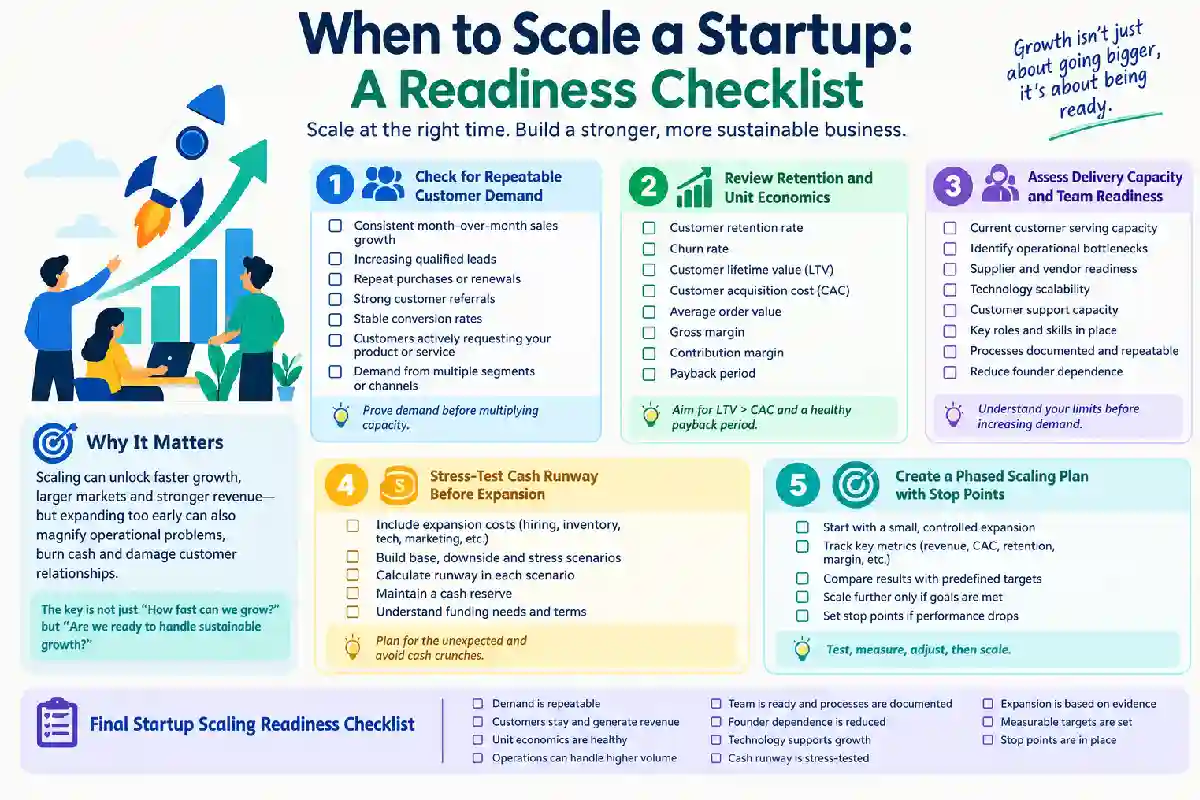
For a startup, scaling can be a pathway to growth, bigger markets and higher revenue but moving too quickly can then amplify operational issues, cause cash burn and undermine customer relationships. The real challenge is not ‘how quickly can we scale’ but rather ‘is the business able to sustain growth?’
A company can consider itself ready to grow when the demand is predictable, customers remain and have good economic characteristics, operations can handle extra volume, the team is ready for higher complexity and the firm has sufficient cash cushion to endure unforeseen expenses.
Consider before launching heavily into growth this startup scaling readiness checklist.
1. Check for Repeatable Customer Demand
Before scaling, determine whether your startup has demonstrated genuine and repeatable demand.
A few large sales or a sudden spike in website traffic does not necessarily mean you have achieved product-market fit. Sustainable scaling requires evidence that customers consistently want your product or service.
Look for patterns such as:
- Consistent month-over-month sales growth
- Increasing numbers of qualified leads
- Repeat purchases or renewals
- Strong customer referrals
- Stable conversion rates
- Customers actively requesting your product
- A predictable sales pipeline
- Demand from more than one customer segment or channel
You should also understand why customers buy. If sales depend heavily on discounts, personal relationships, temporary trends, or one marketing channel, scaling may expose weaknesses in your acquisition strategy.
Startup scaling checklist
Ask:
| Question | Ready? |
| Are sales consistently growing? | ☐ |
| Do customers repeatedly purchase or renew? | ☐ |
| Is demand coming from multiple sources? | ☐ |
| Can you explain why customers choose you? | ☐ |
| Is your conversion process reasonably predictable? | ☐ |
| Are referrals or organic demand increasing? | ☐ |
A useful principle is: prove demand before multiplying capacity.
If customers are not being served within this current scale, then adding employees, technology, locations, or inventory will merely increase costs and not address the issue.
2. Review Retention and Unit Economics
It is not worth much if the customer takes off fast or every sale does not come up.
Check your retention metrics and unit economics before you scale. These figures can tell if gaining more customers is worth it.
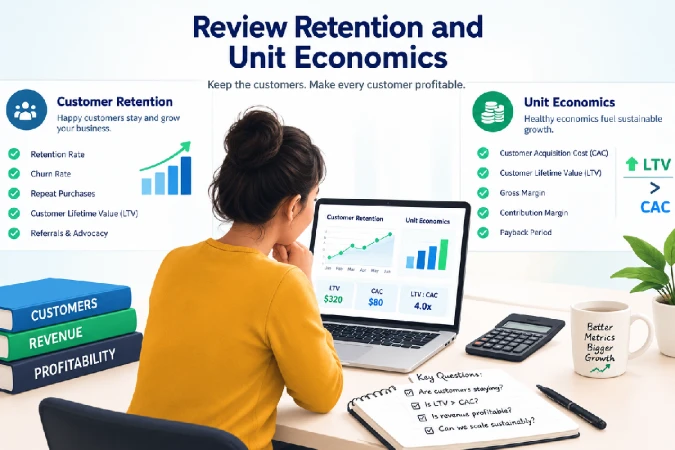
Important metrics include:
- Customer retention rate
- Churn rate
- Customer lifetime value (LTV)
- Customer acquisition cost (CAC)
- Average order value
- Gross margin
- Contribution margin
- Payback period
Take the following instance: if one were to purchase a customer, and that purchase cost one hundred dollars, the value of the contribution margin is only eighty. If one were to increase customer acquisition in this case, losses would ensue.
If customers stay for a long time, generate repeat revenue and deliver good margins then further investment in marketing and saleswill have a stronger economic case.
Observe how CAC is tracking the LTV too.
A simple framework is:
LTV > CAC
But how much you need in reality depends on your business model, margins, growth rate and cash position. An analytic software company, ecommerce company, marketplace, and a professional-services business may all have very different economics.
Also examine payback period. Even profitable customers can create cash-flow problems if the company must spend heavily today and wait a long time to recover acquisition costs.
Don’t scale solely because revenue is increasing. Scale when revenue quality and customer economics are improving or at least remain sustainable.
3. Assess Delivery Capacity and Team Readiness
A startup may have strong demand but still be unprepared to serve substantially more customers.
Scaling increases operational complexity. More customers can mean more orders, support tickets, production requirements, supplier relationships, technical issues, returns, and administrative work.
Before expansion, identify your current capacity.
Consider:
- How many customers can you serve with existing resources?
- Where are the current bottlenecks?
- What happens if demand doubles?
- Can suppliers handle increased volume?
- Can your technology handle additional users?
- Can customer support maintain response times?
- Which processes still depend entirely on the founder?
- Which roles need to be hired before expansion?
Create a capacity forecast rather than hiring or purchasing equipment reactively.
For example:
| Area | Current Capacity | Expected Scale | Gap |
| Monthly orders | 2,000 | 4,000 | 2,000 |
| Support tickets/day | 150 | 300 | 150 |
| Sales representatives | 5 | 8 | 3 |
| Fulfillment staff | 10 | 18 | 8 |
The goal is not to eliminate every constraint before scaling. Some constraints are normal. Instead, understand which bottlenecks could prevent the business from maintaining quality.
Founder dependence is another warning sign
If every important decision still requires the founder, rapid expansion can create chaos.
Document repeatable processes, establish ownership, and introduce appropriate management systems before increasing complexity.
4. Stress-Test Cash Runway Before Expansion
Scaling usually requires spending money before the additional revenue arrives.
You may need to invest in:
- Hiring
- Inventory
- Equipment
- Software
- Marketing
- New facilities
- Product development
- Sales infrastructure
- Customer support
- Compliance and legal requirements
This makes cash runway one of the most important startup scaling considerations.
Don’t calculate runway only using your current monthly expenses. Build scenarios for expansion.
Create three financial scenarios
Base case:
Growth follows your current expectations.
Downside case:
Revenue growth slows while expenses increase as planned.
Stress case:
Sales decline, customers pay later than expected, and expansion costs exceed your initial budget.
Then ask:
How many months can the business operate if the expansion takes twice as long to generate the expected return?
However, a performance of this exercise could identify the education risks before they turn into an emergency.
Keep some cash set aside in case of emergencies. Don‘t use it all now for growth!
If outside funding is needed, find out the amount of capital needed, what it will be used for, and what assumptions are behind the return estimate.
5. Create a Phased Scaling Plan With Stop Points
Scaling isn‘t binary.
A phased scaling plan for expanding allows you to grow and derive results, and provides the ability to tweak the program without the need for huge investment.
Rather than opening ten markets right away, for instance,? – After that, London could open one market.
A phased approach might look like:
Phase 1: Validate
Launch a controlled expansion with limited spending.
Track:
- New customers
- Revenue
- CAC
- Retention
- Gross margin
- Customer satisfaction
- Operational workload
Phase 2: Evaluate
Compare actual performance with your predefined targets.
If the results meet expectations, proceed. If they fall below your thresholds, identify the problem before investing further.
Phase 3: Expand
Increase marketing, hiring, inventory, or geographic coverage only after the initial expansion demonstrates sustainable results.
Phase 4: Optimize
Once growth accelerates, improve automation, processes, management structures, and margins.
Most importantly, establish stop points before you start.
For example:
| Metric | Target | Stop/Review Trigger |
| Gross margin | ≥50% | <40% |
| Customer retention | ≥85% | <75% |
| CAC payback | ≤12 months | >18 months |
| Support response | <4 hours | >12 hours |
| Cash runway | ≥12 months | <6 months |
These numbers are examples rather than universal benchmarks. Your thresholds should reflect your industry, business model, growth stage, and risk tolerance.
Conclusion
How do you learn when to scale? It‘s less a matter of hitting a certain revenue number and more of knowing the right time to do so.
A startup should analyze demand, retention, unit economics, operational capacity, team viability and cash runway at the same time. An excelled business metric may offset a significant related shortcoming.
Controlled scaling-off is usually the most prudent course of action: test an opportunity, set clear, quantifiable performance targets, track the numbers and put more money in as there is documented track record to justify doing so.
Scaling should be the extension of a working business model, not an effort to correct an unproven business model.