

Content Marketing for Startups: A Practical Workflow
Last Updated: September 27, 2026
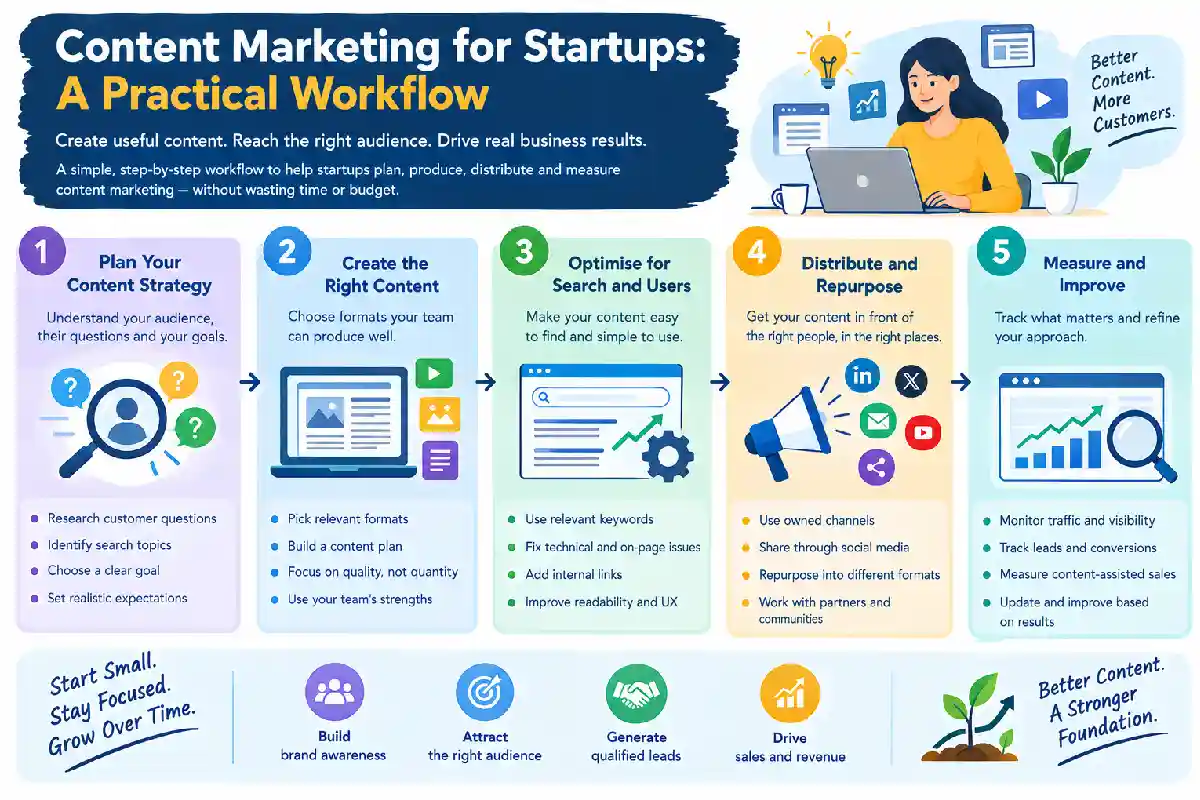
Content marketing provides one of the best means of establishing visibility, informing prospective customers, and establishing demand in a startup that is less reliant on paid promotion. That said, startup content marketing is no mere publishing routine:
A good content strategy links the content a startup offers to the questions customers are seeking answers to along the path to purchase. It also takes into account what formats can be reasonably produced by a small team, establishes an editorial workflow that can be repeated, deliver content through appropriate channels, and track the content‘s effectiveness in generating enquiries and revenue.
Startups usually don‘t have money, a big staff, or the time to maintain an extensive presence. Focus is all the more vital. Rather than attempting to build content around every network and population, startups can instead develop a manageable process that concentrates on a handful of topics that matter, and iteratively refine what‘s successful.
Connect Content Topics to Buyer Questions
Placement is always the customer never the calendar.
Those who could be our customers are already more than likely to have concerns. They could be, for example, trying to research a problem, looking for different options, estimating fees, judging providers, or assessing whether a product actually is appropriate for them.
Content can contribute to handling these questions along each step.
Identify common customer questions
Start by collecting questions from sources such as:
- Sales calls
- Customer support conversations
- Product demonstrations
- Customer reviews
- Surveys
- Search queries
- Community discussions
- Competitor FAQs
- Social media conversations
- Website search data
Map content to the buying journey
Different questions indicate different levels of buying intent.
Awareness:
The customer is trying to understand a problem.
Examples:
- What is cash-flow management?
- Why do small businesses struggle with cash flow?
Consideration:
The customer is exploring possible solutions.
Examples:
- Best cash-flow management tools
- Cash-flow software vs spreadsheets
Decision:
The customer is evaluating specific products or providers.
Examples:
- Accounting software pricing
- Accounting software features
- [Product] vs [Competitor]
A strong startup content strategy should cover multiple stages instead of producing only general educational articles.
Prioritise business-relevant topics
Not every question deserves equal attention.
Prioritise topics based on factors such as:
- Relevance to your target customer
- Search or audience demand
- Business value
- Buying intent
- Competitive difficulty
- Existing expertise
- Potential to connect to your product or service
A smaller A niche audience with real needs can be more profitable than a mass audience with little commercial value.
The objective is producing a piece of content that will draw the right crowd, not necessarily the most people it possibly can.
Choose Formats Your Team Can Produce Well
One mistake startups tend to make is selecting content formats simply because they are new or popular.
Four most likely: A small team is unlikely to need a podcast, a YouTube channel, a daily newsletter, a social media profile, a blog, a web-based seminar series and a downloadable ‘how to’ document all at the same time.
A more prudent route is to identify formats that the team can reliably generate and design a workflow to support them.
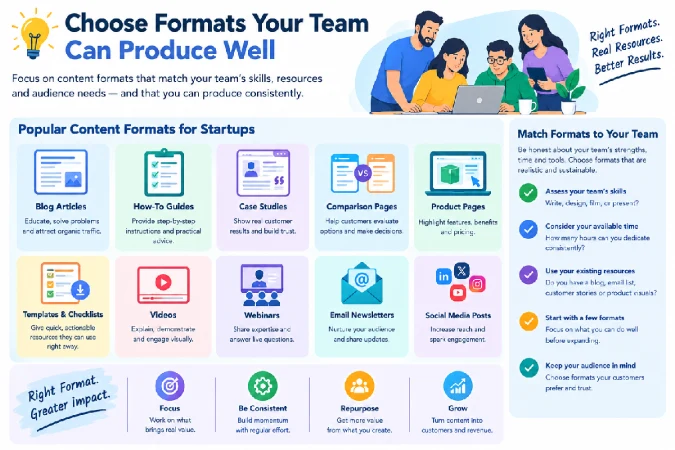
Common content formats
Depending on the audience and business model, useful formats include:
- Blog articles
- How-to guides
- Case studies
- Product comparisons
- Research reports
- Checklists
- Templates
- Webinars
- Videos
- Podcasts
- Email newsletters
- Social media posts
- Infographics
- Frequently asked questions
Each format has different production requirements.
A technical startup with strong internal expertise might perform well with detailed guides and original research. A visually oriented brand may benefit more from demonstrations, short videos, and visual explainers.
Match formats to customer preferences
Consider how your audience prefers to consume information.
A complex technical problem may require a detailed guide. A quick product demonstration may work better as a short video. A checklist may be useful when customers need something they can immediately apply.
The same underlying topic can also be transformed into several formats.
For example, a startup could create a comprehensive article about inventory management and then turn it into:
- A short checklist
- A LinkedIn post
- A customer email
- A presentation
- A short video
- An infographic
- A sales enablement resource
This allows the startup to get more value from the original research.
Build around team strengths
Content quality often improves when people work within their areas of expertise.
A founder may be particularly good at explaining industry problems. A salesperson may understand customer objections. A product manager may explain technical features. A designer may transform complex information into visual content.
Document these strengths and assign responsibilities accordingly.
The objective is not to create the largest volume of content. It is to establish a sustainable production system that the team can maintain.
Build an Editorial Plan Around One Core Topic
Instead of jumping between unrelated subjects, startups can often benefit from building content around a small number of core topics.
This creates a more organised content library and makes internal linking, distribution, and updates easier.
Select a core topic
Choose a broad subject that is closely connected to:
- Customer problems
- Products or services
- Industry expertise
- Search demand
- Business goals
For example, a startup selling project management software could make project management for small teams a core topic.
Supporting content could include:
- Project planning guide
- Team task management
- Project management templates
- Workflow automation
- Managing remote projects
- Project reporting
- Project management software comparison
The pages can then link to one another and to relevant product pages.
Create topic clusters
A topic cluster consists of a central resource supported by related pieces of content.
For example:
Core guide:
Complete Guide to Project Management for Small Businesses
Supporting content:
- How to Create a Project Plan
- Project Management Checklist
- How to Assign Tasks Effectively
- Common Project Management Mistakes
- Project Management Tools Comparison
This structure gives the startup a clear editorial direction while creating multiple opportunities to address customer questions.
Create a realistic publishing schedule
An editorial calendar should reflect available resources.
A small startup might publish one high-quality article every week or two rather than attempting to publish every day.
A basic editorial calendar can include:
| Week | Topic | Format | Intent | Goal |
| 1 | Core industry guide | Article | Informational | Organic traffic |
| 2 | Common customer problem | How-to guide | Informational | Education |
| 3 | Solution comparison | Comparison | Commercial | Product consideration |
| 4 | Customer success story | Case study | Commercial | Trust |
| 5 | Product-focused guide | Landing page | Transactional | Conversion |
Consistency is generally more useful than an unrealistic publishing target.
Include updates in the editorial plan
Content marketing does not end when an article is published.
Older content can lose relevance as products, statistics, customer expectations, regulations, and industry practices change.
Schedule periodic reviews to determine whether pages need:
- Updated information
- New examples
- Additional sections
- Better visuals
- New internal links
- Improved calls to action
- Updated product information
Maintaining useful existing content can be an important part of a startup’s content workflow.
Distribute and Repurpose Your Best Content
Publishing content does not guarantee that people will discover it.
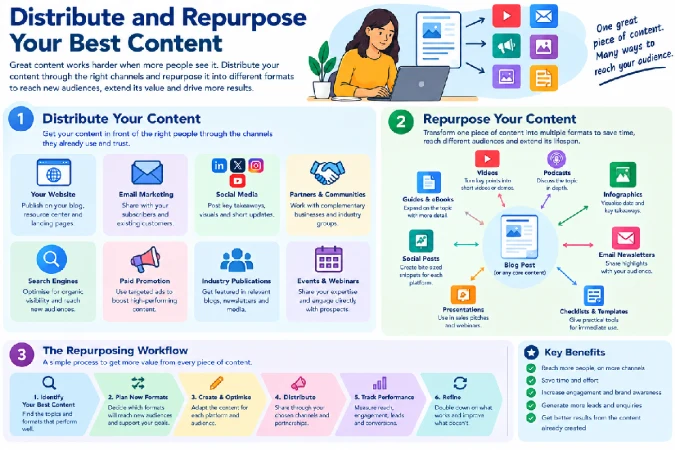
Distribution helps startups place useful information in front of audiences through channels they already use.
Use owned channels first
Start with channels the business controls, such as:
- Website
- Email newsletter
- Customer communications
- Product documentation
- Knowledge base
- Social media profiles
For example, after publishing a detailed guide, the startup could send a summary to its email subscribers and share several key insights through social channels.
Repurpose successful content
Repurposing allows a startup to extend the value of existing research.
A single long-form article could become:
- A newsletter
- Three social posts
- A short video
- A checklist
- A sales presentation
- An infographic
- A webinar topic
Repurposing does not mean copying the exact same content everywhere. Each version should be adapted to the platform and audience.
Distribute based on audience behaviour
Different audiences may prefer different channels.
B2B audiences might respond to email newsletters, industry publications, professional communities, webinars, and LinkedIn. Consumer audiences may discover content through search, video platforms, social media, or creator partnerships.
Start with a few channels where the target audience is actually active.
Avoid spreading a small marketing team across every available platform.
Promote content internally
Content can also support teams outside marketing.
Sales representatives can use comparison guides during conversations. Customer support teams can reference educational resources. Product teams can use FAQs to understand recurring customer questions.
This turns content into a shared business asset rather than something that exists only on the company blog.
Measure Content-Assisted Enquiries and Sales
Traffic and engagement metrics can help evaluate content performance, but startups ultimately need to understand whether content contributes to business results.
The most useful measurement framework connects content activity with customer actions.
Track basic content metrics
Useful metrics may include:
- Organic traffic
- Page views
- Search impressions
- Search clicks
- Engagement
- Returning visitors
- Email subscriptions
- Downloads
- Video views
- Social interactions
These metrics can indicate whether people are discovering and consuming content.
However, they should not be treated as the final measure of success.
Measure meaningful conversions
Depending on the startup, content conversions might include:
- Contact form submissions
- Demo requests
- Free-trial registrations
- Newsletter subscriptions
- Product purchases
- Account registrations
- Consultation requests
- Downloads
- Qualified leads
For example, an article that receives 10,000 visits but generates no qualified enquiries may need a different strategy from an article receiving 1,000 visits and producing several sales opportunities.
Track assisted conversions
Customers rarely purchase immediately after reading one article.
A potential customer might:
- Discover a blog post through search.
- Read a product guide.
- Subscribe to the newsletter.
- Return several weeks later.
- View a pricing page.
- Request a demonstration.
- Become a customer.
If measurement only credits the final page visited before conversion, the earlier content may appear less valuable than it actually was.
Content-assisted reporting can help startups understand how educational resources contribute to the broader customer journey.
Connect content with CRM and analytics
Where practical, connect website analytics with lead and customer data.
Track information such as:
- First content interaction
- Conversion page
- Lead source
- Content viewed before enquiry
- Sales-qualified leads
- Customer acquisition
- Revenue associated with content-influenced journeys
This makes it easier to identify which topics are supporting actual business growth.
Improve the content based on results
Measurement should lead to action.
- If an article attracts relevant traffic but generates few conversions, review its calls to action, internal links, and next steps.
- If a page generates qualified leads but has low traffic, consider improving its search visibility and distribution.
- If a topic consistently attracts the right customers, develop related content around it.
This creates a continuous cycle:
Research → Create → Publish → Distribute → Measure → Improve
Create a Repeatable Startup Content Workflow
A practical content marketing system does not need to be complicated.
A startup can establish a repeatable workflow such as:
Step 1: Investigate customer questions
Gather inquiries from customers, internal sales staff, through search data, communities etc. in the industry.
Step2: Select topics in order of importance
Choose topics that are customer relevant, business related, on purpose and within the process resources available.
Step 3: Choose the format
Determine whether the topic is best suited to an article, guide, video, case study, checklist, webinar, or another format.
Step 4: make useful content. Include breadth, good initial content, a virgin site, or all bits of useful content.
Always write with medium accuracy, medium clarity, originality, some examples, and utility.
Step 5: discoverability.
Treatises, books, manuals, pamphlets, instructions, and other texts should be useful to the user in the UK and by the use of the internal links, handbook pages, home pages, and similar search optimized page elements.
Step 6: Spread the content.
Distribute it on your owned, social, community, partner, and email channels.
Step 7: Repurpose strong content
Transform the good products into more formats.
Perform step 8: Business result measures
Leads, enquiries, sales conversions, content assisted sales.
Archive Step 9: Update & improvement. Having completed all the prerequisite changes, consider possible ways to enhance the page.
Rearrange kritisches Know-how on the critical aspects of recently successful content to reflect how the developments in performance and evolving customer requirements.
Common Content Marketing Mistakes Startups Should Avoid
Furthermore, it should not show up all the mistakes that could be done:
Publishing without a customer purpose
Content should solve a genuine problem or answer a meaningful question. Publishing simply to maintain a schedule can create a large but ineffective content library.
Chasing every trending topic
A trending subject may generate attention without attracting potential customers. Prioritise topics connected to the startup’s audience and offer.
Just considering the issue of traffic:
Traffic is however interesting, it should not however on its own be taken to mean business value. Log tracked conversions and qualified enquiries.
Making way too many formats at a time
Managing a variety of channels can be too much for a small team; wait until one or two formats prove to be successful before trying to grow further.
Ignoring distribution
Even excellent content may receive limited attention if nobody promotes or shares it. Include distribution in the content workflow from the beginning.
Failing to update existing content
A strong article can become outdated. Regular reviews help maintain accuracy and usefulness.
Conclusion
Content Marketing for Startups is most effective as a repeatable business process instead of a race to produce more content. Understand the questions, concerns, and problems your potential customers care about. Then select formats your team can reliably generate content for and design an editorial calendar around a handful of tight core topics.
When they go live, promote the content and repurpose the best assets into other formats. Track more than the traffic and engagement. the next step is to monitor enquiries, qualified leads, conversions and content-enabled sales. Find out how the content translates into growth.
A targeted startup doesn‘t require dozens of pieces of content to get going. A body of useful, relevant, interconnected content can be very valuable marketing tool if it is regularly got out there, analyzed and enhanced.