

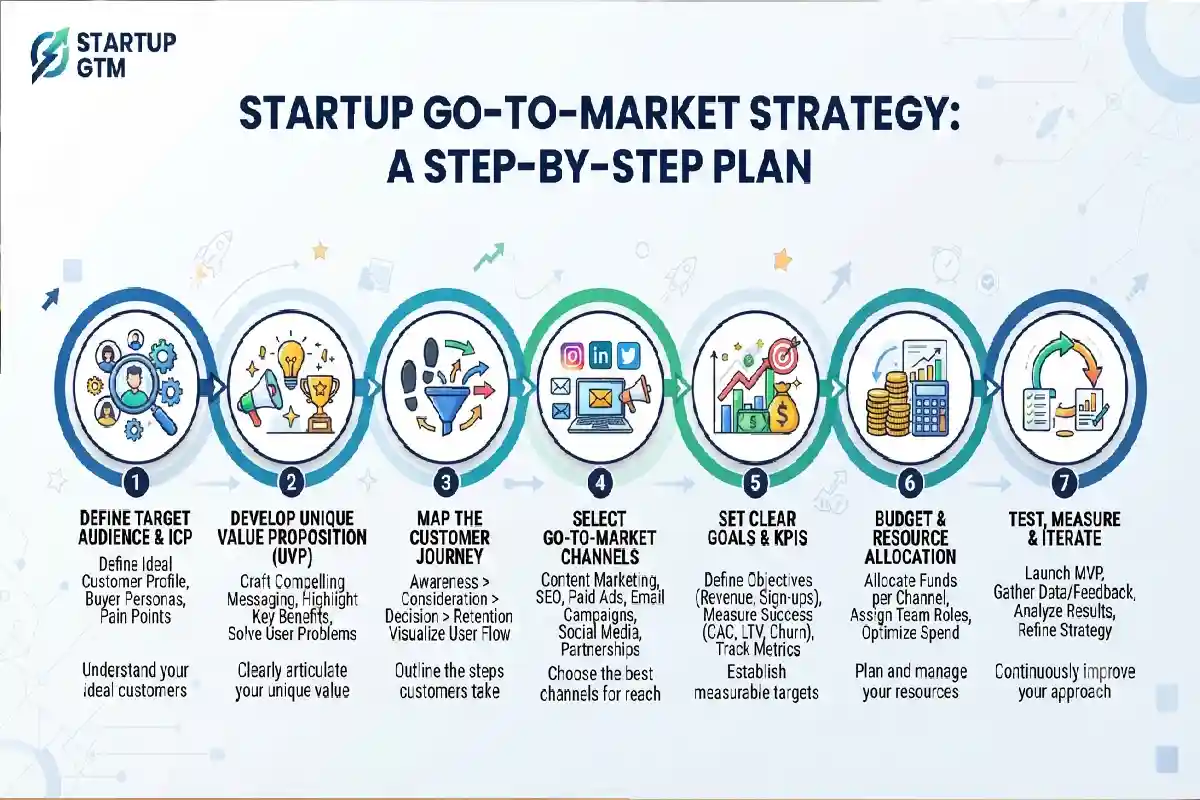
Startup Go-to-Market Strategy: A Step-by-Step Plan
Last Updated: September 26, 2026
A startup go-to-market strategy must devise a plan to launch your product or service into the marketplace, identify and target the right customers, create initial demand and convert this early excitement into sales. It involves aligning product development, marketing, sales, pricing, channel and customer support functions together with a shared launch goal.
For an early-stage startup a go-to-market strategy doesn‘t have to be complex. The key is to find a well defined customer, give a compelling reason to buy, select feasible sales & channels, define ownership and measure the post launch outcome.
A narrowly focused strategy also protects startups from overextending and wasting resources. Instead of attempting to make a broad market entry, entrepreneurs can target a narrow segment first, adapt with valuable feedback and later scale.
Choose Your First Target Customer Segment
Deciding the primary customer segment for your startup is the first task. Even if a product will to be used by multiple sets of customers, it requires a clear initial target segment in order to craft delivery processes and create convincing sales messages.
Begin with the cust some of the best need-benefit to ability-to-pay-to access correlations.

Consider factors such as:
- Demographics
- Location
- Industry
- Company size
- Job role
- Purchasing power
- Current solutions
- Frequency of the problem
- Urgency of the problem
- Buying behaviour
For a B2B startup, the initial segment might be independent ecommerce businesses with a small internal team. For a consumer startup, it could be working professionals looking for a specific type of convenience product.
Identify the strongest customer problem
A target segment becomes more attractive when the startup understands its most important problem.
Ask:
- What problem does this customer experience?
- How frequently does it occur?
- What does the problem currently cost them?
- What solutions do they use today?
- Why might they switch?
- Who makes the purchasing decision?
Customer interviews, surveys, support conversations, competitor reviews, and early sales discussions can provide useful information.
The goal is not simply to find people who like the product. It is to identify customers who have a meaningful problem that the product can solve.
Create an ideal customer profile
Describe the features of the first customer segment in an easy profile. This provides marketing and sales teams a shared definition of the target market.
The customer profile should outline needs, typical objections, buying triggers, channels they use and buying decision.
A targeted customer profile can then set direction for advertising, content, outreach, partnerships, sales conversations.
Define Your Value Proposition and Market Position
Once your ‘who’ is defined, articulate why that ‘who’ would buy your startup.
What is your value prop? Describe how your solution relates to the customer‘s problem:
For example:
For smaller online retailers, our inventory system will address stock issues by offering easy real time inventory tracking.
The clearer the statement is the more use it will be to the customer, Don’t write a list features. The value to the customer must take centre stage.
Make your new business stand out.
There could be existing alternatives for the customers, such as competitors, spreadsheets, manually not doing anything.
Identify what makes your solution meaningfully different.
Potential differentiators include:
- Lower complexity
- Better customer experience
- Faster delivery
- Greater convenience
- Specialised features
- Industry expertise
- Better integration
- Different pricing model
- Personalised service
Avoid claiming that the product is simply “the best.” Explain the specific reason it is relevant to the target customer.
Develop consistent messaging
Your website, sales presentations, advertisements, emails, and social media should communicate a consistent core message.
The wording can change by channel, but customers should recognise the same fundamental value proposition.
Strong positioning helps customers quickly understand:
Who is this for?
What problem does it solve?
Why is it different?
What should I do next?
Select Sales and Distribution Channels
The next step is determining how the product will reach customers.
Different startups require different channels. A SaaS company might use online sales, demonstrations, and direct outreach, while a consumer product may rely on ecommerce, retailers, marketplaces, or partnerships.
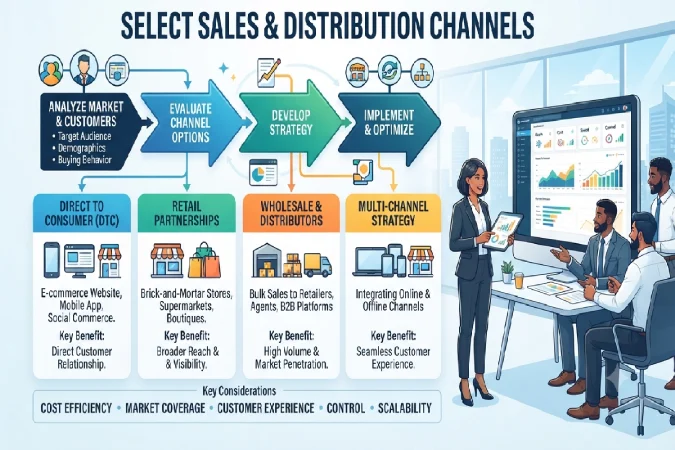
Common startup sales channels
Founder led sales: by selling to initial customers, founders learn directly from the market.
Direct sales: Sales person will find the prospects, demonstrate the product, answer questions and close the sale.
Self-service: The customer will find the product online and purchase directly.
Partnerships: Bringing the product to the audiences of other companies, consultants, agencies or distributors.
Marketplaces: A startup joins an existing marketplace to connect with potential customers.
Retail distribution: The item is physically or through the internet were forwarded to the startups by various retailers.
Choose channels based on customer behaviour
Do not select a channel simply because another startup uses it.
Ask:
- Where does the target customer search for solutions?
- How does the customer normally purchase?
- Does the product require explanation?
- How long is the buying cycle?
- What level of trust is required?
- Can the startup afford customer acquisition through this channel?
A complex B2B product may require demonstrations and conversations. A low-cost consumer product may be easier to sell through ecommerce.
Startups should generally begin with a manageable number of channels rather than spreading limited resources across every possible option.
Plan Your Launch Offer and Team Responsibilities
A launch needs a clear reason for customers to take action.
Your launch offer could include:
- Introductory pricing
- Free trials
- Early-access programmes
- Product bundles
- Limited launch bonuses
- Free consultations
- Extended trials
- Special onboarding support
The offer should create genuine value rather than relying entirely on artificial urgency.
Build a launch plan
A basic launch can be separated into three phases.
Pre-launch: Raise awareness, gather interested prospects, prepare the sales materials, train the team, and test the customer journey.
Launch: enable marketing channels, reach prospects, release launch materials, articulate the offer, and deploy customer acceptance.
After launch: Follow up with prospects, touch base with customers, gather information, solve problems, and evaluate results.
Clearly define responsibilitie
Every major launch activity should have an owner.
For example:
| Activity | Owner |
| Product readiness | Product lead |
| Website and landing page | Marketing |
| Lead generation | Marketing/Sales |
| Customer outreach | Sales |
| Customer onboarding | Customer success |
| Analytics | Growth/Marketing |
| Launch budget | Founder/Finance |
| Customer feedback | Product/Support |
Clear ownership prevents important tasks from being overlooked.
Measure Launch Results and Refine Your Approach
A launch should be treated as a learning opportunity, not simply a one-time event.
Track metrics that show whether the go-to-market strategy is working.
Important metrics may include:
- Website visitors
- Qualified leads
- Demo bookings
- Trial registrations
- Conversion rate
- Number of customers
- Customer acquisition cost
- Revenue
- Average order value
- Retention
- Churn
- Sales cycle length
Analyse the customer funnel
Consider the entire journey:
Reach → Interest → Lead → Trial/Demo → Purchase → Retention
If website traffic is strong but conversions are low, the offer, positioning, landing page, pricing, or customer fit may need investigation.
If customers purchase but quickly leave, onboarding, product value, or customer expectations may require improvement.
Gather qualitative feedback
Numbers tell you what happened, but customer conversations can help explain why.
Ask early customers:
- What made you interested?
- What problem were you trying to solve?
- What alternatives did you consider?
- What nearly stopped you from buying?
- Which part of the product provides the most value?
- What would you improve?
Record recurring patterns rather than reacting to every individual comment.
Refine before expanding
If the initial strategy produces useful results, identify what appears to be working and strengthen it.
If results are weak, investigate the possible cause before simply increasing the marketing budget.
You may need to change:
- Target segment
- Positioning
- Pricing
- Sales process
- Distribution channel
- Launch offer
- Product messaging
- Customer onboarding
A successful go-to-market strategy is rarely perfect on the first attempt. Startups learn through testing and then improve the system.
Conclusion
A startup go-to-market strategy offers an effective roadmap for transforming your product into a marketable and replicable business opportunity. Identify a specific customer group that has a real problem. Identify a focus on some measurable outcome.
Then decide through the lens of the potential customer and start-up resources which sales and distribution channels will work best. Develop a launch offering that provides customers with a tangible reason to participate and identify who is responsible for each critical launch task.
Finally, utilize measurement techniques throughout the whole customer journey. Quantitative data is important, but it must be supplemented with qualitative customer research to get a true picture of performance.
The most effective go-to-market strategy is not always the biggest or most complex. It is a strategy that enables the startup to find the right customers, deliver significant value, win customers quickly, and learn fast enough to iterate and improve before scaling.