

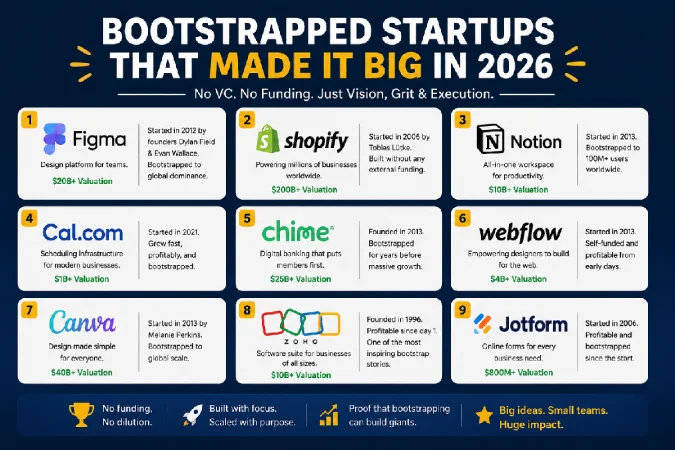
9 Bootstrapped Startups That Made It Big in 2026
Last Updated: September 15, 2026
The startup universe is obsessed with billion-dollar funding rounds, unicorn valuations, and astronomical venture-capital investments, but some of the most extraordinary businesses that have been founded in the last few years have followed a very different progression: they built stuff, acquired paying users, re-invested all their revenue, and grew without the aid of venture capital.
Another reminder for the year 2026 is the persistent reminder from Bootstrapping that founders does not have to fund raise for a huge round in order to run a business. Businesses such as Zoho and Zerodha continue to show how massive businesses can be built out of customer revenue, frugal spending and thinking long-term.
Here are nine through the bootstrap success stories worth taking a look at in 2026.
What is a Bootstrapped Startup?
In case you haven‘t heard of a bootstrapped startup before, as I hadn‘t, the term comes from the idea of pulling yourself up by your own bootstraps. It‘s a life-affirming statement to all those who believe they cannot succeed unless they borrow millions in outside funding.
A bootstrapped startup is often financed with the founders own money, revenues (sales) and profits.
Bootstrapping does not imply that a company can never secure capital. Many firms do choose to raise outside capital, list, or exit after they achieve the critical mass. But their key is that their early growth was fueled predominantly by the entrepreneurs and customers rather than venture capital.
That approach can force founders to focus on:
- Customer needs
- Long-term sustainable growth.
- Smooth and efficient execution.
- Product-market fit
- Long-term decisions
1. Zerodha
India‘s Zerodha is one of the most successful modern case studies of what bootstrapping is capable of:
Established in 2010 by Nithin and Nikhil Kamath, Zerodha was the first to challenge the age-old norms of the Indian brokerage industry through technology, transparent pricing, and a customer first approach.
It also clearly states that it was bootstrapped and profitable from beginning. The company claims that by 2026 it has over following 1.6 crore customer base, and carries approximately follows 6 lakh crore of equity investments with fee income contributing to approximately 15% of overall retail exchange volumes in India.
What is more astonishing than these is that even after having witnessed such successful trading a forex company, Zerodha claims it has not raised any external funds.
What can founders learn from this?
Zerodha demonstrates the power of:
- Handle a costly customer issue
- Building effective technologies
- Keeping pricing simple
- Avoiding unnecessary growth
- Building trust ‘eventually’
Its storyline illustrates that a company can deviate from the classic “raise, scale, raise again” startup approach.
2. Zoho
Zoho appears to have built one of the world‘s most comprehensive business-software framework1 while still being privately held and boot-strapped.
According to the company, “we have been bootstrapped and profitable from day one and have never taken outside funding.”
In 2026, Zoho announces it has 130+ million users worldwide, and is present in over 180 countries with over 65 products in sales, marketing, finance, and operations.
Having far less focus on investor return or IPO mission has allowed Zoho to place a greater focus on investing for the long run in its products and internal research and development.
What entrepreneurs can learn from this.
Zoho‘s model highlights three important principles:
- Build for customers rather than investors.
- Reinvest profits into product development.
- Give a business enough time to compound.
Bootstrapping can be especially effective where there is the possibility of a recurring- revenue model and where the company can continuously reinvest customer revenue into business growth.
3. Mailchimp
Mailchimp is probably the most well known bootstrapped startup story.
The company began in 2001, when Ben Chestnut and Dan Kurzius were working to build a web-design business. Over time, email marketing became a more and more crucial demand from customers, leading to Mailchimp
The return on the venture capital was not increased but the business was expanded with the use of customers’ revenues.
The outcome was staggering. Intuit was said to have bought Mailchimp back in 2021 for a sum of around $12 billion which is considered to be one of the largest acquisitions of a bootstrapped business.
What entrepreneurs will discover. The above table categorizes the lessons that entrepreneurs can take away from the above.
Mailchimp‘s journey demonstrates that:
A small-business problem can lead to a huge business opportunity.
The company was not required to create a completely new industry. It merely identified a problem that kept recurring, created a wonderful product for that problem, and then improved it over time.
4. Basecamp
The ‘original’ bootstrapped software company is also known for: Basecamp. It was founded by 37 signals.
Instead of following the standard venture-supported curve, 37signals focused on building a cash-generating and profitable business.
The company still encourages profitability and reasons that they have been conducting a profitable and financially responsible business operation for over 20 years.
Its much larger “Bootstrapped, Profitable, & Proud” project has also identified many companies that have produced more than $1 million in revenue without ever taking venture capital.
What founders have to learn:
What probably comes home the strongest with Basecamp is that ], and this probably is the biggest lesson of all.
A company can deliberately choose:
- Smaller teams
- Less products
- Sustainable revenue
- Reduced operating costs
- Long term independence
That‘s very appealing to entrepreneurs who want control not growth.
5. Balsamiq
Balsamiq is a software that essentially enables the creation of sketches or wireframes of web pages. It is an easy tool to learn and understand. It is a very useable tool to collaborate with other project members. This tool allows a team to document their decisions and create prototypes quickly and efficiently.
Balsamiq shows that a niche product, if targeted to the appropriate audience, has the potential to grow into a very large business without any bleeding all your profits to fundraising.
Developed in 2008, Balsamiq states that it has been (from its founding) bootstrapped, independent and remote.
Currently, the company claims the tools are used by over 16,000 product/ development teams permonth 1 and have been sold over 1.4 million times in over 204 countries and territories 1.
The company has persisted in modifying its product to reflect the evolution of technology. In 2026 Balsamiq overhauled its prices and increased the scope of its features related to artificial intelligence.
What founder‘s can learn from this?
Balsamiq show that you don‘t even have to have a large market.
A specific problem that enough customer really care to solve: You need.
A focused product can generate sustainable revenue when it has:
- The widest possible audience.
- A slimmed down value proposition
- Strong usability
- Continued customer demand
- A recognisable brand
6. SPANX
On the other side of the coin is if SPANX.
According to the company the line was started with only $5,000 of savings of her own and no outside funding;
It all started with a personal problem. A specific problem. Blakely wanted a cleaner, sleeker look underneath her white pants and worked to turn an altered garment into her own solution. SPANX was born after a long product research and development process.
The business has gone on to become a consumer brand that is world famous.
What founders can learn from it
SPANX illustrates the value of:
- All begin with on a personal problem of
- Calling a product before scale up testing a product before scale up
- Safeguard the brand
- A comprehensive understanding of who our customer
- Converting a simple idea into a differentiated product
This illustration will be especially enlightening for any entrepreneur who thinks that successful startups demand advanced technology.
Occasionally, they don‘t.
7. Shutterstock
Shutterstock originated from a much simpler idea.
Founded by Jon Oringer in 2003, he started the company by bringing thousands of his own personal digital images on the company website. This was to provide the world‘s cheapest and easily available marketplace for licensed images.
It expanded to become an international marketplace for creative content, or grew to the size that it became a publicly traded company.
By how founder can leverage a personal asset she already owned, we can see he to build a scalable web-based business. As an illustration, the story of Shutterstock‘s founding.
What can founders take away from it?
Identify know-how you already have.
Those assets might include:
- Expertise
- An audience
- Software
- Content
- Intellectual property (collaborate on intellectual property).
- relationships with other industry players
- Aspect of specialized knowledge.
If you know how to get hold of what you want to generate, then it is much easier to use the population to start with and the methods of bootstrap are easy enough.
8. SparkFun Electronics
SparkFun Electronics provides a perfect illustration of personal financing in hardware and in the web.
Nathan Seidle started in 2003 SparkFun because he was frustrating for trying to find the parts of an electronics project.
And he built a website to make those parts more accessible for purchase. As part of SparkFun‘s own history, Seidle was said to have “maximumed out nearly all of his credit cards on inventory (and pizza).”: During 2010, the company had the reported Revenue of about $18.4 millionand about 120 employees.
SparkFun was even included as one of 37signals’ examples of bootstrapped and profitable companies.
What entrepreneurs learn
SparkFun‘s story is a reminder that:
Distribution is the opportunity.
The offerings didn‘t have to be radically different. Simplifying access and availability to a particular population provided a lot of value for them to find.
9. Mojang
Mojang provides one of the most astonishing of the phenomena of the small product being taken up into the world.
The company became renowned for the popular sandbox style game Minecraft made by Markus Persson.
Microsoft announced that it would close the deal to purchase Mojang for [2.5 billion dollars] in 2014. Minecraft was already one of the most played video games in the world, with Microsoft claiming that it had over 100 million PC copies downloaded.
This lesson can be especially useful to independent game developers, one-man-band developers or content creators: a narrow product can sell very well when it has a dedicated community.
What founders can learn
Mojang‘s success highlights the importance of:
- Product blindness
- Production obsession
- Community
- Word of mouth
- Iterative development
- Providing users with the freedom to be creative
An eager customer base can often be a companies most powerful marketing channel.
What These Bootstrapped Companies Have in Common
Despite being in very different industries, the stories of these companies demonstrate many similarities.
1. They Solved Real Problems
They addressed recognizable problems:
- Zerodha made everything simpler-investing & brokerage.
- Zoho developed all the software, essentially from scratch.
- Mail Chimp made email marketing simple.
- Made wireframing quick, light and fun Balsamiq.
- SPANX is a solution to a clothing problem.
- SparkFun made accessing a components so easy, I just had to use it.
Customer pain – fixed at the start of business growth.
2. They Focused on Revenue
Bootstrapped companies can‘t rely on the next round of funding to pay the bills.
Which makes for a very potent discipline: customers have to want it enough to buy it.
This can encourage founders to think carefully about:
- Pricing
- Retention
- Customer acquisition
- Margins
- Cash flow.
- Product value
3. They Didn‘t Confuse Growth With Success
Venture-backed startups have incentives to grow as fast as they can.
Bootstrapped founders can also approach it in the following way:
They may prioritize:
Sustainability of profitability -> controlled growth in expansion
rather than:
Funding -> rapid expansion -> new Funding round
There is no better model in all cases, but there is bootstrapping and it offers entrepreneurs another way.
4. They Built Strong Brands
No venture capital doesn‘t mean no ambition.
Zerodha, Zoho, Mailchimp, SPANX, Balsamiq, Shutterstock, and the other brands on this list became memorable by repeatedly offering value.
Brand recognition can allow a business to spend less on paid acquisition and develop highly effective word-of-mouth virality.
5. They Played the Long Game
Perhaps the greatest lesson is patience.
Most of these firms weren‘t born yesterday.
They spent years refining products, learning from customers, streamlining operations, and reinvesting proceeds.
That patience carries more weight in 2026, when entrepreneurs are under even greater pressure than now to grow fast and deliver astronomical valuations.
The 2026 Bootstrapping Advantage
One reason bootstrapping is still appealing in 2026, is that de technologyn has made it cheaper to launch many of the businesses.
If you build cloud, and use AI, no-code tools, digital marketing, remote working, use online payment, and distribute online, then small teams can achieved what previously would require teams of thousands.
However, it is not making it easy to set up a business.
In the end it does mean that sometimes one founder can prove an idea with a lot less initial investment.
Efficiency also plays to the current environments favor. A business that is able to achieve significant revenue with a small team has a huge advantage over business that need recurring injections of capital.
Final Thoughts
Together, the nine companies behind these stories disprove the myth that startups need millions of dollars of venture capital Zerodha established a large financial-services business without outside funding. Zoho developed a worldwide software platform, yet stayed private and self-funded. Mailchimp moved a small business offering to a $12 billion sale. Companies such as Balsamiq and Basecamp show that investors don‘t need to be part of the way to build a resilient, profitable business.
A founder with a real problem, real paying customers, careful expense control and patience can create something truly valuable. In 2026 these just-scraping-by bootstrapped companies still reveal that by and large the best growth strategy turns out to be just building something people really want and funding yourself with the outcome.