

Marketing Planning: How to Create an Effective Marketing Plan
Last Updated: September 15, 2026
Marketing planning is a systematic approach to defining your business goals, and the strategies, tactics and budget required to reach them. It ties your marketing in with other market opportunities and creates a structured, measurable way to target your audience and generate income.
Marketing Planning Key Stages
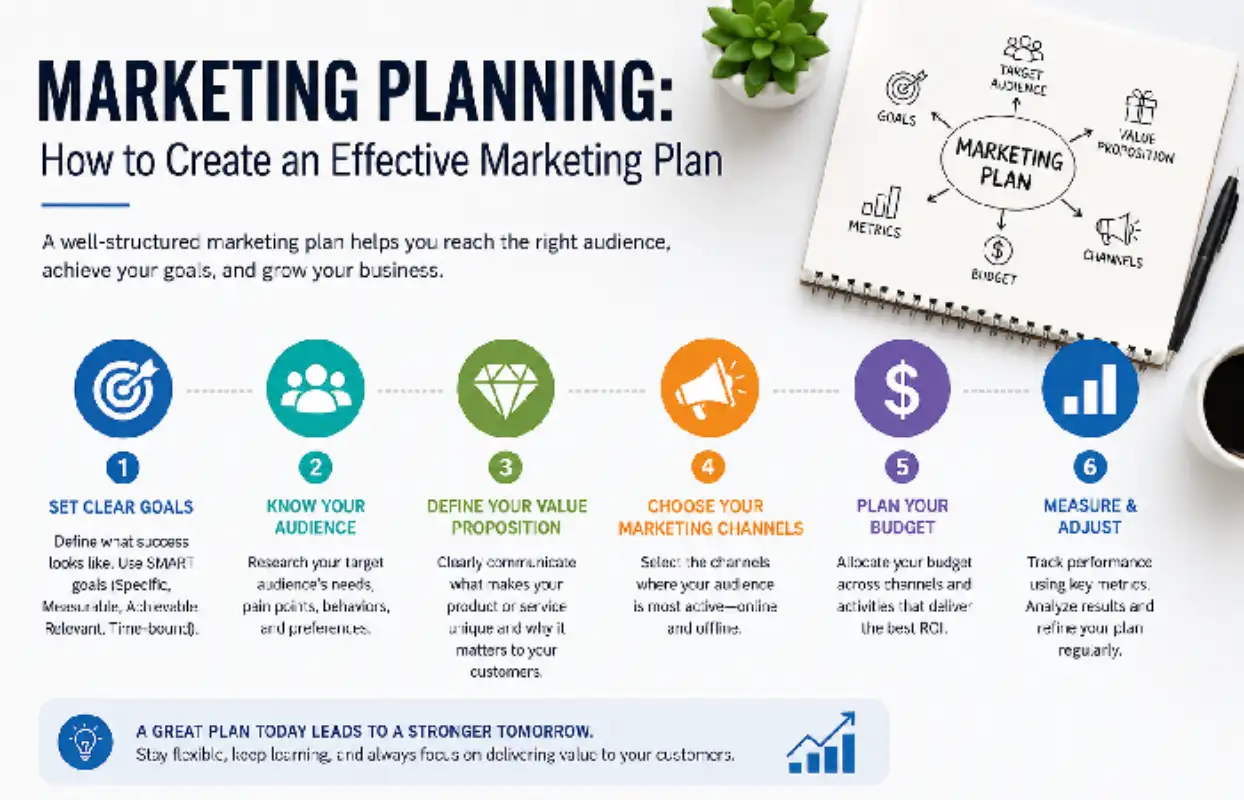
- Identify your target market and customers’ needs. Be aware of who your perfect customer is, what problem they experience and why your offer matters to them.
- Set your position straight. Choose how you want people to view your business versus other companies. For example, as an affordable, upscale or niche specialist.
- Establish SMART goals (specific, measurable, attainable, real and timed), for example, increase sales by 10% in 12 months.
- Select your channels and marketing tactics. When doing this, you should include all the platforms and activities you are going to use, including social media, emails, advertising, content marketing, events, etc.
- Build a budget and schedule. Define costs, owners, and deadlines so implementation is actual and efficiently organised.
- Track and improve. Project results out past it and constantly audit it against ever-changing goals, getting rid of or improving those tactics that aren’t generating results.
The planning of marketing is a process of establishing what your marketing objectives are, what methods and tactics to adopt and how you plan to monitor results over a period of time.
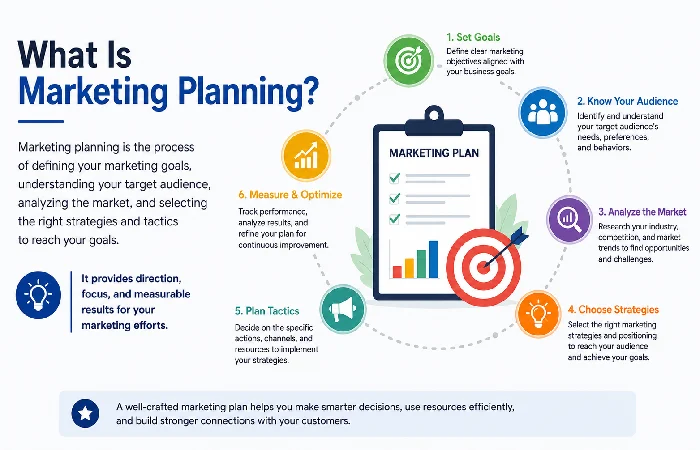
A marketing plan generally refers to market research, defining the target markets, the objectives, positioning, budget, channels and performance control.
Why is it significant:
We can use it to keep a business on track, make sure resources are used effectively and ensure that the company’s marketing activity is contributing to the achievement of the company’s other goals.
That’s your marketing plan, like a road map: the destination, method of propulsion, and, of course, how you’ll know if you’ve arrived at the right destination.
Key Elements of a Marketing Plan
The main components of your marketing plan are the sections that actually translate your marketing objectives into a practically useful outline.
Main components
- Executive summary.
- Situation analysis.
- Aims and objectives of the business.
- Target market.
- Competitive analysis.
- Marketing strategy.
- Marketing strategies.
- Metrics and KPIs.
- Implementation and control.
What each of them does
The executive summary keeps the whole plan short, sharp and to the point, whereas the situation analysis provides a current description of your marketplace and the business environment. The objectives set out precisely what you want the plan to accomplish and the target market determines who you plan to serve. The strategy and tactics describe how you intend to compete and the methods by which this will be achieved, while the budget, metrics and control process enable you to monitor costs and performance.
Conducting Market Research for Planning
Market research is the process of gathering and interpreting information about customers, competitors and market conditions for the purpose of making informed business decisions. It provides an indication of demand, minimises risk, and helps to develop a more comprehensive business or marketing plan.

Why is your concern?
Market research enables you to see that there is actual demand for your product or service, to gauge how big the market is, how much customers are willing to pay and how competitive the market already is. It enables you to spot the gaps in the market that you can fill and develop a more defined competitive advantage.
Research classifications
Market research can be divided into two categories: secondary research uses existing information from sources such as reports, government data, and publications to gain insight into trends, prices, market size, and other information. and primary research, which involves collecting new data via questionnaires, interviews or focus groups.
How can I use it in planning
In business or marketing planning, market research backs up process decisions about who will be the target customer, how the product will be positioned and priced, and how it will be promoted. One practical approach is to ‘state your research question, gather the data, interpret the results and act on them’.
Market research in planning involves gathering data on your potential customers, competitors and overall business environment before you take any important business decisions. It enables you to verify that there is a market need for your idea, identify target customer characteristics and lower the risk of a failed business launch.
Effective market research is likely to start with some form of secondary research. This will involve reading through existing data online, in libraries or in-company material. Such as government figures, market reports and magazines. From this you’ll get an idea of the market size, the target customer profile, general pricing and economic movements. Secondary research is quick, cheap and provides a good overview of the market.
Now you have to conduct primary research. Visit the potential customers directly through interviews, surveys, questionnaires and focus groups. It provides you with one-to-one specific feedback about the needs, pain points and buying behaviours of the people. It also shows you the perception of customers about your competitors and potential people to choose your firm instead of them.
So, the purpose behind research is not only to gather data but to convert it into decisions. The report should reveal the central things like your target market, product positioning, pricing, promotion and sales approach. Good market research will also show gaps in the market, to quantify the demand and measure how competitive the existing market is.
In brief, market research is at the heart of good planning. It provides you with information instead of hunches, allowing you to construct a business or marketing plan that is both realistic and centred on the customer and therefore more likely to succeed.
Setting Goals and Budget
Goals are most effective if they are SMART: specific, measurable, achievable, relevant and time-bound. Using “grow sales” as a goal is not strong enough. Having a goal such as “add qualified leads by 20% in 6 months” is much stronger.
Your budget should be linked to your objectives. Begin by analysing your existing expenses and then distribute a budget to those channels that are most likely to deliver results – content, social media, paid advertising, email or collaboration.
One method is to divide your budget into segments, such as research, content creation, advertising, tools and contingency expenses. This provides a simple way to monitor spending and make adjustments if one channel exceeds another.
Measuring Success
As it is a marketing plan, its measures will be taken based on the results with the goals you have set. The typical measures are leads, conversions, revenue, traffic, engagement and return on investment.
It is also advisable to review performance every few weeks, not only at the end of the campaign. Quarterly or monthly reviews indicate what is happening and provide the opportunity to take swift, corrective action if performance is weak.
Example
Say if your task is to generate 500 leads within three months. Then you can allocate a budget to ad network, content and email marketing, and then monitor the cost per lead, conversion rate, and total revenue.
A sound marketing plan is not about spending more money. But about spending with a purpose and knowing whether it creates real business value.
Conclusion
Marketing planning is the process of translating business objectives into a document that clearly specifies what you want?to achieve and when. It focuses on identifying who you want to target. Where and when you want to target them. How do you want to target them. How you are going to measure your results and how are you going to keep improving?
A good marketing plan is vital as it helps you to concentrate, make the most of your resources and align your marketing activities to the overall business and strategic goals. Good market research backs up your plan by removing guesswork by identifying customer requirements. What is in demand and where there are gaps in the market?
These are the main components of a marketing plan: the executive summary. The situation analysis, the objectives, and the target market. The competitive analysis, the strategy, the tactics, the budget, the KPI‘s and the controls for the implementation. All this will turn ideas into action.