

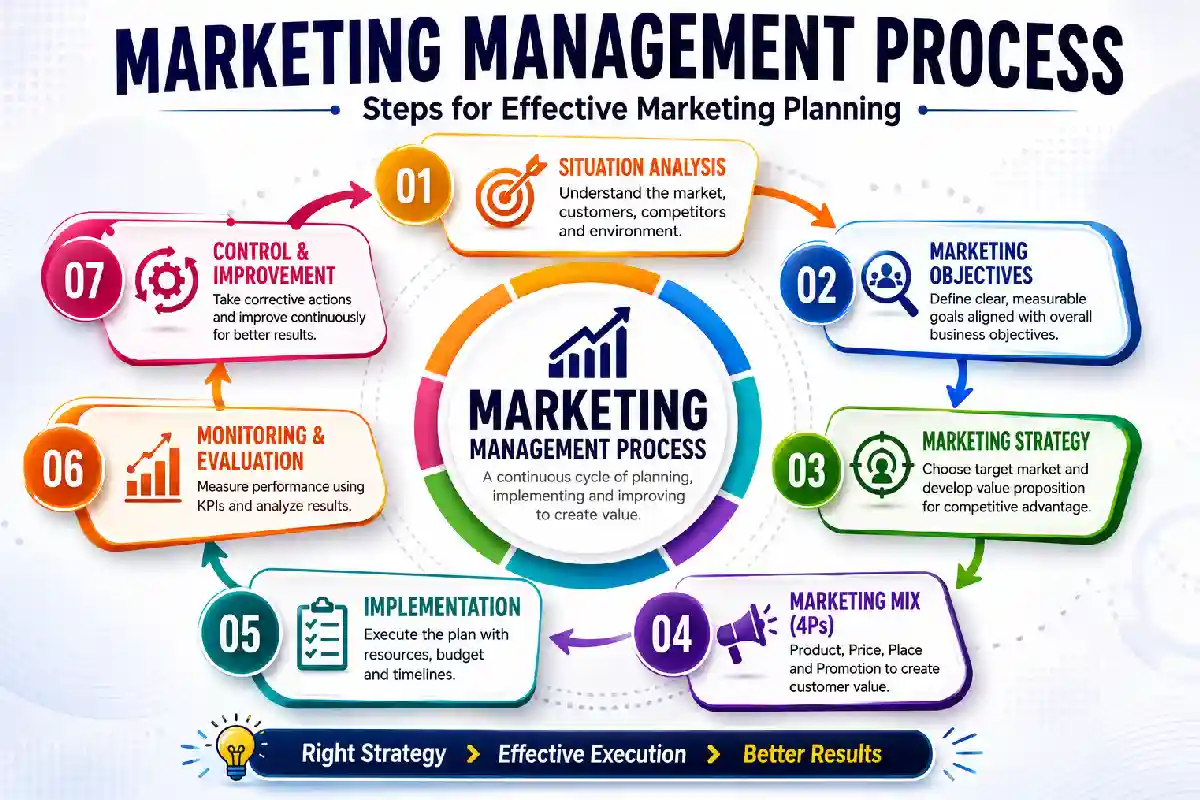
Marketing Management Process: Steps for Effective Marketing Planning
Last Updated: September 15, 2026
Introduction
The marketing management process has provided the company with a framework for better marketing decisions. The decision makers, instead of feeling blindfolded, can decide on their next move based on market data, customer knowledge, goals, strategy and measurement of results. In 2026, it matters even more because the fragmentation of discovery, AI, and increased focus on ROI will impact brand marketing planning.
What is Marketing Management Process?
The marketing management process refers to the complete process by which a business is designed, planned, implemented, and controlled. Put in very simple terms, it is how a business is managed through understanding the market, selecting the target customers, defining the objectives of success, implementing the most appropriate marketing actions, and checking whether they are working.
The most common way competitor pages that mention this cover it is a set of steps set objectives, analyse opportunities, select target markets, design strategy, plan programs, implement plan, and evaluate. However, the less convoluted contemporary explanation along these lines is: research-plan-implement-measure-improve.
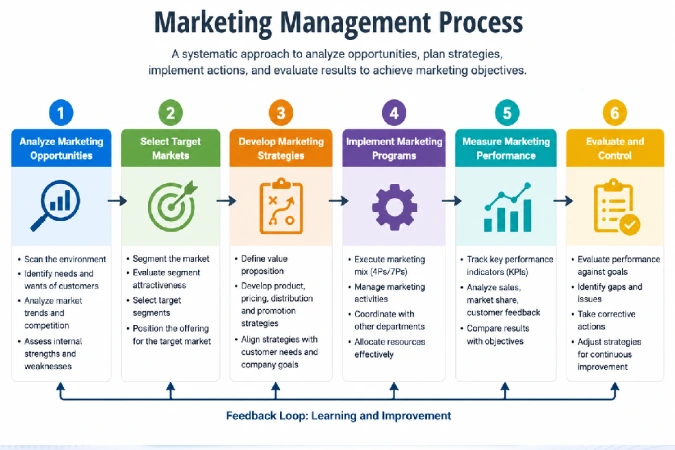
It’s crucial because marketing is not just about visibility anymore. By 2026, marketers will have to demonstrate efficiency, preserve trust in the brand, while using multi-channel workflows, helped by Al and evolving customer discovery methods. That’s why, both tiny and giant companies need a strict process for marketing management.
The significance of the 2026 rules
Marketing teams are working in a more complicated environment than before. According to Hubspot’s 2026 State of Marketing, 61 per cent of marketers say AI will cause the biggest disruption in the marketing world over the last 20 years. also captures up-to-date changes in the business world, saying that, AI, economic pressure and consumer behaviour changes are transforming the ways that brands grow, compete and create value.
That means the planning process must do more than create campaigns. It must help teams decide:
- What to automate.
- What to keep human-centred.
- Deciding among the channels to invest.
- Ways to more effectively define and compute the ROI.
- The challenge of building trust when the content is produced by AI and is omnipresent.
Market Analysis and Opportunity Identification
Market analysis is ‘the first real step’ in the process of marketing management. It provides much of the information you need to help you understand the marketplace, customers, competitors, and identify potential opportunities. No objectives or strategy can be formed if this isn’t carried out.
A strong analysis usually includes:
- Customer research.
- Competitor analysis.
- SWOT analysis.
- Trend analysis.
- Segmentation process.
- Demand and pricing assessment.
Developing Marketing Objectives
After the opportunities are defined, the next step is to set marketing objectives. Objectives help the team know what to achieve, and allow the entire plan to be quantified. Effective objectives tend to be specific, time-bound, and business-related.
A useful model is to connect business goals to marketing goals and then to KPIs. For example:
- Business goal: double revenue.
- Marketing goal: acquire qualified leads.
- KPI: conversion rate, CAC or revenue driven by marketing.
Good examples of being objective.
- Raised the organic traffic by 30% in 6 months.
- Generate 500 high-quality leads each quarter.
- Increase the conversion rate of leads received via the online landing page from 2% to 4%.
- Increase email click-through rate by 20%.
- Improve first-party data collection from website visits.
2026 planning lens
In 2026, marketers will be talking numbers too, around automation, trust and ROI. According to a report from HubSpot, AI is revolutionising working norms, and the report from Deloitte focuses on performance, ROI and accountability being given a more intense focus. Therefore, today the goals need to go above simple reach or awareness.
Include goals such as:
- Reduce manual campaign production time.
- Increase the percentage of campaigns using AI-assisted testing.
- Improve ROI visibility.
- Strengthen first-party data collection.
- Increase branded search or direct traffic.
Objective planning table
| Objective type | Example | Why it matters |
| Awareness | Increase brand reach in a target segment | Helps top-of-funnel growth |
| Engagement | Raise content interaction rate | Shows audience interest |
| Lead generation | Increase qualified inbound leads | Supports sales pipeline |
| Revenue | Improve marketing-sourced sales | Proves business value |
| Efficiency | Reduce campaign production time | Makes teams more scalable |
Implementing Marketing Strategies
Strategy is where planning becomes execution. In the marketing management process, strategy defines how the business will achieve its objectives using a chosen market approach, message, and channel mix. This is also where many teams fail, because they set goals but do not build a realistic execution model.
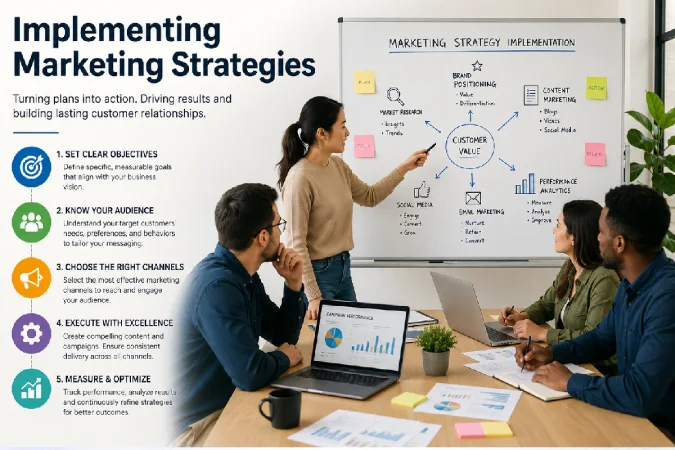
A strong strategy should answer:
- Who is the target audience?
- What problem are we solving?
- What message will resonate?
- Which channels will we use?
- What budget and resources are available?
Core strategic choices
- Segmentation.
- Targeting.
- Positioning.
- Marketing mix selection.
- Budget allocation.
- Channel planning.
- Campaign calendar design.
Product and platform comparison
| Planning approach | Best for | Advantage | Limitation |
| Manual planning in spreadsheets | Small teams | Low cost, simple | Hard to scale |
| Marketing automation platform | Growing teams | Better workflow control | Requires setup |
| Integrated analytics stack | Data-heavy teams | Strong ROI tracking | More complex |
| AI-assisted planning tools | Fast-moving teams | Saves time and improves drafting | Needs human review |
This section is a good place to add screenshots of campaign calendars, dashboards, or AI workflow tools to improve user trust and content depth.
Monitoring and Controlling Marketing Performance
Monitoring and control close the loop in the marketing management process. After campaigns launch, teams need to measure what happened, compare it to the target, and make corrections when needed. This is what turns marketing from guesswork into a management system.
What to monitor
- Traffic.
- Engagement.
- Leads.
- Conversion rate.
- Cost per lead.
- Customer acquisition cost.
- Revenue influenced by marketing.
- Brand search growth.
- Retention and repeat purchase.
Why control matters now
Deloitte Trends 2026 says CFOs are being asked to desperately rationalize ‘all of these investments’: ‘marketers will have to learn how to speak the language of ROI, customer value, and attribution.’ HubSpot confirms AI is revolutionizing work, but human-centric creativity and trust still count for performance. The focus ‘will have to move beyond clicks’ for success.
Control dashboard table
| Metric | What it shows | Action if weak |
| CTR | Message relevance | Refine creative |
| Conversion rate | Landing page quality | Improve offer and UX |
| CAC | Acquisition efficiency | Reallocate spend |
| ROI | Profitability | Cut or fix weak campaigns |
| Retention | Long-term value | Improve lifecycle marketing |
2026 Data and Trends
Combine (1) updated 2026 trend data based on research and (2) comparative graphics. As reported by HubSpot, 61% of marketers think AI is the greatest change we have seen in 20 years. Deloitte: AI, economic pressure, mistrust, and fragmentation are changing marketing strategy and the marketing organisation itself.
2026 marketing planning implications
| Trend | Planning impact | What to do |
| AI adoption | Faster content and analysis | Build AI-assisted workflows |
| Trust concerns | More scrutiny of content quality | Prioritize human review |
| Fragmented discovery | More channels, smaller attention windows | Focus on must-win channels |
| ROI pressure | Tighter budget accountability | Improve measurement and attribution |
| Personalization gap | Need for better relevance | Strengthen data and segmentation |
These trends support the article’s central thesis: marketing management in 2026 is not only about planning campaigns but about building systems that are faster, more measurable, and more trustworthy.
FAQ Section
What is the process of marketing management?
The disciplined approach to the examination of the market, all goal definitions, strategy formulation, campaign development, execution and performance measuring.
What does the marketing management process consist of?
The key steps are market analysis, goal determination, strategy development, implementation, and control.
What makes the process of marketing management so essential?
It enables businesses to make smarter decisions by providing relevant information, helping them to eliminate waste and improve its marketing ROI.
Is the marketing management process consistent with marketing planning process?
They are very interrelated. Marketing planning is a small part of the general process of management; a process which also incorporates the execution and control of the plan.
How will AI influence marketing management in 2026?
Areas where AI can be helpful but teams will still need the human touch to manage: workflows, content creation & analysis.
Conclusion
The process of managing marketing work lies at the basis for a successful marketing plan because the process makes the strategic element a workable system. The successful plan in 2026 will succeed in its marketing management by merging market research, strategy, monitoring its performance, AI support with human strong consumer insight and trust:.