

Disruptive Innovation Explained: Examples & Framework (2026)
Last Updated: September 21, 2026
Disruptive innovation might be proclaimed the most relevant and yet the most stunning phenomenon of modern business strategy. Firms tend to label every revolutionary technology, rapidly expanding startup or revolutionary offering as disruptive. However, as Clay Christensen professor at Harvard Business School and founder of the theory claims,
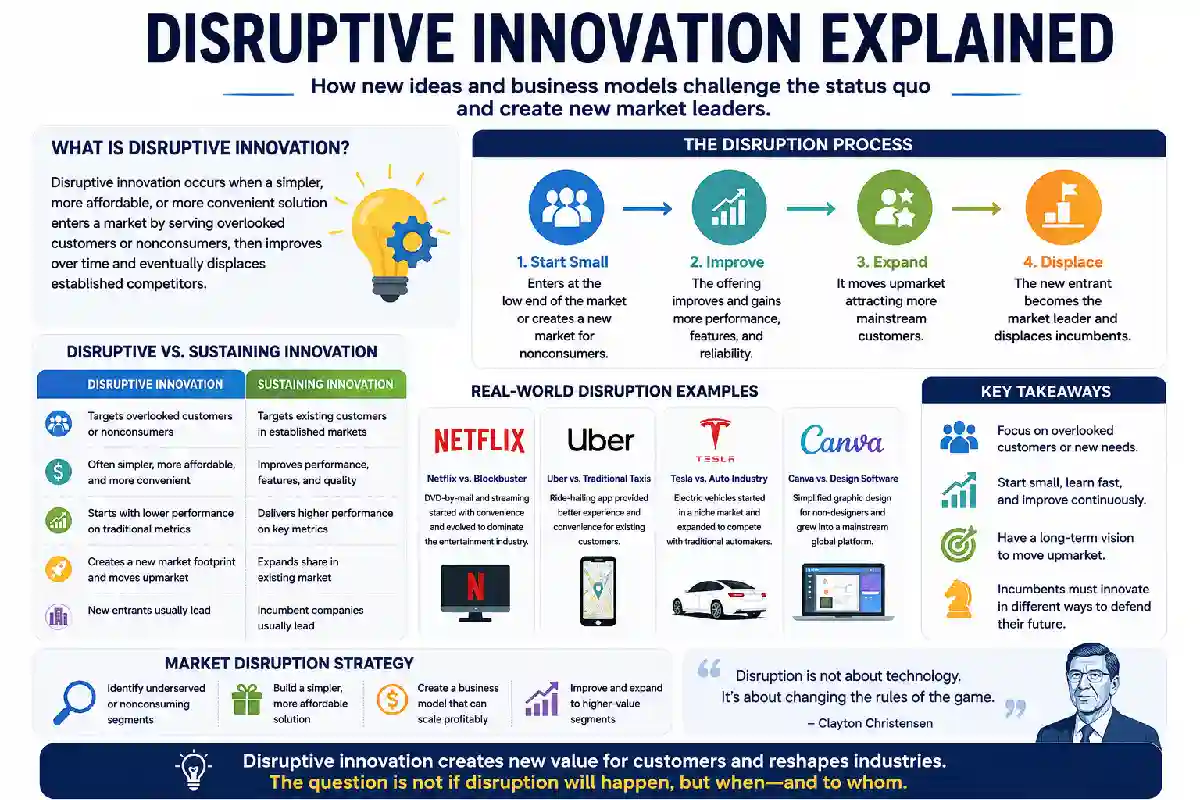
Disruptive innovation arises when a low-end or new-market foothold entrant one that is simpler, more convenient, or cheaper initially takes hold with non consumers or low-end consumers, then improves and eventually displaces established competitors.
What is Disruptive Innovation?
Disruptive innovation is used to characterize the nature of a new entrant which in the beginning enters an unserved, overserved or unserviceable segment.
The new offering is often:
- Simpler
- More affordable
- More convenient
- Easier to access
- Initially less capable than the mainstream alternative
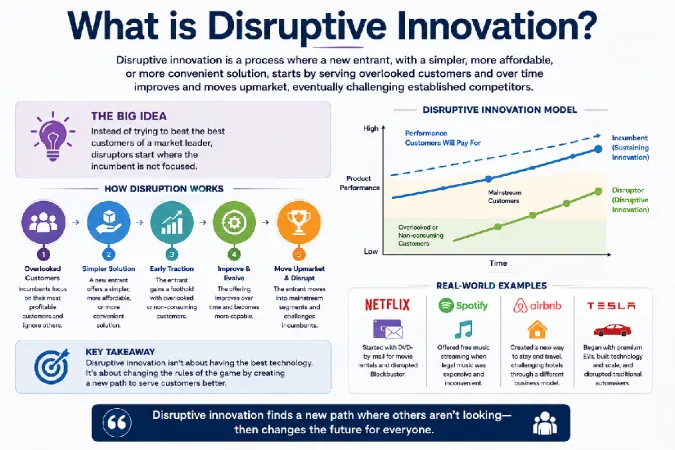
Over time, the entrant improves its offering and moves into increasingly valuable segments of the market.
The established company may initially ignore the entrant because the new market is less profitable or because the product doesn’t satisfy the needs of its most demanding customers.
That creates an opportunity for the entrant to establish itself and improve.
Eventually, the entrant may become competitive with the incumbent across mainstream segments.
The Basic Disruption Pattern
Established market → overlooked customers → simpler solution → early adoption → improvement → movement upmarket → competitive displacement
This process can take years.
That’s why calling every new technology “disruptive” can be misleading. Christensen’s theory is about how an innovation enters and transforms a market, not simply whether the technology is impressive.
Clayton Christensen Theory Explained
The Clayton Christensen theory of disruptive innovation was developed based on Christensen‘s dissertation research into the failures of successful companies.
His research demonstrated how multinational corporations can make rational decisions which, over time, produce opportunities for smaller entrants.
Imagine an established company has two choices:
- Invest in improving its product for its most profitable customers.
- Invest in a simpler product for customers who generate lower margins.
Management may logically choose the first option.
The problem is that the second market can become the foundation for a disruptive competitor.
The entrant doesn’t necessarily win because it has the best product at the beginning. Instead, it gains a foothold where the incumbent has less incentive to compete.
As the entrant improves, it can move toward mainstream customers.
Low-End Disruption
Low-end disruption occurs when a company targets customers who don’t need all the features, performance, or complexity of existing products.
The entrant offers a “good enough” alternative at a lower price or with greater convenience.
The incumbent may be happy to surrender those customers because they produce lower margins.
New-Market Disruption
New-market disruption occurs when an innovation creates a new segment by allowing people who previously couldn’t access or afford a product to become consumers.
Instead of stealing customers immediately from established companies, the new entrant creates consumption where little or none existed before.
Christensen’s research describes both low-end and new-market footholds as important paths through which disruptive innovation can develop.
Disruptive vs Sustaining Innovation
One of the most important distinctions in innovation strategy is disruptive vs sustaining innovation.
Sustaining innovation improves an existing product or service for current customers.
Disruptive innovation creates a new trajectory by serving overlooked customers or nonconsumers and eventually moving toward the mainstream.
| Disruptive Innovation | Sustaining Innovation |
| Often begins with overlooked customers | Usually targets existing customers |
| Can be simpler and more affordable | Usually improves existing performance |
| May initially offer lower performance on traditional measures | Designed to deliver better performance |
| Often creates a new market foothold | Strengthens an existing market position |
| New entrants frequently drive it | Established companies frequently drive it |
| Can eventually challenge incumbents | Usually reinforces the incumbent’s position |
| Develops over time | Often appears as incremental or breakthrough improvement |
Disruption Is Not the Same as Breakthrough Innovation
This is one of the biggest misconceptions about disruption.
A technology can be revolutionary without being disruptive in the Christensen sense.
Likewise, a relatively simple product can become disruptive.
For example, an established company may introduce an extremely advanced product that provides better performance for its best customers. That’s innovation—but it is generally sustaining innovation.
A smaller company might introduce a simpler product for customers who cannot afford the incumbent’s solution. If that product improves and moves into mainstream segments, it may follow a disruptive trajectory.
Innovation describes change. Disruption describes a particular competitive process.
Disruption Examples
1. Netflix and Blockbuster
Netflix is one of the classic examples associated with disruptive innovation.
When Netflix was still a small company, its DVD-by-mail model was not an obvious threat to Blockbuster’s large physical rental-store network.
The service initially had disadvantages compared with walking into a store and immediately renting a movie.
But Netflix created a different value proposition around convenience and eventually developed a streaming model.
Blockbuster, meanwhile, continued operating around an established business model and customer base.
The Christensen Institute identifies Netflix’s eventual displacement of Blockbuster as a classic disruption case and highlights the importance of the incumbent’s incentives in the process.
2. Mini-Mills and the Steel Industry
Christensen’s research into the steel industry provides another important example.
Mini-mills initially focused on lower-value steel products that integrated steel companies had less incentive to prioritize.
Because those segments were less attractive to incumbents, mini-mills gained a foothold.
As their capabilities improved, they moved into increasingly valuable segments.
This illustrates how an entrant can grow by starting where an incumbent is least motivated to compete.
3. Toyota and American Automakers
Toyota’s early entry into the U.S. market with smaller, relatively inexpensive cars is another frequently discussed example.
Large American automakers were heavily focused on larger vehicles and more profitable customers.
Smaller vehicles represented a different opportunity.
As Japanese automakers improved their products and expanded their market presence, they became serious competitors across broader segments.
The Christensen Institute includes Toyota’s early subcompact strategy among notable disruption examples.
4. Personal Computers
The rise of personal computers demonstrates how new-market disruption can develop.
Early computers were far less powerful than large centralized systems, but they made computing accessible to organizations and individuals who didn’t need or couldn’t afford traditional systems.
As personal computers improved, they expanded into increasingly important applications.
Christensen’s research identifies the early PC market as an example of new-market disruption competing against nonconsumption.
But that isn’t necessarily the same as disruptive innovation under Christensen’s framework.
Consider companies such as Uber.
Uber had a huge impact on transportation and posed a significant threat to existing taxi business models. However, CNN Money reports that the Christensen Institute claimed that Uber was not a textbook disruptive innovation as Uber offered a superior experience for current taxi customers, and did not start by serving underserved/nonconsuming populations as highlighted in the framework.
This is important to specify because they will be prevented from referring to any innovation as “disruption”.
A company can:
- Transform an industry
- Grow extremely quickly
- Introduce breakthrough technology
- Change customer behavior
without necessarily being disruptive according to Christensen’s theory.
Market Disruption Strategy: How Businesses Can Think About It
A market disruption strategy shouldn’t begin with the question:
“How can we destroy the market leader?”
Instead, businesses should ask:
“Which customers are underserved, overserved, or not being served at all?”
This changes the strategic perspective.
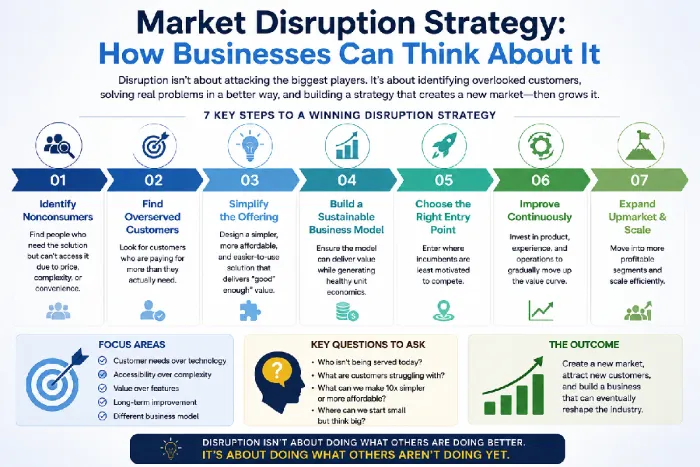
Step 1: Identify Non consumers
Look for people who want a solution but cannot access the current market because of:
- Price
- Complexity
- Location
- Technical requirements
- Lack of availability
- Poor customer experience
- High switching costs
Non consumers can represent significant future opportunities.
Step 2: Find Overserved Customers
Some customers may be paying for features they don’t actually need.
A simpler solution can create value for them.
Ask:
What are customers paying for that they don’t value?
Step 3: Simplify the Offering
Disruptive opportunities often involve reducing complexity.
Consider:
- Fewer features
- Easier onboarding
- Lower costs
- Self-service
- Automation
- Smaller infrastructure requirements
- More accessible distribution
Step 4: Create a Sustainable Business Model
A cheap product isn’t automatically disruptive.
The company still needs a business model that can support growth.
Look at:
- Acquisition costs
- Gross margins
- Distribution
- Customer retention
- Operating expenses
- Pricing
- Scalability
Step 5: Build a Separate Value Network When Necessary
Existing organizations have difficulty pursuing disruptive opportunities within their current organizations because they are already tuned to serving existing customers.A new business model may require different:
- Partners
- Distribution channels
- Pricing structures
- Metrics
- Organizational processes
- Customer-support systems
A Practical Disruptive Innovation Framework
Businesses can use the following framework to evaluate potential disruption:
Stage Key Question Business Objective
- Nonconsumption Who isn’t using the existing solution? Find untapped demand
- Overserved customers Who receives more performance than they need? Identify simpler alternatives
- Accessibility Why is the current solution difficult or expensive? Remove barriers
- Business model Can we profitably serve this segment? Build sustainable economics
- Entry point Where can incumbents least afford to compete? Establish a foothold
- Improvement How can the solution become better? Increase adoption
- Expansion Which higher-value customers can we serve next? Move upmarket
- Scale Can the model expand efficiently? Build competitive advantage
This framework is useful because it focuses on customer behavior and business models, rather than assuming that technology alone creates disruption.
AI Disruption in Business
Artificial intelligence is one of the biggest strategic forces businesses are evaluating in 2026.
But an important distinction should be made:
AI is a technology. AI-enabled disruption is a market process.
Not every AI application is disruptive.
Using an AI assistant to make an existing employee 10% faster may represent sustaining innovation.
Creating an entirely new, low-cost business model that allows previously expensive services to be delivered to millions of new customers could potentially follow a disruptive trajectory.
How AI Could Create Disruption
AI can lower the cost of activities that previously required significant human labor or specialized expertise.
Potential areas include:
- Customer service
- Software development
- Marketing
- Content production
- Data analysis
- Education
- Professional services
- Healthcare administration
- Financial services
- Business operations
The strategic opportunity emerges when lower costs and easier access allow new groups of customers to consume services they previously couldn’t afford or access.
AI and Business Model Innovation
The biggest AI opportunity may not come from adding an AI feature to an existing product.
It may come from redesigning the entire business model.
For example:
Traditional model:
Customer pays a high fee for specialized human service.
AI-enabled model:
Customer is provided with a cheaper, automated/AI-enabled service + human interaction when required.
Additionally, if this type of model is delivered to customers who were unable to afford how traditional service was provided, new-market disruption can set in.
The current business adoption provides both the potential and challenge. Existing reports show that a lot of small businesses use AI technology but much fewer companies have adopted AI across the business; there is often greater opportunity to re-engineer process than to incorporate AI unobtrusively.
Conclusion
Disruptive innovation is not only about creating a new or employing a new technology; it is about shifting the competitive trajectory of a market.
The Clayton Christensen theory also illustrates the fact that emerging firms can successively move upmarket by initially targeting the customers, nonconsumers or overserved waitingmarket that incumbent firms under-serve. As the new entrants’ disruption improves, they will capture the next dominant market.
For businesses in 2026, this is a useful framework in considering the use of AI and automation, as well as new digital business models. Being technologically advanced will not just be enough to be a winner. It could be the companies that understand the customers who are being missed, what blocks their purchase and how best to use technology to eliminate the obstacles.