

How to Build a Culture of Innovation in 2026 (Step-by-Step)
Last Updated: September 1, 2026
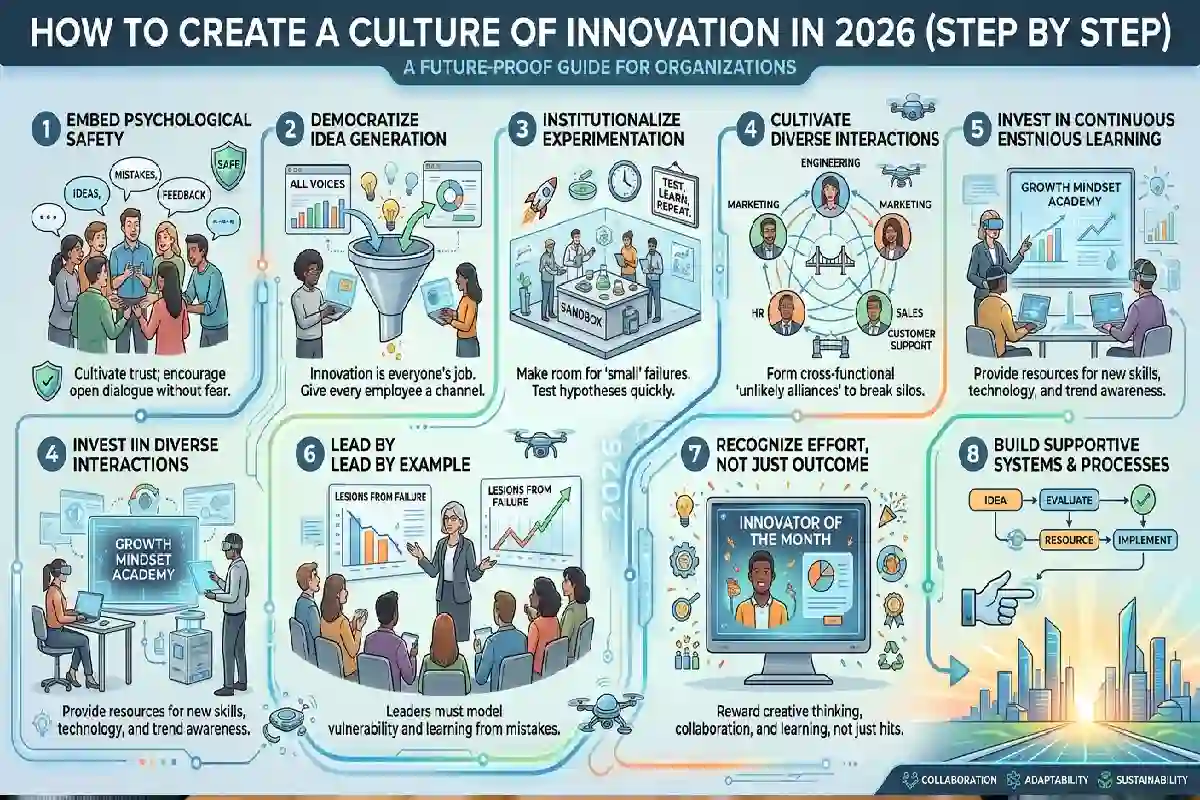
Innovation is present within and outside research and development clusters and high-tech companies. By 2026, companies from all industries must develop a work culture based on experimentation, creativity, feedback learning, and calculated risk-taking to evolve and grow. The firms developing an innovation-enabled workplace will be more agile in adapting to fast-changing markets, more efficient in solving customer problems, and more appealing to talent, and maintain their competitiveness.
What Precisely Composes an Innovation Culture?
An innovative work environment is a “workplace culture that provides support for creativity and experimentation by managers and co-workers, fosters the free flow of ideas, values new and multiple perspectives, and rewards innovative efforts.”
Key characteristics include:
- Open communication
- Psychological safety.
- Cross-Collaboration
- Ongoing education
- Customer orientated thinking
- Monitor leadership
- Data-driven decision-making
- The desire to learn from failures
Why Innovation Matters in 2026
Artificial intelligence, automation, the increase of remote work and digital transformation are all enabling industries to change rapidly.
Organizations that prioritize innovation can:
- Adapt as customers change their needs.
- To accelerate the launching of products.
- Enhance operating efficiency.
- Alleviate employee disengagement.
- Attract and retain the best talent.
- Need to be able to adapt and respond quickly to any turbulence.
Step 1: Create a Clear Innovation Vision
The springboard to innovation.
Managers should define:
- What innovation means to the organisation.
- Top priorities.
- Business objectives
- Customer problem to solve
- Success metrics.
Employees are more inclined to generate ideas if they are aware of the strategic vision and mission of the company;
Step 2: Build Psychological Safety
People won‘t put ideas forward if they think they will be shot down for them.
Encourage a workplace where people can:
- Use questions.
- Share creative ideas.
- Challenge assumptions respectfully.
- Mistakes are the best teachers.
- Provide constructive feedback.
People innovate if they can feel safe to take calculated risks.
Step 3: Empower Employees
Innovation is not the exclusive domain of managers or top management.
Give employees:
- Its authority over the decisions it helps to make.
- Ownership of the projects.
- Turning to the time for experiments.
- Availability of learning materials.
- There are possibilities of leading initiatives.
Led by empowered teams produce more innovative solutions.
Step 4: Encourage Cross-Functional Collaboration
Some of the most innovative thoughts can happen when people from different areas join forces.
Promote collaboration between:
- Marketing
- Sales
- Product
- IT
- Customer Support
- Operations
- Finance
However, greater diversity in ideas can also result in better innovation.
Step 5: Invest in Continuous Learning
Innovation is driven by learning.
Support employees through:
- Tutorial-type online courses
- Industry conferences.
- Internal workshops (things you do yourself)
- Mentorship programs
- Knowledge sharing sessions
- National certification programs( Professional certifications)
Organizations that value learning become more flexible and adapt to change.
Step 6: Use AI and Technology Responsibly
Is an innovation Partner in AI.
Organizations can use AI to:
- Observe the development of the market.
- Automate the boring bits.
- Enhance the quality of customer service provided.
- Talents may also support decision-making.
- The things you‘ll do to speed up research.
Creativity with respect to humans, ethics and critical thinking are investment in:
Step 7: Reward Innovation
Employees are more inclined to offer ideas in an environment that values innovation.
Reward contributions through:
- Recognition programs.
- Career development opportunities.
- Public acknowledgment.
- Innovation awards.
- Team celebrations.
Recognition energises innovative behaviours.
Step 8: Measure Innovation Success
Track innovation through metrics that matter.
| KPI | Why It Matters |
| New ideas submitted | Measures employee participation |
| Ideas implemented | Tracks execution |
| Revenue from new products | Evaluates business impact |
| Customer satisfaction | Measures value delivered |
| Employee engagement | Indicates innovation culture strength |
| Time to market | Reflects operational agility |
Common Barriers to Innovation
| Challenge | Solution |
| Fear of failure | Encourage experimentation |
| Poor communication | Increase transparency |
| Lack of leadership support | Align innovation with business strategy |
| Limited resources | Prioritize high-impact initiatives |
| Resistance to change | Invest in change management |
| Organizational silos | Promote cross-functional collaboration |
Traditional vs Modern Innovation Culture
| Traditional Workplace | Innovative Workplace |
| Top-down decisions | Collaborative decision-making |
| Avoids risk | Encourages calculated experimentation |
| Annual planning | Continuous improvement |
| Department silos | Cross-functional teamwork |
| Manual workflows | AI-assisted processes |
| Limited feedback | Continuous feedback culture |
Innovation Culture Examples
Learning what practices successful organizations use to stimulate innovation can give us all ideas. Not all organizations are the same, but the most successful implementations for innovation include:
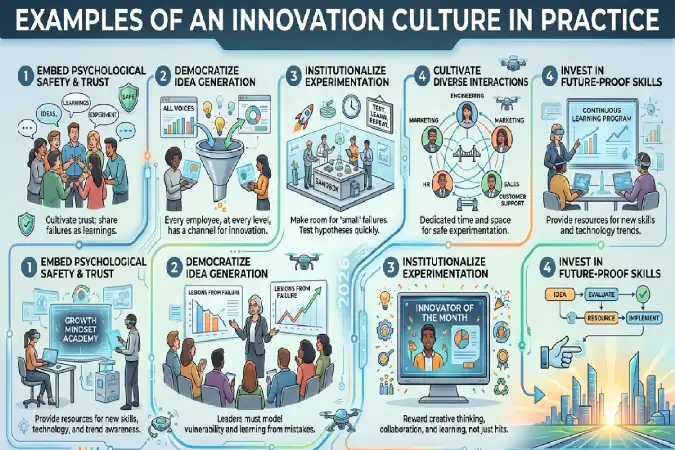
| Company Practice | How It Encourages Innovation | Business Benefit |
| Employee idea programs | Staff submit and vote on improvement ideas | Continuous process improvements |
| Cross-functional teams | Employees from different departments collaborate | Diverse perspectives and faster problem-solving |
| Innovation labs | Dedicated space for testing new concepts | Accelerates product and service development |
| Hackathons | Teams work intensively on creative solutions | Generates fresh ideas and prototypes |
| Learning and development | Continuous training and skill-building | Keeps employees adaptable and future-ready |
| Recognition programs | Rewards creative thinking and implemented ideas | Increases engagement and participation |
Lessons from Innovative Organizations
Successful companies typically:
- Involve staff in continuously improving the process.
- Save money for self-improvement.
- Experiment without fear of failure, support.
- Customer feedback potential
- Distinguish between a triumphant success and a key success factor or lesson learned.
It‘s not just about generating ideas… It‘s about the design of systems that reliably translate ideas into quantifiable business improvements.
Encouraging Creativity at Work
Creativity is the starting point for innovation. When employees are encouraged to think unconventionally, try their own ideas and work closely with friends, they are more likely to come up with useful concepts.
Practical Ways to Encourage Creativity
Create Time for Innovation
Employees find it difficult to think innovatively if each moment is consumed by obsolete activities. Providing employees some time away from the daily grind for brainstorming, training or re-engineering encourages them to think novel.
Promote Cross-Team Collaboration
Departments have different perspectives. Collaboration between sales, marketing, operations, finance, and customer service typically results in more innovation.
Ask Open-Ended Questions
Managers can stimulate creativity by asking questions such as:
- What can we do to make things better?
- What issue is still ailing the customers?
- Can someone suggest an easier way to do this?
- What new approaches would we take if we began afresh?
Encourage Continuous Learning
Learning new skills introduces employees to fresh notions and viewpoints. Fund training courses, webinars, conferences and industry gatherings to promote creative innovation.
Recognize Creative Contributions
Since employees tend to generate ideas more willingly when their efforts are recognized, recognition doesn‘t necessarily have to involve financial incentives. For example, public acknowledgement, promotion and higher accountability are also known to foster employees’ creativity.
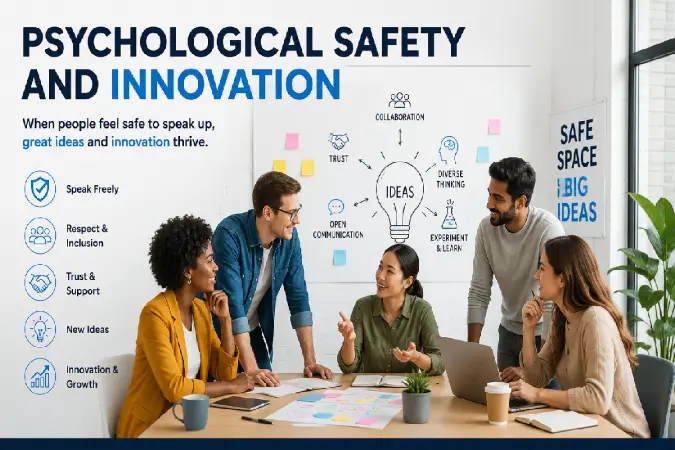
The single most important factor in whether an employee is innovative in the workplace is psychological safety a shared belief that one can speak up, ask questions, admit mistakes and challenge the status quo without being humiliated or punished.
When psychological safety exists, employees are more willing to:
- Suggest new ideas.
- Identify problems early.
- Experiment with different approaches.
- Share constructive feedback.
- Collaborate openly.
- Learn from mistakes.
How Leaders Build Psychological Safety
| Leadership Action | Impact on Innovation |
| Encourage respectful discussions | More diverse ideas |
| Welcome constructive feedback | Better decision-making |
| Treat mistakes as learning opportunities | Increases experimentation |
| Listen actively | Builds trust and engagement |
| Give everyone a voice | Improves collaboration |
| Recognize contributions fairly | Encourages future participation |
To establish psychological safety doesn‘t mean to avoid accountability. It is to hold people accountable and at the same time promote respect, openness and learning.
Employee-Driven Innovation
Innovation should not just be the job of a few executives or R&D teams. Sometimes the most obvious opportunities for improvement come from employees who work directly with customers, operations and the business.
Benefits of Employee-Driven Innovation
- More quickly spot operational efficiencies.
- Enhanced employee engagement and satisfaction.
- Improved customer experiences.
- Enhanced productivity.
- Kindle greater adaptability to change.
- Greater ownership and responsibility.
Strategies to Encourage Employee Innovation
- Develop a website, which serves as an online platform for submitting ideas digitally.
- Begin brainstorming from time to time.
- Call employees into to work on innovation programs.
- Offer resources to test promising new ideas.
- Disseminate best practice and stories of successful innovation throughout your organization.
- The reward adopted brought also potential ways to generate measurable value.
Innovation Mindset
Achieving an innovation culture always begins by creating an innovation mindset. This is the attitude of tackling problems with open mindedness, hope and optimism, flexibility and the attitude to learn.
Only having an innovative mind-set is not enough. Employees who think innovatively are not satisfied with the current processes, they are constantly searching something to improve.
Characteristics of an Innovation Mindset
- Curiosity and continuous learning.
- Openness to feedback.
- Adaptability to change.
- Customer-focused thinking.
- Resilience after setbacks.
- Creative problem-solving.
- Willingness to experiment.
- Data-informed decision-making.
How to Develop an Innovation Mindset
Encourage Curiosity
Encourage employees to challenge assumptions and consider other options rather than maintaining “the way we have always done it”.
Embrace Continuous Learning
Give employees work learning opportunities such as through courses, mentoring, certification and cross-function projects.
Learn from Failure
Must every experiment be a successful one? Certainly not, as every failure is a learning opportunity. Such organizations learn more and so innovate more.
Focus on Customer Needs
By gain understanding of the pain point of Customer, it‘s also possible to explore opportunities creating a better experience.
Celebrate Progress
Acknowledge the smaller progress, not only the United breakthrough. Measuring small innovation made the employee incentive to provide the new idea.
Conclusion
Cultivating innovation culture in 2026 is not a choice anymore. It is now essential for flexibility and growth in ever-evolving business environment. Innovation is a structured process that needs strong leading to be successful. It also needs psychological safety, autonomous employees, cross-border collaboration, constant development, Artificial Intelligence and new technology on board.
Using the practical, step-by-step techniques described here, any organization large or small can build a culture in which employees will be excited to suggest new ideas, willing to try new approaches, and eager to bring about positive change. Keep in mind that innovation is not just about one groundbreaking new product or service; it‘s about embedding a process of ongoing improvement into the fabric of your organization.
No matter if you’re running a start-up, an expanding business or a multinational corporation, creating an innovation culture today will allow you to develop a nimbler, more resilient, forward-looking business. Focus first on making small, trackable improvements, keep track of wins, and optimize constantly. In time, you’ll turn innovation into an everyday practice that really pays off for your staff, your customers and your investors.
(FAQs)
What is a culture of innovation?
An innovative culture consists of a business environment in which employees feel motivated to think creatively, try new procedures, work as a team and seek constant enhancement of products, services and procedures. It is based on trust, education and openness to modifications.
Why is building an innovation culture important in 2026?
For example, the year 2026, will be the year of a fast evolution of Artificial Intelligence, automation, hybrid work and digital transformation and companies need to be ready. Companies with mature innovation cultures are ideal to face this chaotic but prosper environment as they efficiently address customer needs, optimize processes and attract the best people.
How can leaders encourage innovation within their teams?
When leaders promote innovation, they do so by articulating a clear vision, establishing psychological safety, empowering workers, encouraging cross-functional teams, providing training and development, acknowledging creative ideas and supporting employees in experimenting with new ideas.
How can small businesses build a culture of innovation?
Small businesses can develop an innovation culture by listening to employees, involving them in decisions, using low-cost digital technologies, recognising creative ideas, and evolving offerings, operations and internal structures. It is attitudes and leadership that are important, not the size of the business.
How do you measure innovation success?
An evaluation of innovation involved the identification of the key performance indicators (KPIs) of the process, which may include: Ideas submitted, Implementation rate, Sales/profits from new products/services, Customer satisfaction, Employee satisfaction/engagement, Productivity improvements, Time-to-market.
What are the biggest barriers to innovation?
Many challenges and obstacles such as fear of failure, resistance to change, communication breakdowns, resource deficiencies, lack of management support, and organizational silo effects can hinder innovation. These can be overcome through dialogue, employee empowerment, and leadership.
How does AI support workplace innovation?
AI assists organizations to make sense of data, detect patterns and correlations, automating routine operations, create new ideas, enhance customer experiences, and facilitating effective decision-making. Nonetheless, right innovation relies on human contribution and manoeuvrability like ingenuity, cognition, ethical principles, and maintenance.
What is an innovation mindset?
Innovation mindset: Adopting an approach of inquiry and openness that involves questioning, experimentation, willingness to adapt, capacity to learn from failures as well as successes, and means of tackling and seeking solutions to problems. Concerned employees take every effort to enhance processes, products, and customer satisfaction.