

7 Lessons From Billion-Dollar Founders You Can Apply in 2026
Last Updated: September 21, 2026
Ideas don‘t usually build billion-dollar companies. The most valuable lessons learned from billion-dollar founders are: finding ways to provide significant value to customers, executing fast, using failure as a learning tool, attracting great talent and designing scalable systems.
Recent startup statistics also emphasizes why these lessons are still valid. CB Insights, that studied 431 VC-backed companies go bankrupt since 2023, discovered that 70% of them have exhausted their money, 43% had a poor product market fit, 29% presented bad timing and 19% an unprofitable unit economics. Funding can keep a company alive but can‘t fix an unprofitable business model.
What Can Entrepreneurs Learn from Billion-Dollar Founders?
The most important lesson is that top entrepreneurs are not just working harder, they are making the right decision over and over again.
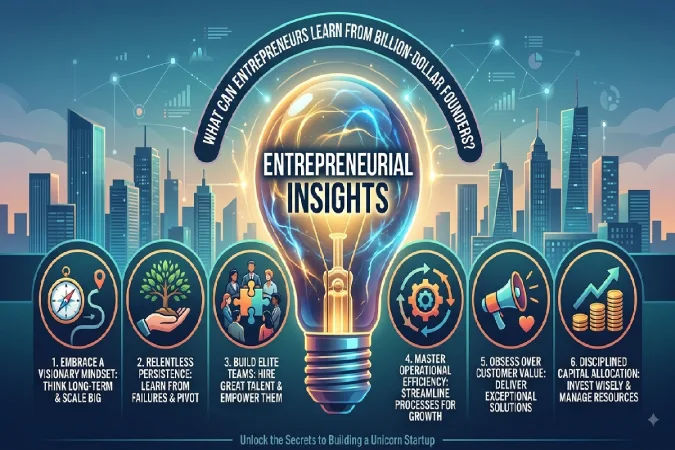
Across founder interviews and case studies, several patterns appear:
| Lesson | What it means | Practical action |
| Solve a real problem | Start with customer pain | Interview customers before building |
| Move with urgency | Avoid unnecessary delays | Shorten testing and decision cycles |
| Focus on product-market fit | Build something people genuinely need | Track retention and repeat usage |
| Start manually | Learn before automating | Do difficult processes yourself first |
| Hire carefully | Early employees shape company culture | Hire for judgment and ownership |
| Protect cash | Growth without economics is dangerous | Track runway and burn |
| Build systems | Scaling requires repeatable processes | Document important workflows |
| Stay adaptable | Markets change | Review assumptions regularly |
| Think long term | Billion-dollar companies take years | Prioritize durable advantages |
| Learn from failure | Setbacks contain useful information | Conduct post-mortems without blame |
Unicorn Founder Advice
Another common recommendation from successful unicorn founders is to go deep with customers first.
Eric Reese has recounted how Parker Conrad, one of the founders of Rippling, recently demonstrated this archetype. Conving interviewed by Garry Tan on the value of doing just those “unscalable” things and then translating them into scalable systems,”
That approach is particularly useful for early-stage founders:
- Find the customer’s painful problem.
- Solve it manually if necessary.
- Observe what customers actually value.
- Remove unnecessary steps.
- Automate only after the process works.
The mistake is thinking that automating a bad process is a good thing just because automation looks advanced.
Billionaire Success Habits
Referring to billionaire success habits can imply that becoming an entrepreneur is simply about incorporating a few morning rituals into your day. It is not.
High-performing founders tend to develop habits around:
- Making decisions with incomplete information.
- Reviewing important metrics regularly.
- Speaking directly with customers.
- Recruiting people who are better than themselves in specific areas.
- Protecting time for strategic thinking.
- Learning continuously.
- Maintaining urgency without confusing activity with progress.
Interviews with recent startup founders further demonstrate that there is no Single founder productivity formula. Some focus on extreme working hours while others lay importance on long sleep and performance.
The lesson is don‘t copy another founder‘s schedule. Copy the discipline that allows the schedule.
Startup Founder Wisdom
The best startup founder advice is frequently counterintuitive.
1. Don’t chase valuation first
An overly high valuation may give rise to excessive expectations. Initially, prioritize customers, income, retention, margins or any other critical indicator of business health.
2. Speed matters, but direction matters more
Moving extremely fast toward disaster is yet another way of getting there very quickly.
3. Fundraising isn’t the business
Capital is fuel. It is not product-market fit, loyalty, or long-term viability.
4. Your first version should teach you something
A minimum viable product should not be “small”. A minimal viable product should answer a important business question.
5. Scaling changes the founder’s job
In the initial stage, a company‘s founders could personally take charge of sales, supports, product decisions and recruitments,what are changing to systems, leadership, organizational design afterwards.
This more general lesson is also supported by research of unsuccessful new ventures: The ominous signs that ultimately doom firms typically emerge early on.
Founder Interviews
Founder interviews are interesting because they uncover other decisions hidden in polished success stories.
Say, for instance, Jack Altman in his 2026 talk about a Lattice covers product-market fit, Customer feedback, hiring, fundraising, and Co-founder relationships and taking a startup to a multi-billion-dollar enterprise.
Similarly, Aravind Srinivas of Perplexity has written some lessons that he gained from Jensen Huang and Elon Musk. Looking at Huang, Srinivas drew lessons on urgency and wars even after great achievements while from Musk he learned the importance of looking at things from a long term mission driven perspective.
When reading interviews, don’t simply collect quotes. Look for:
- What problem did the founder identify?
- What assumption proved wrong?
- How did they find product-market fit?
- What did they stop doing?
- Which hire changed the company?
- How did they respond to competition?
- What would they do differently today?
Billion Dollar Startup Lessons
Each of these billion dollar startup lessons is surprisingly straightforward to apply and is equally transferable.
Lesson 1: Build for a painful problem
Market size alone is not necessarily indicative of demand. Customer pain is a better filter.
Lesson 2: Validate before scaling
Don‘t over hire, spend or build advanced infrastructure before knowing that customers will want the product.
Lesson 3: Sell before you over-engineer
A business that lacks customers despite having a technically flawless product is a feeble business.
Lesson 4: Turn manual learning into systems
Begin close to the problem. When you understand the process, automate and standardize it.
Lesson 5: Hire for the next stage
Those who succeed in a 10-person startup are not necessarily successful leaders of a 1000-person company.
Lesson 6: Protect the runway
The latest failure research is a reminder that cash management continues to be important. The 431 failed startups that were included in CB Insights’ 2026 analysis, for instance, had raised a combined $17.5 billion in venture funding.
Lesson 7: Build for durability
Nothing about this should be to arrive to a 1 billion valuation. Just build a business for the long term, for when Market, investors, trends change.
FAQ
What are the biggest lessons you‘ve learned from founders that have achieved billion dollar valuations?
Below the lessons with the most transferable learning are customer obsessedess, product-market fit, speed of learning, disciplined hiring, cash and cash management, adaptable scalable system.
What are the common practices of successful startups founders?
Successful entrepreneurs tend to establish routines with regards to their communication with customers, decision-making, continuous education, review of metrics and thinking into the future. Their habits tend to be very different from one entrepreneur to another.
What enables founders to reach the multi-billion dollar valuation?
There is no one size fits all. The most successful companies have a mix of many customers’ pain, much product-market fit, efficient execution, talented teams, right time to jump, and able to scale up.
Is it possibly to have without raising venture capital to create a billion dollar company?
No. Funding enables speed of growth, but does not produce product-market fit. The key question is, therefore, if more funding increases a company emerging into a sustainable competitive advantage.
What can first-time founders learn from those founders of these unicorns?
First time founders should understand how those iconic entrepreneurs discovered customer problems, recruited cofounders and built teams, raised cash, and pivoted when their assumptions were wrong instead of trying to clone them.
Final Takeaway
Lessons From Billion-Dollar Founders My lessons here are not hacks. They are practices: solve large, important problems; stay embedded with your customers; test and learn rapidly; carefully hold your cash; hire infrequently; and grow the organization through established processes.
The best founders recognize that billion dollar funding is the result, not the goal. By 2026, where AI will have drastically increased the number of new startups and where failure is just as frequent, execution discipline is Queen.