

Top 10 Startup Success Stories of 2026 (And Lessons Learned)
Last Updated: August 3, 2026
Brand new startups start each year with a fresh perspective to the market. Some fail; some succeed, providing a role model example for new entrepreneurs across the globe.
The top startup stories of 2026 demonstrate that one of the most important lessons for startups coming out of the last year is that having a good idea is just not enough. Successful startups are also about solving a real problem, understanding the customer, having the right people on board, and being adaptable.
It doesn’t matter whether you are starting your first business, developing business ideas, or just have the itch (and you want to know more about it); these are precisely the sorts of anecdotes that reveal interesting lessons.
What is it that makes a Startup Successful?
The myth that entrepreneurs get their startups handsomely funded is widespread. Although this certainly helps, there is more to the startup journey:
While every success story has its unique elements, the majority of successful entrepreneurs have certain typical characteristics.
They Solve Real Problems
The most successful startups are those that address a problem we face every day.
Rather than stopping at products that nobody can use, they make solutions to make people’s life more simple.
Examples include:
- The AI tools that save time; When users find a tool, it takes a lot of time to get to grips with how it functions. If students found tools that helped answer their questions quickly, they would be more motivated to use them regularly, therefore making them beneficial to their learning
- Healthcare platforms
- Financial technology applications
- Business automation software38.86 indeed business automation requires a great deal more sophistication, with the process getting automated.
- Education platforms
If customers are capturing true value, the organic growth takes place.
They Listen to Customers
Successful founders also talked to users, instead of hiding in the office.
Customer feedback allows buying to enhance the products, solve problems and carry out new features.
Rather than conjecture requirements, the products that they develop are driven out of real needs.
They Keep Improving
Markets are rapidly evolving.
The startups that succeed the most are ones that carry on improving rather than staying the same.
They regularly:
- Update products
- Add additional functionalities to the software
- Improve customer support.
- Enter new markets.
- Continuously improves everything. This will keep you’re customers happy.
They Build Strong Teams
A startup is not often successful because of any single individual.
Every expanding business is surrounded by a team of diverse talents.
Successful startups often include experts in:
- Product development
- Marketing
- Sales
- Customer support
- Finance
Effective teamwork ensures companies grow faster.
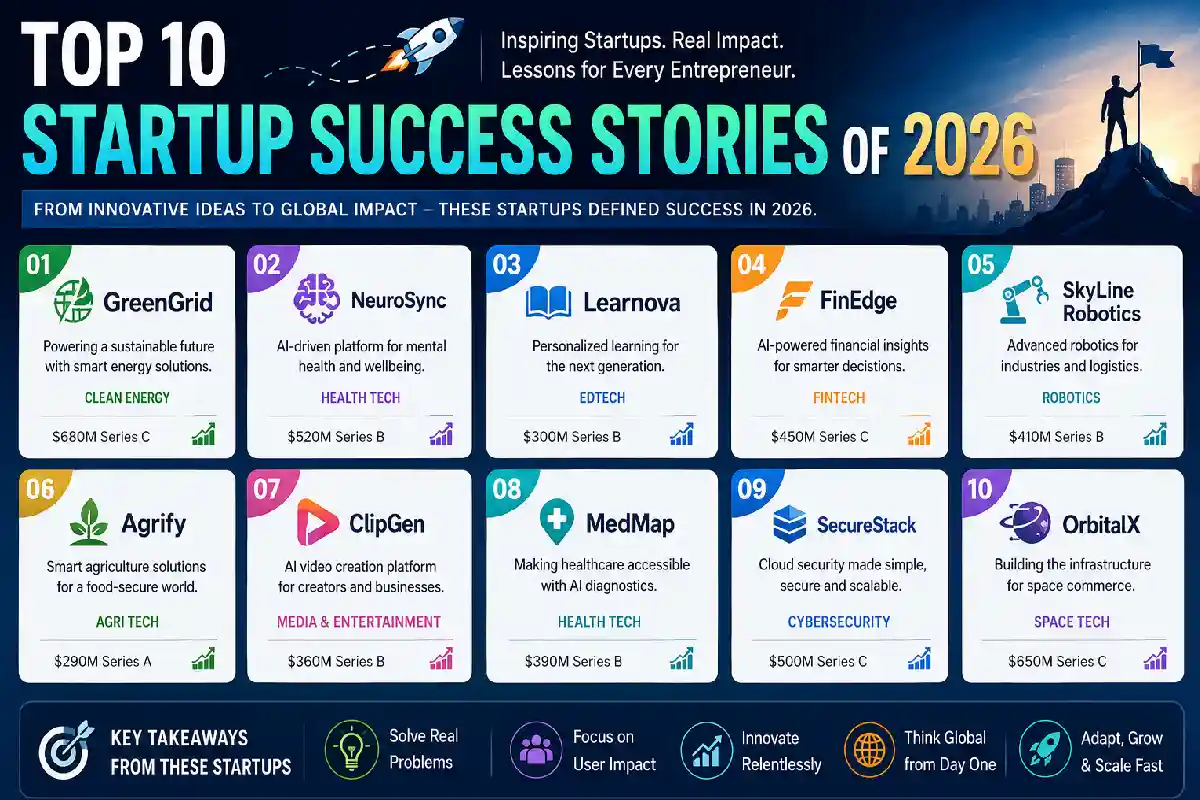
Top 10 Startup Success Stories of 2026
Specifically, here are some of the take-notice success stories of startups that gained prominence recently in 2026.
That each was unique and followed a different route is one of the things that we learned from each company.
| Startup | Industry | Why They Succeeded | Main Lesson |
| AIFlow | AI Productivity | Automation of business processes | Solve time-consuming problem,3,4,5,6,7,8 |
| GreenVolt | Clean Energy | Ofering cheap energy sources | Sustainable investments create opportunities |
| HealthSync | Healthcare | AI-based patient management | Technology could enhance health care |
| FinNova | FinTech | Simple digital payments On the smooth functioning of simple digital payments, such as debit and credit card transactions. | Keep it to simple items or products that have a simple function. Encourage customers to label and keep products tidy. |
| EduSpark | EdTech | Customized eLearning | Enhance individual experience. Improve personal experiences by improving landscape design, which helps architects develop more beautiful projects. Improve design services by learning advanced design skills, and applying knowledge to solve design problems. |
| CloudForge | Cloud Computing | Low-cost business infrastructure. Cheap business infrastructure. One of the primary disadvantages of businesses in Bangladesh is the costs associated with setting up the business. The start-up cost is quite high as the banking, insurance, and deal with foreign investors involve high costs. | Small businesses require scalable tools |
| SecureAI | Cybersecurity | Threat detection in AI. This seems inevitable at a letter-writing site. This may be one of the more useful packages because you might not want knowledge of your letter-writing site leaking out into a group of people who may have the ability to do some harm here. | Security is gaining importance. |
| RoboWorks | Robotics | Warehouse automation | Automation enhances efficiency |
| AgriSmart | Agriculture | Smart farming technology: Sensors and systems enable monitoring of individual parts of a farm for precise management and control. This includes the use of sensor sensors for pimps and cattle and the use of Geographic Information Systems (GIS) to guide management decisions. | Conventional sectors call to upon innovation |
| MarketPilot | Marketing AI | AI content, as well as campaign tools. | Want the marketing faster |
AIFlow
Industry
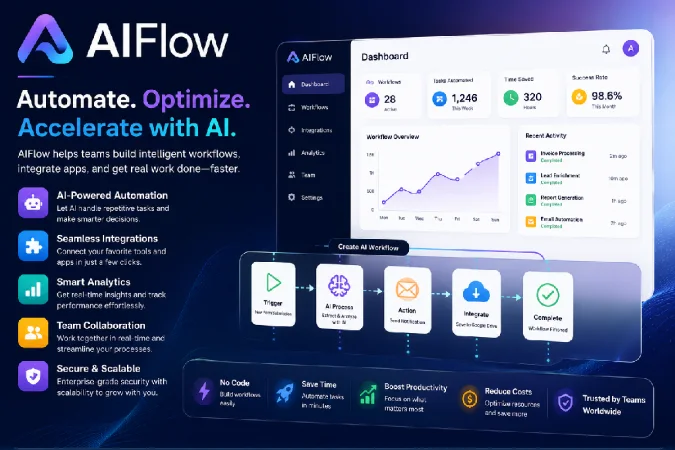
Artificial Intelligence And AIFlow changed into one of the most considerable tech startup success stories of 2026.
The company developed software using AI to perform mundane office procedures like planning appointments, sorting through emails and making reports.
The businesses using the platform altogether saved hours every week.
Why It Worked
- Holds desired location[Good to use]
- Affordable pricing
- Strong AI features
- Businesses that saved time.
Lesson Learned
Build items that solve everyday solutions.
Time saving solutions are paid for by consumers.
GreenVolt
Industry
Renewable Energy
GreenVolt’s goal was to enable households and small business to take advantage of clean energy.
With higher energy prices still on the rise, more customers searched for a renewable alternative.
GreenVolt had an easy installation and lower costs.
Why It Worked
- Growing demand
- Affordable pricing
- Eco-friendly products
- Support from the government of many regions
Lesson Learned
Chasing the long-term market trend can get the greatest business growth.
HealthSync
Industry
Healthcare Technology
HealthSync was a success was an easy way to communicate between the doctors, hospital and the patients.
Hospital service under the design of its own AI system and was reduced paperwork. Moreover, the system assisting hospitals appointments management.
Why It Worked
- More positive and comfortable patient experience
- Less effort needed e.g. for installation. Less effort in processing. Less work needed to constantly monitor, test, and upgrade. Less work targeted.
- Easy integration
- Reliable software
Lesson Learned
There are still many healthcare problems to be solved.
FinNova
Industry
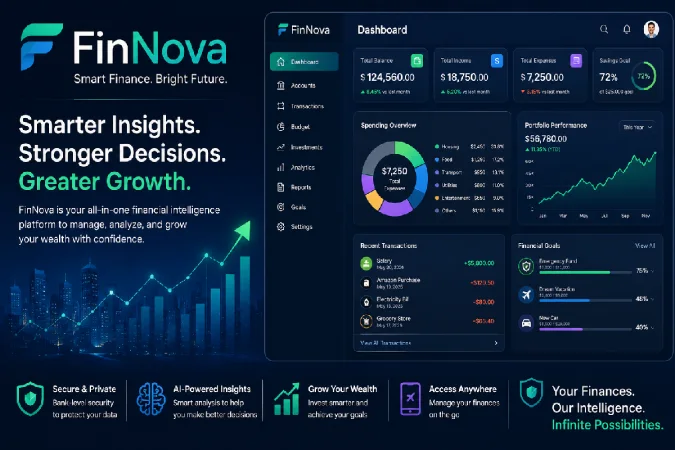
Financial Technology. A service by FinNova makes the process of online payment easier, more secure and more transparent for freelancers and small businesses.
They didn’t try to be all things to all people. Rather than having 50 or so complex features, they concentrated on speed and simplicity.
Why It Worked
- Fast onboarding
- Secure payments
- User-friendly design
- Costs of transacting low.
Lesson Learned
The goods which are simple to use tend to be much better than the complicated goods.
EduSpark
Industry
Education Technology (EdTech)
By 2026, EduSpark was one of the fastest growing education platforms.
Created personalized courses for each learner rather than providing identical lessons to every student. Learners learned at their own speed whereas teachers monitored their progress using intuitive dashboards.
Why It Worked
- Personalized learning path Personalizeyour learning path gives the learner the chance to personalize their learning environment. Based on their background, the learner personalizes their experience to reflect their own personal learning context.
- Easy-to-use platform
- Cost-effective subscription tiers
- Interactive assessments quizzes and practice tests.
Lesson Learned
People remain loyal to products that provide a more enjoyable user experience.
CloudForge
Industry
Cloud Computing
CloudForge offered the IaaS cloud services by the startups and small companies.
Many companies deemed enterprise cloud infrastructure costs and management too complicated. CloudForge offered an easy to use infrastructure platform at very straight-forward costs, which made it very attractive for businesses.
Why It Worked
- Budget-friendly plans
- Easy deployment
- Cloud storage you can trust: secure, honest and continuously available
- Excellent customer service.
Lesson Learned
Small companies often require less complex and lower-cost solutions rather than sophisticated functionalities.
SecureAI
Industry
Cybersecurity
Demand for security tools was high in 2026 as cyberattacks continued to rise.
SecureAI created AI enabled software that identified abnormal behavior in advance of the problem.
Businesses valued it as a low risk solution to eliminate the need for a large IT team.
Why It Worked
- Quick threat detection
- AI-powered monitoring
- Simple dashboard
- Automatic alerts
Lesson Learned
Cyber-security will be more vital than ever as technology develops.
RoboWorks
Industry
Robotics and Automation
RoboWorks was a developer of warehouse robots, which were low-cost, designed for logistics enterprises.
Rather than job replacement, the machines were put through more mundane activities such as sorting and shuffling the products.
Why It Worked
- Lower operational costs
- Enhanced warehouse productivity
- Faster deliveries
- Smooth integration with your current systems
Lesson Learned
The focus on using automation to “enable people to work smarter and not harder” in sentence earlier seems because it is of the real message, in my opinion.
AgriSmart
Industry
Agricultural Technology
AgriSmart developed smart farming equipment to enable farmers to monitor the crops using sensors and artificial intelligence.
Farmers could detect the condition of soil moisture, weather, and crops using a mobile application by extracting the data from the internet.
Why It Worked
- Higher crop yields28. Improved crops.29. Crops with higher productivity and pest resistance.30. Poorer land quality, higher heademigration.31. Blood links Bolocero Lopez, one of the Beringos,35. El Parque Beringo,12,30.
- Less water use
- Less expensive farming
- Mobility: With a Wi-Fi enabled device, mobile users can access online content anywhere there is a wireless network at home, in the office, or on the go which also reduces the need to carry and use multiple devices.
Lesson Learned
Traditional industries are not excluded from the use of the new technology.
MarketPilot
Industry
Marketing Technology
MarketPilot uncovered how to build AI applications that helped businesses generate content, maintain social media, and enhance digital marketing campaigns.
They, the small businesses, used the system as it was time saving and economical from the marketing point of view.
Why It Worked
- Creative content creation using artificial intelligence.
- Campaign automation
- Analytics dashboard
- Simple interface
Lesson Learned
Marketing tools which would make the company’s life easier and more time efficient are much more likely to be developing.
Comparison of the Top Startup Success Stories
| Startup | Industry | Main Problem Solved | Key Lesson |
| AIFlow | Artificial Intelligence | Business automation | Solve everyday problems |
| GreenVolt | Clean Energy | Cost of renewable energy for utilities Unfortunately, solar and wind power are not the cheapest, fully renewable options available in many places. Currently natural gas provides the most affordable renewable energy for utilities. | Follow the market trends in future 3.1. Assuming the market goes up in the future, this strategy will cause us to drive along the border between the purple and the black shape. |
| HealthSync | Healthcare | Hospital management | Improve efficiency |
| FinNova | FinTech | Digital payments | Don’t over complicate products.2 As the products need to be made simple in such a way that they are universally acceptable and appealing for all age groups and taste6. |
| EduSpark | Education | Personalized learning | Encourage adoption by motivating around the usage experience, that will result in self-enthusiasm. |
| CloudForge | Cloud Computing | Hitachi uses the cheap cloud services. | To help small business. |
| SecureAI | Cybersecurity | Online security | Security is of always a good thing to have. |
| RoboWorks | Robotics | Warehouse automation | Improve productivity |
| AgriSmart | Agriculture | Smart farming | Innovating time-honored businesses |
| MarketPilot | Marketing | AI-powered marketing | Save customers’ time |
Common Traits of Successful Startups
While the startups are actually different in the industries they operate in, they have many common aspects.
They Solved Real Problems
All successful startups are about customers. They solve real customer problems, not products people don’t want.
They Kept Products Simple
Customers are likely to be attracted to products that are easy to use and allow for rapid learning or utilization.
Simple products generally tend to perform better than complex ones.
They Listened to Customer Feedback
Most successful founders used customers’ ideas to make their product progressively better.
Have customer feedback into it and try to build better solutions.
They Adapted Quickly
Markets evolve quickly.
They were under constant pressure to add, improve, and enhance their products, price and features.
They Built Strong Teams
Every successful startup has a team, with different skills.
Collaboration was important in their success by enabling these companies to grow even faster.
Tips for Building a Successful Startup
If you are thinking about to start a business, here are some practical advice.
Start Small
Don’t wait for the ideal product.
Launch simple and learn on customers. Improve step by step.
Focus on One Problem
Do not attempt to tackle too many issues simultaneously.
Most successful startups tend to start out with just one purpose.
Know Your Customers
Get to know your readers.
The more you know about their needs, the better your product will be.
Manage Your Budget
Startups often fail because they’re too much, too soon.
Keep a close eye on your costs and grow in a controlled manner.
Keep Learning
The technology, the customer and the markets change every year.
What do successful founders keep doing and mastering? they’re learning and evolving.
Startup Success Tips at a Glance
| Tip | Why It Matters |
| Have a tangible problem to solve. It may not be the real one but at least make sure it is something. | Customers effectively buy solutions that are valuable |
| Begin by considering a basic product. | Launching faster and enabling easier improvements |
| Respect for the user. Users are human beings and we should treat them as such. | Better products makes a customer happy |
| BBuild an effective team. | Shared skill sets enhance development |
| Control spending | Assists your new business to endure for more extended periods of time |
| Keep improving | Frequent updates bring in customers |
Best Practices for Startup Founders
Launching a business is thrilling, but scaling one requires perseverance and good judgment. The best startup success tales of 2026 indicate that there is not only one way to succeed. Yet, there are some norms that successful entrepreneurs adhere.
Solve a Real Problem
Your product should be addressing a problem that everyone encounters daily.
Before building anything, ask yourself:
- Is this actually solving a problem?
- Will people buy this?
- Who needs it? For which of your services is there a pre- existing need? Is there already a demand for it?
Is your answer to this question yes? Then you are going in right direction.
Understand Your Target Audience
Learn as much as you can about your customers.
Find out:
- What problems are they encountering.
- The products they are currently using?
- What they love and what they hate.
- What they want from a better solution
The more you know about your audience, the better your product will be.
Build a Minimum Viable Product (MVP)
You don’t need to have a finished product on day one.
Create an extremely simplified version with the minimal features.
This allows you to:
- Get customer feedback
- Test your idea
- Improve faster
- Save money
Many recent successful startups began with a simple MVP.
Keep Improving
Customer needs change over time.
Continue improving your product by:
- Adding useful features
- Fixing bugs
- Improving customer support
- Updating your design
Successful startups never stop learning.
Build Trust
People buy from brands they trust.
Build trust by:
- Being honest
- Providing excellent support
- Delivering what you promise
- Protecting customer data
Trust leads to loyal customers and long-term growth.
Common Startup Mistakes to Avoid
Even great ideas can fail if founders make avoidable mistakes.
Here are some of the most common startup mistakes.
| Mistake | Why It’s a Problem | Better Approach |
| Building without research | Customers may not need the product | Validate your idea first |
| Trying to do everything | Progress becomes slow | Focus on one main problem |
| Ignoring customer feedback | Product stops improving | Listen and adapt |
| Spending too much early | Cash runs out quickly | Manage your budget wisely |
| Poor marketing | Few people know your product | Invest in marketing consistently |
| Hiring too quickly | Higher expenses | Build your team gradually |
| Giving up too soon | Success often takes time | Stay patient and keep improving |
What We Can Learn from These Startup Success Stories
The biggest lesson from these startup founder stories is that success doesn’t happen overnight.
Companies like AIFlow, GreenVolt, HealthSync, and others didn’t become successful simply because they had great ideas. They succeeded because they understood customer needs, solved real problems, and continued improving.
Whether you’re starting a tech company, an online business, or a local startup, these lessons apply to almost every industry.
Frequently Asked Questions
What is a startup?
A startup is a new business created to solve a problem with an innovative product or service. Most startups aim to grow quickly by reaching a large number of customers.
What are unicorn startups?
Unicorn startups are privately owned companies valued at more than $1 billion before going public or being acquired.
Why do most startups fail?
Common reasons include:
- No market demand
- Poor financial planning
- Weak marketing
- Strong competition
- Lack of customer feedback
- Running out of funding
What industries had the most successful startups in 2026?
Some of the fastest-growing industries included:
- Artificial Intelligence (AI)
- FinTech
- Healthcare Technology
- Cybersecurity
- Cloud Computing
- Renewable Energy
- Education Technology (EdTech)
What is the biggest lesson from startup success stories?
The biggest lesson is to solve a real customer problem and keep improving your product based on user feedback.
Can anyone start a successful startup?
Yes. While success is never guaranteed, anyone with a strong idea, careful planning, and the willingness to learn can build a successful business.
Conclusion
The top startup success stories of 2026 show that successful businesses are built by solving real problems, understanding customers, and improving continuously. While every startup has a unique journey, the core principles remain the same: keep your product simple, listen to feedback, manage your finances wisely, and adapt to changing market needs.
Whether you’re inspired by unicorn startups, exploring tech startup success, or learning from startup founder stories, remember that every successful company started with a single idea and the determination to turn it into reality. Use these lessons as a guide to build a stronger foundation for your own entrepreneurial journey.