

From Failure to Fortune: 8 Entrepreneur Comeback Stories (2026)
Last Updated: August 18, 2026
In fact, failure is many times the equivalent of entrepreneurial success. After all, most of the globe‘s most recognizable entrepreneurs have achieved their largest endeavors only after suffering a refusal, bankruptcy, a weak product, a financial crisis, and so forth.
For entrepreneurs in 2026, these comeback stories serve as an important reminder that a failed venture is not the end of an entrepreneurial career. What is critical is the post-dissolution activities learning from the experience, changing course or focus, safeguarding what you have, and having the nerve to begin again.
These entrepreneurs show us different kind of resilience from Walt Disney‘s early bankruptcy, to Steve Jobs’ spectacular comeback at Apple and Rajat Agarwal‘s transition from bankruptcy to a big recycling venture.
What is the Secret of making an Entrepreneur Comeback Story So Powerful?
A comeback is not about suddenly being successful after experience of failure: it‘s about turning failure into data.
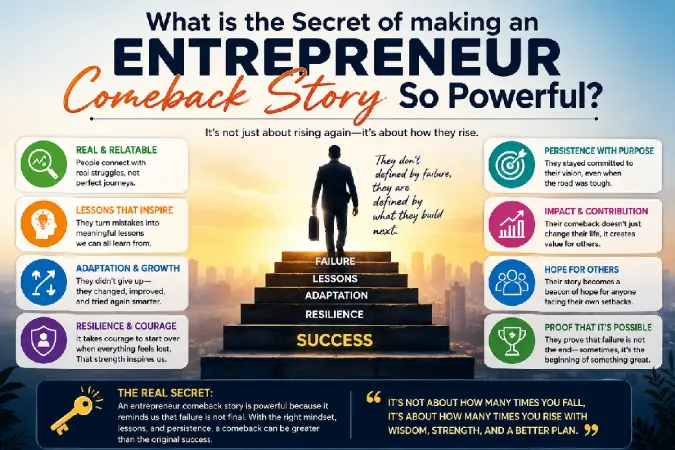
Successful entrepreneurs who failed and succeeded often demonstrate several common behaviors:
- They find out what has gone wrong rather than throwing blame on the situation.
- They change their business model /strategy.
- They keep improving their useful skills.
- They safeguard relationships and reputation during critical times.
- They know when to insist upon change and when to persist.
- They don‘t see failure as an identity, but rather as a feedback.
The next eight stories are markers of these principles.
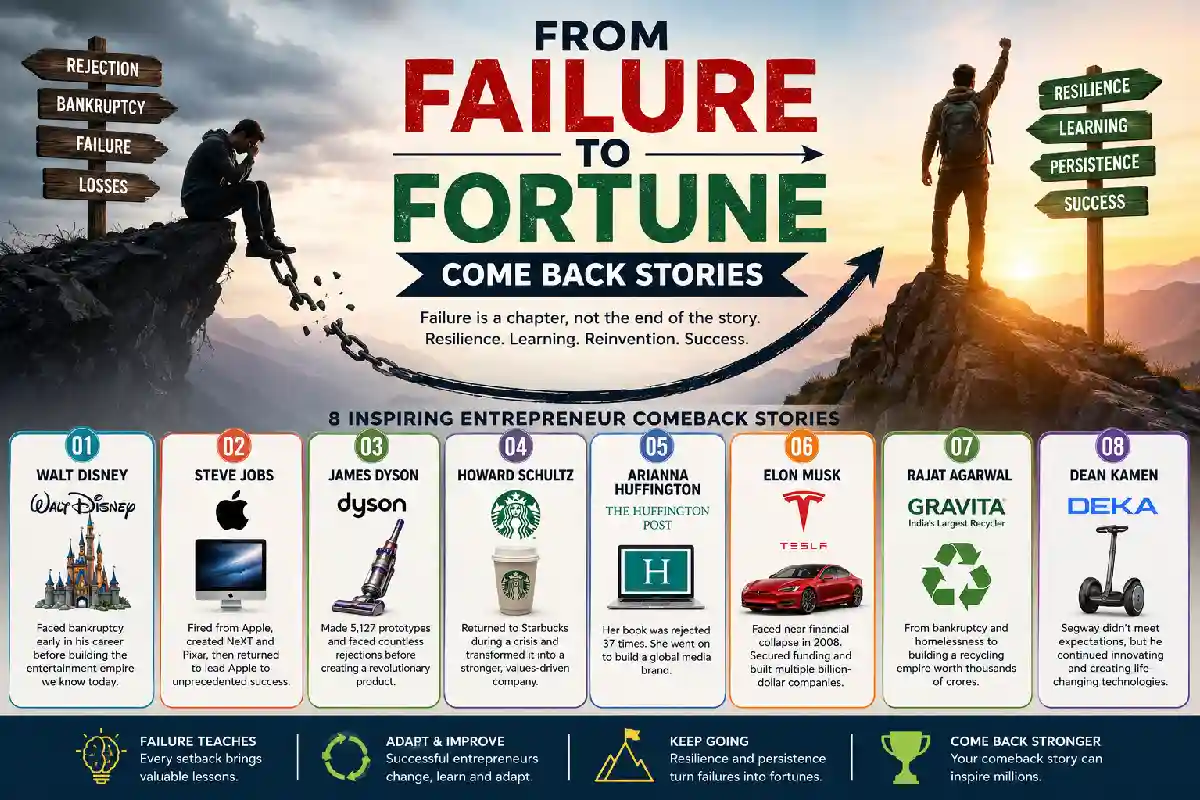
1. Walt Disney: From Bankruptcy to an Entertainment Empire
Walt Disney is a very clear historical example of a founder rebuilding after failure.
Prior to bringing the Disney name to animation and entertainment, Disney‘s initial animation business Laugh-O-gram Films was struggling financially. The company was established in Kansas City, 1922. However, its distributor failed to collect its dues, and the firm was pushed to near-bankruptcy.
Finally Disney left Kansas City and moved to California with his brother Roy. Rather than accepting to give up animation he started again.
The new chapter created the Disney Brothers Studio, since matured into The Walt Disney Company. Failed in the beginning, were not also getting away. They got to be part of the experience to being who Disney became an astute filmmaker and businessman.
The comeback lesson
It is more valuable to start again than continually fix a broken model.
If the original conditions of the business no longer work then in some cases it is not enough to work harder; entrepreneurs need to change the location, partners, products, or what they do altogether.
2. Steve Jobs: Fired from His Own Company and Back Again
There are very few entrepreneurial comeback stories that are as sensational as Paul Allen yet no one can match Steve Jobs’ time of shock and success at Apple.
Jobs was later driven out of the company he co-founded in 1985. During his time away from Apple, he built NeXT and was also involved with the business that would eventually become Pixar. While NeXT was neither a commercial success, the company‘s technology turned out to be strategically important when Apple bought NeXT in 1996.
Jobs arrived back at Apple in 1997.
The entrepreneur who came back was not the same as he left. After his time away he had experienced managing different teams, products, technologies, and running creative businesses. After his time away, Apple followed a product driven strategy and developed products like iPod, iPhone and iPad.
The comeback lesson
Professional failure can force an entrepreneur to develop capabilities that success never required.
Being removed from a company, losing authority, or watching an idea fail can be painful. But those experiences can expose weaknesses and create an opportunity to become a better leader.
3. James Dyson: 5,127 Prototypes Before the Breakthrough
The story of James Dyson shows you you don‘t have to be in Chapter 11 to fail.
Failure sometimes appears as thousands of failed experiments.
Dyson came up with the bagless vacuum idea after becoming fed up with regular suction machines. He persisted at designing the product until he produced 5,127 prototypes before he came up with an efficient design. The other vacuum cleaner manufacturers refused to acknowledge the idea so he had to find different routes to launch in the market.
The end product was the DC01 the first mass produced vacuum cleaner by Dyson in 1993. This model was then seen as the forth in a series of innovative inventions by Mr. Dyson.
In addition, Dyson‘s experience explains the importance of entrepreneurs to differentiate between productive failure and destructive failure.
A shovel looking for a hole. A prototype that doesn‘t work can be a valuable lesson.
A completely different problem occurs if a business consistently failing to make a profit does not provide ‘new’ information.
4. Howard Schultz: Returning to Rebuild Starbucks
As exemplified by Howard Schultz‘s return story, he shows how even a successful business can go through turbulent times.
Before returning to the helm as CEO in 2008 when the company was in crisis, Schultz had earlier stepped aside from Starbucks operations. His transformation plan centered on core values, the customer experience and ground-breaking solutions.
The following years later showed remarkable success stated Starbucks. In a publication from Starbucks in 2014 it reads “For the six years after the 2008 crisis, Starbucks’ market capitalization rose from $5 billion to $57 billion and its stock price much… STARANKET] noticed”
In 2022, Schultz went back to Starbucks as the CEO, mentioned that we are reinvesting in our partners and stores, taking a fresh look at our future.”
5. Arianna Huffington: Rejection Before Building a Media Brand
Not all entrepreneurial failures include a company that fails, no.
Arianna Huffington herself faced rejection time and time again.
Her second book was rejected by dozens of publishing houses. According to Huffington she hit financial rock bottom before managing to find the strength and perseverance to carry on. And her perseverance paid off.
In 2005, she co-founded The Huffington Post. The online publication was seen as a controversial venture in its initial days, however, it grew into one of the important digital media enterprises and was later bought out by AOL.
The story of Who, is especially meaningful for founders, since rejection can take place even before a company has launched.
People are not interested in pitches. The bottom line is that pitchers are not interested in listening to pitches.
The rejected product, customers.
Editors won‘t buy than an idea.
Potential partners refuse.
6. Elon Musk: Surviving the 2008 Crisis
There have been times during the life of Musk‘s companies when they were under extreme financial pressure.
2008: Received a 40 million dollar financing commitment to fund roadster production, powertrain activities and future development.
This time period was especially tough as Tesla was still trying to mainstream electric vehicles as a walk in the park while managing the manufacturing and capital needs.
The common thread of all this is not that every founder should bet everything with the way Musk did in 2008. It is that fledgling businesses should be obsessed with liquidity, execution, financing, and survival.
7. Rajat Agarwal: From Bankruptcy to a Recycling Business
For the entrepreneur seeking a more modern example from India, the story of Rajat Agarwal also proves to be very encouraging:
A 2026 article from The Financial Express showed that Agarwal went bankrupt and sat homeless until he built a large recycling plant linked to Gravita India. The company became a large recycling company and floated in 2010.
This is important as it dispels the myth that entrepreneurs need to have a lot of money at start up, impressive qualifications or a clean bill of professional health.
An extremely unfortunate financial trajectory will not necessarily hinder anyone who wishes to attain the status of successful entrepreneur.
8. Dean Kamen: Moving Beyond a Famous Product Failure
Dean Kamen‘s Segway was probably the best known case of overpriced new product that had all the hype but was not as revolutionary for transportation as many anticipated.
However, to look only to the Segway innovation in order to measure Kamen‘s pioneering enterprise might be missing a broader perspective.
Kamen proceeded with a line of work with DEKA Research and Development in technologies such as medical devices and mobili-ty. Kamen‘s path shows that an entrepreneur can identify with a lot more than a product.
The return lesson.
Entrepreneurship is not for a one failing product to sour a whole business.
Entrepreneurs get too close to a product because they’ve put in a lot of time on it. And sometimes it’s smartest to take the lessons familiarity, contacts, technology, expertise and walk away.
Bankruptcy Comeback: What Founders Can Learn
Bankruptcy is one of the hardest types of entrepreneurial failure to deal with as it encompasses so much – your money, your relationships, your reputation and your own belief in your-self.
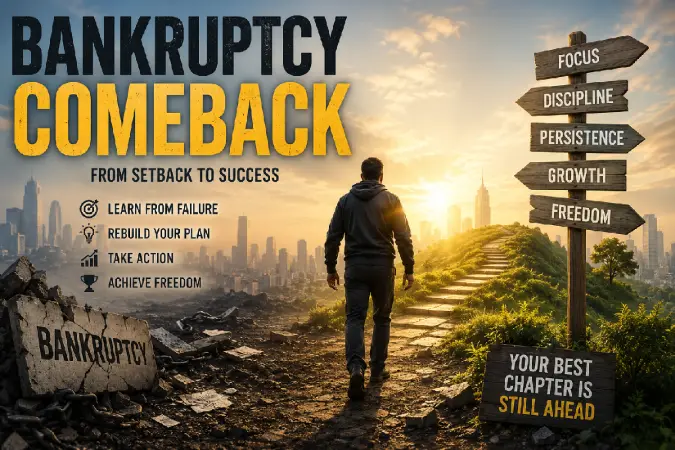
A comeback from bankruptcy should, however, not be motivated by slogans, but be realism-based.
1. Understand what caused the failure
Was it:
Drowning in debt?
Time to address the most serious issue of poor cash-flow management ?
Lack of relevant demand?
rapid expansion?
operational problems?
bad partnerships?
pricing mistakes?
insufficient market research?
2. Separate the founder from the failed business
A company is not a failure without a failure of its entrepreneur.
The business organization is an economic system.
The capital original is a human being who has the ability to adapt, develop and manage again.
That, in any case, is psychologically meaningful.
3. Rebuild financial discipline
A second chance should be followed by tighter controls of the finances.
Track:
- Cash flow
- Gross margins
- Costs of operating
- Costs associated with acquiring customers
- Debt obligations
- A runway
- Working capital
Another crisis can happen if this resilience, in the absence of any financial discipline, goes out of control.
4. Start smaller when necessary
A second enterprise need not simultaneously operate at the magnitude of the first.
A smaller operation can provide:
- faster customer feedback
- Lower fixed costs
- fieldwork. less difficulty in
- Lower financial risks
- More involvement
Are not alive itself. Well, it cannot be recreated, but the goal can be.
The focus, hoping for the future, to be building something better.
How to Turn Failure Into Your Next Opportunity
If your business has failed, your next step does not necessarily need to be another company.
Your experience may become valuable through:
- consulting
- freelancing
- a smaller startup
- entrepreneurship education
- product development
- investing
- advisory work
- a new career
- a completely different industry
The skills developed during a failed venture can remain valuable.
You may have learned how to negotiate with suppliers, manage employees, sell products, acquire customers, create marketing campaigns, handle cash flow, or identify market opportunities.
Those skills don’t disappear when the company closes.
They become part of your entrepreneurial capital.
Final Thoughts
The journey from failure to fortune rarely happens overnight.
For some entrepreneurs, the comeback takes months. For others, it takes years or even decades.
The eight stories above show that failure can take many forms: bankruptcy, rejection, dismissal, product failure, financial crisis, or an unsuccessful business model.
But they also demonstrate something more important.
Entrepreneurial failure does not have to be the end of the story.
The entrepreneurs who rebuild successfully tend to examine what happened, accept responsibility where appropriate, learn from the experience, adapt their strategy, and keep moving.
In 2026, when markets are changing faster than ever, resilience is not simply the ability to withstand disruption. It is the ability to learn, adapt, rebuild, and create another opportunity from the lessons of the first one.