

Investing: The Complete Beginner-to-Advanced Guide to Building Long-Term Wealth in 2026
Last Updated: September 21, 2026
Investing is one of the strongest tools for building long-term wealth, preserving purchasing power, and achieving our goals. Whether you’re investing your first $1,000 or managing a complex portfolio of assets, the goal is the same: deploy funds into assets that hopefully increase in value or produce income over time. But Investing is more than buying Stocks and hoping for price increases. Good Investing comes from understanding risk, choosing the right vehicle to advance your strategy, pairing it with strong diversification, and controlling costs with self-control during market storms.
In 2026, investors will have more options than ever before, from stocks and bonds to ETFs, mutual funds, REITs, IRAs or 401(k) s, and even investment apps. This also a greater need for financial literacy.
This user manual covers all the essentials about investing for beginners, various investment types, portfolio diversification, investment risk & return, investment approaches, long-run & short-run investment.
What is Investing?
To invest money means to commit funds to something for potential income or appreciation over time:
- Shares of a stock Company shares
- Diversified Stock ETF bonds
- (Government and Corporate)
- Mutual Funds
- Real Estate
- REITs
- Other financial investments
These are all some kinds of investment meant to potentially allow your money to grow more rapidly than just putting money into liquid cash accounts; however, all investments carry some form of risk. Savings and investing have different purposes
Investing vs. Saving
Saving and investing serve different purposes.
Saving: Typically, saving involves the accumulation of cash and its safekeeping. Cash savings products such as savings accounts may be suitable for defining needs in the short term or for emergency funds.
Investing is more about long term growth and income. The values of investments tend to be more volatile, investors usually require a longer time frames.
The most practical way is often to use both: keep some accessible savings for the short term, and invest the rest for the long term.
Why is investing Important?
Investing so important because it involves planning in the long term. This is because it is what is of most advantageous to the investor, along with the fact that the money will be in the investment for a longer period of time they are most effective.
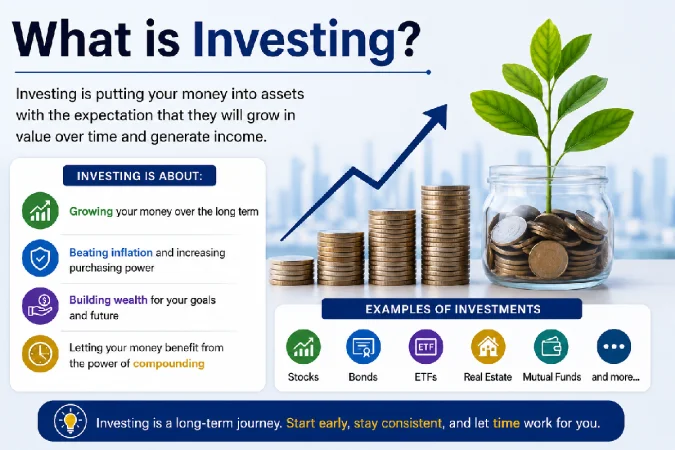
Investing can potentially help your money grow over time through:
- Capital appreciation
- Dividends
- Interest
- Distributions
- Reinvestment
- Compounding
The key advantage is compound growth.
If your investment earns returns and those returns remain invested, future returns can potentially be earned on both your original contribution and previous gains.
For illustration, if you were putting away₹ 5,000 each month for many years, then how long your money remains invested can sometimes have equally as much to do with the final worth of the portfolio as the actual amount you put away.
Investing Basics for Beginners
The time horizon over which you would like to invest (a longer-term investment would allow you take more risk) and your goals should always be taken into account.
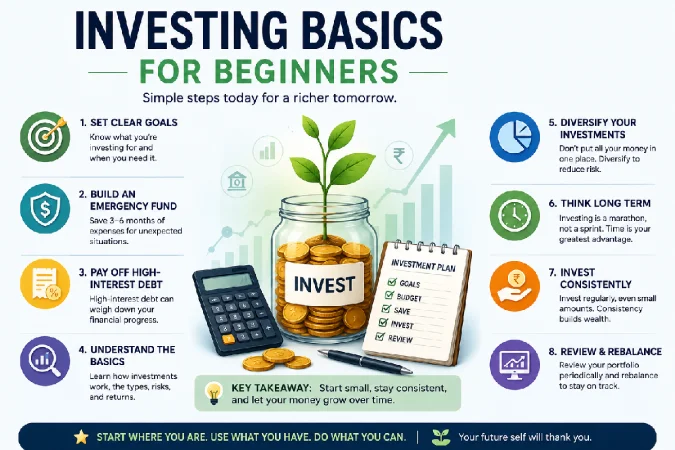
1. Define Your Financial Goals
Start by asking why you are investing.
Your goal might be:
- Building retirement wealth
- Buying a home
- Funding education
- Creating additional income
- Building long-term financial independence
- Preserving wealth
- Saving for another major future expense
Your goal determines your investment time horizon and can influence how much risk may be appropriate.
2. Build an Emergency Fund
It may be wise to build up an emergency fund for those unforeseen problems before going into debt in order to take an aggressive position.
An emergency fund can prevent having to liquidate your investments to pay for an emergency.
It will vary on the comparability of your income, your living expenses, family situation, debt commitments and other right now.
3. Consider High-Interest Debt
Debt that carries a high rate of interest, which can be represented mathematically as I, will reduce personal wealth substantially.
If you carry expensive outstanding debt, compare the interest cost of that debt to the potential, but uncertain, return of investing. For some cases, it might be a higher financial priority to pay off high-interest debt than to invest.
In general, increasing the horizon should allow you to weather the storm of a temporary loss, but does not reduce risk and could cause a long time to wait.
4. Determine Your Time Horizon
Your investment horizon is the length of time before you need the money.
For example:
- Short term: A few months to several years
- Medium term: Several years
- Long term: Many years or decades
Generally, longer horizons provide more time to recover from temporary market declines, although they do not eliminate investment risk.
5. Understand Your Risk Tolerance
Risk tolerance (mtori) might be described as how much risk (loss or volatility) you are willing to accept.
Two investors might have the same financial objective but have very different responses to market decline of 20%.
Ask yourself:
- What would be my reaction if my portfolio drops considerably?
- Would I sell out right?
- How much can I expect to earn?
- Do I require the money now or in the future?
- Am I able to handle a more sustained bear market?
These questions should help you guide the investment choices you can actually survive in harsh markets.
Types of Investments: Stocks, Bonds, ETFs & More
Different investments have different characteristics.
| Investment | Potential Growth | Typical Risk | Income Potential | Diversification |
| Stocks | High | High | Dividends possible | Depends on holdings |
| Bonds | Low–Moderate | Low–Moderate | Interest | Depends on bond portfolio |
| ETFs | Varies | Varies | Possible | Often high |
| Mutual Funds | Varies | Varies | Possible | Often high |
| REITs | Moderate–High | Moderate–High | Potential distributions | Real-estate focused |
| Cash equivalents | Low | Low | Interest possible | High liquidity |
These are general characteristics, not guarantees. Risk can vary significantly within each category.
Stocks
Stocks represent ownership interests in companies.
When you purchase shares, you become a shareholder of the business. Stocks can generate returns through:
- Capital appreciation
- Dividends
Historically, stocks have provided strong long-term growth but stock prices can be very volatile.
Single company failure, problems arising from competitiveness, regulation, or other factors may lead to substantial losses to a single firm.
Bonds
Bonds are debt investments;
By buying a bond, you are typically loaning money to a government, corporation or other authority in return for periodic interest payments and the eventual return of the principal.
Bond risks include:
- Iighandunk-raviindrance
- credit/ default risk
- The risk of inflation
- Reinvestment risk
- Liquidity risk
Bonds can provide a valuable diversifier to a portfolio because their performance can sometimes be quite different from stock market portfolios, but without suggesting that bonds are risk free.
Exchange-Traded Funds (ETFs)
Through Buy Order: This is the process by which ETFs, which are a portfolio ofassets, are traded on exchange.
An ETF may track:
- A broad stock index
- A specific sector
- Bonds
- Commodities
- International markets
- Other asset groups
One benefit of broad-market ETFs is that you can get broad exposure to a large variety of securities with one investment.
However, not all ETFs are diversified very well. There is also ETF invest in a limited industry, theme, country or strategy.
Mutual Funds
A mutual fund collects money from many investors and uses the money to buy a portfolio of assets.
Some mutual funds are invested with active management, while some are invested to copy an index.
Important factors to examine include:
- Expense ratios
- Management approach
- Historical performance
- Portfolio holdings
- Tax considerations
- Minimum investment requirements
Real Estate and REITs
Real estate investment trusts allow investors to gain exposure to real estate without the burden of owning and managing the entire property.
However, still have market, interest-rate, economy, property-specific and liquidity risks.
How to Build a Diversified Investment Portfolio
By diversification, John means spreading the investments across a basket of different assets instead of overweighting on one investment.
The intellectual concept: if one holding is doing badly, other holdings could helpmitigate the effect.
Asset Allocation
Asset allocation explains the way in which your portfolio is subdivided among various asset classes.
For example, a portfolio could contain:
- Equities
- Bonds
- Cash
- Real estate
- Other assets
The appropriate allocation depends on factors such as:
- Age
- Financial goals
- Investment horizon
- Risk tolerance
- Income stability
- Existing assets
- Liquidity requirements
There is no universal portfolio allocation that is suitable for everyone.
Diversification Across Companies
Owning one company exposes you to company-specific risk.
Owning hundreds or thousands of companies through a diversified fund can reduce the impact of any single company’s failure.
Diversification Across Industries
Different industries such as technology, healthcare, financial services, energy, consumer products, industrial companies, etc. react differently during various economic cycles.
International Diversification
Separately, investors could even limit themselves to a local geography.
International investments offer access to economies other than the investors.’
However, international investing introduces additional considerations such as:
- Currency movements
- Political risk
- Different regulations
- Economic differences
- Foreign taxation
- Market-access issues
Rebalancing
Over time, investments can change in value and cause your asset allocation to drift.
For example, if stocks perform strongly, they may become a much larger percentage of your portfolio than originally intended.
Rebalancing means adjusting the portfolio back toward your desired allocation.
How frequently to rebalance depends on the investor’s strategy. Some investors use a calendar-based approach, while others rebalance when allocations move beyond predetermined ranges.
Understanding Investment Risk and Returns
There is no such thing as an investment that will always give full, extensive gains with no risks.
A fundamental rule in investing that if a higher return is available, it means the chance of a lower return (or risk) is higher.
Common Types of Investment Risk
Market Risk
Market risk refers to the risk that prices will go down due to market factors.
Markets can fall for various reasons, including economic downturns, geopolitical situations, shifting rates of interest, changes in investor mood, and more.
Inflation Risk
Imperfect “Money buys less”.
An investment can increase in nominal value but not produce sufficient real growth relative to inflation.
Interest-Rate Risk
Interest-rate swings may impact bonds along with other assets sensitive to asset financing.
For instance, existing bonds can become less desirable if there is issuance of new bonds carrying a higher yield.
Credit Risk
The risk that a borrower will not perform on its obligations.
This would be of greater importance for corporate and other debt investments.
Liquidity Risk
Currency risk is when it is hard to sell the investment for a reasonable price.
Issuer securities are, as a rule, more liquid than many “private” assets, but not always.
Concentration Risk
Concentration risk is having the majority of your portfolio weighted toward one security, one issuer, one sector, asset class or country.
Therefore, the level of risk can be transferred to less risky assets by diversifying.
Understanding Investment Returns
There are several possibilities by which investment returns can be received.
Capital Gains
A profitable sale of an asset is called a capital gain if the sale price exceeds the purchase price.
Dividends
Others return some of the profits to the share market through dividends.
Interest
There are also certain cash investments and bonds which elicit interest income.
Reinvestment
Reinvestment of dividends and interest increases the capital in your portfolio.
Over extended time frames, reinvestment can strengthen the effects of compounding.
Long-Term vs. Short-Term Investing
The difference between long-term and short-term investing largely comes down to time horizon, objectives, strategy, and tolerance for volatility.
| Factor | Long-Term Investing | Short-Term Investing |
| Typical horizon | Many years | Shorter periods |
| Main objective | Wealth accumulation | Shorter-term opportunity |
| Market volatility | Easier to withstand | More significant |
| Trading frequency | Usually lower | Often higher |
| Costs | Potentially lower | Can be higher |
| Timing pressure | Lower | Higher |
| Skill requirements | Moderate | Often significantly higher |
Long-Term Investing
Long-term investors generally focus on the underlying value and growth potential of their investments rather than short-term price movements.
A long-term strategy may involve:
- Regular contributions
- Diversification
- Low-cost investments
- Reinvestment
- Periodic rebalancing
- Avoiding emotional decisions
Long-term investing does not mean ignoring your portfolio. It means keeping short-term market movements in perspective.
Short-Term Investing
Short-term investing seeks to take advantage of movements over shorter timeframes.
This may involve more active trading and other approaches that involve more decision-making.
It is time-consuming and unpredictable to follow short-term market movements; moreover, it is likely that there are few profit opportunities, which also involves higher transaction charges, taxes and emotional stress.
Beginners can complicate trading by confusing investing with regular speculation unnecessarily.
What Does Compound Growth Mean?
Compound growth is defined as when“investment proceeds generate further returns”
Think if you put your money in some kind of investment and then received a return. And instead of retrieving that return, you decided to leave it invested.
The growth of next period can then be based on the larger balance.
This results in a case of compounding.
The basic concept can be represented as:
Future Value = Initial Investment × (1 + Return Rate)^Number of Periods
For investments with ongoing contributions, the calculation is even more complicated as contributions are being added during the life of the investment.
The key lesson is not so much that time is important, but that it can be worth a lot.
The earlier you start, the more time you have to take advantage of a compounding effect.
Popular Investing Strategies in 2026
No single investment strategy works for everybody.
Buy and Hold
Buy-and-hold investors buy investments that they will hold long term.
This places less of an emphasis on short-term market timing.
Dollar-Cost Averaging
Dollar cost averaging: invest a fixed dollar at regular intervals.
Consider, for example, an investor who invests ₹5,000 every month, whether markets have recently risen or fallen.
This may even make investing more systematic and help remove the temptation of waiting for the “perfect” entry point.
However, dollar-cost averaging cannot ensure profit nor avoid loss.
Index Investing
Passive investing or Index-based investing tries to emulate a market index (Passive Investing) rather than explicitly selecting individual securities.
Most broad index funds can give you diversification with relatively low costs (in some cases).
Value Investing
Value investing targets for companies or assets that an investor is convinced sell at a price lower than its intrinsic worth.
Overcoming this strategy involves research and patience because it could take a long to time until an asset move from being undervalued (or overvalued) or just that the investor is wrong.
Growth Investing
Growth investors look for businesses that they think are capable of producing above-average growth.
Investments seeking growth can be painfully volatile since the market might have built into the existing price players’ rosy expectations.
Dividend Investing
Dividend investors look for companies or funds that pay out income.
This is not to say that investors should only buy stocks with a high dividend yield instead they need to assess the underlying business and total return.
Investing Fees Matter
Investment costs seem modest but tend to compound over long periods.
Common costs include:
- Expense ratios
- brokerage commissions
- Account fees
- Advisory fees
- Fund loads.
- Transaction costs
Imagine there are two investments with the same gross returns, but one has significantly higher operating expenses.
Over 20 years, the difference can become significant- because that is money paid in fees, which cannot grow tax-free in the portfolio
Before investing, find out exactly how, and through what services the investment provider receives money, and what you are being charged for.
Tax Considerations
Investors cannot ignore the effect taxes may have on investment if any.
Depending on your country and account type, you may encounter taxes on:
- Capital gains
- Dividends
- Interest
- Income from investments.
- Some of the withdrawals
Tax rules are subject to change and may differ considerably by jurisdiction.
It is important that investors understand the tax consequences of an investment before making decisions and seek out professional tax advice if required.
How To Begin Investing In 2026
An amateur can make a methodical effort toward a task called investing.
Step 1: Establish Your Financial Foundation
Take a look at your income, expenses, savings position (specifically your emergency fund), and debt.
Step 2: Set Clear Goals
Decide what you are investing for and when you think you will need the funds.
Step 3: Determine Your Risk Profile
Know your limits of what you can financially and emotionally handle in terms of the market volatility.
Step 4: Select an Appropriate Account
This may be an ownership registered with a taxation agency in your country e.g. a taxable investment account, or a retirement account, or indeed whatever form of regulated investment is available to you.
Step 5: Choose a Diversified Strategy
Instead of directly investing in individual stocks, familiarise yourself with diversified funds and asset allocation first.
Step 6: Invest Consistently
Making regular deposits can get you into the habit of investing.
Step 7: Monitor Without Obsessing
Review your portfolio periodically rather than reacting to every daily market movement.
Step 8: Rebalance When Appropriate
Rebalance your portfolio when needs to be moved a substantial distance toward your target allocation.
Investing for Different Life Stages
Students and Young Adults
Younger investors can also have a longer investment horizon,thus allowing them to benefit from the effects of compounding for a longer period.
Maybe time to focus on other things, like getting good financial habits in place, learning about investing, paying down high-interest debt and starting to invest consistently.
Early-Career Investors
As the level of income increases, investors could make greater investments.
Automation of investments can help regularize the process of wealth creation.
Mid-Career Investors
Investors at the mid-career stage tend to have more than one goal, for example, retirement, children‘s education fund, house buying fund and wealth accumulation.
Diversification of the portfolio and well-balanced asset allocation are becoming more and more significant.
Pre-Retirement Investors
Retirement may lead investors to revisit their levels of risk, liquidity, income needs and portfolio concentration.
The goal may gradually move away from focusing solely on maximising growth towards managing the growth, income, capital preservation and withdrawals in a balanced way.
Retirees
Retirees should evaluate what investment assets will generate the income for the rest of their lives.
Useful considerations are withdrawal rates, inflation, life expectancy, taxes, liquidity, risk of the portfolio.
Common Investing Mistakes to Avoid
Trying to Time the Market
It is very hard to make consistent predictions as to when to buy and when to sell.
Absent just a few profit-making periods in the market can have implications for one‘s long-term returns.
Investing Based on Social Media Hype
Social media can be a good source of education, but viral investment stories should not be substituted for your own research.
Be wary of promises of guaranteed returns, time-sensitive investment advice, or recommendations from “hidden” sources.
Putting Everything Into One Investment
Concentration can lead to significant losses if the portfolio underperforms.
Chasing Past Performance
An investment which has been good in the past might not be in the future.
Ignoring Fees
Never lose sight of what your investment costs to own.
Panic Selling
It is a mistake to sell just because the markets have gone down as this can convert a paper loss into a real loss.
Investing Without Understanding the Asset
If you‘re not able to explain how an investment functions, what makes it profitable and what scenarios could lead to a loss, then it might be wise to gather some more knowledge before investing.
How Much Money Should You Invest?
There is no universal amount that every investor should contribute.
The appropriate amount depends on:
- Income
- Debt
- Emergency savings
- Financial goals
- Time horizon
- Level of risk aversion.
- Assets already on hand
For instance, an investor could define a fixed monthly amount that would be affordable and simply grow that amount from time to time.
It may be more important to make deposits on a consistent schedule than to time a lump sum deposit optimally.
How to Evaluate an Investment
Before investing, ask:
- What exactly am I buying?
- How does it generate returns?
- What are the major risks?
- What are the fees?
- How liquid is it?
- How diversified is it?
- What is my investment time horizon?
- What happens if the investment falls significantly?
- What are the tax implications?
- Does it fit my overall financial plan?
In such situations, asking ourselves the following questions may save us from hasty choices.
The Role of Technology in Investing in 2026
Technology and its significance for investing 2026. Starting up a company has never been so straightforward, requiring only a click for a multitude of steps.
Modern platforms can provide:
Automated investing
- Portfolio monitoring
- Cash forms
- Education resources
- Market data
- Automated rebalancing
- Conducted interviews and survey
- AI-assisted financial analysis
Investment risk does not disappear with technology; however,
Financial information generated from AI may be inaccurate, become outdated, or include false assumptions.
Frequently Asked Questions About Investing
Is starting to invest always the right choice?
Yes, beginners have to understand some fundamental ideas like diversification, asset allocation, risk, fees and compound interest before they make their investments.
What is the initial cash outlay?
The minimum is determined by the investment and the platform. Investments can be bought for quite a small amount, others can require a lot more.
The real question is whether this investment makes sense for your financial circumstances.
Riskiness of investing:
Yes. All investments have an element of risk. Investments have different kinds and degrees of risk.
Stocks can fluctuate wildly, bonds can be exposed to interest-rate and credit risk, cash can become less valuable through inflation,
What is diversification?
Diversification seeks to reduce exposure to any single investment by holding a variety of investments in different asset, company, industry or geographical markets.
Frequency of investment monitoring: how to set the right level?
For the majority of long-term investors, managing the investment in their portfolio on a day-by-day basis isn‘t necessary.
A periodic review may be all that is necessary to verify that your targets, asset allocation, contributions and risk level are still suitable.
Conclusion
Making money in stocks isn‘t about discovering the one ultimate investment, foreseeing each swing in the stock market, or getting rich without the slightest effort.
In the end good long-term investing is usually based on a combination of time, diversification, regular disciplined contributions, proper risk control, avoiding unnecessary costs and, not least, patience.
The first most basic step is education for beginners. Know what you’re holding and why, especially how it can make you money or how you could lose it.
When your knowledge develops, you will be able to create a strategy based on your financial needs instead of following what is hyped up by the market or social media.
The most useful investing frame of mind is thinking in terms of years and decades rather than days and weeks. Markets will advance and decline, economies will prosper and falter and individual investments will occasionally disappoint. A carefully thought out plan can help you keep you‘re eye on the prize.
Investment is a tool, not a shortcut. By integrating it into a well thought out plan, used in the correct manner wisely and regularly with strengthening one’s ability to build and preserve wealth.